
Menstrual cycles can affect day-to-day suicide risk, study finds

posted in: News | 0

When Tory Eisenlohr-Moul was training as a therapist, she saw people who had chronic suicidal thoughts — thoughts that would abruptly change from week to week. But when one of Eisenlohr-Moul’s patients mentioned her menstrual cycle was impacting her symptoms, the clinical psychologist homed in on how menses might be part of the equation.

“I started having people track their mood symptoms against their menstrual cycle and it seemed, for a lot of my patients, this was a really important reason that their suicidal thoughts and depression were changing week to week,” said the associate professor of psychiatry at the University of Illinois Chicago. “I thought if we had some evidence that this was common then maybe we could do something about it.”

Eisenlohr-Moul led researchers to study how suicidal thoughts fluctuate across the menstrual cycle. The result is a longitudinal study, published in the American Journal of Psychiatry in December, where Eisenlohr-Moul, postdoctoral researcher and clinical psychologist Jaclyn Ross, and M.D. and Ph.D. student Jordan Barone followed 119 female patients who tracked their suicidal thoughts and mental health symptoms daily over at least one menstrual cycle. They found that female patients with a history of suicidality experience an increased risk of suicidal ideation or suicidal planning in the days surrounding menstruation.

The researchers defined suicidal ideation as thinking: “I wish I could go to sleep and never wake up; I might be better off dead.” Suicidal planning is thinking about how and when someone might kill themself and what methods to use. Planning gets more specific and is more active than ideation.

Barone said data from female patients was found and surveyed in clinical trials in Chicago and North Carolina. Study participants had to have a regular menstrual cycle, not be on birth control pills or have a hormonal intrauterine device, and not have been recently pregnant.

The patients were asked a list of questions about thinking about death, thinking about killing themselves, or wishing they were dead. If they responded yes to having any of those symptoms within the past month, they were asked to track those symptoms.

According to the study, earlier research on menstrual cycles and suicidal thoughts looked at patterns in which suicide attempts increased in the days just before or during menses. Ross said the unique strength of the UIC study is the research team had the ability to measure day to day to see when suicidal ideation increases in intensity and when people tend to shift from suicidal ideation to suicidal planning. UIC’s study found suicidal ideation was more severe and suicidal planning was more likely to occur during “the week before and during menses” compared to other times.

“We do find that both suicidal ideation and planning are peaking premenstrually for most people,” Ross said. “Where they tend to experience the lowest levels of ideation and planning is during that early luteal phase (right after ovulation). Then it steadily ticks up and peaks during that peri-menstrual phase. We found that it tended to be those depressive symptoms, hopelessness, losing interest in things we usually enjoyed — those were the types of symptoms that were driving those increases in intensity in suicidal ideation during the peri-menstrual phase. It was depression that really drove it for suicidal planning.”

Suicidal ideation was one thing Shalene Gupta contended with. The Boston-based journalist remembers extreme feelings in her mid-20s. Then in 2020, she was diagnosed with premenstrual dysphoric disorder, or PMDD, a severe form of premenstrual syndrome that includes physical/behavioral symptoms that usually resolve with the onset of menstruation.

“I just thought that I was a bad person with poor emotional control because, once a month, I would have these really terrible fights with my boyfriend,” she said. “I tend to be a calm, conflict-averse, highly boring type-A personality. These were really terrible. There’d be screaming, walking around at midnight, threatening to break up. And I could always predict these fights were going to happen within a couple of days before my period happened.”

The pair broke up after six years together. It was when she started dating her now husband, and the fight pattern continued, that she started researching menstrual rage, PMS and anger. A call to her doctor led Gupta, 36, to getting help for the disorder. Gupta wrote a book about her menstruation journey, “The Cycle: Confronting the Pain of Periods and PMDD,” where she cites Eisenlohr-Moul’s work. Gupta describes the history of PMDD, which was a known condition since the 1960s, but a feminist debate in the 1980s — and fears about the condition discrediting women everywhere — kept it from being added to the Diagnostic and Statistical Manual of Mental Disorders, the diagnostic tool published by the American Psychiatric Association.

A PMDD diagnosis requires a mix of symptoms that include: increased mood swings, anger or irritability, depression, anxiety, decreased interest in activities, difficulty concentrating, lethargy, marked change in appetite, sleeping patterns, a sense of being overwhelmed, or physical symptoms such as breast tenderness, joint or muscle pain, bloating or weight gain. To count as PMDD, symptoms must be severe enough to interfere with someone’s work, education or relationships. The symptoms must also appear a week before menstruation and then disappear the week after menstruation.

Gupta got help by way of antidepressants. Treatment can also be found with birth control. Gupta said 5% to 10% of the population has classic PMDD, a condition that has a 30% to 80% chance of being transmitted from parent to offspring.

Given the data in the UIC study, Eisenlohr-Moul said the medical community can’t use a cookie-cutter definition of premenstrual syndrome, or PMDD. A broader understanding of all of the different ways people can be sensitive to the menstrual cycle needs to be established, she said, so the medical community can provide more specific treatments.

Ross, who runs a private practice clinic for premenstrual disorders, agreed. She cites the large variability in the effects across patients and their menstruation cycle to show that the health care field really needs to individualize approaches to treatment in these suicidality and menstruation cases, especially when it comes to psychotherapy. Eisenlohr-Moul said it’s equally important to change the way we talk about PMS and PMDD as a society — that it’s more of a disorder people can have, and not a default characteristic of women who have periods. 

“Historically, we’ve thought about premenstrual mood symptoms as some people have them and some people don’t,” Eisenlohr-Moul said. “If you look in the general population, you see that it’s 1% that have significant changes worth talking about. But it turns out that when you recruit people who just happen to be female with suicidality, most people have some degree of change, and it doesn’t look the same for everyone. It’s not so black and white, like you have it or you don’t. It’s a gradient: How sensitive are you to these hormonal changes in the brain?”

The American College of Obstetricians and Gynecologists recently released new clinical treatment guidelines for physicians treating premenstrual disorders. Eisenlohr-Moul said although premenstrual disorders are caused by an abnormal brain sensitivity to normal cyclical hormone flux, medical treatment can be provided by gynecologists, psychiatrists or primary care providers. Psychologists and other mental health professionals can help patients better cope and reduce the stress that can worsen the condition.

Researchers suggest women track their symptoms across their menstrual cycle, which could help clinicians make personalized recommendations about care. Symptom trackers and menstruation resources for patients can be found at the International Association for Premenstrual Disorders. Gupta agrees about the benefit of tracking one’s menstruation symptoms and notes that mental symptoms surrounding menstruation are a disorder.

“If you’re having regular breakdowns, it is important to figure out the timing,” she said. “That’s something I think doctors should ask.” She tracked hers and said it took about two months of tracking before getting her official diagnosis.

Tory Eisenlohr-Moul, left, and Jaclyn Ross in Chicago on March 15, 2024. (Terrence Antonio James/Chicago Tribune)

“We’re doing a lot of biomarker studies,” Eisenlohr-Moul said. “Jordan’s dissertation is looking at one of the markers that we think might be especially important for progesterone sensitivity, one of the hormones that people can be sensitive to. Others are more focused on sensitivity to estrogen and how that can affect different systems. We’re trying to go down more specific pathways to understand the biology (of menses) so we can develop treatments. Biological targets … behavioral targets … just because somebody’s symptoms are caused by hormones doesn’t mean that a behavioral intervention can’t help to right the ship and keep people functioning and even reverse some of those biological changes. We’re trying to come at this from all angles.”

Gupta is hopeful about the ongoing research with menstruation and mental health. She said too often menstruation is stigmatized, and seen through a sexist lens to discredit people.

“I read Elon Musk’s 600-page biography by Walter Isaacson. (Musk) has undiagnosed bipolar disorder. He’s talked about it. And he gets to be the CEO of six companies, and no one is like, ‘Hey, maybe we shouldn’t let him do that because he has undiagnosed bipolar disorder,’” she said. “If that’s the case, then if somebody has PMDD, and they’re getting treatment for it, they’re managing it, that shouldn’t be a reflection on what opportunities we give them as a society.”

For ‘public safety crisis’ of copper wire theft, MN legislators proposing licenses for sellers

posted in: News | 0

Copper wire theft that’s darkened streetlights have discouraged teenagers in St. Paul’s North End from playing basketball at their local courts, caused older couples to discontinue early-morning walks around Como Lake and led to local shops struggling to attract customers because people felt unwelcome on the dim sidewalks.

“Then on Christmas Eve of 2023, the unthinkable happened,” said Rep. Athena Hollins, DLF-St. Paul. A driver fatally struck Steven Wirtz, a 64-year-old retired Marine, as he walked his dog across a North End street that was pitch black due to copper wire theft.

“That was the moment that I realized that copper wire theft is more than a mere inconvenience or perpetual infrastructure expense,” Hollins said Monday. “It’s a public safety crisis.”

Since January, Hollins said she’s paired with the city of St. Paul “to work on legislative solutions for this crisis, one that we believe will curb the selling of illegally-obtained copper without overburdening the scrap metal industry.”

She and Sen. Sandy Pappas, DFL-St. Paul, are sponsoring bills that are due to be heard in legislative committees Monday and Tuesday.

The legislation would require anyone selling copper metal to have a license issued by the state. People licensed to perform electrical work are deemed to hold a license. The bills would still allow residents and businesses to recycle copper materials with scrap metal companies for free.

The top shows regular copper wire and the bottom is stripped wire. (Mara H. Gottfried / Pioneer Press)

St. Paul Mayor Melvin Carter and 37 other mayors signed onto a letter dated Sunday, urging the Senate and House commerce committees to support the bills. “We represent communities as far away as Virginia on the Iron Range, as large as Minneapolis and as small as Gem Lake,” Carter said.

“We’ve seen how successful state policy can be through the work on curbing catalytic converter theft through registration and accountability,” he said. “We can do the same thing with copper wire.”

St. Paul Public Works spent more than $1 million to fix street lights and traffic signals damaged by copper wire theft. That’s 10 times the amount from 2019, when the cost to Public Works was just over $100,000.

The problem continues to extend to other sources — “they’re going after traffic signals, which is incredibly dangerous,” Public Works Director Sean Kershaw said last month. “They’re going after phone systems, they’re going after utility vaults, they’re going after HVAC systems” and charging stations for electric vehicles.

Related Articles

Politics |


Corrections officials, inmates say MN prison conditions a matter of public safety

Politics |


Letters: ‘Little money to work with’? What the heck?

Politics |


MN Legislature may pass gun bills on straw purchases, safe storage, reporting stolen weapons this session

Politics |


Letters: Speed up energy permitting in Minnesota

Politics |


Minnesota justices hear arguments in felon voting rights case

Palestinians returning to Khan Younis after Israeli withdrawal find an unrecognizable city

posted in: Society | 0

DEIR AL-BALAH, Gaza Strip (AP) — Streams of Palestinians filed into the southern Gaza city of Khan Younis on Monday to salvage what they could from the vast destruction left in the wake of Israel’s offensive, a day after the Israeli military announced it was withdrawing troops from the area.

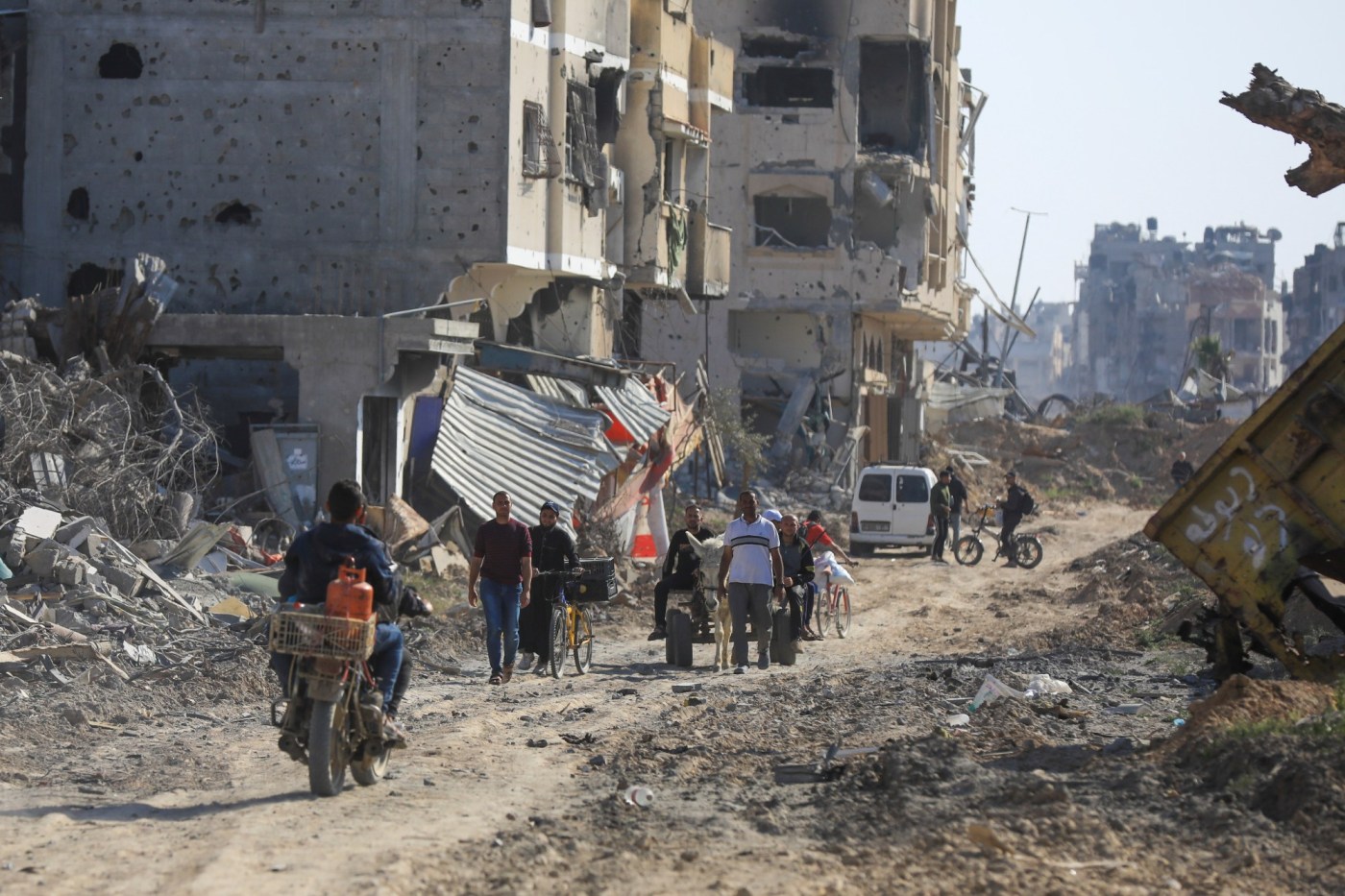
Those returning found their hometown, Gaza’s second largest city, unrecognizable, with thousands of buildings destroyed or damaged. Men, women and children went down streets bulldozed into stretches of dirt, searching for their homes among fields of rubble and debris that were once blocks of apartments and businesses. On other blocks, buildings still stood but were gutted shells, scorched and full of holes, with partially shattered upper floors dangling off precipitously.

The scenes of destruction in Khan Younis underscored what has been one of world’s most destructive and lethal military assaults in recent decades, which has left vast swaths of the tiny coastal territory unlivable for its 2.3 million people. It also portended what is likely to happen in Gaza’s southernmost town of Rafah, where half of Gaza’s uprooted population is now crowded, if Israel goes ahead with plans to invade it.

Israeli Prime Minister Benjamin Netanyahu escalated his pledge to invade Rafah, declaring in a video statement Monday, “It will happen. There is a date,” without elaborating. He spoke as Israeli negotiators were in Cairo discussing international efforts to broker a cease-fire deal with Hamas, which has been designated as a terrorist organization by the United States, Canada and the European Union.

Related Articles


Israel says its strike that killed aid workers was a mistake. Rights groups say it was no anomaly


Biden urges Egypt, Qatar leaders to press Hamas to come to agreement for Israeli hostages in Gaza


After six months of war, Israel’s isolation grows with no end in sight


Israel dismisses 2 officers after deadly aid convoy strike


Biden tells Israel’s Netanyahu future US support for war depends on new steps to protect civilians

Magdy Abu Sahrour was stunned seeing his house in Khan Younis flattened.

“I couldn’t find my home because of all the destruction,” he said as he stood in front of the rubble. “Where is my place, where is my home? … It’s a tragic situation.”

Israel sent troops into Khan Younis in December, part of its blistering ground offensive that came in response to Hamas’ Oct. 7 attack and hostage-taking into southern Israel. Its withdrawal brought Israeli troops in the tiny coastal enclave to one of the lowest since the war began.

The war, now in its seventh month, has killed more than 33,000 Palestinians, mostly women and children, according to local health authorities. Israeli authorities say 1,200 people, mostly civilians, were killed and roughly 250 people taken hostage in Hamas’ Oct. 7 attack.

Many of the thousands who filtered into Khan Younis by foot and on donkey cart on Monday have been sheltering in Rafah since they fled their homes. The withdrawal gave them a chance to see the wreckage of their homes and retrieve a few possessions. But with the city now unlivable, they said they had little immediate chance to return.

An estimated 55% of the buildings in the Khan Younis area – around 45,000 buildings – have been destroyed or damaged, according to the latest figures from two researchers in the U.S. who have been using satellite imagery to track destruction throughout the war — Corey Scher of City University of New York and Jamon Van Den Hoek of Oregon State University.

Mahmoud Abdel-Ghani, who fled to Rafah in December, found his and his neighbors’ houses flattened. “Many areas, especially the city center, have become unfit for life,” he said.

One woman clambered over slabs of collapsed concrete atop a mountain of wreckage that was once her home. Her son crawled on all fours into a hollow under the rubble and twisted rebar, clearing away concrete blocks.

“There are no words to describe the pain inside me,” the woman said, her voice breaking. “Our memories, our dreams, our childhood here, our family — we were raised with them here … It’s all gone.” The woman, who identified herself only by her first name, Hanan, put a few items they found into a backpack, including a plastic red flower.

Khan Younis’ main Nasser Hospital was trashed inside, with debris strewn around the wards and ceiling panels collapsed. The exterior appeared largely intact, but the extent of the damage was not immediately clear. Israeli troops stormed the facility during the offensive, saying they believed the remains of hostages were inside, though they did not report finding any.

Israel said Khan Younis was a major Hamas stronghold and that its operations there killed thousands of fighters and inflicted heavy damage to a vast network of tunnels used by Hamas to move weapons and fighters. It also claimed to have found evidence that hostages were held in the city.

With the troops’ withdrawal, Hamas could seek to regroup there as it has in northern Gaza, where the military scaled back forces earlier.

Israel plans to invade Rafah, which it says is Hamas’ last major stronghold, have raised international alarm over the fate of the around 1.4 million Palestinians sheltering there, most displaced from other parts of the Gaza Strip.

Israel’s top ally, the U.S., has said invading Rafah would be a mistake and has demanded to see a credible plan to protect civilians.

Israel is purchasing 40,000 tents to prepare for the evacuation of Rafah, an Israel official said, speaking on condition of anonymity because they were not authorized to speak to the media.

Allowing people to return to Khan Younis could relieve some pressure on Rafah, but many have no homes to return to. The city also is likely filled with dangerous unexploded ordnance left by the fighting.

Israel’s military quietly drew down troops in devastated northern Gaza earlier in the war. But it has continued to carry out airstrikes and raids in areas where it says Hamas regrouped, including Gaza’s largest hospital, Shifa, leaving what the head of the World Health Organization called “an empty shell.” Israel blames Hamas for the damage, saying it fights from within civilian areas.

Israel says its war aims to destroy Hamas’ military and governing capabilities and return the roughly 130 remaining hostages, a quarter of whom Israel says are dead. Negotiations brokered by Qatar, Egypt and the U.S. meant to bring about a cease-fire in exchange for the release of hostages are underway.

Magdy reported from Cairo.

Iran’s foreign minister accuses U.S. of giving Israel ‘green light’ to attack consulate in Syria

posted in: Politics | 0

By KAREEM CHEHAYEB and ALBERT AJI (Associated Press)

DAMASCUS, Syria (AP) — Iran’s foreign minister Monday accused the United States of giving Israel the “green light” for a strike on its consulate building in Syria that killed seven Iranian military officials including two generals.

Hossein Amirabdollahian reiterated Tehran’s vows that it will respond to the attack, widely blamed on Israel, that appeared to signify an escalation of Israel’s targeting of military officials from Iran, which supports militant groups fighting Israel in Gaza, and along its border with Lebanon.

Hezbollah leader Hassan Nasrallah in an address Monday reiterated the Iran-backed group’s support for a Tehran military response to the attack that killed Gen. Mohammad Reza Zahedi, a senior military official in the Iranian Revolutionary Guard’s Quds Force, and worsened fears of the war spiraling into the rest of the Middle East.

Since the war in Gaza began six months ago, clashes have increased between Israel and Lebanon’s Hezbollah. Hamas, which rules Gaza and attacked Israel on Oct. 7, is also backed by Iran, as well as an umbrella group of Iraqi militias targeting U.S. military bases and positions in Syria and Iraq.

Though Israel has regularly conducted strikes targeting Iranian military officials and allies, Zahedi’s death was the most significant blow for Tehran since a U.S. drone targeted and killed Quds Force chief Gen. Qassim Soleimani in 2020 in Baghdad.

“I’d like to say with a very loud voice from here in Damascus that America has a responsibility in what happened and must be held responsible,” Amirabdollahian told reporters in Damascus during a visit where he met his Syrian counterpart, Faisal Mekdad, who condemned both the strike and Israel’s offensive in Gaza. Amirabdollahian also met President Bashar Assad, with whom he discussed Gaza and the wider situation in the region, a statement from Assad’s office said.

The Iranian foreign minister, who earlier that day inaugurated the opening of a new consular section in a nearby building, justified his claims by saying that Washington and “two European countries” did not condemn the attack on the diplomatic building.

The Biden administration has insisted that it had no advance knowledge of the airstrike. Washington is Israel’s vital military ally.

Israel, which rarely acknowledges strikes against Iranian targets, said it had no comment on the strike in the Syrian capital. However, Pentagon spokeswoman Sabrina Singh said last week that the U.S. has assessed Israel was responsible.

Initially after the strikes, Iranian state media said Zahedi led the Quds Force in Lebanon and Syria until 2016.

Then, in a public address Monday, Hezbollah leader Hassan Nasrallah said Zahedi was a key figure for the Lebanese group, and had three four-year stints in the tiny Mediterranean country.

Nasrallah, like Syria, and other key allies of Tehran, have said they remain committed to backing Iran.

“It’s a natural right for Iran. It’s natural for the Islamic Republic to conduct this response (to the consulate attack),” Nasrallah said.

Nasrallah said Zahedi’s first involvement was until 2002, overseeing Israel’s withdrawal from southern Lebanon, and helping Hezbollah scale up. Zahedi’s second term covered some of the fiercest fighting in Syria’s uprising turned civil war, where Tehran and Russia played a key role in backing Assad against opposition forces. Zahedi’s final stint began in 2020 and ended when he was killed.

Hezbollah militants and Israeli troops have clashed along the tense Lebanon-Israel border since Oct. 8, the day after the Hamas attack on southern Israel.

The Hezbollah leader said that the moment the clashes began, Zahedi reportedly wanted to join Hezbollah militants on the front line but wasn’t permitted to do so.

Earlier Monday, Israeli airstrikes over southern Lebanon killed Ali Ahmad Hussein, an elite commander of Hezbollah’s secretive Radwan Force. Hezbollah announced Hussein’s death, but did not give any details on the circumstances or his role with the group in line with how it makes public the deaths of its members.

The killing of Hussein, one of the most senior militants slain thus far, came ahead of the Iranian foreign minister’s visit to Syria.

Israel considers Hezbollah its most serious immediate threat, estimating it has some 150,000 rockets and missiles, including precision-guided missiles that can hit anywhere in Israel. The group, which has thousands of battle-hardened fighters who participated in Syria’s 12-year conflict, also has different types of military drones.

In January, Israeli jets struck and killed another elite Hezbollah commander from the Radwan Force, Wissam al-Tawil, who fought with the group for decades and took part in some of its biggest battles.

Hezbollah says it will stop firing rockets once a ceasefire is reached in the Gaza Strip that would end the Israel-Hamas war. Israeli officials have been demanding that the Radwan Force withdraw from the border area in order for tens of thousands of displaced Israelis to return home.

Washington and Paris have been scrambling to find a diplomatic resolution to halt the fighting along the Lebanon-Israel border, hoping to prevent a new all-out war between Hezbollah and Israel since a month-long war in the summer of 2006.

Chehayeb reported from Beirut.