Donald Trump asks appeals court to intervene in last-minute bid to delay hush money criminal case

posted in: Politics | 0

By MICHAEL R. SISAK and JAKE OFFENHARTZ (Associated Press)

NEW YORK (AP) — Donald Trump asked a New York appeals court on Monday to reverse his gag order and move his hush money criminal trial out of Manhattan in an eleventh-hour bid for a delay just a week before it is scheduled to start.

A judge in the state’s mid-level appeals court was to hold an emergency hearing Monday afternoon after the former president’s lawyers filed paperwork challenging Manhattan Judge Juan M. Merchan’s pretrial rulings.

The documents were placed under seal, but a person familiar with the matter told The Associated Press they pertained to Trump’s gag order — recently expanded to prohibit comments about judge’s family — and the Republican’s desire to move the trial out of heavily Democratic Manhattan. The person was unauthorized to speak publicly and did so on the condition of anonymity.

Messages seeking comment were left for Trump’s lawyers, the Manhattan district attorney’s office and a spokesperson for New York’s state court system.

Trump had pledged to appeal after Merchan ruled last month that the trial would begin April 15. His lawyers had pleaded to delay the trial at least until summer to give them more time to review late-arriving evidence from a prior federal investigation into the matter.

Merchan, who had already moved the trial from its original March 25 start date because of the evidence issue, said no further delays were warranted.

Trump’s lawyers filed their appeals Monday on two separate court dockets. One was styled as a lawsuit against Merchan, a legal mechanism allowing them to challenge his rulings.

In New York, judges can be sued over some judicial decisions under a state law known as Article 78. Trump has used the tactic before, including against the judge in his civil fraud case in an unsuccessful last-minute bid to delay that case last fall.

A clerk at the appeals court, the Appellate Division of the state’s trial court, said no documents were publicly available from either appeal docket.

Trump’s hush money trial is the first of his four criminal indictments slated to go to trial and would be the first criminal trial ever of a former president.

Trump is accused of falsifying his company’s records to hide the nature of payments to his former lawyer and fixer Michael Cohen, who helped him bury negative stories during his 2016 campaign. Cohen’s activities included paying porn actor Stormy Daniels $130,000 to suppress her claims of an extramarital sexual encounter with Trump years earlier.

Trump pleaded not guilty last year to 34 felony counts of falsifying business records. He has denied having a sexual encounter with Daniels. His lawyers argue the payments to Cohen were legitimate legal expenses.

Trump’s move Monday is the latest escalation in his battles with Merchan.

The presumptive Republican presidential nominee assailed the judge on social media after he imposed a gag order last month barring Trump from making public statements about jurors, witnesses and others connected the case. After Trump’s complaints, Merchan expanded the gag order to include members of his own family.

Last week, Trump renewed his request for the judge to step aside from the case, citing Merchan’s daughter’s work as the head of a firm whose clients have included his rival President Joe Biden, Vice President Kamala Harris and other Democrats.

The former president alleges the judge is biased against him and has a conflict of interest because of his daughter’s work. The judge rejected a similar request last August.

Trump has also made numerous other attempts to get the trial postponed, echoing a strategy he’s deployed in his other criminal cases. “We want delays,” Trump proclaimed to TV cameras outside a February pretrial hearing in his hush money case.

Merchan last week rejected his request to delay the trial until the U.S. Supreme Court rules on presidential immunity claims he raised in another of his criminal cases.

The New York judge has yet to rule on another defense delay request, which claims that Trump won’t get a fair trial because of “prejudicial media coverage.” Trump has suggested on social media that the trial should be moved to Staten Island, the only New York City borough he won in 2016 and 2020.

Trump also filed an eve-of-trial lawsuit against the judge in his New York civil fraud case, accusing the jurist of repeatedly abusing his authority. Among other issues, Trump’s lawyers in that case complained that Judge Arthur Engoron had refused their request to delay the trial. Their suit was filed about three weeks before the trial was slated to begin.

A state appeals court rejected Trump’s claims, and the trial started as scheduled Oct. 2.

During the civil trial, Trump sued Engoron again, this time over a gag order he’d issued after Trump smeared the judge’s principal law clerk in a social media post. The gag order barred parties in the case — and, later, their lawyers as well — from commenting publicly on court staffers, though not on the judge himself.

A sole appeals judge lifted the gag order, but a four-judge appellate panel ultimately restored it two weeks later. The panel said Trump’s lawyers should have followed a normal appeals process instead of suing the judge. Trump’s attorneys said they had been trying to move quickly.

Engoron, who decided that case without a jury, ruled that Trump, his company and key executives defrauded bankers and insurers by overstating his wealth in documents used to get loans and coverage. Trump denied any wrongdoing and is appealing the finding and over $454 million in penalties and interest.

___

Associated Press reporter Jennifer Peltz contributed to this report.
How do wildfires affect mental health? A new study examines the connection

posted in: News | 0

Taylor Blatchford | (TNS) Seattle Times

SEATTLE — Checking air quality and staying indoors when smoke inundates the Seattle area has become second nature during Washington’s wildfire season in recent years. But new research highlights how wildfires can affect a less visible aspect of well-being: mental health.

A University of Washington study published in late February found an increase in prescriptions to treat depression and anxiety or stabilize mood in the six weeks after wildfires. The study used prescription data, commercial insurance claims and pharmacy records to examine the impact of 25 large California wildfires from 2011 to 2018.

“California experienced a substantial burden of wildfires from 2011 to 2018, and as wildfires become more intense and frequent in the context of anthropogenic climate change, it is increasingly important to understand and address their mental health effects,” the authors wrote.

Extensive research has focused on how wildfires and smoke affect cardiovascular and respiratory health; a study published in February found that the overlap of extreme heat and wildfire smoke had a compound effect and increased hospitalizations.

But few studies have examined how fires affect mental health. Previous research on the connection has been more qualitative, using focus groups to examine the effect of one fire in one region, said Zack Wettstein, the lead author of the study and a UW Medicine emergency medicine doctor. He conducted the research as a guest researcher with the Centers for Disease Control and Prevention’s Climate and Health Program.

“All too often we’re overlooking these mental health impacts,” Wettstein said. “There are a lot of vulnerable groups of people and these fires have substantial mental health impact we need to prepare for.”

Sleep disruption and decreased sense of safety likely affect mental health, particularly among those who must evacuate and face property loss, researchers wrote. Wildfires can also cause or exacerbate mental health conditions such as post-traumatic stress disorder, anxiety, depression and complex grief.

Wettstein has practiced emergency medicine in California, Idaho and Washington during wildfire season. Summer is already one of the busiest times in the emergency department, he said, and fires add an influx of patients.

“When smoke waves and heat waves roll through, it feels like we’re being inundated with patients experiencing a range of conditions from these exposures,” Wettstein said. “We’re seeing lots of folks coming in with stress and anxiety related to smoke exposure, let alone folks in closer proximity to fires who are evacuating, or have lost family or property.”

The study recommends “ensuring access to mental health services and supporting programs that promote mental health resilience before, during and after wildfires” as interventions to mitigate mental health effects. Wettstein hopes that hospitals will consider how to allocate resources during wildfire season and plan for potential surges.

“I don’t know how much people have considered upstaffing our mental health teams in the emergency department and otherwise,” Wettstein said. “There are opportunities to consider what to do in advance of these events. Providers can make sure their patients have enough medication on hand, so they don’t find themselves short.”

As in all studies, there are limitations: The data only includes patients enrolled on commercial insurance, meaning it didn’t reflect the experience of uninsured people, or those on Medicaid or Medicare. The data didn’t specify whether the prescriptions were new or refills, making it hard to tell whether smoke exposure led to new diagnoses or exacerbated existing mental health conditions.

Researchers also focused on metropolitan statistical areas (MSAs), a geographic designation the CDC uses to highlight urbanized areas with a population of at least 50,000. This means that rural communities, which “face a disproportionate burden of wildfire exposure and concomitant lack of mental health resources,” the authors wrote, are likely underrepresented.

There hasn’t been a similar study done in Washington, Wettstein said; he sees a “huge opportunity” to use this approach to examine other regions of the U.S. besides California.

The research findings raise a broader question: How do we deliver mental health care, especially when an emergency affects broad swaths of the population?

“Our mental health care system is already overtaxed,” Wettstein said. “With the projections of climate related impacts on temperature, air quality and other conditions in Washington, there’s going to be a greater burden of health impacts related to these events. What can we do to help prepare our system and make it more resilient, so we can treat everybody?”

___

©2024 Seattle Times. Visit at seattletimes.com. Distributed by Tribune Content Agency, LLC.

Budget Cuts Could Make it Harder for NYC Govt. to Reduce Its Carbon Footprint

posted in: News | 0

The government agency tasked with ensuring city-owned buildings and vehicles don’t contribute to climate change is facing a $1 billion cut to its preliminary capital commitment plan. Of those, $775 million directly impacts environmental efforts.

Michael Appleton/Mayoral Photography Office

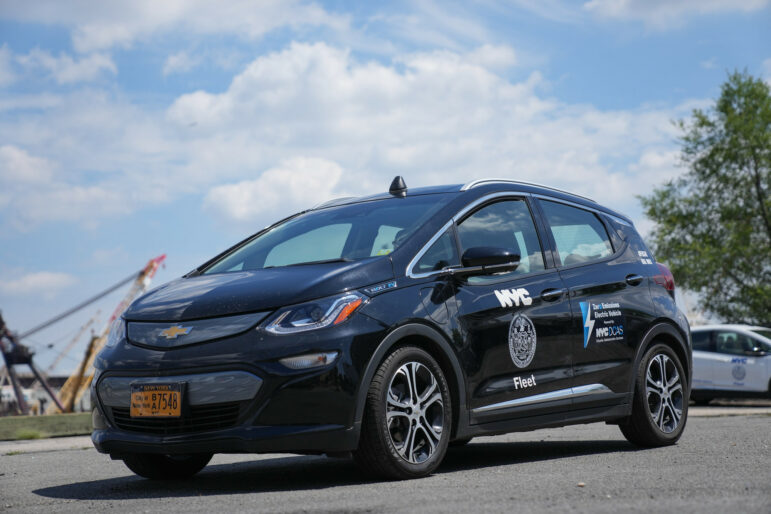
A city-owned electric car. New York City government owns or leases some 30,000 vehicles, managed by DCAS.

The agency tasked with managing city government’s buildings and vehicles is facing some hefty budget cuts, which lawmakers and advocates say could jeopardize New York City’s ability to comply with its own climate mandates.

The Department of Citywide Administrative Services (DCAS) could see over $1 billion in cuts under the preliminary capital commitment plan, which covers long‑term investments in facilities and infrastructure for the next five years. Of those, $775 million come from “reductions to resiliency, sustainability and energy efficiency projects,” according to the Comptroller’s office.

Councilmember Lincoln Restler, who chairs the committee on governmental operations, says the reduction is so significant that it makes up 17 percent of all cuts in Mayor Eric Adam’s capital plan.

“If Mayor Eric Adams is committed to climate justice, he needs to work with the City Council to reverse these indefensible cuts,” Restler told City Limits

At a City Council hearing last month, DCAS officials broke down some of the elements being slashed in the budget. They include a $538 million reduction to energy conservation projects that will help make government agencies and city-owned buildings more climate friendly. On top of that, the Department will see an annual cut of $15 million for electric vehicles purchases. 

DCAS is tasked with managing the city’s properties and various agencies, including making sure they meet their environmental goals. Not only does it handle the purchasing of climate-friendly electric vehicles for the city’s expansive fleet, but it also distributes resources for energy efficiency upgrades that aim to decarbonize city buildings. That includes switching out old cooling and heating systems for more efficient ones powered with non-polluting electric energy. 

Making cuts to the agency’s environmental arm, Restler says, will directly impact the city’s ability to meet its climate mandates like the landmark building emissions law, Local Law 97. 

“[The cuts] may save the city some money today, but it undermines our ability to manage the pending climate disaster that is upon us. There is no room for backsliding or backstepping or compromising in the fight against climate change,” the councilmember said.

Leading by example?

The department’s energy management program will be taking the $538 million hit in the capital budget. The total budget for DCAS’ capital plan—which spans from fiscal year 2024 to 2028—is approximately $1.7 billion, according to the agency.

Another $295 million for these energy efficiency efforts will be diverted or pushed back to the next capital plan, according to DCAS officials

“Our active and in-progress decarbonization projects remain unimpacted and will continue to contribute towards compliance with our emission reduction mandates,” DCAS spokesperson Dan Kastanis said in an email. 

“Despite recent fiscal headwinds, we remain unwavering in our commitment to advance fleet electrification goals and Local Law 97 mandates,” he added.

Local Law 97 (LL97), went into effect this year promising to curtail carbon pollution from buildings, which contribute to nearly 70 percent of the city’s greenhouse gas emissions. The law sets a cap on the amount of carbon that buildings larger than 25,000 square feet can emit over a series of compliance periods, the first one of which kicks in next year.

The city and its related authorities own or lease over 17,000 properties, according to the Department of City Planning (DCP), though it was not immediately clear how many are subject to LL97 rules. 

Last December, Beatrice Thuo, executive deputy commissioner for citywide operations at DCAS, admitted at a public hearing that they “expect to fall short of our Local Law 97 reduction target for 2025.”

The department has also pledged to reduce emissions generated by government operations 40 percent by 2025 and 50 percent by 2030.

At the December hearing, Thuo said they were working hard to get “as close to” that goal as possible.” But added that they have faced a series of “challenges” to achieving that 40 percent goal, including the pandemic, contracting delays and pressure on the administration to curtail spending that are “outside of the city’s control.”

Still, the environmental community is alarmed by the cuts and the department’s inability to meet Local Law 97’s first compliance period.

“All of this makes me question how serious the administration is about addressing citywide emissions reductions,” said Shravanthi Kanekal, senior resiliency planner at New York City Environmental Justice Alliance.  

“These budget cuts are going to hurt the public sector’s progress in building decarbonization and we can’t expect the private sector to completely comply when the public sector is not complying. We expect the city to lead by example when it comes to building decarbonization,” Kanekal added.

And her colleague, Senior Transportation Planner Kevin Garcia, believes the city should also be setting the example when it comes to electrifying its vehicles. 

“When you look at the larger budget the $15 million cut seems small, but it’s not just this budget, it’s future budgets as well,” Garcia said. “We’re concerned that this first cut is going to lead to a ripple effect of additional cuts or that the city may decide that they don’t need to put funding towards electric vehicle purchasing.”

Last year, DCAS’ budget for new electric vehicles was $25 million; this year it’s down to $10 million. The reduction will translate to 350 to 375 fewer electric cars in the city’s streets per year, according to DCAS Commissioner Dawn Pinnock.

The department said that as of March of this year there are 5,000 electric vehicles among the 28,000 cars the city owns, representing 18 percent of the overall fleet. 

The goal, signed into law by Mayor Adams in the fall of last year, is to transition the city’s entire automobile fleet—including all of its school buses—to zero emissions vehicles by 2038.

DCAS says its on track to meet this year’s electrification target of securing 5,500 electric vehicles. 

“We are pleased to report that the City is exceeding previous estimates in transitioning our fleet to zero-emission vehicles,” Kastanis of DCAS said in an email.

While environmental groups have applauded the agency for staying on track with their electrification goals, they worry that budget cuts could snowball and ruin that head start. 

Adams recently secured a $15 million federal grant from the U.S. Department of Transportation’s (USDOT) to build an electric truck and vehicle charging depot in the Bronx. 

But Jaqi Cohen, director of climate and equity policy at the environmental non-profit Tri-State Transportation Campaign, warns that relying on applications for federal grants only isn’t wise, since New York isn’t always guaranteed to get them. 

“When it comes to our zero emissions transition in general, New York plays a really disproportionate role in the United States because other cities are looking to see how we implement this transition so they can follow suit,” Cohen said.

“With the whole country watching, we need to be throwing everything we can into ensuring the success of transitioning to zero emissions.”

To reach the reporter behind this story, contact Mariana@citylimits.org. To reach the editor, contact Jeanmarie@citylimits.org

Want to republish this story? Find City Limits’ reprint policy here.

Twins recall infielder Jose Miranda, place reliever Daniel Duarte on IL

posted in: News | 0

Jose Miranda is back in the big leagues after being called up by the Twins on Monday afternoon. Where exactly he plays in the field remains to be seen.

Though he has played some third base during his time in the majors, Miranda has spent most of his time at first base as of late.

It will be interesting to see if the Twins try Miranda at the hot corner with everyday third baseman Royce Lewis out with a right quad strain. If Miranda isn’t an option at third base, he could play first base in a pinch, or more likely, fill in as a designated hitter.

After battling through a lingering right shoulder injury for most of last season, Miranda is looking to gain some traction in the early stages of this season. In a corresponding move, relief pitcher Daniel Duarte was placed on the 15-day injured list with a right triceps strain.

Related Articles

Minnesota Twins |


Twins-Guardians series finale washed out by rain

Minnesota Twins |


Twins bullpen an early bright spot as team awaits return of trio of arms

Minnesota Twins |


Slow-starting Twins’ offense held to just two hits in loss to Guardians

Minnesota Twins |


Charley Walters: Time is now for Vikings to get a franchise quarterback

Minnesota Twins |


After 40 years in the Twins’ broadcast booth, Dick Bremer ready to transition to the diamond