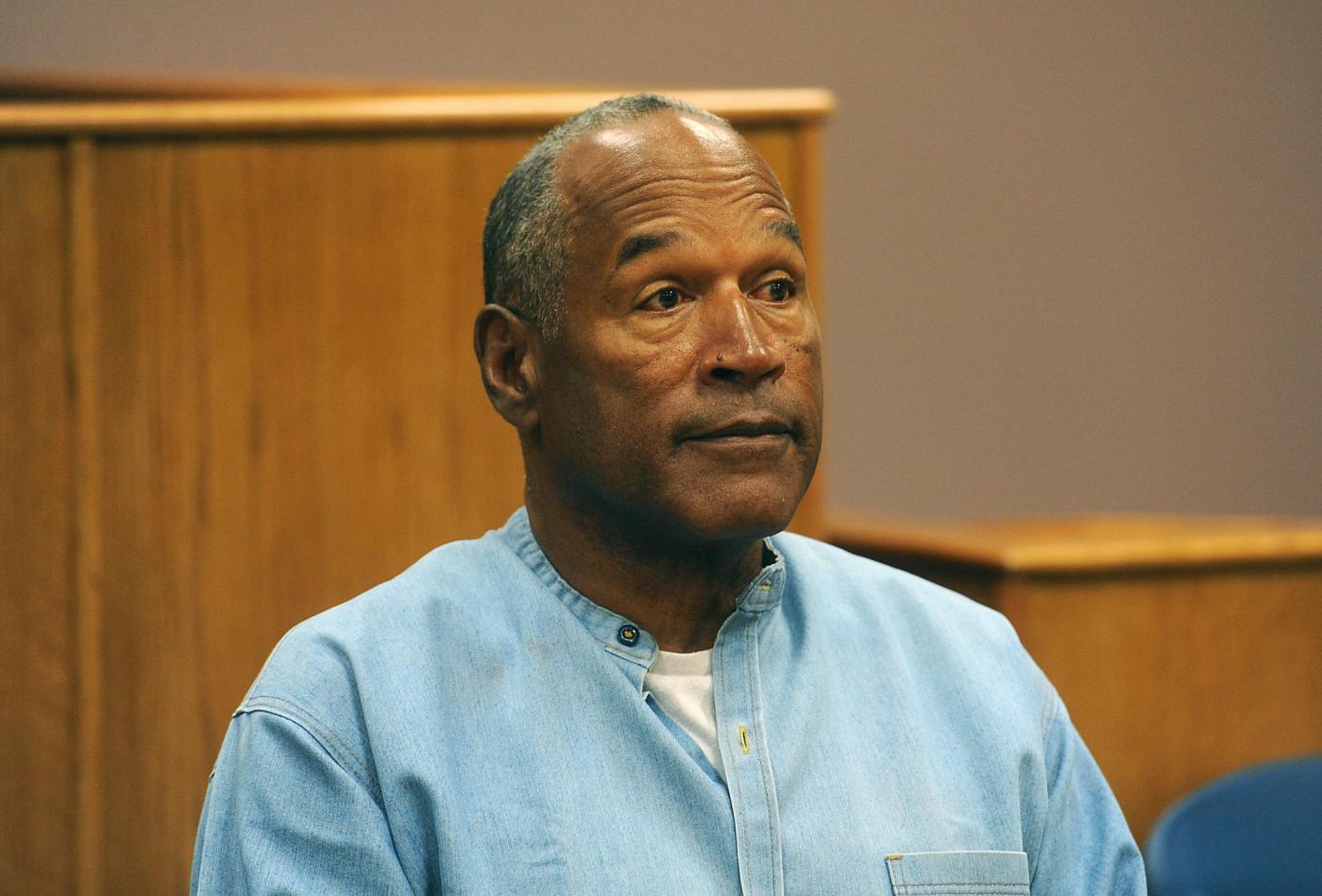
OJ Simpson, fallen football hero acquitted of murder in ‘trial of the century,’ dies at 76

posted in: News | 0

By KEN RITTER (Associated Press)

LAS VEGAS (AP) — O.J. Simpson, the decorated football superstar and Hollywood actor who was acquitted of charges he killed his former wife and her friend but was found liable in a separate civil trial, has died. He was 76.

The family announced on Simpson’s official X account that Simpson died Wednesday after battling prostate cancer. Simpson’s attorney confirmed to TMZ that he died in Las Vegas.

Simpson earned fame, fortune and adulation through football and show business, but his legacy was forever changed by the June 1994 knife slayings of his ex-wife, Nicole Brown Simpson, and her friend Ronald Goldman in Los Angeles.

Live TV coverage of his arrest after a famous slow-speed chase marked a stunning fall from grace.

He had seemed to transcend racial barriers as the star Trojans tailback for college football’s powerful University of Southern California in the late 1960s, as a rental car ad pitchman rushing through airports in the late 1970s, and as the husband of a blond and blue-eyed high school homecoming queen in the 1980s.

“I’m not Black, I’m O.J.,” he liked to tell friends.

The public was mesmerized by his “trial of the century” on live TV. His case sparked debates on race, gender, domestic abuse, celebrity justice and police misconduct.

A criminal court jury found him not guilty of murder in 1995, but a separate civil trial jury found him liable in 1997 for the deaths and ordered him to pay $33.5 million to family members of Brown and Goldman.

A decade later, still shadowed by the California wrongful death judgment, Simpson led five men he barely knew into a confrontation with two sports memorabilia dealers in a cramped Las Vegas hotel room. Two men with Simpson had guns. A jury convicted Simpson of armed robbery and other felonies.

Imprisoned at age 61, he served nine years in a remote northern Nevada prison, including a stint as a gym janitor. He was not contrite when he was released on parole in October 2017. The parole board heard him insist yet again that he was only trying to retrieve sports memorabilia and family heirlooms stolen from him after his criminal trial in Los Angeles.

“I’ve basically spent a conflict-free life, you know,” said Simpson, whose parole ended in late 2021.

Public fascination with Simpson never faded. Many debated whether he had been punished in Las Vegas for his acquittal in Los Angeles. In 2016, he was the subject of both an FX miniseries and five-part ESPN documentary.

“I don’t think most of America believes I did it,” Simpson told The New York Times in 1995, a week after a jury determined he did not kill Brown and Goldman. “I’ve gotten thousands of letters and telegrams from people supporting me.”

Twelve years later, following an outpouring of public outrage, Rupert Murdoch canceled a planned book by the News Corp.-owned HarperCollins in which Simpson offered his hypothetical account of the killings. It was to be titled “If I Did It.”

Goldman’s family, still doggedly pursuing the multimillion-dollar wrongful death judgment, won control of the manuscript. They retitled the book “If I Did It: Confessions of the Killer.”

“It’s all blood money, and unfortunately I had to join the jackals,” Simpson told The Associated Press at the time. He collected $880,000 in advance money for the book, paid through a third party.

“It helped me get out of debt and secure my homestead,” he said.

Less than two months after losing the rights to the book, Simpson was arrested in Las Vegas.

David Cook, an attorney who has been seeking since 2008 to collect the civil judgment in the Ron Goldman case, said he spoke with Fred Goldman, father of Ron, on Thursday about Simpson’s death. Cook declined to say what Fred Goldman said or where he was.

“He died without penance,” Gook said of Simpson. “We don’t know what he has, where it is or who is in control. We will pick up where we are and keep going with it.”

Simpson played 11 NFL seasons, nine of them with the Buffalo Bills, where he became known as “The Juice” on an offensive line known as “The Electric Company.” He won four NFL rushing titles, rushed for 11,236 yards in his career, scored 76 touchdowns and played in five Pro Bowls. His best season was 1973, when he ran for 2,003 yards — the first running back to break the 2,000-yard rushing mark.

“I was part of the history of the game,” he said years later. “If I did nothing else in my life, I’d made my mark.”

Of course, Simpson went on to other fame.

One of the artifacts of his murder trial, the carefully tailored tan suit he wore when acquitted, was later donated and placed on display at the Newseum in Washington. Simpson had been told the suit would be in the hotel room in Las Vegas, but it turned out it wasn’t there.

Orenthal James Simpson was born July 9, 1947, in San Francisco, where he grew up in government-subsidized housing projects.

After graduating from high school, he enrolled at City College of San Francisco for a year and a half before transferring to the University of Southern California for the spring 1967 semester.

He married his first wife, Marguerite Whitley, on June 24, 1967, moving her to Los Angeles the next day so he could begin preparing for his first season with USC — which, in large part because of Simpson, won that year’s national championship.

Simpson won the Heisman Trophy in 1968. He accepted the statue the same day that his first child, Arnelle, was born.

He had two sons, Jason and Aaren, with his first wife; one of those boys, Aaren, drowned as a toddler in a swimming pool accident in 1979, the same year he and Whitley divorced.

Simpson and Brown were married in 1985. They had two children, Justin and Sydney, and divorced in 1992. Two years later, Nicole Brown Simpson was found murdered.

“We don’t need to go back and relive the worst day of our lives,” he told the AP 25 years after the double slayings. “The subject of the moment is the subject I will never revisit again. My family and I have moved on to what we call the ‘no negative zone.’ We focus on the positives.”

___

Biographical material in this story was written by former AP Special Correspondent Linda Deutsch.

Letters: The lifesaving advantages of secure gun storage

posted in: News | 0

The advantages of secure firearm storage

Your piece on “Lawmakers weigh gun proposals” was welcomed, however its coverage is incomplete. The gun rights supporter who was interviewed about the pending safe-storage bill at the Legislature shared points that are misleading or misguided.

First, his complaint about the law being a “one size fits all” policy that doesn’t recognize the realities of how different people live across the state ignores the fact that no city, town, or municipality is allowed to pass any gun laws themselves. All gun regulations must come from the state Legislature with very few exceptions. We are in this situation because of an NRA-backed policy called preemption which was passed many years ago in Minnesota and other states. So, the different needs of people cannot be met by local governments. It’s either a state law or nothing.

The interviewee goes on to complain that a hypothetical farmer in Roseau who has livestock to defend would be treated the same as a hypothetical daycare operator in Edina under the proposed state policy of secure firearm storage. Please be aware that suicides in Minnesota make up more than 70% of all gun deaths. These suicides are more prevalent in rural areas, among middle-aged men. Guns on the farm can be just as dangerous as they are at the daycare.

Another defense used by the gun rights supporter is that there is already a state law about safe storage regarding children. Secure storage of firearms should strive to protect ALL people in Minnesota, including children. Unattended, unsecured guns can be stolen by people who are dangerous and shouldn’t have them. Loose firearms do not allow people in a moment of crisis to seek help before an impulsive act. A woman in a domestic-abuse situation has a significantly higher chance of being killed if a gun is accessible.

It is time for common sense to prevail. Today’s gun safes allow responsible gun owners to access a weapon in a matter of seconds while deterring unauthorized users. It is time to stop misleading Minnesotans about the lifesaving advantages of secure firearm storage.

Gretchen Damon, St. Paul


We don’t need these street storms

It’s spring, which around here usually means thunderstorms. Indeed, we’ve been getting thunderstorms this spring – only not in the skies.

Our thunderstorms are in the streets, including arterials and normally quiet residential streets. Turbocharged, under-muffled muscle cars and racing bikes roar around, disturbing the peace with their high-revs, dragster starts, and backfires.

This illegal and uncivil noise, plus the often-accompanying aggressive driving, makes such vehicles a first-class pest, detracting from local livability. Moreover, intermittent loud noise is now known to pose significant physical and mental health threats, costing years of life and contributing to anxiety and depression.

Since manual enforcement of noise ordinances and speed limits is infeasible, once speed cameras are in place to deter speeding we should follow up with noise cameras, to impartially ticket offending vehicles, as is done already in New York, London and Paris. Unlike rain-bringing thunderstorms, which we do need, our current in-the-streets thunderstorms we don’t need, and shouldn’t tolerate.

James Johnson, St. Paul


Do we really want to let everybody in?

There have been people in this paper and other places talking about how immigrants have built this country and we should stop our actions to keep them out.

They are correct that all of our ancestors came from other countries. However, they need to understand and come to grips with all the facts that enter in.

We are a country that lives by laws that protect us all. Do we really want to have an open border that not only lets people in who want to help American remain great, but also drug dealers, people smugglers, criminals, etc.?

We need to agree on a border that can review those who enter. People we want to live with and trust to be a part of our working class.

Phil Hove, Cottage Grove


The basis of an orderly society

There has been much pushback against religion exemplified by the statement, “Religion has no right …” (Letters to the Editor, April 4) regarding government efforts supported or condemned by different religious groups.  The presumption is that religion should have no place in politics.

The public pronouncements seem to reference the word, religion, as an abstract term, which it is not. It is a philosophy of life that is acquired from studying a base of knowledge that has a foundation in philosophy and sociology. It is then adopting that creed as a basic code of life.

The idea of a religion (philosophy) is based on the fact that we, as humans, and the top predators on this planet, have an intellect. That intellect comes with responsibilities in all we do. My faith teaches that we are created with the respect of God — that we have the ability to do unbelievable evil but our intellect, when properly cultivated, is capable of boundless beneficence. We are responsible to cultivate that intellect and employ it in the pursuit of the common good.

That philosophy is the basis of an orderly society that our founding fathers recognized and used in forming these United States — read the documents. I’m not sure we would be capable of that heavy lifting today.

Art Thell, West St. Paul


Thankful for the pioneers in women’s sports

As I watched the Iowa Hawkeyes (women) race up and down the court in their quest for a national championship, I was reminded as to how girls basketball was played in my day. I grew up in Ohio during the 1950s and ’60s as a who guy had numerous opportunities to participate in sports, my “specialty” being track and baseball.

Of course, back then, girls being the “weaker” sex and with a concern for their safety, track was not an option, and basketball had rules that would make it unrecognizable by today’s standards. As I recall, girls could only play half-court. I suppose we were concerned they would be unable to catch their breath. Three girls from each team would play on each side of the court, unable to cross the half-court line. Shooters on one side, defenders on the other.

I am so thankful to the many pioneers in women’s sports who encouraged young girls and women to pursue their dreams and ambitions. Well done!

Don Lohrey, Shoreview


His own money

Joe Biden’s strategy to buy votes by relieving students of the awful obligation of paying loans they took out to attend school is brilliant. But, I just wish he would use his own money and not mine.

T. J. Sexton, St. Paul


Any doubt?

As to: “Minneapolis Mayor Jacob Frey, hospitality industry urge compromise on Uber, Lyft wages” … and, specifically, as to the Uber and Lyft businesses — a primary issue is free enterprise vs. government intervention.

Can there be any doubt which is best for the free-market consumer, vis a vis the Minneapolis City Council politburo reaching beyond its actual reason for being?

Gene Delaune, New Brighton

Related Articles

Opinion |


Nacho mania: Seven of our favorite plates of chips, cheese and more in the east metro

Opinion |


Lime rolls e-bikes, e-scooters back to St. Paul on Thursday

Opinion |


St. Paul and Xcel Energy Center roll out Frozen Four red carpet again

Opinion |


Coming soon to St. Paul area: Squad pickups to spot distracted drivers

Opinion |


St. Paul EV charging rules loosened prior to April 17 vote

Shakopee Mdewakanton challenge board’s decision to allow new form of betting at horse tracks

posted in: News | 0

A Minnesota Indian tribe asked the state Court of Appeals on Tuesday to overturn a Minnesota Racing Commission decision allowing a new form of betting at two horse tracks.

The Shakopee Mdewakanton Sioux Community filed a petition with the court seeking to block a recent regulatory change. Earlier this month, the Minnesota Racing Commission approved a gambling game known as historical horse racing, which uses terminals to allow bets on races from the past.

Lawyers for the Shakopee community argue the commission lacked authority to approve the games. The companies that operate Canterbury Park in Shakopee and Running Aces in Columbus jointly applied for the ability to have 500 terminals for the new games, which the commission ratified.

The gambling would be allowed beginning on May 21 — the day after the Legislature is due to adjourn for the year.

Lawyers for the tribal community contend the form of gambling is too similar to slot machines, which tribes have exclusive rights to host in their casinos.

“The community seeks an order from the Court of Appeals reversing the commission’s decision because it exceeded the commission’s statutory authority, was based on an erroneous legal theory, procedurally defective, unsupported by substantial evidence, arbitrary and capricious, and a violation of the community’s due process rights,” the lawyers wrote in their petition.

Absent a reversal, the attorneys say formal rulemaking should be required or a contested case hearing be initiated that could allow for more input.

Racetrack operators say the betting is based on skill, not luck.

“Somebody who understands handicapping is going to do better than someone who doesn’t understand handicapping,” said Evan Nelson, an attorney for Running Aces. “That’s the reason it is not a game of chance.”

State lawmakers are considering a bill that would outlaw historical horse racing and other types of card games the Legislature hasn’t explicitly approved. Racetrack operators say that move would deprive them of a critical revenue source.

At the House committee hearing, several racetrack executives and employees testified their livelihoods and that of the state’s horse breeding industry are at stake. Randy Sampson, chief executive at Canterbury Park, said Minnesota’s horse tracks are at a crossroads.

“Each of these Minnesota gaming industries provide different types of economic community development with positive impacts throughout the state,” he said. “As technology and consumer preferences evolve, each of these groups is subject to the same competitive pressures and the need to adapt.”

Jack Meeks, chairman of the group Citizens Against Gambling Expansion, spoke in favor of the bill.

“The machines under consideration look like slot machines, act like slot machines, and at any reasonable evaluation are slot machines,” he told lawmakers.

The bill advanced through a House committee on a 9-8 vote on Tuesday.

DFL Rep. Brad Tabke joined all committee Republicans in opposition. He represents a district that includes the Shakopee Mdewakanton Sioux Community and the Canterbury Park track, and said he is working toward a solution that suits all interests.

“Everyone has both similar and competing interests with everything that is going forward here today,” he said.

“There is a solution there to be had,” he told his colleagues, referring to a parallel sports betting bill as a place for compromise. The tracks are seeking a share of those revenues.

Related Articles

News |


Coming soon to St. Paul area: Squad pickups to spot distracted drivers

News |


Why is the EPA regulating PFAS and what are these ‘forever chemicals’?

News |


Food shelf visits in Minnesota increased by 2 million in 2023; a new bill hopes to help

News |


A look at six Minnesota films and events at the Minneapolis St. Paul International Film Festival

News |


New DNA analysis underscores peril facing Minnesota’s state bee

Thomas Friedman: Israel: Cease-fire, get hostages, leave Gaza, rethink everything

posted in: News | 0

Israel today is at a strategic point in its war in the Gaza Strip, and there is every indication that Prime Minister Benjamin Netanyahu is going to choose the wrong path — and take the Biden administration along for a very dangerous and troubling ride. It is so dangerous and troubling that Israel’s best option, when all is said and done, might be to leave a rump Hamas leadership in power in Gaza. Yes, you read that right.

To understand why, let’s look back a bit. I argued in October that Israel was making a terrible mistake by rushing headlong into invading Gaza, the way America did in Afghanistan after 9/11. I thought Israel should have focused first on getting back its hostages, delegitimizing Hamas for its murderous and rapacious Oct. 7 rampage, and going after Hamas’ leadership in a targeted way — more Munich, less Dresden. That is, a military response akin to how Israel tracked down the killers of its athletes at the 1972 Munich Olympics, and not how the U.S. turned Dresden into a pile of rubble in World War II.

But I understood that many Israelis felt they had a moral and strategic right and necessity to go into Gaza and remove Hamas “once and for all.” In which case, I argued, Israel would need three things — time, legitimacy, and military and other resources from the U.S. The reason: The ambitious goal of wiping out Hamas could not be completed quickly (if at all); the military operation would end up killing innocent civilians, given how Hamas had tunneled under them; and it would leave a security and government vacuum in Gaza that would have to be filled by the non-Hamas Palestinian Authority in the West Bank, which would have to be upgraded and transformed to take on that task.

In short, Israel would need to fight this war with the least collateral damage for Palestinian civilians and accompany it with a political horizon for a new relationship between Israelis and Palestinians, built around two nation-states for two Indigenous peoples. Doing so would give Israel a chance to say to the world that this was not a war of vengeance or occupation, but a war to eliminate the Palestinian entity that was out to destroy any two-state solution — Hamas — and create the political space for a deal with the Palestinian Authority, which is still committed to a two-state deal. That approach would have won the support, funding and, I think, even peacekeeping troops of moderate Arab states like the United Arab Emirates.

Unfortunately, Netanyahu and his military did not pursue that course. They opted for the worst strategic combination: Militarily they opted for the Dresden approach, which, though it may have ended up killing some 13,000 Hamas fighters, also killed thousands of Palestinian civilians, leaving hundreds of thousands of others injured, displaced or homeless — and delegitimizing, for many around the world, what Israel thought was a just war.

And diplomatically, instead of accompanying this war strategy with an initiative that would buy Israel at least some time, legitimacy and resources to dismantle Hamas, Netanyahu refused to offer any political horizon or exit strategy and expressly ruled out any collaboration with the Palestinian Authority under orders from the Jewish supremacists in his governing coalition.

That is an utterly insane strategy.

It has locked Israel into a politically unwinnable war, and it has ended up isolating the United States, imperiling our regional and global interests, compromising Israel’s support in the U.S. and fracturing the base of President Joe Biden’s Democratic Party.

And the timing is truly awful. The Biden foreign policy team, led by Secretary of State Antony Blinken and National Security Adviser Jake Sullivan, have just finished working out the draft of a new strategic deal with Saudi Arabia — including a civil nuclear program, advanced arms and much deeper security ties. The deal, a senior Biden administration official told me, could be wrapped up in a matter of weeks — but for one element. It hinges on Saudi Arabia normalizing relations with Israel in return for Israel ending the war in Gaza, getting out of the Strip and agreeing to a defined “pathway” for a two-state outcome — with clear metrics in terms of what both Israel and the Palestinian Authority would have to do and in what time frames.

We are talking about a game-changing deal — precisely the deal that an Iran-backed Hamas launched this war on Oct. 7 to undermine, because it would have isolated Iran and Hamas. But the war in Gaza has to end first and Israel needs a government ready to embark on a two-state pathway.

Which takes us to this fork in the road. My preference is that Israel immediately change course. That is, join with the Biden administration in embracing that pathway to a two-state deal that would open the way for Saudi normalization and also give cover for the Palestinian Authority and moderate Arab states to try to establish non-Hamas governance in Gaza in Israel’s place. And — as the Biden team urged Netanyahu privately — forget entirely about invading Rafah and instead use a targeted approach to take out the rest of the Hamas leadership.

Even if Israel is intent on ignoring the U.S. advice, I pray it doesn’t try to invade Rafah and reject Palestinian Authority involvement in Gaza’s future. Because that would be an invitation for a permanent Israeli occupation of Gaza and a permanent Hamas insurgency. It would bleed Israel economically, militarily and diplomatically in very dangerous ways.

So dangerous that I believe Israel would actually be better off agreeing to Hamas’ demand for a total Israeli withdrawal from Gaza and a cease-fire and an all-for-all deal — all Israeli hostages in return for all Palestinian prisoners held by Israel. In other words, if Israel is not going to partner with the Palestinian Authority and moderate Arab states to create different governance in Gaza, and create conditions for normalizing relations with Saudi Arabia, Israel needs to get its hostages back, end the humanitarian crisis in Gaza, get out of Gaza, have a new election and do a deep rethink.

Please, Israel, do not get sucked into Rafah and permanently occupy Gaza. It will be a disaster.

“Friedman, you mean you would let a militarily decimated Hamas and its murderous leader Yehia Sinwar govern Gaza again?”

Yes, for the near term. As I said, this is not my preferred choice. It’s because Netanyahu has left Israel WITH NO OTHER CHOICE. He refuses to have Israeli troops govern Gaza and won’t bring in the Palestinian Authority. That leaves only two options: Gaza becoming a Somali-like gangland on the Mediterranean; or Gaza being held together with some flimsy Hamas governance.

If I were Israel, I’d take a weakened Hamas over Somalia, for two reasons.

I have no illusions that the morning after a cease-fire commences and Sinwar comes out, some will wildly cheer him for the hurt he inflicted on Israel. But the morning after the morning after, Sinwar will face brutal questioning from the people of Gaza: Where’s my house, where’s my job, who gave you the right to expose my children to death and devastation?

It is the best punishment I can imagine for Sinwar. Let him own all of Gaza’s travails that he so recklessly exacerbated — not Israel. Only Palestinians can delegitimize Hamas, and though it won’t be easy, and Hamas will kill anyone to hold power, this time we won’t be talking about just a handful of dissidents.

For the time, if it happens, when Israel gets out of Gaza and has its hostages back, the Biden team is already talking to Egypt about working closely with the U.S. and Israel to ensure Hamas can never again smuggle in the sorts of arms it did in the past under the Egypt-Gaza border. Israel could say that every ounce of food and medicine that the people of Gaza need will be delivered, as well as the bags of cement for rebuilding from countries that might want to help. But if one ounce is found going to dig new attack tunnels, rebuild rocket factories or restart rocket attacks on Israel, the borders will close. Again, let Sinwar deal with that dilemma: Go back to Hamas’ old ways and starve his people — or keep the cease-fire.

The second reason is that it won’t be just Palestinians in Gaza going after Sinwar and Hamas. Plenty of Palestinians understand that Sinwar cynically launched this war because he was losing influence to both more moderate factions in Hamas and to his archrival, the Fatah political movement, which runs the Palestinian Authority in Ramallah. He also feared this possible deal between Israel, Saudi Arabia and the Palestinians.

As Hussein Ibish, an expert at the Arab Gulf States Institute in Washington, who has provided some of the most clearsighted analyses of this war from the start, argued in a recent essay in The Daily Beast, Hamas wanted to provoke a massive Israeli response to Oct. 7 in part to corner Fatah. “A surge of nationalist sentiment and shared outrage at the mass killing and suffering of the 2.2 million Palestinian civilians in Gaza muffled nationalist leaders like President Mahmoud Abbas (also the chair of the PLO) in publicly acknowledging Hamas’ breathtaking cynicism,” he wrote.

But now, Ibish notes, the gloves are coming off: When Hamas complained about the Palestinian Authority’s decision to appoint a new prime minister, without Hamas’ input, Fatah shot back with a statement noting that Hamas consulted no one before launching “an adventure on Oct. 7 that has led to a nakba that is more severe than the 1948 Nakba.” “Nakba” means catastrophe.

Ibish concluded, “If these accusations are repeated — as they certainly should be on a daily, if not hourly, basis — they could create the permission structure for ordinary Palestinians everywhere, and especially in Gaza, to begin honestly asking themselves why Hamas acted on Oct. 7 without regard to the impact on the people of Gaza or making any preparations whatsoever for them.”

This dynamic is the only way to marginalize Hamas and Islamic Jihad — by Palestinians themselves discrediting these groups for what they are: mad and murderous proxies of Iran, whose leadership is ready to sacrifice endless Palestinian lives to pursue its aspiration for regional hegemony. If Palestinians cannot or will not do that, they will never get a state.

Just a brief word about Iran. As I feared, Israel has played into its hands beautifully from Tehran’s point of view. By invading Gaza with no morning-after plan, while also occupying the West Bank, Israel is now overstretched militarily, economically and morally — while deflecting attention from the fact that Iran is accelerating its nuclear program and expanding its influence as the biggest occupying power in the Middle East today.

Iran indirectly controls large swaths of five Arab states or territory (Lebanon, Syria, Iraq, Yemen and part of Gaza) using local proxies ready to sell out their own people for Iran’s benefit. Iran has helped to keep each Arab entity war-torn or failing. Put me down as opposed to both the Israeli occupation of the West Bank and the Iranian occupations of Lebanon, Syria, Iraq and Yemen. To decry Israeli settler “colonialism” in the West Bank and ignore Iranian Revolutionary Guard “colonialism” in five Arab power centers is utterly dishonest. The Revolutionary Guard leader whom Israel killed in Syria last week was not there on a tourist visa.

Biden has a plan: Get to a six-week cease-fire and hostage release. After which, as part of the Saudi-normalization package, the president will come out with a bold peace initiative, what Israeli peace process expert Gidi Grinstein has called “more for more” — more security and normalization with Arab states than Israel was ever offered and more Arab and U.S. help for Palestinians to achieve statehood than they’ve ever experienced. Hopefully, such an initiative can induce everyone to make the cease-fire permanent, and further marginalize Hamas and Iran.

I have read all the articles about how a two-state solution is now impossible. I think they are 95% correct. But I am going to focus on the 5% chance that they are wrong, and the chance that courageous leadership can make them wrong. Because the alternative is a 100% certain forever war, with bigger and more precise weapons that will destroy both societies.

Thomas Friedman writes a column for the New York Times.

Related Articles

Opinion |


Steven Hill: Financial literacy is good for Americans, and for the country

Opinion |


Other voices: The U.S. still owes a debt to its Afghan allies

Opinion |


Lawrence K. Zelvin: Fraudsters have artificial intelligence too

Opinion |


Stefanos Geroulanos: Why would anyone want a paleo diet? We’re desperate for half-truths about human origins

Opinion |


David French: Israel is making the same mistake America made in Iraq