Investigators will detail causes of the midair collision over Washington, DC, and recommend changes

posted in: All news | 0

By JOSH FUNK, Associated Press Transportation Writer

So many things went wrong last Jan. 29 to contribute to the deadliest plane crash on American soil since 2001 that the National Transportation Safety Board isn’t likely to identify a single cause of the collision between an airliner and an Army helicopter near Washington, D.C., that killed 67 people at its hearing Tuesday.

FILE – Rescue and salvage crews pull up a part of a Army Black Hawk helicopter that collided midair with an American Airlines jet, at a wreckage site in the Potomac River from Ronald Reagan Washington National Airport, Feb. 6, 2025, in Arlington, Va. (AP Photo/Jose Luis Magana, File)

Instead, their investigators will detail what they found that played a role in the crash, and the board will recommend changes to help prevent a similar tragedy. Last week, the Federal Aviation Administration already took the temporary restrictions it imposed after the crash and made them permanent to ensure planes and helicopters won’t share the same airspace again around Reagan National Airport.

Family members of victims hope those suggestions won’t be ignored the same way many past NTSB recommendations have been. Tim Lilley, whose son Sam was the first officer on the American Airlines plane, said he hopes officials in Congress and the administration will make changes now instead of waiting until for another disaster.

“Instead of writing aviation regulation in blood, let’s start writing it in data,” said Lilley, who is a pilot himself and earlier in his career flew Black Hawk helicopters in the Washington area. “Because all the data was there to show this accident was going to happen. This accident was completely preventable.”

Over the past year, the NTSB has already highlighted a number of the factors that contributed to the crash including a poorly designed helicopter route past Reagan Airport, the fact that the Black Hawk was flying 78 feet higher than it should have been, the warnings that the FAA ignored in the years beforehand and the Army’s move to turn off a key system that would have broadcast the helicopter’s location more clearly.

The D.C. plane crash was the first in a number of high-profile crashes and close calls throughout 2025 that alarmed the public, but the total number of crashes last year was actually the lowest since the COVID-19 pandemic hit in 2020 with 1,405 crashes nationwide.

FILE – Crosses are seen at a makeshift memorial for the victims of the plane crash in the Potomac River near Ronald Reagan Washington National Airport, Jan. 31, 2025, in Arlington, Va. (AP Photo/Jose Luis Magana, File)

Experts say flying remains the safest way to travel because of all the overlapping layers of precautions built into the system, but too many of those safety measures failed at the same time last Jan. 29.

Here is some of what we have learned about the crash:

The helicopter route didn’t ensure enough separation

The route along the Potomac River the Black Hawk was following that night allowed for helicopters and planes to come within 75 feet of each other when a plane was landing on the airport’s secondary runway that typically handles less than 5% of the flights landing at Reagan. And that distance was only ensured when the helicopter stuck to flying along the bank of the river, but the official route didn’t require that.

Related Articles


Northeast gets last brunt of winter storm that brought ice, snow, cold to much of the US


Private jet with 8 aboard crashes on takeoff in Maine, FAA says


Today in History: January 26, largest diamond ever found in South Africa


Judge set to hear arguments on Minnesota’s immigration crackdown after fatal shootings


Trump blames democrats for ‘tragic’ deaths as agents clash with protesters

Normally, air traffic controllers work to keep aircraft at least 500 feet apart to keep them safe, so the scant separation on Route 4 posed what NTSB Chairwoman Jennifer Homendy called “an intolerable risk to flight safety.”

The controllers at Reagan also had been in the habit of asking pilots to watch out for other aircraft themselves and maintain visual separation as they tried to squeeze in more planes to land on what the Metropolitan Washington Airport Authority has called the busiest runway in the country. The FAA halted that practice after the crash.

That night a controller twice asked the helicopter pilots whether they had the jet in sight, and the pilots said they did and asked for visual separation approval so they could use their own eyes to maintain distance. But at the investigative hearings last summer, board members questioned how well the crew could spot the plane while wearing night vision goggles and whether the pilots were even looking in the right spot.

The Black Hawk was flying too high

The American Airlines plane flying from Wichita, Kansas, collided with the helicopter 278 feet above the river, but the Black Hawk was never supposed to fly above 200 feet as it passed by the airport, according to the official route.

Before investigators revealed how high the helicopter was flying, Tim Lilley was asking tough questions about it at some of the first meetings NTSB officials had with the families. His background as a pilot gave him detailed knowledge of the issues.

“We had a moral mandate because we had such an in-depth insight into what happened. We didn’t want to become advocates, but we could not shirk the responsibility,” said Lilley, who started meeting with top lawmakers in Congress, Transportation Secretary Sean Duffy and Army officials not long after the crash to push for changes.

The NTSB has said the Black Hawk pilots may not have realized how high the helicopter was because the barometric altimeter they were relying on was reading 80 to 100 feet lower than the altitude registered by the flight data recorder.

Investigators tested out the altimeters of three other Black Hawks of the same model from the same Army unit and found similar discrepancies.

Past warnings and alarming data were ignored

FAA controllers were warning about the risks all the helicopter traffic around Reagan airport created at least since 2022.

And the NTSB found there had been 85 near misses between planes and helicopters around the airport in the three years before the crash along with more than 15,000 close proximity events. Pilots reported collision alarms going off in their cockpits at least once a month.

Officials refused to add a warning to helicopter charts urging pilots to use caution when they used the secondary runway at Reagan the jet was trying to use before the collision.

Rachel Feres said it was hard to hear about all the known concerns that were never addressed before the crash that killed her cousin Peter Livingston and his wife Donna and two young daughters, Everly and Alydia, who were both promising figure skaters.

“It became very quickly clear that this crash should never have happened,” Feres said. “And as someone who is not particularly familiar with aviation and how our aviation system works, we were just hearing things over and over again that I think really, really shocked people, really surprised people.”

Talks with US and Ukraine in Abu Dhabi were constructive but major challenges remain, Kremlin says

posted in: All news | 0

Negotiations aimed at ending Russia’s invasion of Ukraine are yielding apparent signs of progress, but major challenges remain on the path to a final settlement, a senior Kremlin official said Monday.

Related Articles


European Union opens investigation into Musk’s AI chatbot Grok over sexual deepfakes


Today in History: January 26, largest diamond ever found in South Africa


Iran unveils mural warning of retaliation if US conducts a military strike


Today in History: January 25, Charles Manson convicted of murder, conspiracy


Today in History: January 24, suicide bomber kills 37 at Moscow airport

Talks between envoys from Ukraine, Russia and the United States in recent days in Abu Dhabi were constructive and another round is planned for next week, Kremlin spokesman Dmitry Peskov told journalists.

He reported no major breakthrough so far, however, and added: “The very fact that these contacts have begun in a constructive way can be assessed positively, but there is still serious work ahead.”

Officials revealed few details of the talks held on Friday and Saturday, which were part of a yearlong effort by the Trump administration to steer the sides toward a peace deal and end almost four years of all-out war.

While Ukrainian and Russian officials have agreed in principle with Washington’s calls for a compromise, Moscow and Kyiv differ deeply over what an agreement should look like.

Meanwhile, the grinding war of attrition along the roughly 600-mile front line snaking through eastern and southern Ukraine has dragged on, and Ukrainian civilians are enduring another winter of hardship after Russian bombardment of cities in the rear.

U.S. President Donald Trump has set out deadlines for an agreement and threatened additional sanctions on Moscow, but Russian President Vladimir Putin apparently hasn’t budged from his public demands.

Ukrainian President Volodymyr Zelenskyy also described the Abu Dhabi talks as constructive. He added Sunday that a document setting out U.S. security guarantees for Ukraine in a postwar scenario is “100% ready,” although it still needs to be formally signed.

Kyiv has insisted on postwar American security commitments as part of any broader peace agreement with Moscow after Russia’s 2014 illegal annexation of Crimea and support for separatist rebels in eastern Ukraine, followed by its full-scale invasion in February 2022.

Zelenskyy has acknowledged that there are fundamental differences between Ukrainian and Russian positions, though he said last week that peace proposals are “nearly ready.”

A central issue is whether Russia should keep or withdraw from areas of Ukraine its forces have occupied, especially Ukraine’s eastern industrial heartland called the Donbas, and whether it should get land there that it hasn’t yet captured.

Negotiators will return to the United Arab Emirates on Feb. 1 for another round of talks, according to a U.S. official, speaking on condition of anonymity because they were not authorized to speak to the media. The weekend talks covered a broad range of military and economic matters and included the possibility of a ceasefire before a comprehensive deal, the official said.

Russia’s Defense Ministry said Monday that air defenses downed 40 Ukrainian drones late Sunday and early Monday, including 34 over the Krasnodar region and four over the Sea of Azov.

In this photo provided by Ukraine’s 24th Mechanized Brigade press service, servicemen fire a 2S1 Gvozdika self propelled howitzer towards Russian positions near Chasiv Yar town, Donetsk region, Ukraine, Sunday, Jan. 18, 2026. (Oleg Petrasiuk/Ukraine’s 24th Mechanized Brigade via AP)

Krasnodar officials said drone fragments fell on two industrial plants in the city of Slavyansk, sparking fires that were extinguished. One person was injured, they said.

By contrast, Ukraine’s general staff said an oil refinery in the Krasnodar region was targeted by Ukrainian forces. The facility supplied the Russian military, it added.

Russian forces launched 138 drones at Ukraine overnight, 110 of which were shot down or suppressed, Ukraine’s air force said, and 21 of them hit targets in 11 locations.

Northeast gets last brunt of winter storm that brought ice, snow, cold to much of the US

posted in: All news | 0

By KATE BRUMBACK and JULIE WALKER, Associated Press

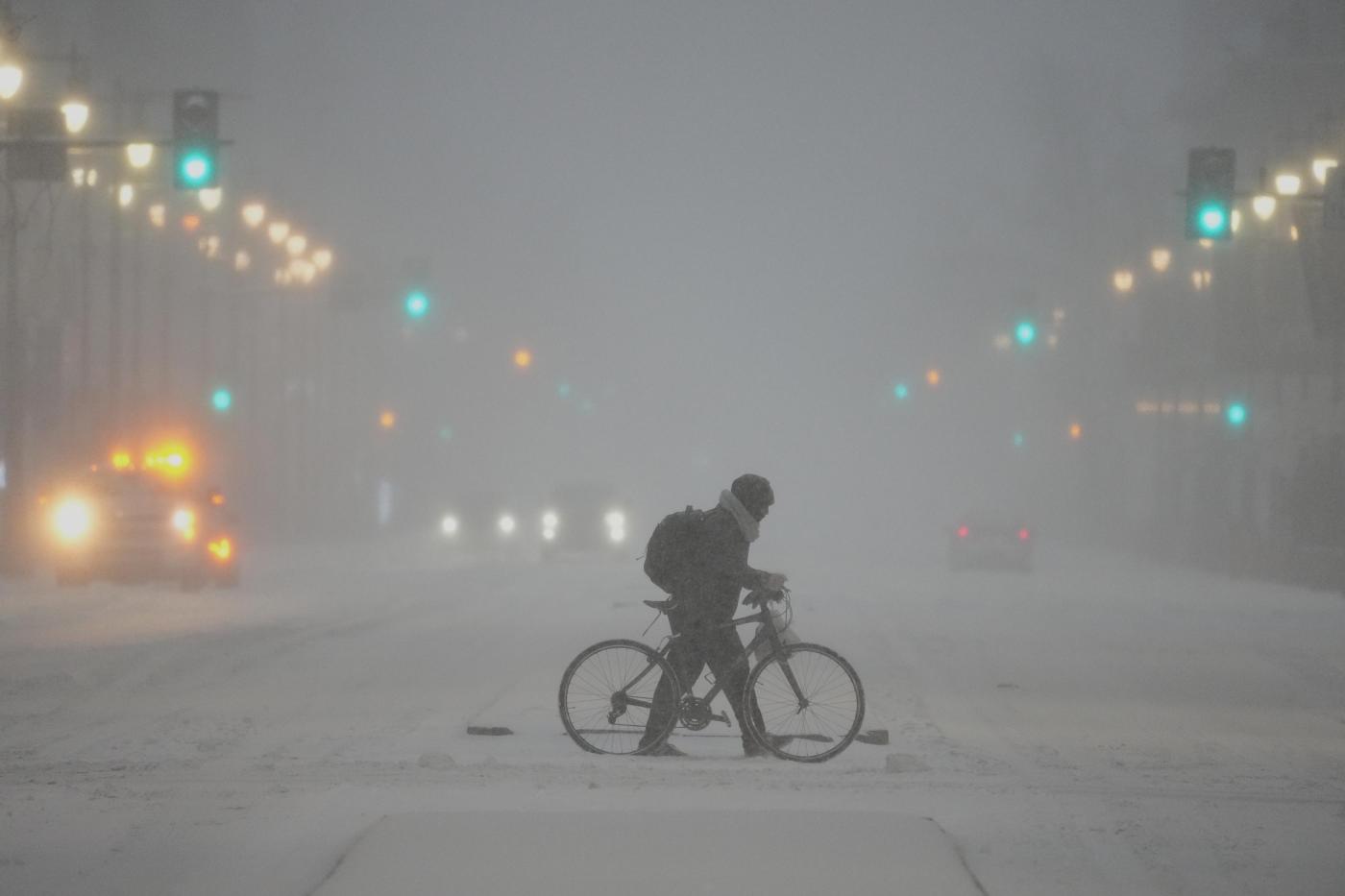
The U.S. work week opened with yet more snow dumping on the Northeast under the tail end of a colossal winter storm that brought ice and power outages, impassable roads, canceled flights and frigid cold to much of the southern and eastern United States.

Deep snow — over a foot extending in a 1,300-mile swath from Arkansas to New England — halted traffic, canceled flights and triggered wide school cancellations Monday.

Up to two feet were forecast in some of the harder-hit places.

In Falmouth, Massachusetts, about an hour’s drive south of Boston, snow was coming down in sheets and closing down the town.

Local minister Nell Fields had to shovel out just to be able to let her dog outside. Seven inches had fallen, with up to that much more still on the way.

“I feel that the universe just put a big, huge pause on us with all the snow,” Fields said.

On Manhattan’s Upper East Side, January Cotrel enjoyed the fresh snow on a block that always closes during snowstorms for residents to sled, throw snowballs and make snowmen.

“I pray for two feet every time we get a snowstorm. I want as much as we can get,” she said. “Let the city just shut down for a day and it’s beautiful, and then we can get back to life.”

Meanwhile, bitter cold followed in the storm’s wake. Overnight Sunday, the entire Lower 48 states were forecast to have their coldest average low temperature — 9.8 degrees — since January 2014.

Record warmth in Florida was the only thing keeping that average from going even colder, said former National Oceanic and Atmospheric Administration chief scientist Ryan Maue, who calculates national averages based on National Weather Service data.

From Montana to the Florida Panhandle, the weather service posted cold weather advisories and extreme cold warnings as temperatures in many places dipped to zero (minus-18 degrees Celsius) and even colder. Wind made conditions even chillier and the overnight cold threatened to refreeze roads early Monday in a cruel reprise of the weekend’s lousy travel weather.

Even with precipitation ending in Mississippi, “that doesn’t mean the danger is behind us,” Gov. Tate Reeves said in a news conference Sunday.

Freezing rain that slickened roads and brought trees and branches down on roads and power lines were the main peril in the South over the weekend. In Corinth, Mississippi, heavy machinery manufacturer Caterpillar told employees at its remanufacturing site to stay home Monday and Tuesday.

Related Articles


Private jet with 8 aboard crashes on takeoff in Maine, FAA says


Today in History: January 26, largest diamond ever found in South Africa


Judge set to hear arguments on Minnesota’s immigration crackdown after fatal shootings


Trump blames democrats for ‘tragic’ deaths as agents clash with protesters


Shutdown risk rises as GOP dismisses threat to block DHS funds

It already was Mississippi’s worst ice storm since 1994 with its biggest-ever deployment of ice-melting chemicals — 200,000 gallons — plus salt and sand to treat icy roads, Reeves said. He urged people not to drive anywhere unless absolutely necessary. “Do please reach out to friends and family,” Reeves added.

At one point Sunday morning, about 213 million people were under some sort of winter weather warning, authorities said. Hundreds of thousands of customers were without power, according to poweroutage.us, with Tennessee and Mississippi hit especially hard.

Some 12,000 flights also were canceled Sunday and nearly 20,000 were delayed, according to the flight tracker flightaware.com. Airports in Philadelphia, Washington, Baltimore, North Carolina, New York and New Jersey were among those feeling the brunt of the storm with impacts expected to linger into Monday.

In New York City, Mayor Zohran Mamdani said at least five people who died were found outside as temperatures plunged Saturday, though the cause of their deaths remained under investigation. Two men died of hypothermia related to the storm in Caddo Parish in Louisiana, according to the state health department.

In Massachusetts, Fields, the minister, held church services despite the storm, saying in some ways the weather was a gift.

“I’m sorry it’s disrupted things, but it’s given us some silence, and maybe we’re using this time to think about what’s really important, and that’s community and taking care of each other,” Fields said.

Brumback reported from Atlanta. Walker reported from New York. Kristin Hall and Jonathan Mattise in Nashville, Tennessee, Philip Marcelo in New York, Ed White in Detroit, Jeff Martin in Kennesaw, Georgia, Mead Gruver in Fort Collins, Colorado, Jessica Hill in Las Vegas and Seth Borenstein in Houston contributed reporting.

Private jet with 8 aboard crashes on takeoff in Maine, FAA says

posted in: All news | 0

BANGOR, Maine (AP) — A private aircraft carrying eight people crashed on takeoff Sunday night at Maine’s Bangor International Airport, the Federal Aviation Administration said.

Related Articles


Today in History: January 26, largest diamond ever found in South Africa


Judge set to hear arguments on Minnesota’s immigration crackdown after fatal shootings


Trump blames democrats for ‘tragic’ deaths as agents clash with protesters


Shutdown risk rises as GOP dismisses threat to block DHS funds


Most Fox News reporting on Minneapolis shooting supports official version

The Bombardier Challenger 600 crashed around 7:45 p.m., and there was no immediate word on the conditions of those aboard. The FAA and the National Transportation Safety Board are investigating.

The crash occurred as New England and much of the country grappled with a massive winter storm. Bangor had undergone steady snowfall Sunday along with many other parts of the country.

The airport issued a statement that emergency crews were on the scene at the airport, which was closed after what it described as an incident involving a single aircraft departing the airport.

Bangor International Airport offers direct flights to cities like Orlando, Florida, Washington, D.C., and Charlotte, North Carolina, and is located about 200 miles (320 kilometers) north of Boston.

Throughout the weekend, the vast storm dumped sleet, freezing rain and snow across much of the eastern half of the U.S., halting much air and road traffic and knocking out power to hundreds of thousands of homes and businesses in the Southeast.

Commercial air traffic was also heavily disrupted around much of the U.S.

Some 12,000 flights were canceled Sunday and nearly 20,000 were delayed, according to the flight tracker flightaware.com. Airports in Philadelphia, Washington, Baltimore, North Carolina, New York and New Jersey were among those impacted.

The Bombardier Challenger 600 is a wide-bodied business jet configured for nine to 11 passengers. It was launched in 1980 as the first private jet with a “walk-about cabin” and remains a popular charter option, according to aircharterservice.com