By The Associated Press
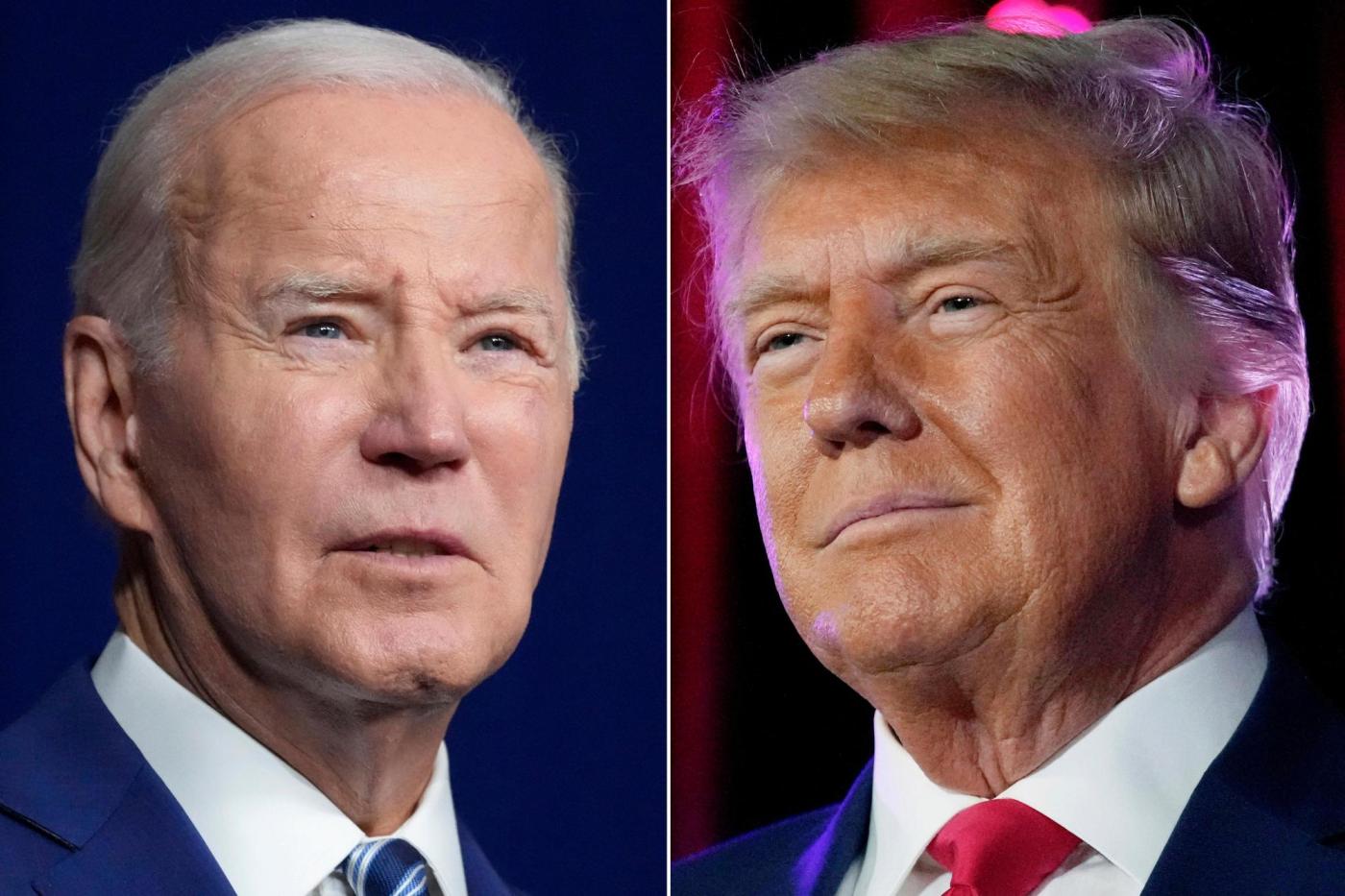
To hear former President Donald Trump tell it, the U.S. has fallen apart under President Joe Biden: the economy is failing, countries are emptying their prisons and mental institutions across the southern border and crime has skyrocketed.
Biden, on the other hand, has claimed he confronted an inflation rate of 9% and $5 gas prices when he took office, and boasts about his administration’s job creation without telling the full story.
There’s no comparing the volume of false and misleading claims Trump has deployed throughout his campaigns and presidency with Biden, who tends to lean more on exaggerations and embellishments rather than outright lies. But as the two men prepare to debate Thursday night, here’s a look at the facts around false and misleading claims frequently made by the two candidates.
Economy
Trump and his team like to claim his presidency gave the U.S. its “greatest economy in history.”
That’s not accurate.
First of all, the pandemic triggered a massive recession during his presidency. The government borrowed $3.1 trillion in 2020 to stabilize the economy. Trump had the ignominy of leaving the White House with fewer jobs than when he entered.
But Trump’s team likes to argue that only his pre-pandemic economic record should be judged. So, how does that compare?
— Economic growth averaged 2.67% during Trump’s first three years. That’s pretty solid. But it’s nowhere near the 4% averaged during Bill Clinton’s two terms from 1993 to 2001, according to the Bureau of Economic Analysis. In fact, growth has been stronger so far under Biden than under Trump.
Now, Trump did have the unemployment rate get as low as 3.5% before the pandemic. But again, the labor force participation rate for people 25 to 54 — the core of the U.S. working population — was higher under Clinton. The participation rate has also been higher under Biden than Trump.
Trump also likes to talk about how low inflation was under him. Gasoline fell as low as $1.77 a gallon. But, of course, that price dip happened during pandemic lockdowns when few people were driving. The low prices were due to a global health crisis, not Trump’s policies.
Similarly, average 30-year mortgage rates dipped to 2.65% during the pandemic. Those low rates were a byproduct of Federal Reserve efforts to prop up a weak economy, rather than the sign of strength that Trump now suggests it was.
— Biden has misrepresented the economy at times, including falsely claiming that gas prices were $5 when he took office. The average price was around $2.39 a gallon the week Biden was inaugurated in January 2021, according to data from the U.S. Energy Information Administration.
The president also has said in a few instances that he inherited high inflation. In May interviews, he said the inflation rate was 9% when he took office in January 2021. It was 1.4% at that point and increased steadily during the first 17 months of his presidency, reaching a peak of 9.1% in June 2022. But since then it has fallen and May data showed it at 3.3%.
His standard message has been that prices fell from their 2022 peaks without the mass layoffs and recession that many economists had predicted.
Biden correctly noted that inflation was a global phenomenon as the world economy reopened after the pandemic. He can claim that the U.S. economy is faring better than its peers. The World Bank recently estimated the U.S. economy would grow 2.6% this year, way better than the 0.7% for the 20 countries on the euro currency or 0.7% for Japan.
Yet Biden has at times boasted about his economic achievements without providing the full context. He has said his administration created a record 15 million jobs in its first three years. While data supports that, it’s partly because Biden inherited a pandemic economy. After staggering job losses early in the pandemic, the job recovery began under Trump, and continued under Biden when he took office.
Immigration
A mass influx of migrants coming into the U.S. illegally across the southern border has led to a number of false and misleading claims by Trump. For example, he regularly claims other countries are emptying their prisons and mental institutions to send to the U.S. There is no evidence to support that.
Trump has also argued the influx of immigrants is causing a crime surge in the U.S., although statistics actually show violent crime is on the way down.
There have been recent high-profile and heinous crimes allegedly committed by people in the country illegally. But FBI statistics do not separate out crimes by the immigration status of the assailant, nor is there any evidence of a spike in crime perpetrated by migrants, either along the U.S.-Mexico border or in cities seeing the greatest influx of migrants, like New York. Studies have found that people living in the country illegally are less likely than native-born Americans to have been arrested for violent, drug and property crimes.
The number of foreigners on the terrorist watch list has increased, but federal immigration authorities say they “are very uncommon” and a small fraction of the total number of migrants who cross the border. From October 2022 to September 2023, the U.S. Border Patrol reported seeing 169 people from the list, compared with 98 the previous year. Since October 2023, the Border Patrol has reported 80 encounters.
Crime
Trump falsely claims that crime has skyrocketed since he left office in 2021, particularly in Democratic-led big cities that he says are overrun with violence and bloodshed.
In reality, as Biden has accurately pointed out, violent crime is close to its lowest point in 50 years after a spike in 2020. That year, Trump’s last in office, was marred by the onset of the COVID-19 pandemic and civil unrest after a Minneapolis police officer murdered George Floyd.
The FBI’s annual crime report for 2022, the last year for which yearly data is available, showed violent crime across the U.S. dropping to about the same level as before the pandemic — a rate of 380.7 violent crimes per 100,000 people compared to 380.8 per 100,000 people in 2019. Since 1972, only 2014 had a lower violent crime rate.
A quarterly FBI crime report released June 11 showed the downward trend continuing, with sharp drops in violent crime in January-March compared with the same period in 2023. According to the report, overall violent crime was down 15%, with murder and rape both down 26%, robbery down 18% and 13% fewer aggravated assaults.
Experts noted, however, that while violent crime almost certainly dropped in the first quarter, the report is preliminary, subject to revision, and is likely overstating the size of the drops.
What role will housing affordability play in 2024 election?
Biden claims an early debate win: RFK Jr.’s absence from stage
How to watch the Biden-Trump presidential debate
Key results from Colorado, New York, South Carolina and Utah races
Supreme Court wipes out anti-corruption law that bars officials from taking gifts for past favors
While violent crime has trended lower, property crime has spiked — though that too may be ebbing. The 2022 report showed a 7.1% jump in property crime, such as vehicle thefts, while the quarterly report counted a 15% drop compared to the first three months of 2023.
Trump, meanwhile, contends the FBI’s statistics are skewed and don’t tell the real story. In his June 15 speech, Trump falsely claimed the statistics “no longer include data from 30% of the country including the biggest and most violent cities.”
While it’s true that some law enforcement agencies didn’t provide data to the FBI, a change in collection methods helped close the gap. The FBI said the 2022 report is based on data from 83.3% of all agencies covering 93.5% of the population. By contrast, the 2021 report contained data from 62.7% of agencies, representing 64.8% of Americans. For agencies that didn’t provide data, the FBI estimates the numbers based on comparably sized cities.
During his criminal trial in New York in April and May, Trump falsely claimed on social media that violent crime was “running rampant and totally out of control” in the city and said Manhattan District Attorney Alvin Bragg had let violent crime “flourish at levels never seen before.”
In reality, crime in New York is nowhere near the levels seen in the early 1990s, when the city averaged more than 2,000 murders a year. Last year, according to the NYPD, there were 391 murders. This year, the city is on pace for less than 350. Shootings have dropped 41.4% since 2021, though some crimes, like reports of rape, robbery and felony assault have trended higher.
Elections
Trump’s lie that he was the real winner of the 2020 election has permeated the Republican Party and its agenda over the past four years – and the former president has shown no interest in reversing that in his current campaign.
Trump has continued using the disproven claim as fuel to motivate his supporters and sow doubt in the upcoming election results, insisting without evidence that anything but a landslide victory in 2024 would be a sign of Democrats rigging the vote.
“The radical left Democrats rigged the presidential election in 2020, and we’re not going to let them rig the presidential election in 2024,” he said at a recent campaign rally in Wisconsin.
Biden beat Trump in 2020 with 306 electoral votes to Trump’s 232 and won the popular vote by more than 7 million ballots. Legal challenges to the election were heard and roundly rejected in dozens of state and federal courts, including by judges whom Trump appointed.
And despite Trump’s allegations of foul play, members of his own administration and election administrators in his own party have maintained that election safeguards were effective and there was no evidence of widespread fraud. An exhaustive AP investigation in 2021 found fewer than 475 instances of confirmed voter fraud across six battleground states — nowhere near the magnitude required to sway the outcome of the race.
Trump and his allies have made the specter of mass numbers of noncitizens voting in the presidential election their latest rallying cry. That’s also not based in fact.
It’s a felony for non-U.S. citizens to vote in presidential elections — one that states have mechanisms to catch. Election administration experts say the number of noncitizens illegally voting in federal elections is extremely small, and audits of voter rolls in several states confirm that.
The world
Foreign affairs are likely to loom large in the debate as both Trump and Biden look to tout their leadership while criticizing the other’s handling of world affairs. Likely topics include the wars in Ukraine and Gaza, conflicts with China, Russia and Iran, as well as the strength of U.S. alliances — complicated subjects that have long been the topic of misleading, debunked and exaggerated claims.
Trump has repeatedly misled about his own administration’s support for Ukraine in the years ahead of Russia’s 2022 invasion. Trump has said that his administration gave Ukraine the $400 million that Congress had approved ahead of schedule — even though he actually held up the funding in an effort to pressure Ukraine to announce an investigation of Democrats. That incident led to Trump’s first impeachment by the U.S. House.
He has also falsely accused his predecessors of ignoring Ukraine’s pleas for military aid. “The Obama-Biden administration only sent them meals and blankets,” he said two years ago.
Trump has repeated a debunked story that Ukraine sought to intervene in the 2016 U.S. election by hacking into Democratic Party servers and then framing Russia for the attack. Authorities have said the evidence shows that Russia was behind the attack, and that suggestions that Ukraine did it are playing into the Kremlin’s hands.
“Fictions,” Trump’s former special assistant on the National Security Council, Fiona Hill, told members of Congress when asked about Trump’s assertions. “I would ask that you please not promote politically driven falsehoods that so clearly advance Russian interests.”
Biden, for his part, has misleadingly taken credit for an international group including the U.S., Australia, Japan and India known as the Quad. Last year, Biden claimed he convinced the countries to form the organization to maintain stability in the Indian Ocean and South China Sea. But the group was actually formed in the early 2000s, and revived in 2017 under Trump.
Associated Press writers Josh Boak in Washington and Mike Sisak and Ali Swenson in New York contributed to this report.
Find AP Fact Checks here: https://apnews.com/APFactCheck.