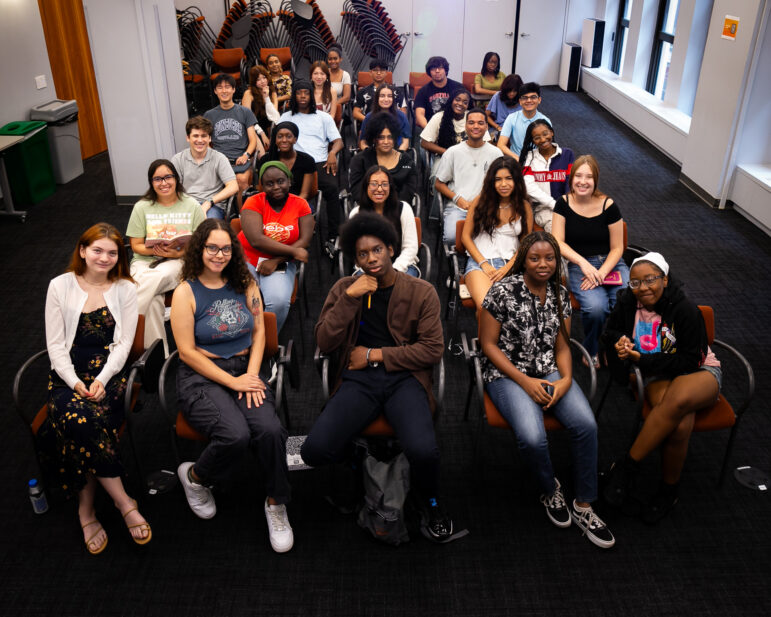
CLARIFY (The City Limits Accountability Reporting Initiative for Youth) is working with more than two dozen talented high school students from across New York City, who are reporting on issues impacting their communities.
Adi Talwar
2024 Summer City Limits Accountability Reporting Initiative for Youth (CLARIFY) class at CUNY Newmark Graduate School of Journalism in Manhattan.
For the past decade, City Limits has has operated a paid training program for New York City high schools students who learn and apply the skills of investigative journalism as they report on issues affecting their own neighborhoods.
This summer, more than two dozen young journalists are taking part in CLARIFY (The City Limits Accountability Reporting Initiative for Youth), based at the CUNY Newmark Graduate School of Journalism in Midtown Manhattan.
Learn more about this summer’s CLARIFY interns below.
Ean Bermudez is a 16- going 17-year-old who currently attends The Frederick Douglas Academy in East Harlem. Nine years ago, Ean was exposed to the intricate world of art and its many expressions and interpretations. Ean partakes in art in his free time and is something he strives to better himself in. Examples include drawings, poems or music. This hobby remains essential to his character and still persists to this day, now revolutionized and adaptive to the modern age.
Emmanuel Brown is a Rising Senior at Uncommon Leadership Charter High. He is passionate about writing and storytelling, and loves to write fictional stories and read novels in his free time. In addition to his creative pursuits, Emmanuel is also an athlete, and enjoys running track and playing basketball. As a member of City Limits he is looking forward to combining his writing skills with his passion for sports and community issues.
Anyeli Clemente is a 17-year-old who will be attending her first year at Fordham University in the fall of 2024. She was born and raised in the Bronx by Guatemalan parents and is an older sister of two. She shares interests in both the medical field and in business. She is figuring out what exactly she wants to do in her life. Anyeli is trying many career paths where she hopes to find a new passion. As of now, she plans to major in neuroscience and minor in marketing. Her interest in journalism emerged as she enjoys writing about her experiences and taking part in helping the community.
Suhani Cuenot is a 17-year-old student attending Brooklyn High School of the Arts. Born and raised in New York City, her interest in journalism arose from her enjoyment of writing and general curiosity. She hopes to spread important, reliable information to the public as well as investigate issues that aren’t widely known in order to speak up for those who can’t. In her spare time, Suhani enjoys films, art, and listening to music, mainly inspired by artists such as Elliott Smith and Cocteau Twins.
Saniyah Davis is a 17-year-old rising senior at Saint Jean Baptiste High School. From a young age, she was exposed to various dance styles and participated in many dance programs. Dance has been a calming factor in her life. She was told from a young age that nursing would be a good career path. Now in her senior year of high school, she discovered that she is interested in studying pediatric nursing with a psychology minor in college. In her spare time, Saniyah can be found wandering the city with friends, reading or listening to music.
Melanie Gonzalez is a rising Senior at Benjamin N. Cardozo High School in Bayside, Queens. She’s a member of her school’s newspaper, ‘The Verdict, as well as a clarinet player in her school band. She enjoys writing, reading and jewelry making. She loves listening to music and journaling. Journalism is her passion, and she strives to work every day to improve her writing skills.
Deanna Hayward is a 16-year-old rising junior at Bronx Theatre High School. She lives in Brooklyn, but was raised in the Bronx with her mother and her seven siblings. She loves anything that involves music, and loves just laying in bed with headphones on. Despite going to a theater school, she loves the academic side and has a great interest in reading and writing. She knows she wants to do something in the film industry but doesn’t know if she wants to be behind or in front of the camera. She joined the City Limits program because she loves raising awareness about issues she’s passionate about, and wants to give people a voice.
Dylan Hernandez-Abreu is a 16-year-old rising sophomore at Discovery High School. Dylan always had a hard time trying to find what brought him happiness. He spends his time either poring over unsolved criminal cases or pouring his heart out in his journal. He wasn’t able to have the childhood he wanted, nor the mental health he deserved. He aimed his purpose in life toward finding a way to help other people. Through journaling or reporting, Dylan wants to help others better understand their environment and hardships. He wants to major in psychology so he can learn to recognize people’s triggers and pain, and to guide them to live a fulfilling life.
Cesar Jimenez is an incoming senior at Bronx River High School, where he is editor-in-chief for the Bronx River News, his school’s award-winning newspaper. He is passionate about journalism because it offers him a platform to speak his voice, as well as speak for people who aren’t often listened to. He will be participating in Press Pass NYC with Lara Bergen this August where he will do authentic, project-based, community-centered learning. Cesar hopes to strengthen his journalism skills to produce better writing and enhance his teamwork skills to be a great editor-in-chief. During his downtime, Cesar likes to spend time with family and friends, listen to podcasts, and travel.
Mannat Kaur is a 17-year-old rising senior at NYC Museum School. What sparked her interest in journalism was when her teacher appreciated her writing and recommended working for the school newspaper. She soon began writing for the school’s paper, The Gallery, where she is currently the news editor. She looks forward to majoring in political science in college. Mannat loves to socialize with her friends and family in her spare time. She also likes to read, watch dramas, and listen to music. Mannat is a member of her school’s girls soccer team and the French club.
Fatima Konneh is a 16-year-old rising junior at New Visions Charter High School in the Bronx. From a young age, she was fascinated by the art of writing, literature, and activism. She finds that important issues in her community are often unacknowledged, like housing pricing, MTA safety, the homeless epidemic and others. She believes there needs to be more awareness of these issues and that journalism may be an effective vehicle to prompt necessary change. With City Limits, Fatima plans to improve her writing skills and learn the fundamentals of journalism to implement them in her future career.
Pierce Malter is a rising junior at the Abraham Joshua Heschel School, where he participates in student government, mock trial, and the school paper, the Helios, where he serves as co-news editor. He enjoys journalism because of its potential to spotlight unheard voices and inform readers, which is a key piece of his participation in CLARIFY. Outside of journalism, he enjoys reading, writing comedy, and connecting with nature.
Allen Mantilla is a music-loving old soul. She loves to spend her time listening to Tally Hall and their side projects. She is a senior at High School of Telecommunication Arts and Technology located in Brooklyn. Allen also loves to screenwrite and thrift. She’s always had a passion for writing and became inspired to become a journalist after her teacher told her she had potential. She spends time with her three dogs and a cousin, whom she cherishes very much. Allen’s love for journalism also stemmed from the fact that she wants to educate people about injustice and inequality. While doing that, she also wants to help teens realize that the struggles they are going through don’t define them. She wants to use her past experiences to educate people around the stigma of mental health. Being a journalist means she’ll finally get to educate people on her own experiences, and listen to and amplify perspectives that are often ignored.
Giana Newball is a 16-year-old rising sophomore year at Bronx Academy of Letters. She was born and raised in the Bronx. She is interested in learning more about journalism and being able to express her opinions more openly. As a CLARIFY Intern, Giana plans on taking the knowledge she will learn and using it towards her education. She’s unsure of what she wants to do in college but always had an interest in business.
Namarachi Okwuka is a 16-year-old University Heights High School student who enjoys writing. She believes words have power and hopes to use her writing skills to change the world one day. She feels that words can describe the indescribable as well as the most beautiful experiences in such a way that they touch someone’s soul and make them believe they were there firsthand. She joined City Limits to improve her investigative skills and learn how to write stories about real-world issues that would benefit her community. She also wanted to improve her analytical skills by learning how to analyze complex data and present it in a coherent, understandable manner. She aims to use her writing creativity to explore contemporary social issues. She enjoys writing poetry in her spare time, listening to music, and crocheting different kinds of hats. She understands that journalism plays a crucial role in raising awareness about under-reported issues. Although she aspires to work in medicine, she still likes exploring her artistic and creative side.
Naheema Olatidoye is a 17-year-old incoming college freshman at the City College of New York. From a young age, Naheema was known to be a chatterbox – lovingly nicknamed “parrot” by her grandmother. There was no limit to what she would talk about, whether it be commentary about her favorite book, arguing with her siblings, or observations about the world around her. This trait carried on and evolved. She’s not just talkative. She’s a ranter with purpose! Now, she focuses on modern-day events, politics, and the law (a talkative girl wants to be a lawyer, how shocking.) What better way to immortalize your thoughts than to write them down? Naheema’s goal in this journalism internship is to document the world around her and share her findings with others, for she is as curious as she is talkative.
Akeelah Outland is a 17-year-old sophomore at Bronx Academy of Letters High School. She always loved to read fantasy books and comics from a young age and currently loves drawing. Akeelah doesn’t know what her passion is or her future career, but is willing to try new things to help her find her interests. While Akeelah is interning at City Limits, she wants to improve her writing skills, communication skills, and public speaking.
Duncan Park is a rising senior attending Stuyvesant High School. He works on the school’s paper, The Spectator, as a managing board editor, sports editor, and chief of the copy department. He has published over 20 works, ranging from sports editorials to news reporting on school events to features stories on relevant alumni, students, and faculty. He also participates in the honor society, ARISTA, captains the school soccer team, and is a mentor to incoming freshmen. He hopes to hone his investigative skills and report on pressing issues in our diverse city.
Mujtaba Raja is a 16-year-old junior at The Dalton School in Manhattan. His passion for journalism began as a student reporter with Scholastic Kids Press, an award-winning organization reporting “news for kids, by kids.” Writing for The Daltonian as a sews section editor, he has sparked tough but necessary conversations within his school community. Additionally, Mujtaba is involved with The Barakah Initiative, a youth-led effort that interviews influential Muslim public figures and creates informational posts to counter misrepresentation in a post-9/11 world. He is excited to work with City Limits because he is inspired by the impact that investigative journalism can have on policy and community welfare. In the words of journalist Arundhati Roy, “There’s really no such thing as the ‘voiceless.’ There are only the deliberately silenced, or the preferably unheard.” Serving as director of Diversity, Equity, and Inclusion for The Daltonian this upcoming year, Mujtaba aims to further his impact. When he’s not writing, you can catch him debating on his school’s Model Congress team, volunteering, or binge-watching Marvel movies.
Ginger Roger is a 16-year-old rising junior attending Manhattan Early College for Advertising. In high school, she is eager to find her “spark” and wants to explore different ventures. She loves living by the principle that “rejection is redirection.” This saying has helped her get through some of the hardest times of her life, and she wants to inspire people to live in the present through photography and writing. Growing up in New York City has made her eager to venture out into the world and meet people from different cultures. She can’t wait to see what the future has in store for her yet wants to live in the moment.
Paww Sue Scott is a 17-year-old senior at Democracy Prep Endurance High School. She was born and raised in Ghana then later immigrated to the United States at 11 years old. She loves to dance, cook and listen to Afrobeat music. She wants to major in healthcare administration in college. Her favorite color is pink. Paww Sue Scott’s dream is to build an orphanage home in Ghana and eventually become the President there. She wants to be a humanitarian and philanthropist. Coming to America influenced her dream, since she has so many privileges that people in Ghana do not have such as education, jobs, and a good healthcare system. She plans to advocate for establishing a stable electricity system, improving water cleanliness, and building up Ghanaian infrastructure, such as implementing a healthcare system and building roads. Since youth is the future generation, she also wants to open an organization that mimics NYC’s Summer Youth Employment Program (SYEP). Her ultimate dream is to change Ghana for the better and improve life satisfaction there.
Subrina Singh is a rising freshman at Baruch College, eager to begin her journey into higher education. Her passion for writing and storytelling has led her to explore journalism, aiming to uncover and share compelling stories. As a CLARIFY intern, Subrina is excited to explore the world of journalism and develop her investigative reporting skills. Her interest in journalism was sparked by a desire to uncover and share stories that often go untold. When she isn’t busy with her studies or internship, Subrina enjoys reading contemporary fiction, experimenting with new recipes in the kitchen, and volunteering at her local nursing home. She hopes to use her time with CLARIFY to make a meaningful impact, grow as a writer and journalist and hone her reporting skills.
Erica Tillman is an upcoming college freshman. She has a past of youth advocacy within the juvenile justice system and has also participated in a plethora of civil and political rights movements and protests, such as Black Lives Matter demonstrations. As a history buff and science enthusiast, she enjoys spending a good amount of her free time researching various topics and increasing her knowledge and understanding. She is very passionate about raising awareness to different international issues and has donated financially to displaced families. Her hobbies include writing, watching television and playing video games.
Jayleen Torres is a rising senior at the George Washington Educational Campus. Jayleen looks forward to majoring in law and pursuing a career in education law. She is inspired to continue writing and reading books related to her identity and background, such as “Dominicana” by Angie Cruz, and “An Invisible Thread” by Laura Schroff and Alex Tresniowski. She became the founder of her school newspaper her sophomore year. As a child, Jayleen knew that lawyers read and write consistently and defend various cases. So, she acknowledged that by getting involved in journalism, she would be given the freedom to speak and advocate for her community. By writing articles for her school, she became engaged in politics. She became the editor-in-chief of her school newspaper her junior year of high school. With this leadership opportunity, she was able to help diversify her school newspaper by allowing Spanish-speaking students to contribute. Outside of journalism, you will find her embracing her Dominican heritage, playing soccer, going on long walks, and spending time with her family. Her future aspiration is to continue to be involved in leadership opportunities that challenge her to grow as an individual. You will see her enhancing her public speaking skills and being an activist for the Latino community.
Andrew Vera is an incoming freshman at Kenyon College and a Thomas Edison CTE High School alumni. During his time at Edison, Andrew co-led the Model UN team, led educational initiatives through his works at ImagineSchools, and took part in the school’s FutureReady internship. Beyond the classroom, he enjoys spending time analyzing constitutional legal cases to prepare for a future in the legal field. As a CLARIFY intern, Andrew hopes to provide an unbiased perspective on the issues that most affect the city. In his free time, you can find Andrew going on runs, reading a book, or parading the city looking for the newest food conquest he can embark on.
Maya Wierciszewski is a 17-year-old incoming college freshman at Pratt Institute who is studying digital arts and animation. She has enjoyed the arts and creative writing since middle school. During this internship, she wants to improve her writing and engagement with her community. By listening to others’ experiences and stories, she wants to learn from them and improve her communication and public speaking skills.
Jovanna Wu is a teaching assistant with CLARIFY and an incoming freshman at New York University. Since she was young, she spent hours reading her latest classic novel. In high school, she got involved with her school’s newspaper and fell in love with writing, eventually becoming an editor in the science department. At college, she will join her school’s newspaper and continue writing for it. In her free time, Jovanna enjoys watching horror movies, shopping with her friends, and sewing her clothes.
Chloe Zi Ching Wong is a rising junior at College of Staten Island High School for international studies. As a rising captain of the debate team, she aims to improve her writing skills at CLARIFY. In college, Chloe plans to major in political science and minor in journalism, building and developing a stronger writing career. One day, she hopes to be a lawyer. Additionally, she hopes to start a podcast to educate people on real world events from an unfiltered lens, welcoming new minds to discuss and sway ideologies, her own or other people’s.
CLARIFY has been generously supported by the Pinkerton Foundation, Google News Initiative, Harman Family Foundation, DJ McManus Foundation and the Dow Jones News Fund. Click here to apply for the Fall 2024 session of CLARIFY.