November ballot will feature question to St. Paul voters on even-year local elections

posted in: Society | 0

Despite gaining national attention, turnout for St. Paul’s most recent mayoral and city council elections still paled in comparison to voter participation during even years, when the governor or the president of the United States were up for election.

To boost turnout, why not move local St. Paul elections to even years?

It’s logic that Peter Butler, a former city financial analyst, has been trying to convince voters to subscribe to for years, across three different ballot petitions. On Wednesday, he finally broke through his foremost obstacle — getting a question about even-year elections on St. Paul’s November ballot.

“The last time I looked, out of more than 800 Minnesota cities, 25 of us are on odd-year election cycles,” Butler said. “Most are on even years. That’s the default requirement in state statute.”

Peter Butler, candidate for St. Paul City Council, Ward 2, in the November 2023 election. (Courtesy of the candidate)

Turnout down in odd years

Butler, who ran last year for the Ward 2 seat on the city council, said the problem with odd-year municipal elections is readily apparent from a quick glance at ballot figures.

In 2023, about 48,500 St. Paul voters went to the polls to elect the city’s first all-female city council, a sizable drop from 2021 when some 60,000 voters weighed in on whether to approve rent control.

“Apparently, four open seats and a sales tax referendum did not (increase turnout),” Butler said. “We dropped by about 12,000 voters from 2021.”

In contrast, more than 152,000 voters went to the polls in 2020 to choose between President Joe Biden and former President Donald Trump.

Butler and a small coalition of even-year advocates recently presented Ramsey County Elections and the city with more than 5,500 signatures from St. Paul voters, reaching the requisite threshold of 5,437 valid signatures required by state statute for a ballot petition.

Even that process was torturous, said Butler, noting the city clerk asked the county to add back more than 1,000 signatures that the county had rejected.

Ballot question approved — with concerns

The St. Paul City Council approved Butler’s ballot question on Wednesday, but not without some members raising concerns.

Council President Mitra Jalali, who had looked this month into her legal options, called approving the question for ballot “a procedural action” only and not an indication of council support for even-year elections, which would add an extra year of service for the council and one three-year term for the next mayor during the transition.

She said she would soon issue a public statement in opposition, alongside other council members.

“In my personal capacity, I am extremely concerned about changing (the election schedule),” said Jalali, in an interview this week. “It’s not a simple thing to reschedule an election. State law does not contemplate ranked-choice voting in the ballots that print state-year elections.”

“There’s been so many implications here that I think have not been considered, and that could negatively impact our voters,” she added.

Opposition from mayor, others

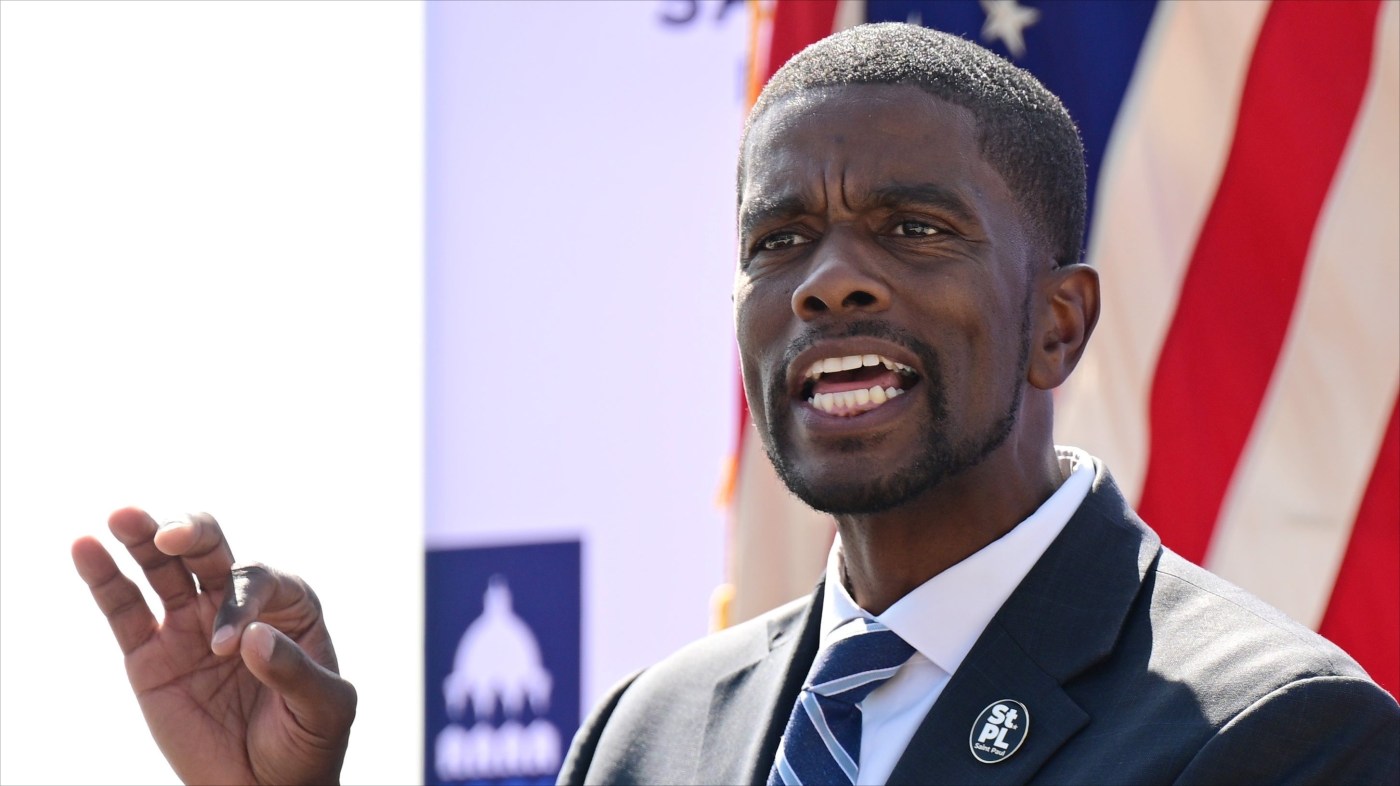
The prospect of even-year municipal elections has drawn opposition from St. Paul Mayor Melvin Carter and other DFLers, who have expressed concern that important local races will be overshadowed by better-funded statewide and national races.

If city council races get lost in the shuffle, that could have negative consequences for campaign fundraising, volunteerism, debate attendance and other aspects of municipal elections. St. Paul chooses its mayor and city council through ranked-choice election, meaning there is no political primary to whittle down the field and no limit to how many candidates can appear on an Election Day ballot.

Leading up to an even-year municipal election, it’s possible that after presidential, gubernatorial and other state office campaigns have knocked on a voter’s door, another eight city council candidates or more could follow.

“It’s always harder to fundraising and volunteers when there’s other races on the ballot,” Butler acknowledged. “The people who donate to Mayor Carter also probably donate to candidates in the U.S. Congress, the U.S. Senate and presidential race. But most Minnesota cities are on even years. They’re somehow getting the job done.”

Signatures rejected — and added back

After Butler submitted his petition for a charter amendment, Ramsey County Elections rejected 1,150 signatures last month, most of which St. Paul City Clerk Shari Moore requested they add back just a week later after reviewing some added documentation.

“Most of the add-backs were because someone had included a house number and street name but not the word ‘avenue’ or ‘street,’ so very insignificant reasons to reject a signature,” Butler said. “Someone might have written ‘2020 Lincoln,’ but they forgot the word ‘Avenue’ so they were initially scratched. There was one where someone misspelled Snelling with one ‘l,’ so she had them add it back in.”

“This is my third petition, and the first two never had that type of scrutiny,” Butler added. “I strongly believe there was a partisan attempt to keep us off the ballot.”

If even-year elections are approved in November, Butler said the next city council would be elected in 2028, requiring the existing city council to serve one extra year. An odd-year mayoral election next year would select a mayor for a one-time, three-year term, before resuming a normal cycle on even years.

Child care, early learning also on ballot

Another question on St. Paul’s November ballot will ask voters whether to approve a 10-year property tax increase to raise subsidies for child care and early learning programs.

If approved, the tax levy increase would raise $2 million in the first year, $4 million in the second year, $6 million in the third and so on for a decade to fund child care subsidies for low-income families first, with the hope of expanding those subsidies using philanthropy or other funding sources to include a wider net of families.

Related Articles

Local News |


Ramsey County judge: St. Paul violated Data Practices Act 14 times, must pay bike trail opponent

Local News |


First all-women St. Paul City Council inspires crochet project, museum exhibit

Local News |


St. Paul City Council approves expansion of Downtown Improvement District

Local News |


Former City Council Member Amy Brendmoen to join St. Paul Port Authority

Local News |


St. Paul City Council poised to double size of Downtown Improvement District

Vance and other Trump allies amplify a false claim about Harris’ racial identity

posted in: News | 0

Ohio Sen. JD Vance, Donald Trump’s running mate, defended on Wednesday a false claim the former president made about Vice President Kamala Harris ‘ racial identity, suggesting wrongly that Harris had downplayed her Black heritage in trying to suggest she’s inauthentic.

“What I took it as was an attack on Kamala Harris being a chameleon,” he told reporters when asked in Michigan about the former president’s suggestion that Harris, the daughter of Jamaican and Indian immigrants, had only recently identified as Black.

“I think he was observing the basic foundational reality that Kamala Harris pretends to be something different depending on what audience she’s speaking to,” Vance said. “She fakes who she is depending on the audience she’s in front of, and that’s who she is and that’s who she’s always been.”

Vance’s was the most recent of the Republican criticisms of how Harris portrays herself, in the wake of Trump’s comments last week to the National Association of Black Journalists conference in Chicago. Florida Rep. Byron Donalds, a high-profile Trump surrogate who is a Black man, echoed the claim on Sunday as a guest on ABC’s “This Week.”

The proliferation of Trump’s falsehood by other Republicans is part of their effort to stay in his favor, said former Republican National Committee Chairman Michael Steele.

“It’s ‘I’ll do anything and I don’t want to be on the wrong side of you,’” said Steele, a former Maryland lieutenant governor who was the first Black man to lead the RNC. “It’s ‘I don’t want to take the heat that comes with calling out your racism, that comes with calling out your ugliness, so I will pretend that’s not what it is’.”

The Harris campaign has declined to comment specifically on Trump’s false claim. The vice president, speaking to a Black sorority last week, accused Trump of “the same old show: the divisiveness and the disrespect.”

Harris has frequently talked about being Black in addition to being Indian American during her political career. She was the first African American to serve as California attorney general and became the first Indian American to serve as a U.S. senator and the second Black woman, after Carol Moseley Braun of Illinois.

As an undergraduate, Harris attended Howard University, one of the nation’s most prominent historically Black colleges and universities, where she also pledged the historically Black sorority Alpha Kappa Alpha.

As San Francisco’s first Black district attorney, she was recognized as a “Woman of Power” by the National Urban League and received the Thurgood Marshall Award from the National Black Prosecutors Association in 2005.

She was recognized in India Abroad during her 2010 campaign for California attorney general as being potentially “the first African American as well as the first Indian-American” to hold the office.

Harris identified as both Black and Indian in an Associated Press story published that same year about the number of candidates of Indian descent running for prominent offices that year.

“I grew up in a family where I had a strong sense of my culture and who I am, and I never felt insecure about that at all,” she said at the time. “Slowly, perhaps, with each of us taking on more prominent positions, people will start to understand the diversity of the people.”

Harris joined the Congressional Black Caucus when she entered the Senate in 2017. And writing about her time at Howard in her 2019 memoir, “The Truths We Hold,” Harris wrote: “Every signal told students that we could be anything — that we were young, gifted, and black, and we shouldn’t let anything get in the way of our success. The campus was a place where you didn’t have to be confined to the box of another person’s choosing.”

The echo of Trump’s claim comes as the Republican nominee has tried to cut into Harris’ fundraising and media attention following her taking over President Joe Biden’s campaign after the president quit the race. Some Republican strategists have criticized Trump for making personal attacks that echo his past questioning of President Barack Obama’s citizenship, instead of pivoting to issues like the economy or immigration.

Vance previously hit Harris for using what he called a “fake Southern accent” when she campaigned in Atlanta last week. And Michaelah Montgomery, a Black conservative activist who organized a widely shared Trump meet-and-greet with local college students at an Atlanta Chick-fil-A, tore into Harris at the former president’s rally on Saturday, suggesting of Harris, “She’s only Black when it’s time to get elected.”

Rashawn Ray, a national scholar on racial and social inequity and vice president at American Institutes for Research, said the criticism willfully ignores the growing number of people who identify as multiracial.

“People can be both Black and Asian,” Ray said.

Casting doubt on Harris’ identification as Black is also an effort to use race to undermine her qualification to be president — as Trump did questioning Obama’s citizenship — said Ray.

“Some people believe that by attacking the authenticity of Vice President Harris’ Blackness, they can send a dog whistle that questions her Americanness and electability,” Ray said. “People are often judged by what they look like rather than what they represent. Some people are banking on the shallowness of this perspective.”

Related Articles

National Politics |


Wesley Bell beats Cori Bush in 1st Congressional District

National Politics |


Michigan sets matchups in Senate race, House battlegrounds

National Politics |


Harris VP pick Walz’s long history with China may prove awkward

National Politics |


How Tim Walz pushed Minnesota toward aggressive climate policies

National Politics |


Takeaways from a Harris-Walz ticket now that the stage is set for a reimagined presidential race

Beaumont reported from Des Moines, Iowa. Associated Press researcher Rhonda Shafner in New York contributed to this report.

Minnesota Supreme Court upholds law restoring right to vote to people with felony convictions

posted in: News | 0

By JOSH FUNK

The Minnesota Supreme Court on Wednesday upheld a 2023 state law that restores voting rights for felons once they have completed their prison sentences.

The new law was popular with Democrats in the state, including Gov. Tim Walz, who signed it and who is Vice President Kamala Harris’ running mate in the presidential race. The timing of the decision is important because early voting for next week’s primary election is already underway. Voting for the Nov. 5 general election begins Sept. 20.

The court rejected a challenge from the conservative Minnesota Voters Alliance. A lower court judge had previously thrown out the group’s lawsuit after deciding it lacked the legal standing to sue and failed to prove that the Legislature overstepped its authority when it voted to expand voting rights for people who were formerly incarcerated for a felony. The high court agreed.

Before the new law, felons had to complete their probation before they could regain their eligibility to vote. An estimated 55,000 people with felony records gained the right to vote as a result.

Minnesota Democratic Attorney General Keith Ellison had been pushing for the change since he was in the Legislature.

“Democracy is not guaranteed — it is earned by protecting and expanding it,” Ellison said in a statement. “I’m proud restore the vote is definitively the law of the land today more than 20 years after I first proposed it as a state legislator. I encourage all Minnesotans who are eligible to vote to do so and to take full part in our democracy.”

Minnesota was among more than a dozen states that considered restoring voting rights for felons in recent years. Advocates for the change argued that disenfranchising them disproportionately affects people of color because of biases in the legal system. An estimated 55,000 Minnesota residents regained the right to vote because of the change.

Nebraska officials went the other way and decided last month that residents with felony convictions could still be denied voting rights despite a law passed this year to immediately restore the voting rights of people who have finished serving their felony convictions. That decision by Nebraska’s attorney general and secretary of state, both of whom are Republicans, has been challenged in a lawsuit.

Israel court hears bid to close prison where soldiers are accused of sexually assaulting Palestinian

posted in: News | 0

JERUSALEM — The Israeli Supreme Court considered a petition Wednesday to shutter a desert military prison where soldiers have been accused of abusing Palestinians, as a new video emerged purporting to show the sexual assault of a Palestinian detainee.

Rights groups have been engaged in a legal battle since June to shut down the detention facility, known as Sde Teiman, where Israel has held many Palestinians detained in Gaza during the 10-month war with Hamas. The groups claim that conditions at the facility are grave and that abuse by Israeli soldiers is common, basing their claims on testimony from released detainees and Israeli whistleblowers.

Calls for the prison’s closure ramped up in late July, when Israeli military police arrested 10 soldiers from Sde Teiman on suspicion of their involvement in the alleged sexual assault of a Palestinian detainee at the facility. Five of the soldiers are no longer under investigation. A physician who identified himself as the person who reported the attack said last week that the detainee appeared to have been seriously sexually abused.

The soldiers’ detention triggered angry protests by supporters, and at least two government ministers demanded their release. The response underscored tensions between the military command and hard-line nationalists in Prime Minister Benjamin Netanyahu’s government who advocate even harsher treatment of Palestinians detained from Gaza.

Defense lawyer Nati Rom told The Associated Press that the soldiers were arrested about a month after the alleged attack and are accused of performing acts of sodomy on the detainee. He said the soldiers used force to defend themselves against a detainee who attacked them during a search, but did not sexually abuse him.

A video purporting to reveal the assault shows a group of masked soldiers wresting a detainee from the ground, where he and other Palestinians appear to be lying face down in a fenced-in pen, their arms cuffed above their heads. The soldiers take the detainee to an area of the pen they appear to cordon off using shields. Footage then shows about eight soldiers and a dog with the detainee, largely hidden from view by shields held up by some of the soldiers. Israel’s Channel 12 news, which broadcast the video, said it captures the moment of the attack.

Two soldiers who formerly worked at the facility and requested anonymity for fear of retribution told the AP they believed the video had been taken at Sde Teiman. The room in which the detainees appear, a corral topped by barbed wire, matches photos of the facility shared with the AP and the description of incarceration conditions that whistleblowers have previously described.

Military prosecutors stated that evidence brought forth in the case indicates “a reasonable suspicion of the commission of the acts,” the Israeli military said Tuesday. The military did not comment on the video.

U.S. officials have seen the video, State Department spokesperson Matthew Miller said Wednesday. He called the reports of sexual abuse “horrific.”

“Prisoners’ human rights need to be respected in all cases and when there are alleged violations, the government of Israel needs to take steps to investigate those who are alleged to have committed abuses and, if appropriate, hold them accountable,” Miller said.

Meanwhile, more information about the case has come to light from a doctor who treated the detainee in question.

Dr. Yoel Donchin, an Israeli anesthesiologist at the field hospital for Palestinian detainees at Sde Teiman, came forward Friday as the person who reported the case to the military authorities.

In an interview with Israeli public broadcaster Kan, Donchin said the detainee’s life was in danger and that he was in need of emergency surgery after the attack.

During the interview, Donchin confirmed information attributed to an unidentified medical official who said the detainee had fractured ribs, showed signs of beating and bore evidence of being sodomized, leading to a tear in the lower part of the intestines.

Donchin said the detainee’s case was the most extreme he had witnessed since working at the facility.

Naji Abbas, a case manager with the Israeli Physicians for Human Rights, said the detainee was transferred to a civilian hospital outside Sde Teiman about a month ago because his injuries were too severe for treatment at the military facility. Abbas received his information from a medical source with knowledge of the case.

In a written submission to the Israeli Supreme Court in advance of Wednesday’s hearing, state attorneys did not mention the military’s sexual assault investigation, but insisted the rights groups’ claims of deplorable conditions were inaccurate.

The Israeli organization arguing in court for the military prison’s closure, the Association for Civil Rights in Israel, had alleged that detainees at the facility are punished with severe violence, including with attack dogs and sexual assault; made to sit on the ground blindfolded and handcuffed 24 hours a day; forbidden from moving or speaking and rarely shower or change clothes.

An investigation by the AP into the facility documented how detainees are blindfolded, handcuffed and diapered during medical treatment.

The state, in a written response, said detainees were given sufficient food and water, showered regularly, accessed medical treatment as needed, and were blindfolded and handcuffed because of concerns that they could harm staff. The state said a new wing of Sde Teiman set to open Sept. 5 would improve conditions, including adding a walking area for detainees. Additional improvements are expected to be made later this year, it said.

Following Wednesday’s hearing, the court gave the state a week and a half to provide more information about conditions at the prison.

Sde Teiman was the main military prison holding Palestinians captured in large-scale raids on the Gaza Strip. Israel began moving detainees out of the facility following the rights groups’ petition to shut it down. State filings show 28 detainees remain.

Under Israeli law, Palestinians from Gaza can be held at the facility, and other military detention camps, without a detention order, trial or charge for over a month. Many Palestinian detainees have spent weeks in the facility before being released back to Gaza after Israeli authorities deemed them unaffiliated with Hamas, which has been designated a terrorist group by the U.S., Canada, and the European Union.

Related Articles


Turkey formally asks to join the genocide case against Israel at the UN court


Hamas says it has chosen Yahya Sinwar, mastermind of the Oct. 7 attacks, as its new leader


Thomas Friedman: The dangerous game Iran is playing


UN report says Palestinians detained by Israeli authorities since Oct. 7 faced torture, mistreatment


Hamas’ top political leader is killed in Iran in strike that risks triggering all-out regional war

Associated Press reporters Tia Goldenberg and Melanie Lidman in Tel Aviv, Israel, and Jack Jeffery in Ramallah, West Bank, contributed to this report.