Harvard sues Trump administration to stop the freeze of more than $2 billion in grants

posted in: All news | 0

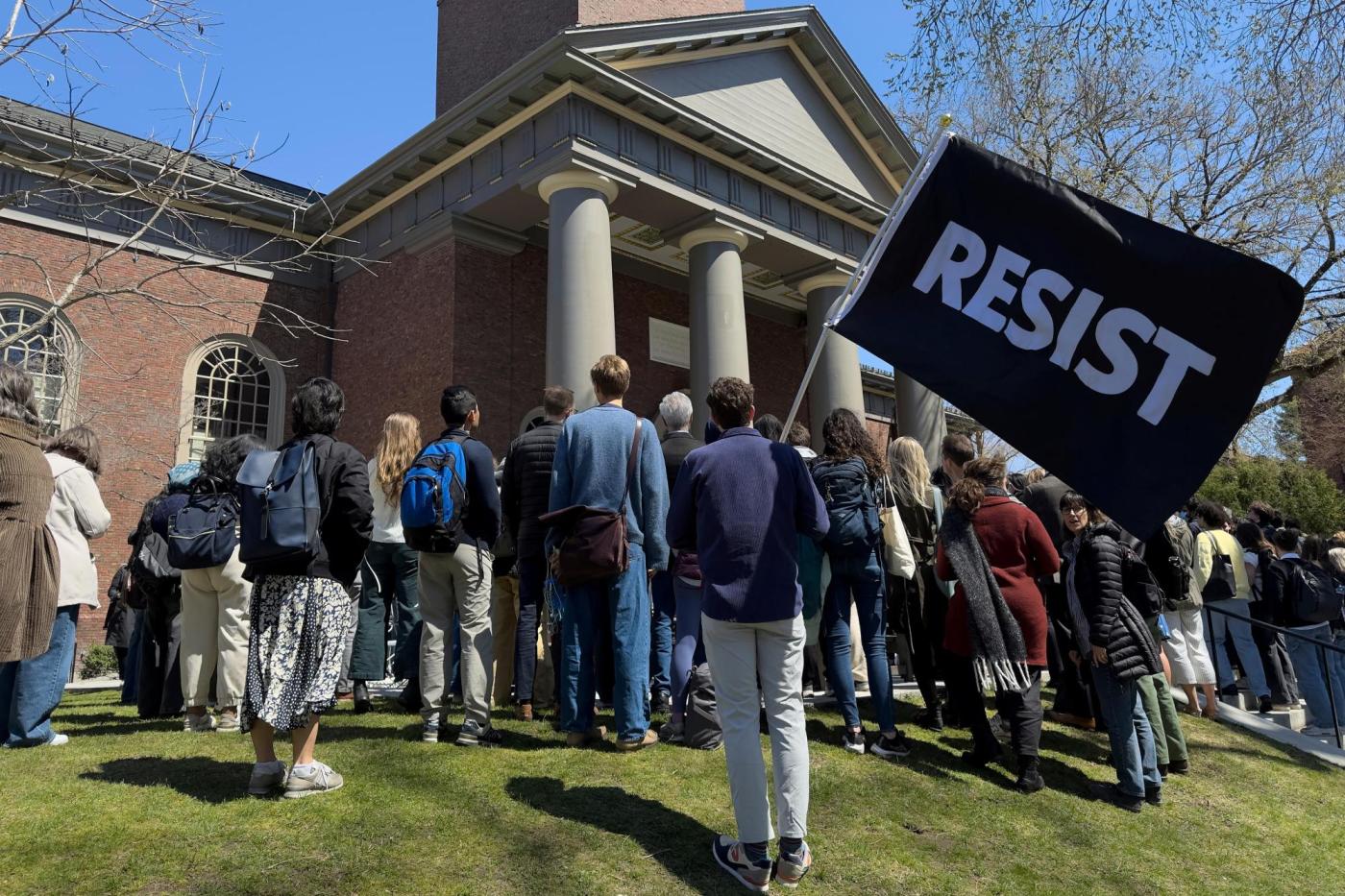
BOSTON (AP) — Harvard University announced Monday that it was suing the Trump administration to halt a freeze on more than $2.2 billion in grants after the institution said it would defy the Trump administration’s demands to limit activism on campus.

Related Articles


Supreme Court appears likely to uphold Obamacare’s preventive care coverage mandate


Student loans in default to be referred to debt collection, Education Department says


Wife of former US Sen. Bob Menendez convicted in bribery scheme


Homeland Security Secretary Kristi Noem’s purse stolen at DC restaurant, officials say


US Supreme Court won’t revive a Minnesota ban on gun-carry permits for young adults

In a letter to Harvard earlier this month, the Trump administration had called for broad government and leadership reforms at the university as well as changes to its admissions policies. It also demanded that the university audit views of diversity on campus, and stop recognizing some student clubs.

Harvard President Alan Garber said the university would not bend to the government’s demands. Hours later, the government froze billions of dollars in federal funding.

“The Government has not — and cannot — identify any rational connection between antisemitism concerns and the medical, scientific, technological, and other research it has frozen that aims to save American lives, foster American success, preserve American security, and maintain America’s position as a global leader in innovation,” the university wrote in its lawsuit.

“Nor has the Government acknowledged the significant consequences that the indefinite freeze of billions of dollars in federal research funding will have on Harvard’s research programs, the beneficiaries of that research, and the national interest in furthering American innovation and progress,” it added.

The Trump administration, in the April 11 letter, told Harvard to impose tougher discipline on protesters and to screen international students for those who are “hostile to the American values.”

It also called for broad leadership reforms at the university, changes to admissions policies and the removal of college recognition for some student clubs. The government also demanded Harvard audit its faculty and student body to ensure wide viewpoints in every department and, if necessary, diversify by admitting additional students and hiring new faculty.

Last Monday, Harvard said it would not comply, citing the First Amendment. The following day, Trump took to his Truth Social platform, questioning whether the university should lose its tax-exempt status “if it keeps pushing political, ideological, and terrorist inspired/supporting ‘Sickness?’”

The Trump administration also threatened to block the university from enrolling international students.

The university frames the government’s demands as a threat not only to the Ivy League school but to the autonomy that the Supreme Court has long granted American universities.

For the Trump administration, Harvard presents the first major hurdle in its attempt to force change at universities that Republicans say have become hotbeds of liberalism and antisemitism.

The conflict is straining the longstanding relationship between the federal government and universities that use federal money to fuel scientific breakthroughs. Long seen as a benefit to the greater good, that money has become an easy source of leverage for the Trump administration.

“Today, we stand for the values that have made American higher education a beacon for the world,” Garber wrote Monday to the Harvard community.

“We stand for the truth that colleges and universities across the country can embrace and honor their legal obligations and best fulfill their essential role in society without improper government intrusion,” he wrote. “That is how we achieve academic excellence, safeguard open inquiry and freedom of speech, and conduct pioneering research—and how we advance the boundless exploration that propels our nation and its people into a better future.”

FTC sues Uber, alleging it signed up Uber One subscribers without their permission

posted in: All news | 0

By DEE-ANN DURBIN

The U.S. Federal Trade Commission filed a lawsuit against Uber on Monday, alleging that it enrolled consumers in its Uber One subscription program without their consent and made it too difficult for them to cancel the service.

Uber One members pay $9.99 per month or $96 per year for a range of services, including fee-free Uber Eats food deliveries and cash back when they take Uber rides.

In its lawsuit, the FTC said multiple customers complained that Uber signed them up for Uber One without their permission or charged them for the service before a free trial period was over. In at least one case, a person was charged $9.99 per month even though they didn’t have an Uber account, the lawsuit said.

The FTC said Uber also made it extremely difficult for subscribers to cancel Uber One. The agency said Uber requires customers to take at least 12 different actions on at least seven screens to cancel the service. Cancellation gets even harder for consumers within 48 hours of their billing date, the FTC said, requiring them to navigate as many as 23 screens and still contact customer service.

“Americans are tired of getting signed up for unwanted subscriptions that seem impossible to cancel,” said FTC Chairman Andrew N. Ferguson, who has led the FTC since January after he was tapped as chairman by President Donald Trump.

In a statement, Uber said it was disappointed that the FTC chose to move forward with the lawsuit. Uber said its sign-up and cancellation process is clear, simple and lawful.

“Uber does not sign up or charge consumers without their consent and cancellations can now be done anytime in-app and take most people 20 seconds or less,” Uber said.

Uber said at one point it did require customers to contact a service representative if they wanted to cancel within 48 hours of a billing period, but that is no longer the case.

The Timberwolves are no longer the underdogs to the Lakers. Is that cause for concern?

posted in: All news | 0

After Minnesota’s resounding Game 1 win on Saturday to claim a 1-0 advantage over the Lakers, Anthony Edwards was asked what the message was to the world after pundits across the globe had widely picked Los Angeles to win the first-round playoff series.

“No message, man,” Edwards said. “They still got the Lakers. Lakers supposed to win. That’s how it’s supposed to go and how it’s supposed to be.”

It’s debatable whether that’s still true. Minnesota has received plenty of praise in the wake of its impressive performance to open the series, and is now the betting favorite on all sportsbooks to topple the Lakers.

But it’s in the best interest of the Timberwolves to believe otherwise. What’s particularly interesting about the Timberwolves is the degree to which they know that to be true.

Wolves guard Mike Conley recently lauded his team’s ability to meet any challenge.

“We’re a team that plays well when we’re looking up, and fight our way and claw our way up a hill,” Conley said. “We understand with our back against the wall, we’re a much more dangerous team in our minds.”

Which is a great trait, as seen in last Saturday’s victory. Minnesota was on its P’s and Q’s in Game 1. The Wolves were as sharp as they’ve been on all season on both ends of the floor, particularly over the final three quarters.

That was the team many envisioned pushing the Thunder to win the Western Conference at the season’s outset. It’s why the Wolves were such a frustrating and confusing watch throughout the regular season. Because the team that took the floor over the first five months of the season rarely looked like the one that trounced the Lakers.

When Minnesota believed it was destined for the play-in tournament, it went on a 17-4 tear over its final 21 games to nab a top-six seed. Some of that strong close to the season had to do with Minnesota’s roster — reconfigured just two days before the start of training camp — meshing at the right time. But the urgency with which the team played was also palpable.

Ideally, of course, the team could deliver that same brand of basketball regardless.

“Sometimes when we get too much love and attention, we get a little bit soft and lazy,” Wolves coach Chris Finch said in the hours ahead of Game 1.

There’s a lot of evidence behind that assertion. Even just this season, the schedule brought Minnesota to California immediately after the Wolves used a thrilling fourth-quarter rally to down Oklahoma City in overtime. The next day, Finch and numerous Wolves players made in-person appearances on national programs.

And then proceeded to drop their next two games.

“We are our biggest opponent. We get a little complacent. When people start saying we’re good, and when the odds are with us, that’s when we’re not as good,” Wolves center Rudy Gobert noted at the end of March. “It happened last year in the playoffs. The odds had us losing every series. As soon as the odds had us winning (against Dallas in the West Finals), we didn’t.”

That was prevalent at a more granular level within the Western Conference semifinals. Minnesota was not picked by many to down the defending champs in Denver, but then the Wolves took Game 1. Gobert’s absence in Game 2 made Minnesota a heavy underdog again, and the Wolves ran roughshod over the Nuggets.

Heading back to Minnesota armed with a 2-0 series lead, a sweep felt almost inevitable. But Minnesota’s tenacity dipped noticeably and the Wolves dropped the next three games. The urgency returned in Game 6 for another dominant win and, finally, Minnesota put the Nuggets away in Game 7 — but only after and indifferent first-half performance that left the Wolves trailing by 20 in the third quarter.

After that second-half performance in Denver, Wolves assistant coach Micah Nori noted, “Fear is a hell of a motivator.”

“Fear of your season being over,” Nori said. “Fear of just not performing and going out the way that you would want to.”

That fear, that urgency, was all present in Minnesota’s performance Saturday in Los Angeles.

“I know we wanted it more,” Naz Reid said after the game. “That’s kind of how it has to be, especially when you’re the underdog.”

Minnesota is one of the best underdogs in basketball. It’s .500 record this season when playing as an underdog (10-10), per Sportsbook odds, was only bested by Oklahoma City, which was 2-1. Minnesota also had the second-best performance against the Vegas spread this season when playing as an underdog, behind only Cleveland.

The Wolves do not like to be discounted, but they play their best when they are.

“I think we have a lot of guys in this locker room that have been underdogs their whole life,” Gobert said. “It’s a position that we embrace, and I think we embrace it individually and collectively.”

The challenge for this group is to maintain that same mindset even when things are going well. The Wolves certainly don’t need to win Game 2 on Tuesday (in which they are still an underdog), but can they play as though they do?

Because while Minnesota ultimately won the Denver series a year ago, there’s a strong case to be made that the mid-series slump — which forced Minnesota to play seven grueling, energy-sapping games — ultimately cost the Wolves an NBA Finals appearance.

That’s not a mistake you want to make twice.

“Experience is real. It’s a real thing — especially when you can kind of keep it within a same eight or nine guys who go through it together,” Conley said. “You immediately remember things. You immediately remember Luka destroying us last season and what happened in the conference championship. You immediately remember Milwaukee a week ago when we lost a game up 24. … Those things pop in your mind and you immediately try to be like, ‘What do we got to do different?’ Right now, it’s one game, and move onto the next one.”

“It’s on us to fix our own odds,” Gobert said. “We’ve been through it for the last few years, so by now we know that it’s just about us.”

Related Articles


Timberwolves Playoffs: Reserves again ignite team’s best play


The Timberwolves had one of best shooting performances of the season Saturday. How will the Lakers react in Game 2?


Pack of rabid Timberwolves harass Lakers en route to Game 1 rout


Timberwolves playoffs: From contracts to reputation, what’s at stake


5 things the Timberwolves must do to upset the Lakers, plus a prediction

NCAA passes series of rules that sets table for schools to pay players directly

posted in: All news | 0

By EDDIE PELLS, Associated Press

The NCAA passed rules Monday that would upend decades of precedent by allowing colleges to pay their athletes per terms of a multibillion-dollar lawsuit settlement expected to go into effect this summer.

Related Articles


Women’s basketball: Gophers add 6-2 post through portal


Sports world mourns soccer-loving Pope Francis with games in Italy and Argentina postponed


Where are Gophers projected to go in NFL Draft?


Gophers football: Running back Jaydon Wright to enter transfer portal


More of same in postseason: Wild drop Game 1 in Vegas

The nine proposals passed by the NCAA board were largely expected but still mark a defining day in the history of college sports. An athlete’s ability to be paid directly by his or her university is on track to be enshrined in a rulebook that has forbidden that kind of relationship for decades.

For the NCAA rules to officially go into effect, the changes prescribed by the House settlement still have to be granted final approval by a federal judge, whose hearing earlier this month led to questions about potential tweaks before the new guidelines are supposed to go into play on July 1.

The changes will eliminate around 150 rules and alter many others in the NCAA’s sprawling rulebook. They essentially codify measures set up by the settlement, including:

Modifying bylaws to allow schools to pay the athletes directly.
Eliminating scholarship limits for teams, while also setting roster limits that are designed to replace the scholarship caps. Some details of the roster limits, which were a key sticking point in the April 7 hearing, will be finalized later.
Establishing annual reporting requirements for schools that pay athletes; a payment pool is set to be approximately $20.5 million for the biggest schools beginning next academic year.
Setting up a clearinghouse for all name, image and likeness (NIL) deals that come from third parties and are worth $600 or more.
Granting authority to an enforcement body being developed by the conferences named as defendants in the lawsuit to enforce the new rules passed to implement terms of the settlement. This includes compliance with roster limits, payment of direct benefits to players and meeting requirements for the third-party deals.