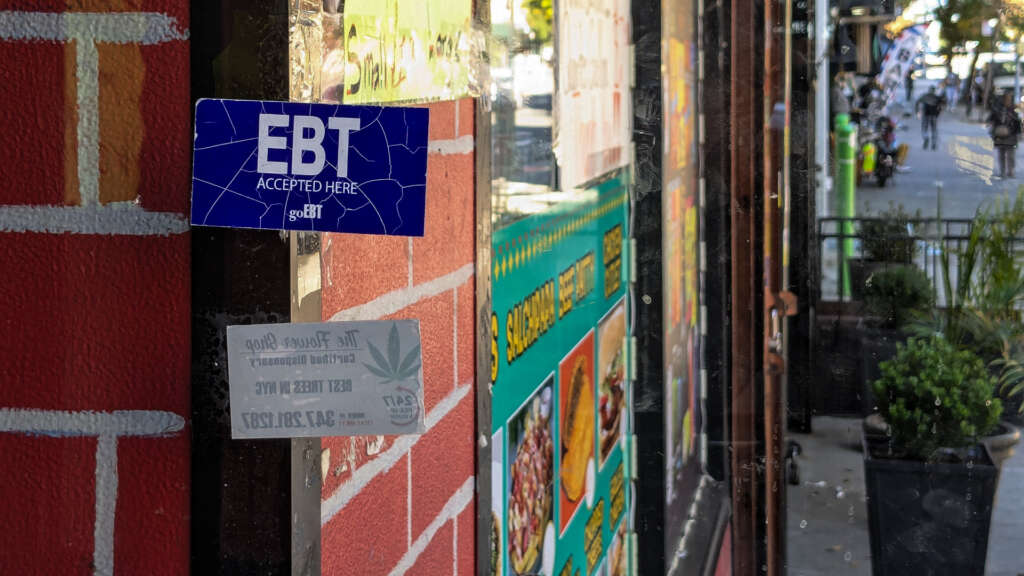
The lawsuit was filed on behalf of several New Yorkers who had their EBT accounts drained through skimming—a type of electronic fraud in which card data is stolen.
A storefront on East Gun Hill Road in the Bronx, Saturday, Oct. 4, 2025. (Adi Talwar/City Limits)
One morning in January, Crystal Carrero went to her usual grocery store in Crown Heights. But when she went to pay, the cashier told her there was no money on her Electronic Benefit Transfer (EBT) card.
“It was impossible,” she remembered saying, because she hadn’t used any of the funds, and she had recently checked the balance: $923, her monthly benefits from the federal Supplemental Nutrition Assistance Program (SNAP), which helps low-income households afford groceries.
Carrero, 38, was still stunned when she got back to her apartment and checked her account. In six different transactions early in the morning, her SNAP benefits were drained. The money she used to feed her two kids and support her granddaughter was gone.
Her EBT card had been “skimmed”—a type of electronic fraud in which card data is stolen. Thousands of New Yorkers have been victims of it in recent years, with no recourse to recover what was lost. The federal government no longer refunds stolen benefits after the legislation that authorized those reimbursements ended in 2024.
Despite an uptick in EBT card skimming across the country in recent years, the U.S. Department of Agriculture (USDA), which oversees SNAP regulations, only reimburses physical card thefts, not skimming fraud. In 2023, a group of New Yorkers who had their SNAP benefits stolen through electronic skimming filed a class action lawsuit against the USDA.
A federal judge dismissed the case in August, but the two organizations representing New Yorkers affected by the EBT card data theft, Legal Aid Society and Freshfields—a global law firm—filed an appeal on Monday.
At the heart of the case is whether rules that were created when paper SNAP coupons were still being issued apply to new forms of electronic benefit theft, and how the protections stipulated by Congress when it made the transition from paper to cards apply in this new era. Under the paper regime, USDA would only replace benefits that were stolen in the mail, before they were received.
“But if you had the coupons in your pocket and you were on your way to the store and they got stolen, those would not be replaced,” explained Ed Josephson, a supervising attorney at Legal Aid. “The theory was that at least you know if they’re in your pocket, you have some control over your coupons, and you can take care with them, but you obviously have no control when they’re in the mail.”
Today, skimming lets scammers access a compromised account remotely, even as soon as the account receives funds. The lawsuit argues that this modern scam is similar to mail theft, because the benefits are stored in a government account and are stolen before the recipient can exercise control over them.
The plaintiffs also say that the USDA’s EBT regulation doesn’t follow the law’s “similar rights” requirement from the paper era. When Congress changed SNAP from paper coupons to EBT cards decades ago, it said recipients should maintain the same rights and that the rules for getting money back should be “similar” to the rules for paper coupons.
“So what we’re arguing is that what Congress intended was that no group of SNAP recipients would lose out as a result of the transition from paper to EBT,” Josephson said. “And what USDA has done is they’ve excluded this huge category of people, which is the people who lose benefits before they have them, before they receive them.”
The USDA didn’t respond to a request for comment.
Josephson also said that the agency’s current refund policy is too narrow and ignores skimming altogether. One of the goals of the lawsuit, he explained, is for USDA to update or put out a new rule that properly accounts for skimming-type losses.
Congress previously passed a bill that allowed for some reimbursement for skimming losses occurring between Oct. 1, 2022, and December 2024. But it’s since expired.
Josephson said it will take several more months for their case to play out. In the meantime, many people continue to fall victim to skimming, and must rely on food pantries to make ends meet to make up the difference, including Carrero.
In the absence of federal changes, some states have stepped in to implement the use of modern chip cards, which are more secure. Last month, Gov. Kathy Hochul announced the long-awaited upgrade of New York’s EBT cards to a chip-based technology, something advocates have long pressed for.
The state’s Office of Temporary and Disability Assistance (OTDA), which administers SNAP in New York, put out a request for proposals last year for a new EBT card vendor to carry out the switch. The agency did not provide a timeline or estimated costs for the change, but said the governor wants to implement it as quickly as possible, with more information expected soon.
“As federally funded nutrition programs like SNAP are under attack in Washington, Governor Hochul has been laser-focused on protecting the dollars that New Yorkers depend on and ensuring they can access resources necessary to uplift them and their families,” an OTDA spokesperson said in a statement.
OTDA urges EBT users to be aware of skimming fraud when using their cards, change PINs often, check store terminals for loose keypads or card readers, freeze the card when it’s not in use and block out-of-state transactions through the app (available in Apple App Store and Google Play Store) or the ebtEDGE website.
To reach the reporter behind this story, contact Daniel@citylimits.org. To reach the editor, contact Jeanmarie@citylimits.org
Want to republish this story? Find City Limits’ reprint policy here.
The post Legal Groups Appeal in Push for Feds to Replace Stolen SNAP Benefits appeared first on City Limits.