Apple Valley park’s $16M renovation to feature inclusive playground, new pool

posted in: All news | 0

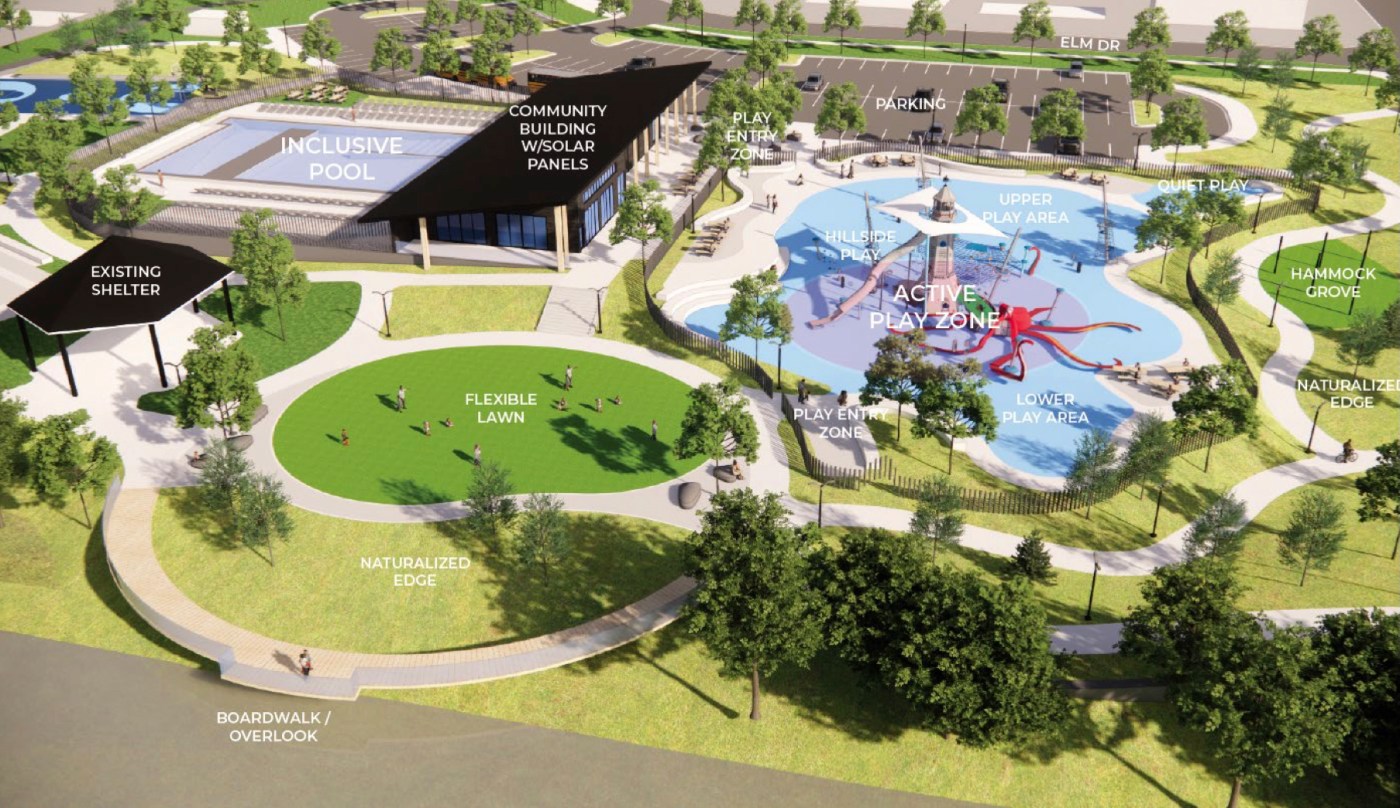
A courtesy rendering of the newly imagined Redwood Park in Apple Valley, which will include an inclusive playground area, pickleball courts, a basketball court, as well as a new community pool and pool house with community meeting spaces, and other amenities. The park and pool will be fenced off for the entire year, with the goal of reopening in spring 2026. (Courtesy of Confluence and the City of Apple Valley)

Lisa Hiebert says the first question at her first parks committee meeting in 2019 was about inclusive play: “Could we someday build an adaptive playground in Apple Valley for kids of all abilities and needs?” they were asked.

That concept is moving toward reality this summer, as construction work transforming Apple Valley’s Redwood Park is underway, a nearly $16 million investment that includes a new inclusive playground area, pickleball courts, basketball court, pool and pool house with community meeting spaces and other amenities.

The park and pool will be fenced off for the entire year, with the goal of reopening in spring 2026.

Funding for the work comes from a voter-approved citywide parks referendum in 2023, a two-question ballot measure that asked residents to issue more than $73 million in bonds to fund updates to Apple Valley’s parks, recreation facilities and trails. The second question asked voters specifically to approve $6.5 million in bonds to replace the Redwood Community Pool.

The state of Minnesota also appropriated $1.4 million in state bonding funds specifically to use for the inclusive playground.

The Redwood Park renovations are maybe the most visible of the efforts, but renovations are planned at more than 40 neighborhood parks over the next few years.

Hiebert, who served on the Apple Valley Parks and Recreation Advisory Committee before becoming a city council member this year, said one word comes to mind when asked to describe all of the park renovations already underway across town: “Exciting.”

“This really is a transformational parks bond referendum,” she said.

The city has already finished minor renovations to the newly branded Splash Valley Water Park, formerly known as Apple Valley Family Aquatic Center. Work is also underway to retool the fields at the Hayes Youth Athletic Complex.

Community input

The inclusive playground area at Redwood Park will be the first such playground in Apple Valley.

While older playgrounds with sand or wood-chip surfaces are prohibitive for those using a wheelchair or a walker, the planned adaptive playground will have a rubberized bottom that removes that barrier. Playground equipment such as swings and ramps also are designed for people living with disabilities.

The desire for the playground emerged during some 40 community outreach meetings that city staff held in developing a master plan for the park.

During those meetings, Apple Valley Parks and Recreation Director Eric Carlson said it became clear what residents wanted, and didn’t want, to include in the eventual referendum plans.

He echoed Hiebert’s thoughts.

“These improvements are going to be exciting. Everyone can come and gather, no matter what their abilities are,” Carlson said. “They are going to be comprehensive, and they are necessary, based on the age of the infrastructure.”

A rendering of the future pool house at Redwood Park in Apple Valley. The new pool and pool shelter will include areas with different depths, allowing for lessons at different swimming levels, and also a diving board and climbing wall. (Courtesy of JLG Architects and the City of Apple Valley)

The Redwood pool complex was built about 60 years ago. Some of the first buildings in what later would become Apple Valley were built on that same site – aerial images from 1953 show farm buildings surrounded by farmland and prairie.

Apple Valley Mayor Clint Hooppaw said many longtime residents at community meetings talked about their positive memories at the Redwood pool, which was a quieter, different environment than the Splash Valley Water Park across town.

“That to me was a sign that residents wanted to see the next generation have those experiences. It was not about what they want, but about what is good for the whole community,” Hooppaw said.

Apple Valley bases its swimming lesson programming at the Redwood Pool, and the new pool will include areas with different depths, allowing for lessons at different swimming levels.

Pedestrian crossing

Related Articles


Charges: Hastings man put gun to woman’s head and pulled the trigger, but no bullet fired


Eagan native Eva Erickson talks about competing on ‘Survivor,’ revealing autism


Acme Tools opens Eagan storefront, its first new Minnesota location in 20 years


In 17th year, Rick’s Bike Sale surpasses $600K in donations for Dakota County nonprofits


Pioneer Press 2025 patio guide: Spots to see and be seen

The city’s master plan for Redwood Park also includes a pedestrian tunnel under County Road 42.

The tunnel is not part of the Apple Valley parks referendum work, but would be part of eventual road improvements by Dakota County. That work with Dakota County Transportation staff continues, and community meetings are being held this summer. The pedestrian underpass is currently part of county design proposals.

The tentative project schedule for renovating County Road 42 involves finalizing the engineering and design through 2026 and beginning construction in 2027, according to Dakota County.

U of M researchers are planting ‘survivor’ trees in hopes of defeating Dutch elm disease

posted in: All news | 0

The 36 trees planted last week at Boutwells Landing senior living community in Oak Park Heights have a big job: To help revitalize the state’s elm population.

The American elm trees, each about 2 years old and 4 to 6 feet tall, were cloned by University of Minnesota researchers to be resistant to Dutch elm disease, a fungal disease that killed millions of elm trees around the world.

In the late 1970s, there were 1.3 million American elms with diameters greater than 21 inches in Minnesota. Dutch elm disease killed 95 percent of them, leaving behind fewer than 60,000 big elms, according to U researchers.

Ryan Murphy and Ben Held, co-investigators on the U’s disease-resistant elm selection and reintroduction program, want to revive the population. On May 16, they got some help from Boutwells Landing residents David Lime, 84, and Neal Kingsley, 87, both U.S. Forest Service veterans, who participated in the three-hour planting project.

Soon after Lime moved to Boutwells Landing three years ago, he pitched the idea of starting a nursery in the southeast corner of the 100-acre property to help offset the loss of ash trees from emerald ash borer.

Boutwells Landing officials expressed interest, and Lime, who worked for 20 years in the Forest Service’s experiment station on the St. Paul campus and later taught at the U’s College of Forestry, started looking for places giving away trees and people who were researching trees “where we could invite them to plant some trees on our property,” he said.

Lime connected with Kingsley, and the two met with Rob Venette, director of the Minnesota Invasive Terrestrial Plants and Pests Center at the U of M and research biologist with the U.S. Forest Service Northern Research Station. He connected them with Murphy and Held.

“It was just one of those things where they had space, and we were looking for places, and it just was the right connection,” Murphy said.

Hardy elms survived

Dutch elm disease is caused by a fungus that can be spread by a bark beetle or through two trees that have interconnected roots. Beetles reared in infected trees emerge from the diseased wood carrying spores, which they then deposit into healthy trees by feeding on the young twigs. The fungus triggers reactions that block the tree’s vascular system, which prevents it from getting water and nutrients normally, and it becomes wilted, leading to rapid death, Murphy said.

Fortunately, Dutch elm disease didn’t kill every elm tree in the state. Some very hardy “survivor” elms were left behind.

“Oftentimes, they’re the only elm tree left in an area where everything else has died,” Murphy said.

Said Venette: “It’s just a matter of a random mutation that happens to occur in these trees. In general, the species as a whole is highly susceptible, but it’s just these very lucky individual (trees) that have natural resistance.”

Researchers are using the “survivor” elms from around the state – identified by forestry officials, arborists and private landowners – to grow Dutch elm disease-resistant trees.

Here’s how it works: Researchers visit the “survivor” elm in the wintertime and take the branch tips and then grow a tree genetically identical to that elm. “You take that tissue from that twig, and you graft it onto a rootstock,” said Murphy, who also manages the U of M’s Urban Forestry Outreach & Research Lab, which provides education about trees to communities around the state.

Related Articles


Urban fires can mean long trips for helicopters to get water. One firefighter had a better idea


Trump signs executive orders to boost nuclear power, speed up approvals


Louisiana stifles community air monitoring with threat of million-dollar fines, federal lawsuit says


Trees killed by caterpillar outbreak helped to fuel Minnesota wildfires


NOAA predicts ‘above average’ number of storms in hurricane season starting June 1

The cloned trees are then planted back in the landscape either at the St. Paul campus or at the Minnesota Landscape Arboretum in Chanhassen “to confirm that they really are resistant, and that they weren’t just lucky and got missed by the bark beetles,” Venette said.

Once the tree is propagated, it can take five to seven years to get to a size where it can be inoculated with the pathogen, Murphy said.

“We then drill a hole into the main stem of the tree, inject the tree with concentrated spores of the fungus which causes the disease, and wait to see its effect,” he said. “To find one resistant cultivar, it could easily take 10 years.”

If the tree survives inoculation with the fungus, researchers will then propagate more of them and plant those at different test sites around the state “because we have more evidence to suggest that they are truly resistant,” he said.

Multiple sites

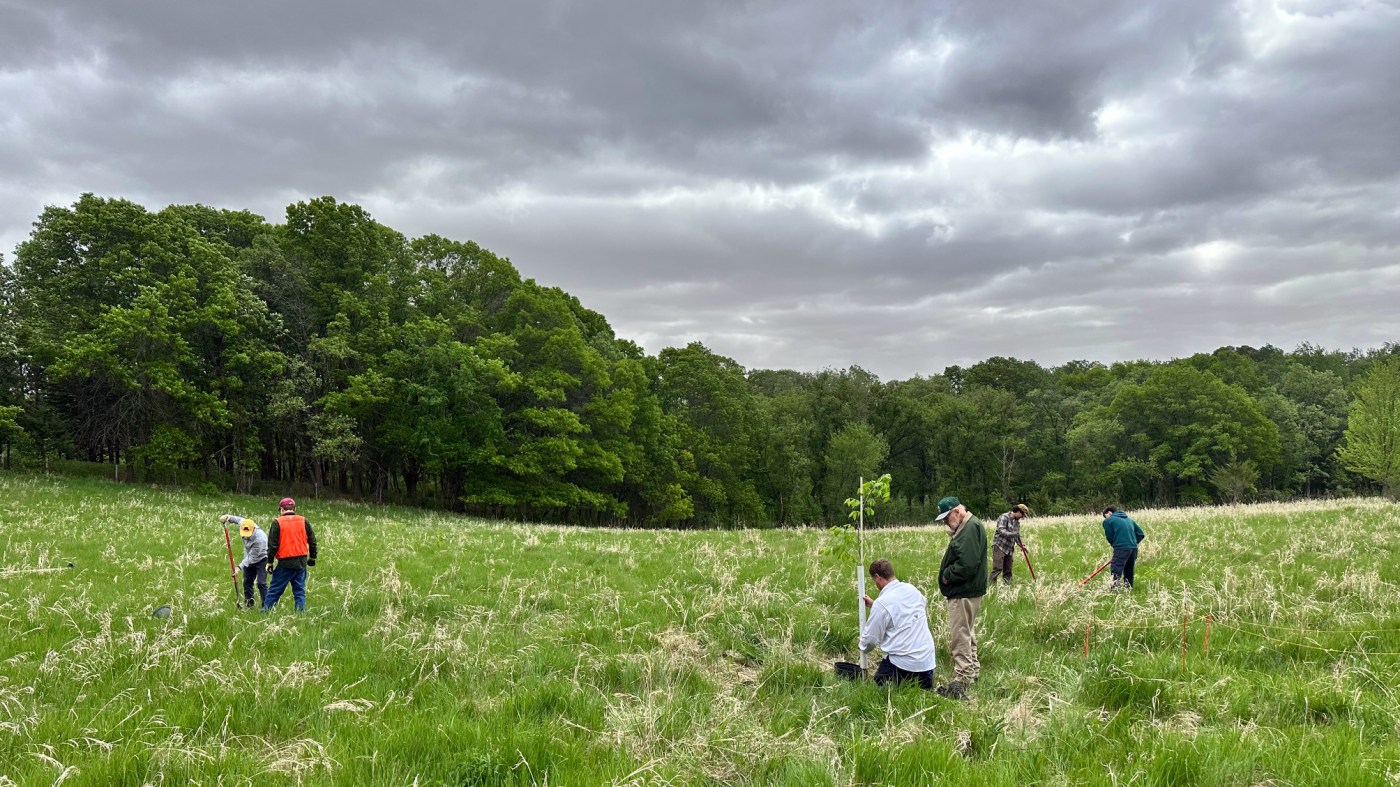
Robert Venette, from left, Ben Held, Ryan Murphy, Kyle Rue, Johannes Dufault and Neal Kingsley gather to plant elm trees in a field at Boutwells Landing senior living community in Oak Park Heights on Friday, May 16, 2025. (Courtesy of Boutwells Landing)

The resistant elms are being planted at Boutwells Landing, Nerstrand Big Woods State Park, Elm Creek Park Reserve and in the Minnesota River Valley.

Researchers plan yearly follow-up visits to assess the tree performance; the trees are expected to grow several feet each year, Murphy said.

Fifteen more trees will be planted in a forested area at Boutwells Landing that was impacted by emerald ash borer, an invasive beetle that attacks and kills ash trees. Ash trees were planted in many urban forests in Minnesota to replace elm trees decimated by Dutch elm disease, Venette said.

“It’s all part of growing a more diversified urban forest,” he said. “We’ve nearly come full circle.”

The research project at Boutwells Landing is expected to last somewhere between five and 10 years “because we really are trying to understand how well these trees get established and what factors might be affecting their survival and growth,” Venette said.

The $226,000 research project, funded by the Minnesota Invasive Terrestrial Plants and Pests Center, started in January 2024. An earlier U of M research project on developing Dutch-elm resistant trees received $234,000 in funding from the center and was completed in 2023. The center was formed in 2014 to coordinate the U’s research into invasive insects and land-based plants. It is funded by the state’s Environment and Natural Resources Trust Fund as recommended by the Legislative-Citizen Commission on Minnesota Resources. The center, which has four employees, has an annual budget of $330,000.

Engaging people in science

Officials were thrilled when Murphy and Held proposed the project, said Heather Koop, the Invasive Terrestrial Plants and Pests Center’s associate program director.

“When we can get a piece of research to that point of implementation, that’s the gold standard for us … that’s how we really like to measure our success,” she said. “So often we see research that is done that never really gets to that next stage. Because this is all publicly funded, we feel very strongly that this research needs to be in the public realm, and people need to understand it and how to use it. Hopefully, they’ll apply it, and hopefully, we’ll see better management options available for different invasive species.”

Another plus: The project “engages people in science,” she said. “You have these folks who are super-eager to help us out, and that just makes me really happy.”

In addition to having a few retired foresters, Boutwells Landing has “a very rich community of folks who are interested in science,” Venette said. “They reached out and asked about opportunities to engage in collaborative work related to trees, and we just happen to have this project that was a nice fit.”

Researchers worked with teens from the Green Crew, the youth program of the Izaak Walton League’s Minnesota Valley chapter, to plant trees in Bloomington on Earth Day 2023, so it was fitting to work with seniors on the Boutwells Landing project, Venette said. “It really shows the breadth of interest in this kind of work,” he said.

Related Articles


Woodbury: East Ridge teacher on leave following report of racial slur


Inmate rights groups demand say in Stillwater prison closure plan


Pioneer Press 2025 patio guide: Wring every second out of summer at these 100+ Twin Cities spots


Pioneer Press 2025 patio guide: Along the water and scenic spots


Truck driver tells trooper he was distracted by map before Washington County fatal crash

Lime, who walks or drives past the new trees at least once a day, said the project is giving staff and residents at Boutwells Landing a chance “to learn about the role of science in helping solve serious natural-resource problems” and how they can help bring American elm trees back to the Minnesota and Upper Midwest landscape, he said.

“The idea is that if we can re-establish them in Minnesota, maybe we can do it in other states,” Kingsley said. “Bringing them back would be great because they were beautiful.”

Although Kingsley knows he may not be around to see whether the experiment was a success, he said he is happy to have played a part.

“My grandfather built fishing schooners, and I remember as a kid growing up seeing a ship that my grandfather helped build,” he said. “It was nice. Maybe my grandkids or great-grandkids will say, ‘See that tree? Bamp helped plant that.’ That would be kind of nice.”

Working Strategies: Breaking the no-experience-no-job cycle

posted in: All news | 0

Amy Lindgren

We’ve all heard the lament: Jobs go to those with experience but you can’t get experience without a job.

But is it true? While the first half of the complaint is largely accurate – jobs do more frequently go to those with experience – the second part can be misleading. It’s not the related job that’s required, but applicable ability.

Try this version instead: Jobs go to those with experience and you can get experience by doing related tasks.

The difference between the two concepts is foundational. In the first, you have the image of a Mobius strip, or perhaps a snake swallowing its tail. That is, a circle without end. But in the second concept, you’re invited to imagine what tasks are relevant to the work you seek and then conduct those tasks to build needed experience.

Let’s break that down for someone wishing to break into a new field – perhaps a new graduate or a career-changer or a caretaker re-entering the workforce. You’ll need some steps to analyze the problem before solving it:

1. Choose a job target. We’ll use nonprofit communications for this example.

2. Research to learn (and list) the typical duties. Here’s what came from a recent batch of job postings for the duties of a nonprofit communications person: Strong writing ability; newsletter and web content; social media posting/monitoring; website management; writing/editing press releases; building external relationships for the organization; grant writing; creating training materials; etc.

Most jobs wouldn’t demand all of these duties, but the variety gives you a sense of what the job primarily consists of. Not surprisingly, that would be communications.

3. Match your own skills and experience to the list. Put a mark next to the duties you’ve conducted before, whether that was in a job, for a class, as a volunteer, or just on your own.

You’ll need to prove your ability for these areas, so now’s the time to gather up the evidence. Perhaps you’ve written newsletter articles for your house of worship, or build relationships between your student club and college administration. Put everything into computer files on your desktop or file folders on your actual desk, easily accessible when it’s time to write your résumé.

4. Look for the gaps between the job duties and your own background. The second time through the list of duties, you’ll be using a different symbol or color to mark the communications job tasks you haven’t done before. These are areas where you need to gain experience and build skills.

So those are the problem-analysis steps. What if you discover a complete lack of skills or related experience for the job you desire? That’s when you’ll need a bridge that takes you from zero to the minimum needed by the average employer. For most people, that bridge would be some kind of hands-on, immersive experience such as an internship, certificate program, volunteer gig or part-time job.

On the other hand, your analysis could reveal that you have some good experience but not in all the areas. In that case, you’ll need a plan to fill the gaps. For example, suppose one gap is a lack of website management – how can you develop this ability? You probably have an idea already, but some of the possibilities include taking a class, using tutorials to build/maintain a site for a small nonprofit or startup, asking a friend to teach you, or requesting to cross-train on this function if you’re working in a job now.

Time for a recap. So far, you’ve chosen a target job, analyzed the job’s usual duties and the skills needed to do them, reviewed your own skills and experiences, identified the things you can do/have done before, and identified the things you can’t do, while making a partial plan for learning to do them.

Not too shabby, as my dad used to say. Now here’s the baseline question: How badly do you want to break into this field? Assuming it’s at least a 50-50 in terms of your interest, you’re ready for the home stretch. It’s time to build a résumé touting the skills you do have while starting on the plan for getting the other skills. In both categories, remember the power of examples. You’ll be more convincing if you create online and print portfolios to share with prospective employers during your interviews.

Come back next week for more ideas to break the no-experience-no-job cycle.

Amy Lindgren owns a career consulting firm in St. Paul. She can be reached at alindgren@prototypecareerservice.com.

Joe Soucheray: George Floyd Square is an embarrassment to the man it’s supposed to honor

posted in: All news | 0

Events memorializing the May 25, 2020, death of George Floyd include, this weekend, concerts, prayer services, moments of silence, art displays, a dance and candlelight vigils. Of at least a dozen events on this Memorial Day weekend of solicitude and celebration, at least six are to be held at George Floyd Square, at 38th Street and Chicago Avenue in Minneapolis.

In fact, on the night itself, May 25, there will be a gospel concert followed by a candlelight vigil at George Floyd Square.

It’s been five years, five long years, certainly an acceptable duration of public grief. And yet one thing has been forgotten, one crucial element forgotten over the five long years of institutionalizing the memory of Floyd.

A can of paint.

Not a single example of aesthetic pleasantry has come to that intersection. The adult political children and professional activists who run Minneapolis have burned through millions of taxpayer dollars on planning. Planning what? You haven’t accomplished anything. Neighbors have been heard — “leave us alone” — and then ignored. Barricades come and go. Graffiti is the common language, as is a malignant idleness so thick in the air you could cut it with a knife. What businesses remain have apparently just run out of options, and they hang on, tired and careworn.

In the early days, the square was run like a protection racket by self-appointed kingpins. Say the magic word and you could get past the sawhorse gate. But it was merely an entrance to a dystopian nightmare of disfunction. Police were eyed with contempt. Rules for the corrupt ghost town were made up on the spot and changed just as quickly. There was no order and no apparent goals.

Evidenced by the lack of paint.

If Floyd was to be truly respected, there would be paint. There would have been scrubbing and polishing and power washing until the concrete sparkled. If the memory of the man is supposed to point to a worldwide revolution in policing, you would think that such a milestone might be marked by more than litter and gutters full of dirty rain water.

George Floyd Square is an embarrassment, to Floyd, to the residents near it and to the citizens of the Twin Cities who expect more and continue to get less.

First of all, it isn’t a square. Why not make it one? Thus, the paint. Five long years of city council committees and hearings and listening sessions and political activists walking around with their iPads and their latest pedestrian mall brainstorm. And then all you got was something from a song, another day longer and deeper in debt.

The original sin happened five years ago when the city was alight with rioting and destruction. The mayor and his like-minded ideologues from the governor on down let a police precinct burn and stores get looted. They had trouble reaching for the phone to call the National Guard. They certainly weren’t intending to demand that rioters behave. After all, we were told those were peaceful protests.

The powers that be had neither the courage nor the intelligence to put a stop to the Wild West shenanigans at 38th and Chicago. They just let it go and it’s still going, going, gone.

A square suggests sidewalk tables and shade trees. A respite, a place of quietude and reflection, usually found in the middle pockets of sprawling cities.

But not here. Here we have the stain of ineptitude and malfeasance passed off as some sort of virtue.

None of the ideologues are capable of embarrassment or shame. And that leaves the man they hide behind memorialized by nothing more than litter and dirty rain water in the gutter.

Joe Soucheray can be reached at jsoucheray@pioneerpress.com. Soucheray’s “Garage Logic” podcast can be heard at garagelogic.com.

Related Articles


Letters: What’s your plan, Democrats? It’s so much safer to just criticize


Kendall Qualls: Here’s why I’m running for governor of Minnesota


Matt Ehling: This open-meeting law change is a problem. Undo it, legislators


Real World Economics: Tax bill full of perverse incentives


Skywatch: Virgo the Virgin, a large but faint constellation