Kent Nerburn cradles in his palm a small turtle carved from clay quarried at Pipestone, a place in southwestern Minnesota sacred to American Indian people. This little guy plays an important role in “Lone Dog Road,” the story of two Lakota boys on the run in Nerburn’s first novel after writing 15 nonfiction books.
“To the Lakota the sacred is in everything. It comes with their way of understanding the world,” he says. “The turtle represents patience, a vision of longevity.”
Patience and longevity are qualities of the wise and witty old great-grandfather in “Lone Dog Road,” which continues Nerburn’s efforts to honor Native people, striving to bridge the gap between Natives and the dominant white culture. His most popular books make up the trilogy that won two Minnesota Book Awards: “Neither Wolf Nor Dog” (made into a film), “The Wolf at Twilight” and “The Girl Who Sang to the Buffalo.”
“My novel is a relative to ‘Neither Wolf Nor Dog,’ but more expansive in its voices,” Nerburn says. “It’s the capstone to the trilogy. The characters are different but the themes and heartbeat and inner and outer landscapes are much the same. I put everything I know into this book.”
(Courtesy of New World Library)
As he talks about writing and his early career as a sculptor, Nerburn settles into a chair in the University Grove home he shares with his wife, Louise Mengelkoch, a retired Bemidji State University journalism professor. He had just returned from North Dakota where he was cultural liaison for staff of Smiles Network International who were doing dental work at the Standing Rock Sioux reservation.
Nerburn, 78, writes about Lakota and Ojibwe people but he claims no Native blood. His writing comes from traveling the “pow wow highway” with Indian elders, participating in a sweat lodge, teaching Indian youngsters, immersing himself in the people’s lives as a respectful outsider.
“I am a guest in their world,” he says of his Indian friends. “I loved introducing non-Natives to Natives, who see spirituality as fundamental to human experience.”
That spirituality is deep in “Lone Dog Road,” set in the summer of 1950 on the high plains of South Dakota. Part coming-of-age story, part fast-paced road adventure, the novel’s main characters are brothers Levi, 11, Reuben Long Dog, 6. When a man comes to the reservation to forcibly take Reuben to the government school where Indian children are stripped of their culture, the boys’ strong, fierce mother tells them to run. Before they leave, their beloved great-grandfather’s ceremonial pipe is broken and given a dignified burial because it cannot be used again. The boys journey some 400 miles to Pipestone to get clay they use to fashion a new pipe for Grandpa that has a small turtle on its shaft. An image of the turtle is also on the first pages of the book’s sections.
As the brothers travel they are helped by Natives and non-Natives, including a wandering white man caught in the American cowboy myth who’s missing his dead dog, a cheerful Black entertainer who joins his beautiful voice to Reuben’s, a Lakota woman and her white ex-seminarian husband grieving the death of their child, a mixed-blood man who has lost his culture. On the reservation lives an elderly Dakota woman in a wheelchair who advises the boys, knows the old ways and maybe has a little magic in her.
“My books tend to speak from the heart. I try to touch people,” Nerburn says. “With this one I wrote the book I wanted to write; a book about good people, each struggling. Every character embodies someone I knew or admired. I love my characters. If I love them the reader can love them too.”
Nerburn’s writing has been praised by Louise Erdrich, Pulitzer Prize-winner and a member of the Turtle Mountain Band of Chippewa Indians; Anton Treuer, professor of Ojibwe at Bemidji State University; and the late Ojibwe civic leader Roger Jourdain.
William Kent Krueger, white author of the Cork O’Connor mystery series featuring a protagonist who is Irish and Ojibwe, is an admirer of Nerburn’s writing. He will be onstage with Nerburn when “Lone Dog Road” is launched Thursday at the University Club of St. Paul.
“Kent opened the door for many of us writing about a culture not his own,” Krueger says. “I so appreciated his nonfiction, which captured so well from a white guy’s perspective the beauty of the Dakota culture. And in ‘Lone Dog Road’ he does a spectacular job of writing in multiple voices.”
It’s no surprise Nerburn’s novel is permeated with spirituality. He’s proud of being described as a “guerrilla theologian” who found emotions in wood before he turned to writing.
A Minnesota kid becomes a sculptor
“I’ve always tried to be a watcher. It’s what I do in my books,” Nerburn says, looking back on growing up “in a tiny cracker-box bungalow outside of Minneapolis.”
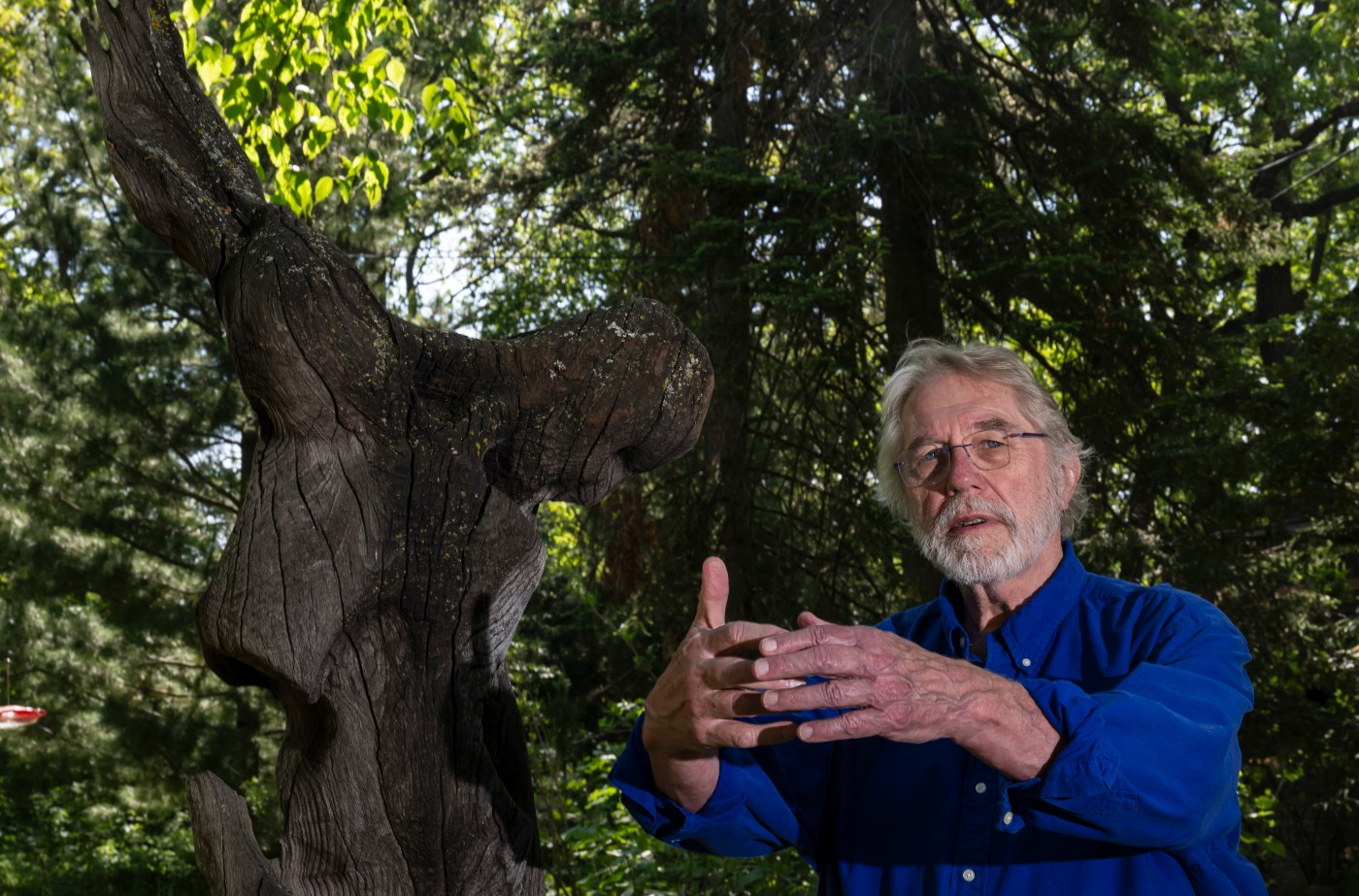
Author Kent Nerburn talks about his career in his St. Paul home on Wednesday, May 14, 2025. (John Autey / Pioneer Press)
His attention to what was happening around him was learned when his father, director of disaster relief for the Red Cross Midwest region, would sometimes get him out of bed in the middle of the night to race to an emergency that might be a four-alarm fire on the North Side or a drowning.
“Seeing disasters and crises in other people’s lives made my life pale in comparison,” he says about staying on the sidelines while the Red Cross team offered support services. Later in life, these experiences gave him the ability to stand aside and let others talk, a valuable attribute for a writer.
After graduating from the University of Minnesota, Nerburn attended graduate school at Stanford University in California. He was interested in studying religion but was not happy about the way it was taught at Stanford. So he traveled to Marburg, Germany, to learn the language. Visiting beautiful churches and museums in the old city, Nerburn was mesmerized by the woodworking of farmers and peasants.
“The carvings had been so filled with heart, so honest in their spiritual learning, I, who was in graduate school for the study of religion… had found in them a spiritual presence I experienced nowhere else,” Nerburn writes in his 2018 book “Dancing With the Gods,” made up of essays on life in the arts.
Securing a job at an antique-restoration shop, Nerburn cut into a piece of maple for the first time: “I dug into that wood with no understanding of what I was doing. I only knew that something was alive and waiting to be released from inside the block of wood on the bench before me.”
Returning to Minnesota, Nerburn studied with the late Kostas Papadakis, world-renowned artistic woodcarver. In 1980 he graduated with a doctorate in religion and art from Graduate Theological Union and the University of California, Berkeley.
Nerburn’s larger-than-life wood sculptures are in a monastery in British Columbia and the Hiroshima Peace Museum in Japan. His only work in bronze is the figure of St. Francis commissioned by the Hennepin County Humane Society for their headquarters in Golden Valley.
To the reservation and beyond
Nerburn met his future wife when they worked on The Northsider, an award-winning Minneapolis community newspaper. After their marriage in 1989, Louise got a job at a newspaper in Bemidji and Kent went with her. Living in a house on a lake, the couple raised their son, Nicholas, and Mengelkoch’s children: Stephanie, Alexandra and Creighton Penn.
During those years Nerburn also founded and directed Project Preserve, an oral history project on the Red Lake Ojibwe reservation. He and his students published oral histories “To Walk the Red Road” and “We Choose to Remember.”
After co-writing “Native American Wisdom” with Mengelkoch, Nerburn’s first solo book was Letters to My Son: A Father’s Wisdom on Manhood, Life, and Love” (1993). That was followed by others inspired by his Indian friends, including “The Wisdom of the Native Americans,” “Chief Joseph and the Flight of the Nez Pierce,” “Voices in the Stones,” and the Wolf/Dog trilogy.
After Louise retired in 2011, the couple relocated to Oregon, hungry for different experiences. “I envisioned us sitting in our robes, watching daytime TV,” Nerburn says with a laugh. “But I could never find my footing there, or my heart.”
The boy in the chair
Last year Nerburn and his wife moved back to Minnesota to be near family, but they were still living in Oregon when the pandemic hit, and Kent recalled a picture he’d seen 25 years ago of a little Indian boy sitting in a rocking chair. He didn’t know the child’s name, or where the old photo came from. He only knew the boy haunted him and was one of the inspirations for “Lone Dog Road.”
“Finally, the boy could no longer be denied,” Nerburn recalled in a social media post. “His face said what I had been trying to say in words for almost three decades. He was innocence stolen, promise denied, confusion and defiance in the face of a world he did not make and could not understand.”
“Lone Dog Road” took a three-year journey to publication and Nerburn is clear-eyed about why publishers were wary of this book: “Old white guy. No history as a novelist. A 400-plus-page book. No social media presence other than a faithful but small following on Facebook. Writing in voices of people whose experience it’s assumed I cannot possibly understand… Ending up in the rejection pile of any publisher that keeps an eye on the bottom line. And that’s all of them.”
Happily, Nerburn’s best friend from Hopkins High School, Marc Allen, loved the novel and published it through his New World Library. Allen, who has published the majority of Nerburn’s books, recalls that young Kent first sculpted a life-sized Indian head at the Allen family’s cabin in Deerwood.
“I always knew Kent could write because of the way he talked,” Allen recalled in a conversation from his home near San Francisco. “We’d be walking along when we were 12, 13, and he’d say something so fresh and beautiful.”
During the years Allen published Nerburn’s books, he watched his friend’s nonfiction gradually take more fictional form. So he wasn’t surprised when he got the manuscript for “Lone Dog Road.”
“To make money in publishing these days you need a good backlist and an occasional bestseller to keep going. Kent has both,” Allen said. “And, he has a great soul.”
Summing it up
The afternoon grows more cloudy as Nerburn poses for a picture with one of his sculptures in his side yard. When he’s asked about writing, he says he followed the counsel of an Indian elder: “Always teach by stories, because stories lodge deep in the heart.”
If you go
Nerburn will launch “Lone Dog Road ” with a free program at 7 p.m. Thursday at the University Club, 420 Summit Ave., St. Paul, presented by SubText Bookstore. He will be at Comma Bookshop, 4250 Upton Ave. N., Mpls. at 6:30 p.m. June 9, and at Stillwater Public Library on June 21.
Related Articles
12 new books to send restless readers on a summer road trip
Literary calendar for week of May 18: ‘Weird, Sad and Silent’
Readers and writers: Selections for Mental Health Awareness Month
Kids author Mo Willems and The Pigeon stare down the future in a new book
Like it or not, the Like button has changed the world