Macalester alum sues college over animal testing in psychology labs

posted in: All news | 0

A lawsuit accuses Macalester College of violating state consumer fraud laws “by advertising itself as a model of compliance” with ethical animal research guidelines, while killing small animals in “outdated” psychology courses.

The civil complaint was filed Tuesday in Hennepin County District Court by Dr. Neal Barnard, a 1975 Macalester psychology graduate and medical doctor who founded the Washington D.C.-based Physicians Committee for Responsible Medicine, a nonprofit group that advocates for alternatives to animal testing.

Barnard, while preparing to celebrate his 50th college reunion, discovered the school “continues to kill large numbers of animals every year in mechanical devices designed more than 100 years ago,” the nonprofit group says in a Tuesday news release.

A billboard campaign against its practices is also planned for St. Paul. A spokesman for the group said one will go up this week near Snelling and Selby avenues that reads, “Macalester Psychology Education: Outdated, unethical” and shows a rat in a Skinner box. A second one is planned for next week three blocks south.

Macalester has not immediately responded to a request for comment Tuesday.

Macalester psychology courses use small metal “Skinner boxes,” invented by psychologist B.F. Skinner in the 1920s, to force the animals deprived of food or water for long periods to perform a variety of acts to get the food or water they need to survive, the complaint says. Afterward, the animals are killed.

“As a psychology major in 1972, I participated in those old-fashioned exercises,” Barnard says in the release. “At the end of each laboratory series, the animals were tossed into a trash can, chloroform was poured over them, and the lid was closed.”

Investigating behavior and brain function have evolved dramatically since then and teaching methods, including computer models and hands-on classroom exercises with human participants, have largely replaced the use of animals in psychology education, the complaint says.

“On information and belief, Macalester continues to use and kill small, vulnerable animals in psychology laboratory exercises whose objectives can easily be met without animals,” the complaint states.

The lawsuit alleges one count each of fraudulent misrepresentation, false statement in advertisement and unlawful practices. It seeks, among other actions, an order compelling Macalester “to cease its use of animal laboratories in psychology instruction and in all other areas for which non-animal methods are available.”

Meetings went nowhere

According to the complaint, Macalester reached out to Barnard and other Class of 1975 graduates two years ago about a 50th college reunion, asking for donations for activities and whether they were interested in planning them.

Barnard went to Macalester’s website on 50th reunions, then found the school’s page on research policies and procedures. It lists the college’s Institutional Animal Care and Use Committee, which “acts to review and ensure that animal welfare standards and ethical principles are applied at the highest possible level in any animal use or research conducted at or in association with the college.”

The webpage, which includes two links for charitable donations to Macalester and one for prospective students to apply to the college, says the committee derives its authority from the law, mandated by the Health Research Extension Act of 1985 and the Animal Welfare Act.

Barnard contacted Macalester psychology department chair Jaine Strauss to request an in-person meeting to find out whether the school uses live animals and “Skinner boxes” in its psychology courses.

Barnard, who lives in Maryland, met Strauss in Minnesota in May 2024. In response to Barnard’s questions, Strauss confirmed the department continues its Skinner-inspired animal laboratories as part of the introductory psychology course and other courses, the complaint alleges.

Related Articles


Mahtomedi school board adds second referendum question to fall ballot


Astronaut one day, artist the next: How to help children explore the world of careers


Chinese student struck a chord emphasizing humanity during Harvard commencement speech


FACT FOCUS: Trump’s claims about remedial math at Harvard don’t add up


Trump’s education secretary threatens to pull funding from NY over its Native American mascot ban

Barnard “shared his view” to Strauss that the “Three Rs” prohibit such activities. The complaint says accepted ethical principles regarding the use of animals in science, called the “Three Rs” — for replacement, reduction and refinement — have been incorporated into regulations that implement the federal Animal Welfare Act, as well as the Guide for the Care and Use of Laboratory Animals, adherence to which is mandatory for activities covered by the federal Health Research Extension Act.

Strauss told Barnard that Macalester’s IACUC, which oversees all scientific uses of animals by the college, is “very careful” in its work, the complaint says.

Barnard sent a follow-up email to Strauss that month outlining his concerns, expecting she would take them to the committee “and, in compliance with the Three Rs, replace the use of animals with other methods of study,” the complaint says.

Barnard, believing the college was open to reform, then accepted an invitation to join Macalester’s Class of 1975 Planning Committee and serve on its Gift Subcommittee. In his role from July 30 through Nov. 1, Barnard made phone calls, sent emails and mailed postal letters to fellow Macalester alumni assigned to him by Macalester’s fundraising staff to solicit charitable donations.

Meanwhile, Barnard did not receive any email or written response from Strauss as to any decision regarding replacing the use of animals as required by the Three Rs, the complaint says.

Barnard met with Macalester president Suzanne Rivera and Macalester vice provost Paul Overvoorde on Nov. 6 to discuss his concerns. The next day Barnard and Rivera spoke briefly in person, with Rivera stating she had forwarded his concerns to appropriate people. Later that same day, Barnard participated in person in another gift subcommittee meeting and afterward donated $100 to the school.

Rivera emailed Barnard on Dec. 2, instructing him to direct all future communications on animal use matters to Macalester’s legal counsel.

Barnard relied on Macalester’s “false statements” in joining the school’s Class of 1975 Planning Committee, as well as its Gift Subcommittee, and donating to the school.

The publication of Barnard’s name on Macalester’s website, “while (the school) refuses to apply the Three Rs ethical principles to its animal use program, harms the reputation of “Barnard), who has worked for decades to end the use of animals in such settings,” the complaint continues.

According to the Physicians Committee for Responsible Medicine, Barnard previously worked on a child psychiatry ward at Fairview Hospital in Minneapolis; completed medical school and psychiatry residency at the George Washington University in Washington D.C.; presided over an outpatient psychiatric clinic at the George Washington University; and maintained a private practice in psychiatry, among other achievements.

‘Major victories’

The group, which Barnard founded in 1985 and has 17,000 doctor members, boasts online of its “major victories” over the past two decades, including all medical schools in the U.S. and Canada stopping the use of live animals to train medical students, and the National Institutes of Health stopping its experiments on chimpanzees.

Related Articles


David French: Why Trump is mad at ‘sleasebag’ Leonard Leo


St. Paul man sentenced to workhouse for throwing fatal ‘sucker punch’ outside East Side bar


Charges to be dismissed in St. Paul sexual assault case


Toxicology result brings second charge in Wisconsin crash that killed restaurant owner David Burley


Derrick Thompson’s trial begins in deaths of 5 women

In 2019, the group filed a complaint with the U.S. Department of Agriculture against Mayo Clinic alleging it was violating the federal Animal Welfare Act by using pigs in once-a-year emergency medical training. Mayo Clinic later confirmed that it had changed its policy.

Earlier that year, Hennepin Healthcare ended the use of live animals for teaching emergency medicine residents, according to the nonprofit. Previously, Hennepin Healthcare used up to 150 sheep and 150 rabbits each year to teach invasive procedures like drilling a hole into an animal’s skull and opening the chest cavity to access the heart.

Last month, the U.S. Food and Drug Administration announced it was phasing out animal testing in the development of monoclonal antibody therapies and other drugs with “more effective, human-relevant methods.”


The Trump administration is pushing therapy for transgender youth. What does that look like?

posted in: All news | 0

Since President Donald Trump returned to office in January, federal policy has shifted to promote psychological therapy as the only treatment for transgender youth in distress.

A report issued last month by the Trump administration’s Department of Health and Human Services on care for transgender and nonbinary people analyzed 17 studies out of more than 3,400 looking into gender-affirming care — an umbrella term that can include talk therapy, puberty blockers, hormone treatments and surgeries.

They included only analyses of other studies that didn’t include any patients older than 26. Those that examined mental health generally found improvements from gender-affirming care, though with low certainty, because they didn’t include a large enough group, the effects were small, or other factors.

The report had more sweeping conclusions, however, stating that people under 19 with gender dysphoria should receive only psychological therapy, rather than being able to choose puberty blockers or hormone therapy. Gender dysphoria refers to distress when someone’s gender identity and their sex, or the way others see them, don’t match.

Major medical groups, such as the American Academy of Pediatrics, have endorsed offering the full range of affirming care to appropriate patients, and experts interviewed by The Denver Post agreed that while some patients only need therapy, others benefit from gender-affirming medical care.

The new report comes as the administration ordered providers to stop offering puberty blockers and hormone therapy to anyone under 19, threatening to take away federal funding from hospitals that didn’t comply. A federal judge blocked Trump’s executive order while a legal challenge plays out from four states, including Colorado.

The Trump administration also forbade transgender people from serving in the military, threatened federal funding for schools if they promote “gender ideology,” removed references to LGBTQ health disparities from health websites, ordered the Justice Department to take action to stop trans girls from playing on sports teams with cisgender girls, forbade the issuing of passports displaying the gender trans people identify with, and moved inmates who are trans women into men’s prisons.

Dr. Rae Narr, a nonbinary psychologist in Denver, said the administration’s actions targeting transgender people suggest the government is going to push therapy that attempts to change someone’s sexual orientation or gender identity. But, done right, therapy can also be affirming, they said.

“On their face, what they are suggesting is therapy and support for these youth,” Narr said. “When you really look at what they’re suggesting, it’s conversion therapy.”

Conversion therapy, as typically practiced today, looks for a pathological root for someone’s sexual orientation or gender identity, Narr said. For example, the practitioner might argue that another condition, such as autism, caused someone to think that they were transgender, or that they wanted to change their gender because of shame about being gay or a history of sexual trauma, they said.

Mainstream medical groups condemn the practice and Colorado banned conversion therapy for minors, though the law faces a challenge at the Supreme Court.

Affirming therapy, in contrast, starts from the position that no identity is right or wrong, Narr said. The goal isn’t to encourage young people to transition, but to help them sort through what would make them comfortable in their bodies and lives, they said.

That can involve talking about how they imagine their adult lives and practical exercises, such as trying on different clothes, Narr said. They also discuss where the young person would feel physically and emotionally safe exploring. For example, someone might go to the next town over to try out going to a store dressed differently, they said.

“I talk to kids a lot about what does it mean to you when you imagine being a boy, or a girl, or something else,” they said.

‘We listen to them’

In 2024, 46% of transgender or nonbinary young people reported seriously considering suicide, and 14% attempted it, according to the LGBTQ nonprofit The Trevor Project.

Those who reported they’d experienced bullying or physical harm because of their gender identity were more likely to report thoughts of suicide, as were those who said their schools didn’t support them.

But the odds of suicide drop when youth report that people in their lives accept them, such as by calling them by their chosen name and pronouns, Narr said.

Dr. Casey Wolf, a child and adolescent psychiatrist at WellPower in Denver, said the field hasn’t agreed to a protocol for treating gender dysphoria, but does have evidence-based therapies for the depression, anxiety or trauma that typically push people to seek help.

Sometimes, those symptoms stem from gender dysphoria or from mistreatment based on someone’s gender identity, but not always, she said.

“We listen to them. We try to understand what their symptoms are,” Wolf said.

While the public is talking about gender identity more than in the past, Wolf said she hasn’t seen an increase in young people experiencing gender dysphoria. Despite the perception that being transgender is trendy, people don’t take on marginalized identities like they change their hairstyles, she said.

Not all trans people experience gender dysphoria, and not everyone who has gender dysphoria decides to transition, said John Mikovits, an assistant professor of nursing who studies care for LGBTQ people at Moravian University in Pennsylvania. Some people may only need emotional support at some points in their life, but may decide to socially or medically transition later, he said.

What the therapist helps the patient work on may also change, Mikovits said. For example, a person who opts to transition may feel relief from gender dysphoria, but needs to learn skills to cope with increased discrimination, he said.

“The treatment is not about curing someone’s transgender or misaligned identity, it’s about affirming that identity and improving their quality of life,” he said.

‘The most basic and easiest thing to do’

Acting as a liaison between kids and parents can also be part of the job.

Related Articles


Two artists awarded $25K as McKnight Book Artist Fellows


Here are five ways to celebrate Pride month, from Pee-wee Herman to F1rst Wrestling


Most LGBTQ+ adults feel Americans don’t accept transgender people, poll finds


Federal judge strikes down workplace protections for transgender workers


Judge OKs Iowa limits on K-6 gender identity, sexual orientation teaching but not elective programs

Young people often struggle to tell their parents what they’re feeling, so the news they’re questioning their gender can feel like it comes out of nowhere, Narr said. Parents also don’t always do the best job explaining their feelings, so confusion or fear for their child’s future can come off as rejection, they said.

“Even if the parents are supportive, it’s reasonable to have some fear and grief” for the life they imagined for their child, they said.

While discussion about affirming care focuses on puberty blockers, hormones and surgeries, just using the right pronouns for someone can be important affirmation, Mikovits said.

“It’s the most basic and easiest thing to do, to refer to people the way they want to be referred to,” he said.

Everyone wants others to see them the way they see themselves, and if that isn’t happening, it can bring shame and hopelessness, Wolf said. When someone says they aren’t wrong or sick because of how they see themselves, that can bring back some hope that the problem is their environment, and they may be able to change it, she said.

“That’s the beginning,” she said.

What’s in a name? Hurricane season has begun and here are the storm names for 2025

posted in: All news | 0

There are 26 letters in the alphabet but only 21 are set aside each year for potential tropical storm and hurricane names in areas tracked by the National Hurricane Center.

The names for the 2025 Atlantic hurricane season are Andrea, Barry, Chantal, Dexter, Erin, Fernand, Gabrielle, Humberto, Imelda, Jerry, Karen, Lorenzo, Melissa, Nestor, Olga, Pablo, Rebekah, Sebastien, Tanya, Van and Wendy.

There are no names for Q, U, X, Y and Z, and each of the 21 names alternate from female to male. This year starts with a female name and next year will begin with a male name.

If some of this year’s names seem familiar, it’s because each year’s names are decided six years out by an international committee of the World Meteorological Organization. If a storm name isn’t retired after a season it recycles.

This year, for instance, the WMO Hurricane Committee retired Beryl, Helene and Milton from its Atlantic basin name list “because of the death and destruction these storms caused in 2024,” according to a WMO press release. They were replaced by Brianna, Holly and Miguel — but those won’t be used until 2030.

Hurricane Debby, though, which struck Florida’s Big Bend in August, remains on the potential storm names list for 2030. The storm was blamed for 12 deaths but was nowhere near as destructive as Helene or Milton.

So a good chunk of the storm names used in 2019 are getting reused this year. Andrea, for instance, had been used in 2019, 2013 and 2007.

The only new name in 2025 is Dexter, which replaced Dorian, a deadly and destructive Category 5 hurricane that wreaked havoc in the Bahamas in 2019.

If there are more than 21 named storms, WMO initiated a supplemental list first available in 2021 for new storm names. They are Adria, Braylen, Caridad, Deshawn, Emery, Foster, Gemma, Heath, Isla, Jacobus, Kenzie, Lucio, Makayla, Nolan, Orlanda, Pax, Ronin, Sophie, Tayshaun, Viviana and Will.

Before 2021, if there were more than 21 named storms in a year it would take on a letter from the Greek alphabet for its name: Alpha, Beta, Gamma, Delta, Epsilon and so forth.

Only twice has NHC utilized the spillover list. First in 2005 when it used six letters of the Greek alphabet, and again in 2020 when it required nine letters including Zeta, Eta, Theta and Iota. That was deemed potentially confusing and dangerous and thus begat the new augmented naming system.

The NHC began naming storms in 1963.

In addition to 2019’s Dorian and last year’s Beryl, Helene and Milton, the other retired storm names over the last decade are 2022’s Fiona and Ian; 2021’s Ida; 2020’s Laura, Eta and Iota; 2018’s Florence and Michael; 2017’s Harvey, Irma, Maria and Nate; 2016’s Matthew; and Otto and 2015’s Erika and Joaquin.

Other storms that have struck Florida whose names were retired include 2005’s Dennis, Katrina and Wilma; 2004’s Charley, Frances, Ivan and Jeanne; 1995’s Opal; and 1992’s Andrew.

Scientists say a record amount of seaweed hit the Caribbean and nearby areas in May

posted in: All news | 0

By DÁNICA COTO

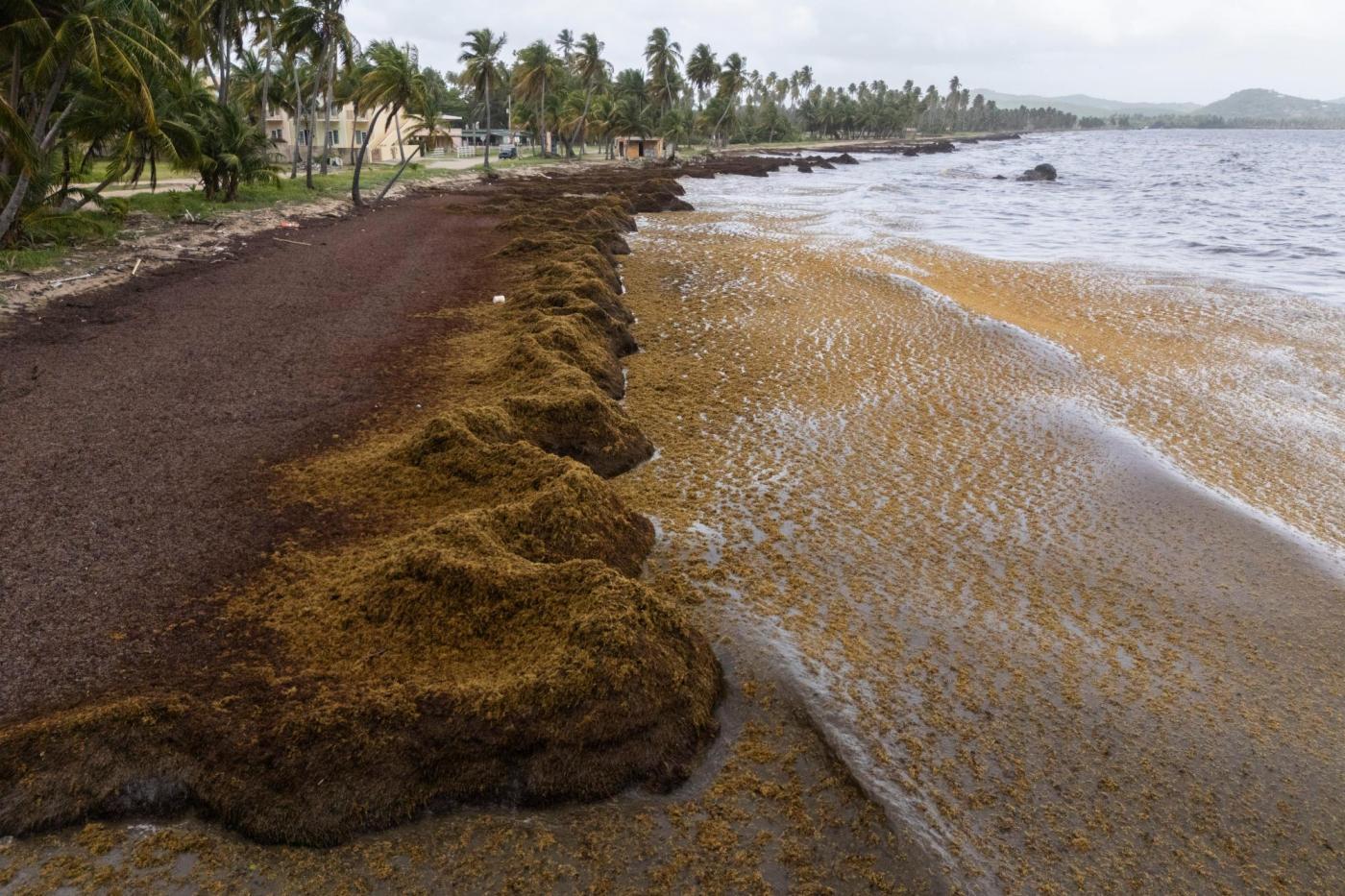
SAN JUAN, Puerto Rico (AP) — A record amount of sargassum piled up across the Caribbean and nearby areas in May, and more is expected this month, according to a new report.

Related Articles


Schwarzenegger tells environmentalists dismayed by Trump to ‘stop whining’ and get to work


Oakdale PFAS project would divert water around former 3M dump


Air quality alert extended for MN as thousands evacuated in Canadian wildfires


The Department of Energy axes $3.7 billion in clean energy project grants


Winds push smoke from Canadian wildfires south into US and worsen air quality

The brown prickly algae is suffocating shorelines from Puerto Rico to Guyana and beyond, disrupting tourism, killing wildlife and even releasing toxic gases that forced one school in the French Caribbean island of Martinique to temporarily close.

The amount — 38 million metric tons — is the biggest quantity of algae observed across the Caribbean Sea, the western and eastern Atlantic and the Gulf of Mexico since scientists began studying the Great Atlantic Sargassum Belt in 2011, said Brian Barnes, an assistant research professor at the University of South Florida who worked on the report published on Monday by the University of South Florida’s Optical Oceanography Lab.

The previous record was set in June 2022, with some 22 million metric tons.

“The peaks just seem to keep getting bigger and bigger year after year,” he said.

But scientists don’t know why yet.

“It’s the million-dollar question,” he said. “I don’t have a supremely satisfying answer.”

Three different types of sargassum exist in the Caribbean and nearby areas, reproducing asexually as they remain afloat thanks to tiny air sacs. They thrive in different ways depending on sunlight, nutrients and water temperature, factors that scientists are currently studying, Barnes said.

Sargassum covers the coast of Playa Lucía, Yabucoa, Puerto Rico, Monday, June 2, 2025. (AP Photo/Alejandro Granadillo)

Experts also have said that agricultural runoff, warming waters and changes in wind, current and rain could have an effect.

While large clumps of algae in the open ocean are what Barnes called a “healthy, happy ecosystem” for creatures ranging from tiny shrimp to endangered sea turtles, sargassum near or on shore can wreak havoc.

It can block sunlight that coral reefs need to survive, and if the algae sinks, it can smother reefs and sea grasses. Once it reaches shore, the creatures living in the algae die or are picked off by birds, Barnes said.

Huge piles of stinky seaweed also are a headache for the Caribbean, where tourism often generates big money for small islands.

“It is a challenge, but it’s certainly not affecting every single inch of the Caribbean,” said Frank Comito, special adviser to the Caribbean Hotel and Tourism Association.

In the popular tourist spot of Punta Cana in the Dominican Republic, officials have invested in barriers to prevent sargassum from reaching the shore, he said.

Sargassum gathers off the coast of Playa Lucía, Yabucoa, Puerto Rico, Monday, June 2, 2025. (AP Photo/Alejandro Granadillo)

In the Dutch Caribbean territory of St. Maarten, crews with backhoes were dispatched in late May as part of an emergency clean-up after residents complained of strong smells of ammonia and hydrogen sulfide, which can affect a person’s respiratory system.

“The smell is quite terrible,” Barnes said.

Meanwhile, in the French Caribbean, officials expect to soon use storage barges and an upgraded special vessel that can collect several tons of seaweed a day.

The sargassum “disfigures our coasts, prevents swimming and makes life impossible for local residents,” French Prime Minister François Bayrou recently told reporters.

But Comito said such vessels are “massively expensive” and not a popular option, noting that another option — using heavy equipment —- is labor-intensive.

“You have to be careful because there could be sea turtle eggs affected,” he said. “It’s not like you can go in there and massively rake and scrape the whole thing.”

A pier sits damaged as sargassum surrounds the coastline of Punta Santiago, Humacao, Puerto Rico, Monday, June 2, 2025. (AP Photo/Alejandro Granadillo)

Some Caribbean islands struggle financially, so most of the cleanup is done by hotels, with some offering guests refunds or a free shuttle to unaffected beaches.

Every year, the amount of sargassum expands in late spring, peaks around summer and starts to decline in the late fall or early winter, Barnes said.

The new record set is hardly stationary — experts said they expect even more sargassum for June.

Follow AP’s coverage of Latin America and the Caribbean at https://apnews.com/hub/latin-america