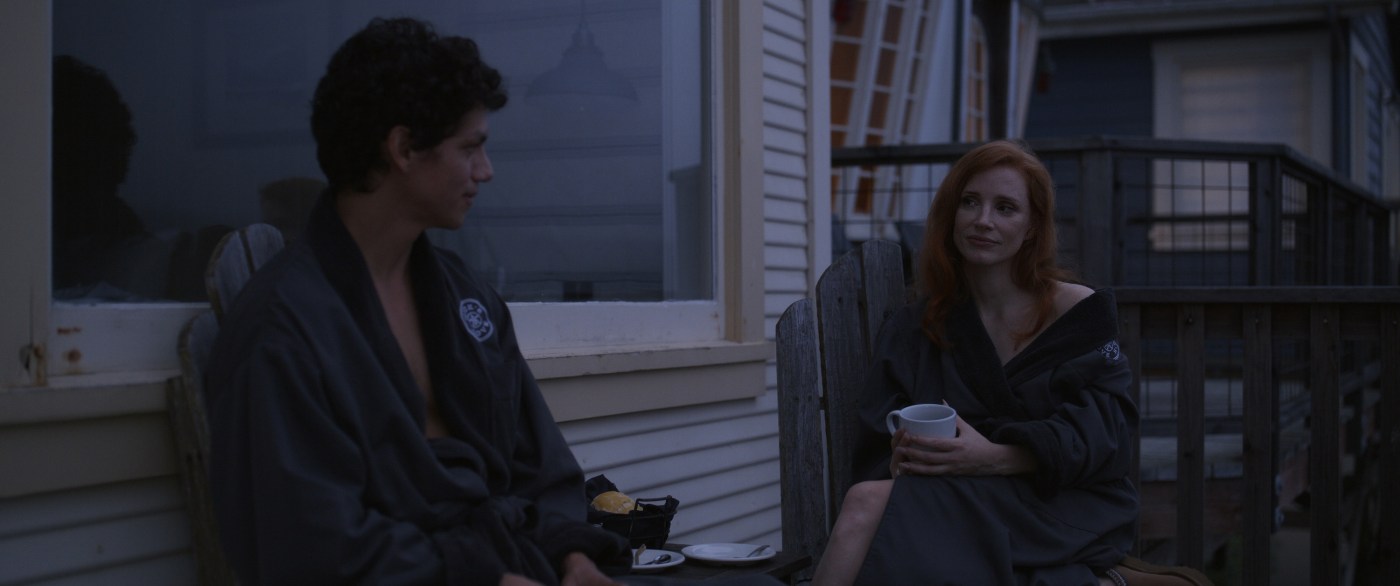
Mexican writer/director Michel Franco explores the dynamics of money, class and the border through the spiky, unsettling erotic drama “Dreams,” starring Jessica Chastain and Isaac Hernández, a Mexican ballet dancer and actor.
In the languidly paced “Dreams,” Franco presents two individuals in love (or lust?) who experiment with wielding the power at their fingertips against their lover, the violence either state or sexual in nature. The film examines the push-pull of attraction and rejection on a scope both intimate and global, finding the uneasy space where the two meet.
Chastain stars as Jennifer McCarthy, a wealthy San Francisco philanthropist and socialite who runs a foundation that supports a ballet school in Mexico City. But Franco does not center her experience, but that of Fernando (Hernández), whom we meet first, escaping from the back of a box truck filled with migrants crossing the U.S./Mexico border, abandoned in San Antonio on a 100-degree day.
His journey is one of extreme survival, but his destination is the lap of luxury, a modernist San Francisco mansion where he makes himself at home, and where he’s clearly been at home before. A talented ballet dancer who has already once been deported, he’s risked everything to be with his lover, Jennifer, though as a high-profile figure who works with her father and brother (Rupert Friend), she’d rather keep her affair with Fernando under wraps. He’s her dirty little secret, but he’s also a human being who refuses to be kept in the shadows.
As Jennifer and Fernando attempt to navigate what it looks like for them to be together, it seems that larger forces will shatter their connection. In reality, the only real danger is each other.
The storytelling logic of “Dreams” is predicated on watching these characters move through space, the way we watch dancers do. Franco offers some fascinating parallels to juxtapose the wildly varying experiences of Fernando and Jennifer — he enters the States in a box truck, almost dying of thirst and heat stroke; she arrives in Mexico on a private plane, but they both enter empty homes alone, melancholy. During a rift in their relationship, Fernando retreats to a motel while working at a bar, drinking red wine out of plastic cups with a friend in his humble room, ignoring Jennifer’s calls, while she eats alone in her darkened dining room, drinking red wine out of crystal.
These comparisons aren’t exactly nuanced, but they are stark, and for most of the film, Franco just asks us to watch them move together, and apart, in a strange, avoidant pas de deux. Often dwarfed by architecture, their distinctive bodies in space are more important than the sparse dialogue that only serves to fill in crucial gaps in storytelling.
Cinematographer Yves Cape captures it all in crisp, saturated images. The lack of musical score (beyond diegetic music in the ballet scenes) contributes to the dry, flat affect and tone, as these characters enact increasing cruelties — both emotional and physical — upon each other as a means of trying to contain their lover, until it escalates into something truly dark and disturbing.
Franco, frankly, loses the plot of “Dreams” in the third act. What is a rather staid drama about the weight of social expectations on a relationship becomes a dramatically unexpected game of vengeance as Jennifer and Fernando grasp at any power they have over the other. She fetishizes him and he returns the favor, violently.
Ultimately, Franco jettisons his characters for the sake of unearned plot twists that leave the viewer feeling only icky. These events aren’t illuminating, and feel instead like a bleak betrayal. The circumstances of the story might be “timely,” but “Dreams” doesn’t help us understand the situation better, leaving us in the dark about what we’re supposed to take away from this story of sex, violence, money and the state. Anything it suggests we already know.
‘Dreams’
(In English and Spanish with English subtitles)
1.5 stars (out of 4)
No MPA rating (some nudity, sex scenes, swearing, sexual violence)
Running time: 1:35
How to watch: In theaters Feb. 27
Related Articles
How social media killed the food festival stars. And created others
Olympics stars Alysa Liu, Ilia Malinin and other Team USA skaters coming to St. Paul in May
Robert Carradine, ‘Revenge of the Nerds’ and ‘Lizzie McGuire’ star, dies at 71
British comedian Russell Brand pleads not guilty to new rape and sexual assault charges
Rob Reiner’s son pleads not guilty to murder in the killing of his parents
Movie review: Ballet-themed erotic drama ‘Dreams’ dissipates in finale
Glenn Whipp: The case for ‘Sinners’ to win best picture
How social media killed the food festival stars. And created others
After about 30 years, Minnesota’s last two D’Amico & Sons restaurants will both close next month
This California spot leads list of worst tourist attractions in the world
Many seeds only require soil and water to sprout. Others, however, have a harder coating that makes germination a bit difficult. That’s because in the wild, they rely on birds and other wildlife that eat them to carry them far distances before dropping them.
It’s a good plan: The journey ensures biodiversity by introducing the species to another location. And the seed’s tough outer coating ensures its survival through an animal’s digestive tract, which erodes only enough of the protective layer to allow water to enter. The remaining coating prevents the seed from waking up too early, which would otherwise spell death for tender sprouts in cold temperatures.
But nature’s survival plan creates a bit of a challenge for home gardeners because the hard coating prevents those seeds from sprouting easily. So it’s up to us to mimic the effects of stomach acid to expose the seed’s inner layer so that moisture can penetrate.
This is called scarification, and there are a few ways to do it, all of which are simple.
Sanding
Rub each seed lightly against medium-grit sandpaper, an emery board or a nail file until you see a hint of its paler inner layer. This method works best with larger seeds, but you can also tuck several small ones between two sheets of sandpaper and gently rub the sheets together. Just a little friction should do the trick.
Nicking
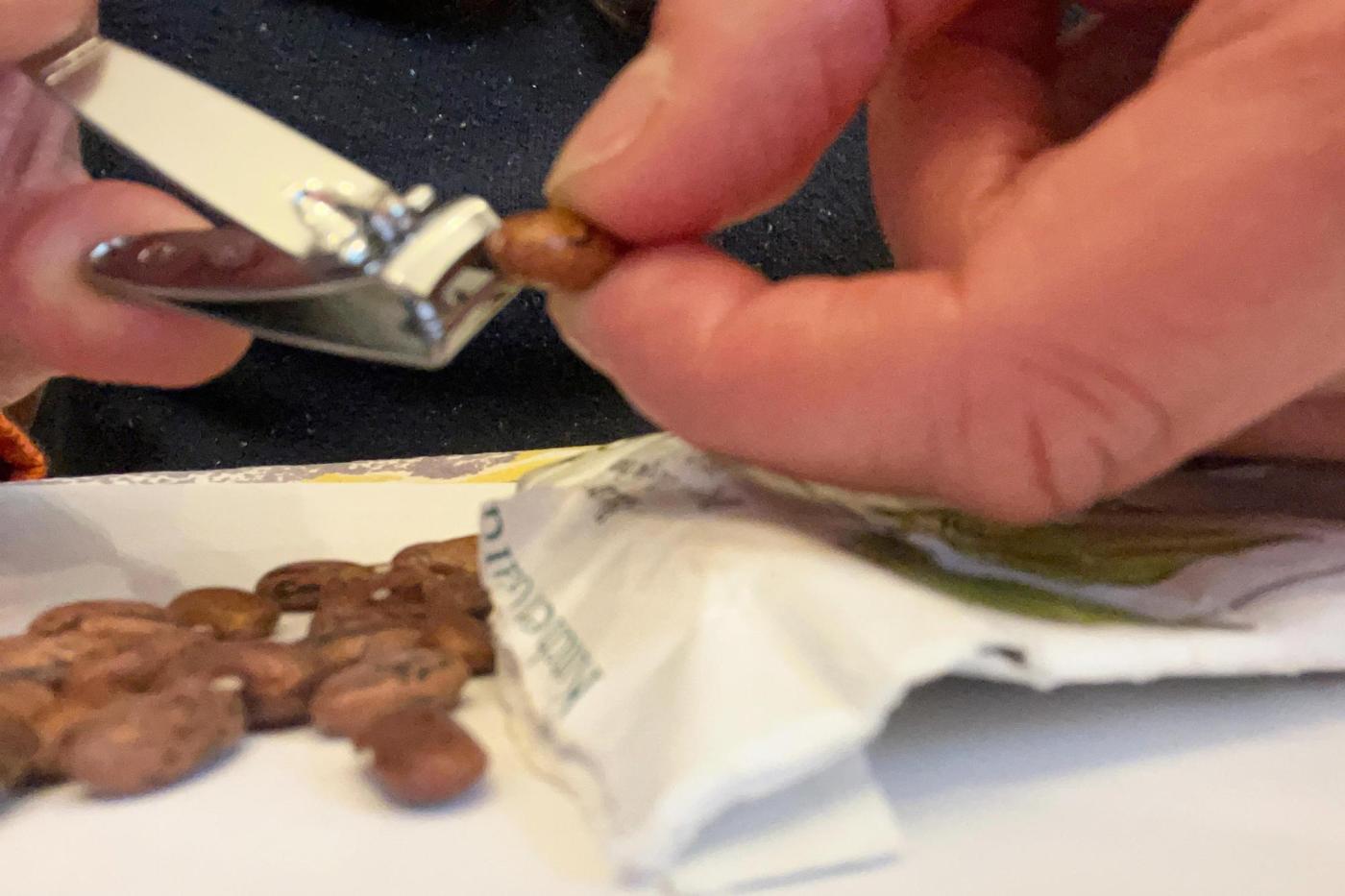
Sometimes I use small nail clippers intended for babies to snip a tiny sliver off the edge of the seed’s coat.
Soaking
If you have more time than wherewithal, this is the easiest method: Place the seeds in a bowl, cover them with warm water, and let them sit for a few hours or overnight. They’ll swell slightly as they take in moisture, which is exactly what you want.
Poppy seeds undergo scarification in a bowl of warm water on Feb. 15, 2025. (Jessica Damiano via AP)
Some tips
Never use hot water; cooked seeds won’t grow. Keep the temperature below 150 degrees Fahrenheit. And whatever method you choose, do it right before planting. Once the seed’s inner tissue is exposed, it will begin to dry out.
Is scarification absolutely required? No. Seeds will often sprout without it, but it could take much longer, and you’ll likely end up with far fewer seedlings. Scarified seeds don’t have to wait around for their coats to break down under soil, which is a real advantage if your growing season is short, your elevation is high or you’re a procrastinator.
A blooming nasturtium plant appears on Long Island, N.Y., on June 2, 2024. (Jessica Damiano via AP)
Edibles to scarify include all bean types, luffa, spinach, strawberry and winter squash.
Some of the really stubborn seeds — chickpeas, lima beans, nasturtiums — respond well to a one-two approach: a little nick or sanding, followed by a soak.
Jessica Damiano writes weekly gardening columns for the AP and publishes the award-winning Weekly Dirt Newsletter. You can sign up here for weekly gardening tips and advice.
LOS ANGELES — To get to the “Sinners” exhibit on the Warner Bros. Studio Tour, you have to navigate past the backlot’s iconic water tower, cross through the New York Street and then skirt city hall and the fountain from the opening credits of “Friends.” Eventually, you wind up at Stage 48, home of the Central Perk Cafe, a gift shop selling all manner of “Friends” bric-a-brac and offering a smattering of knockoff furniture from Monica’s palatial apartment to enjoy.
Comparatively, the newly installed “Sinners” showcase, featuring costumes and a couple of props, is, to use a real estate agent’s euphemism, “cozy,” certainly smaller than Rachel’s closet. On the night of its opening, “Sinners” production designer Hannah Beachler and cinematographer Autumn Durald Arkapaw are inside sitting on a sofa — not the sofa, but close enough. A few hours ago, they were celebrating with their fellow Oscar nominees at the academy’s annual luncheon.
Related Articles
How Elvis Presley roars back to life in Baz Luhrmann’s ‘EPiC’ concert film
Robert Carradine, ‘Revenge of the Nerds’ and ‘Lizzie McGuire’ star, dies at 71
KARE 11 chief meteorologist Belinda Jensen is retiring in May
Netflix releases a posthumous interview with Eric Dane after his death from ALS
Warner Bros reopens takeover talks with Paramount after receiving a waiver from Netflix
“She’s a regular,” Arkapaw says, her arm around Beachler, who won an Oscar in 2019 for her work on “Black Panther.”
The two women and the rest of the “Sinners” team have been hobnobbing with Oscar and guild voters for months now and talking about their work on the film, which was released in April, for even longer. At the time of this “Sinners” event on the Warner Bros. lot, which included yet another screening of the movie for guild members, the Oscars were still more than a month away.
“I can believe it,” Beachler says. Adds Arkapaw: “Me too. I’m stressing about the stuff they’re having us doing. But I think Teyana Taylor said it best: ‘Don’t be complaining about answered prayers.’”
“Sinners” had a lot of prayers answered when Oscar nominations were announced last month — 16, to be precise.
Now the question is whether that record-breaking haul might be enough to catapult Ryan Coogler’s genre-defying American horror story to a best picture Oscar victory.
When it opened in September, Paul Thomas Anderson’s “One Battle After Another” immediately took the pole position in the best picture race, and it remains the front-runner. But all those “Sinners” Oscar nominations do complicate things. Put it this way: When you submit your movie in 16 different categories and hit in each and every one of them, you have a film boasting broad support across a dozen voting branches. That’s significant.
And if you’re a voter and you weren’t necessarily a fan of the film — or had put off watching it because the horror genre gives you pause — the nominations total does something else. It prompts you to take stock. What is everyone else seeing? Maybe you watch “Sinners” again. Maybe you finally clear the deck and press play for the first time. Perhaps you see that it’s just as much a movie of the moment as “One Battle,” what with the unapologetic, overt racism coming from the White House.
So if you’re on the fence and you do reconsider “Sinners,” maybe it’s not a complete reversal. But it might be enough for you to put the movie higher on your ranked ballot when you vote for best picture.
As you may know, the Academy of Motion Picture Arts and Sciences uses a preferential ballot for the best picture category and only the best picture category. When the academy’s 10,136 voting members mark their ballots this year, they cast a single vote in 23 of the 24 Oscar categories. The nominee with the most votes wins.
For best picture, though, members are instructed to rank the 10 nominated movies. The system, in place since the academy expanded the best picture field from five to 10 nominees in 2009, is designed to reflect the wishes of the greatest number of voters. This means that the winner is sometimes not the movie that is most passionately loved but the picture that is most generally liked — or, if you’re a glass-half-empty kind of person, the picture that is least disliked.
The process works like this: Once voting ends, PricewaterhouseCoopers accountants sort the best picture ballots and place them in stacks based on members’ No. 1 votes. They then eliminate the movie with the fewest first-place votes, giving those votes to each ballot’s second-ranked film. The process continues — smallest stacks eliminated, votes redistributed to the next choice down — until one movie has more than 50% of the vote.
The math to “Sinners” winning best picture necessitates it being the No. 1, 2 or 3 choice on more ballots than “One Battle After Another.” And that plays into what a couple of awards consultants told me about the psychological effect the movie’s record-breaking 16 nominations might have on voters when they rank the nominated movies.
“Maybe it’s not your favorite, but you still rank it high because of that overwhelming level of respect,” says one rival campaigner. “Who knows if the math adds up. But at this point in the season, you’re looking for any advantage you can find.”
A test of that math will come Saturday at the Producers Guild Awards, a ceremony that uses the same preferential ballot system to determine its best picture. The PGA winner more often than not repeats at the Oscars, though in the last decade there have been two notable exceptions — “Moonlight” besting PGA winner “La La Land” in 2017 and, three years later, “Parasite” taking the Oscar over “1917.”
Should “Sinners” prevail at the PGA and then the next night go on to win the cast prize at the Actor Awards (formerly known as the Screen Actors Guild Awards), then the race will be dramatically recast. Both ceremonies take place in the middle of the window of final voting for the Oscars, which runs Feb. 26 through March 5.
“It’s a miracle that we were all nominated,” Beachler says. “That’s rare for everyone to get that recognition.”
For a film with a hero named Preacher Boy, one last miracle certainly isn’t out of the question. And if the last few months have taught us anything, it’s that you underestimate “Sinners” at your peril.
MIAMI (AP) — For nearly 10 years running, Lesley VanNess never missed the South Beach Wine & Food Festival, a beachfront bacchanal of celebrities, booze and bites that tens of thousands of attendees pay hundreds to thousands of dollars to join.
It was about access, the chance to nosh and gab with the likes of Rachael Ray and Bobby Flay, people she otherwise could experience only via the hands-in-pans purview of the Food Network.
“I’d get the Food Network Magazine and there would be advertisements for it. I’m like, ‘0h my god! You could go to that? Go to these great events and meet these celebrity chefs?’,” said VanNess, a 44-year-old former restaurant owner from Iowa. “I’m in!”
That was during the food festival heyday, a decade-long stretch starting around 2010 when copycat events popped up everywhere, creating a circuit-like scene for A-list chefs (and ample wannabes).
Then came social media, a force that melted barriers between fans and food celebs. People like VanNess realized that instead of crowding into football field-size tents to chance a chat with Flay, they could just DM him.
Or better yet, they could tune in to online #instafood chatter to perhaps discover the next Ray or Flay, a whole new level of social cred unlocked.
VanNess hasn’t been back to South Beach since at least 2020. “I’d rather see them on social media or go to their restaurant,” she said.
Attendees walk by the Florida International University 25th anniversary tent at the South Beach Wine and Food Festival Saturday, Feb. 21, 2026, in Miami Beach, Fla. (AP Photo/Marta Lavandier)
Bartender Victor Uceda-Vereo prepares cocktails at the South Beach Wine and Food Festival Saturday, Feb. 21, 2026, in Miami Beach, Fla. (AP Photo/Marta Lavandier)
Lee Schrager, founder of the South Beach Wine and Food Festival, is seen at a festival event Friday, Feb. 20, 2026, in Miami Beach, Fla. (AP Photo/Marta Lavandier)
Friends walk the South Beach Wine and Food Festival Saturday, Feb. 21, 2026, in Miami Beach, Fla. (AP Photo/Marta Lavandier)
Chef Ryan O’Sullivan puts the finishing touches to samples of grilled Kvaroy salmon with fennel remoulade at the South Beach Wine and Food Festival Saturday, Feb. 21, 2026, in Miami Beach, Fla. (AP Photo/Marta Lavandier)
Patrick Garcia samples an array of Asian dishes during the South Beach Wine and Food Festival Friday, Feb. 20, 2026, in Miami Beach, Fla. (AP Photo/Marta Lavandier)
Octopus empanadas with sweet pepper tobiko sauce are arranged on a table during the Asian Night Market at the South Beach Wine and Food Festival Friday, Feb. 20, 2026, in Miami Beach, Fla. (AP Photo/Marta Lavandier)
Friends enjoy a band performance during the Burger Bash at the South Beach Wine and Food Festival Friday, Feb. 20, 2026, in Miami Beach, Fla. (AP Photo/Marta Lavandier)
Professional cook Rachel Ray congratulates the staff at Coney Burger during the Burger Bash at the South Beach Wine and Food Festival Friday, Feb. 20, 2026, in Miami Beach, Fla. (AP Photo/Marta Lavandier)
Tori Neville, center, and friends enjoy the food and drinks at the South Beach Wine and Food Festival Friday, Feb. 20, 2026, in Miami Beach, Fla. (AP Photo/Marta Lavandier)
A couple enjoys the Burger Bash at the South Beach Wine and Food Festival Friday, Feb. 20, 2026, in Miami Beach, Fla. (AP Photo/Marta Lavandier)
Chicken tikka is served at the South Beach Wine and Food Festival Friday, Feb. 20, 2026, in Miami Beach, Fla. (AP Photo/Marta Lavandier)
An event participant adds bitters to Alabama oysters during the South Beach Wine and Food Festival Friday, Feb. 20, 2026, in Miami Beach, Fla. (AP Photo/Marta Lavandier)
Friends take a break during the South Beach Wine and Food Festival Saturday, Feb. 21, 2026, in Miami Beach, Fla. (AP Photo/Marta Lavandier)
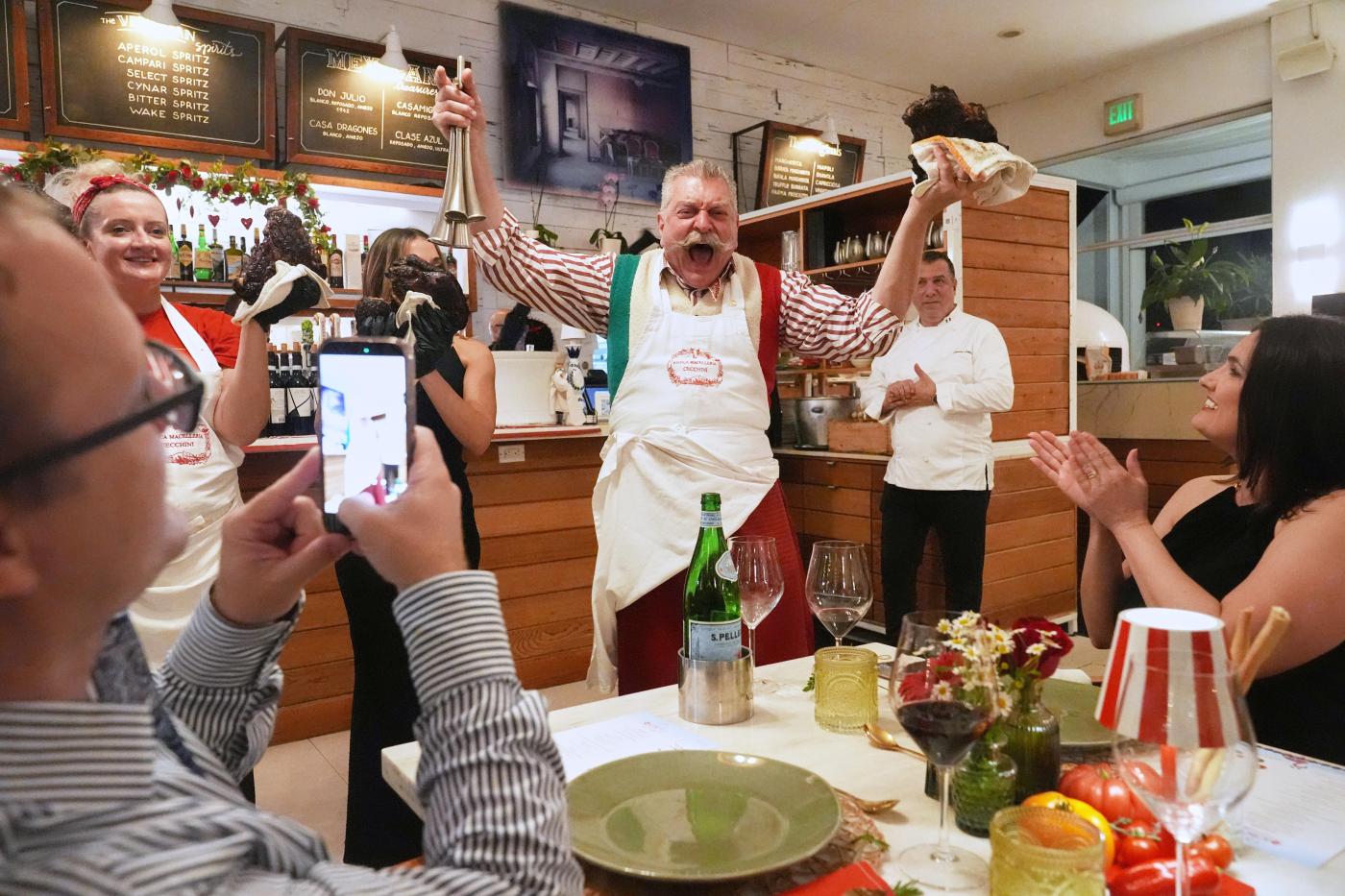
Butcher Dario Ceccini of Italy, welcomes guests to a private dinner at the South Beach Wine and Food Festival Saturday, Feb. 21, 2026, in Miami Beach, Fla. (AP Photo/Marta Lavandier)
1 of 15
Attendees walk by the Florida International University 25th anniversary tent at the South Beach Wine and Food Festival Saturday, Feb. 21, 2026, in Miami Beach, Fla. (AP Photo/Marta Lavandier)
Last weekend, the South Beach Wine & Food Festival turned 25, cementing it as one of the elders of the festival scene, along with its sister event, the New York City Wine & Food Festival, and the Food & Wine Classic in Aspen, Colorado. By all accounts, all three are going strong. But many smaller festivals have disappeared, victims of the pandemic, slumping ticket sales, soaring food and labor costs, and chef disinterest.
So, are food festivals still relevant?
“South Beach and New York, they fill a niche and I can see them going on forever. But food events and food festivals are going in a whole other direction,” said Mike Thelin, one of the founders of the now shuttered Oregon festival Feast Portland.
Festivals’ success long hinged on the need of chefs, wineries, mixologists, food producers, and what only now are known as food influencers to reach a wider audience. In 2026, that’s an antiquated notion.
“In 2010, they wanted to get on the map,” Thelin said. “They don’t need that anymore.”
Seeking that local connection
That doesn’t mean festivals are dead. There’s a recalibration happening, he explained. What many call “white tent affairs,” a not-so-subtle nod to South Beach’s events that stretch along the sands of the Atlantic, are fading.
“If I’m going to a certain region, I want to know what makes that region special,” Thelin said. “I don’t want to go into a giant white tent that’s devoid of geography and drink a bunch of wines from California if I’m in Washington or Tennessee.”
Taking their place? A host of small, hyper-focused events grounded in people and place. Events like AAPI Food & Wine, a 3-year-old Oregon and New York City-based festival that highlights the work of Asian Americans and Pacific Islanders.
“The foodie scene has changed so much,” said Lois Cho, one of the founders of that event, which draws about 1,000 attendees a year. “People didn’t realize wine and black bean noodles and izakaya and all these different Thai dishes — they had no idea they paired. Creating a different narrative and community where you can connect with people, those are the types of events we’ll see now.”
Social media, she said, unlocked so many overlooked voices.
“And a lot of people haven’t caught on because it’s been a lot of cookie-cutter events for the last 20 years,” she said.
It’s been a similar story for the Southbound Food Festival, which celebrates the culinary scene of Birmingham, Alabama. Started in 2022 and stretching over a week every fall, the event pulls support not just from chefs, but also the region’s art and music scenes.
“There’s less appeal today with these TV chefs. Great chefs are everywhere,” said Nancy Hopkins, one of the event’s founders. “People come to celebrate and uplift Birmingham.”
The OG festivals still draw crowds
Still, as Thelin said, the South Beach Wine & Food Festival and it’s New York sibling aren’t going anywhere anytime soon, white tents, Food Network faces and all. Tickets to nearly all of South Beach’s 110 events, which featured 500-plus chefs and food personalities, sold out this year. In its quarter century, the festival has raised more than $45 million for the Florida International University Chaplin School of Hospitality and Tourism Management.
Lee Schrager, the force behind the two festivals, said the South Beach blueprint remains relevant today.
“There’s something very different about DM’ing Bobby Flay than going to an intimate dinner at a table of 10 that he’s doing that’s sold out in three days,” Schrager said. “Social media has made everyone available, but can you touch and feel it?”
Related Articles
After about 30 years, Minnesota’s last two D’Amico & Sons restaurants will both close next month
Quick Fix: Chicken Hungarian Goulash with Caraway Pappardelle
Steak Frites by Meritage pop-up to return in March
Burger King is testing AI headsets that will know if employees say ‘welcome’ or ‘thank you’
6 European beer stews to try this winter
The first South Beach event, attended by only 10 chefs, was little more than a wine tasting. This year, more than 30,000 people attended. Martha Stewart hosted a luncheon at Joe’s Stone Crab, Italian celebrity butcher Dario Cecchini tossed slabs of beef into an eager dinner crowd, and Ray reprised her Burger Bash, where everything from Kool-Aid pickles to foie gras adorned smashed wagyu patties on potato buns.
Schrager acknowledged that most smaller festivals can’t operate the way his do, including hosting events he knows will sell tickets even if they ultimately lose money. He said he sold $7 million in tickets this year and brought in $6 million in sponsorships — and netted just a little over $1 million.
“It’s a good number in the festival world, but it’s not a great return if you’re running a profit business,” he said.
Ray, who has participated in nearly every South Beach and New York festival, continues to show up. It’s about loyalty to Schrager, who took her seriously when much of the food world didn’t. But it’s also about in-person access to fans.
“I love talking to people, being with people, having people climb all over you, hang on you, give you a compliment,” she said. “I love being in the real-life experience.”
J.M. Hirsch is a food and travel journalist, and the former food editor for The Associated Press.