By Christopher Reynolds, Los Angeles Times
We were well into our journey from Los Angeles to Chicago, surrounded by cornfields and grain elevators, when the train halted and a voice rang out.
Related Articles
10 supremely interesting places to travel in February 2026
Riding the Mushroom Train for fungi, fine wine and forest conservation
Colorado lake named among best places for ice fishing in US
Elephant orphans. Goat’s milk. This safari reveals the impact of wildlife conservation in Kenya
Egypt reveals restored colossal statues of pharaoh in Luxor
“All right, folks,” said a man on the PA system. “We’ve come to a stop in what appears to be the middle of nowhere.”
To a traveler in a hurry, this is the stuff of nightmares. To a seasoned passenger on the L.A.-Chicago train known as Amtrak’s Southwest Chief, it’s just another day.
When you board an American long-distance train in 2025, you are trading the airport routine for entry into a locomotive-driven realm where there is neither TSA nor WiFi. And AI might as well stand for aged infrastructure.
There will be delays, often because of passing freight trains. But in the bargain, you are freeing yourself from worry about aerodynamics or the chronic shortage of U.S. air traffic controllers and gaining access to ground-level scenery and idle hours.
You’re also joining a modest trend. Even before this fall’s bout of flight cancellations during the government shutdown, Amtrak had set records for passengers and revenue in fiscal 2024, then again in 2025. Ridership on the Southwest Chief rose 12.6% in the last year. Amtrak’s long-distance trains haven’t caught up with their pre-pandemic numbers yet, but we seem to like them a little more lately.
To learn why, I boarded the Southwest Chief at Los Angeles Union Station on a recent Monday afternoon. I was ready to see a few desert sunsets from the Sightseer Lounge and hear what people say when they have the time to chat with a stranger IRL.
Passengers board the Southwest Chief at Los Angeles Union Station. (Christopher Reynolds/Los Angeles Times/TNS)
Before long, I had been party to conversations about fear of flying, doctors in Tijuana, how to make beef jerky and how to sleep in a moving metal box. I’d also heard these sentences:
•”I like watching the country go by. I draw and I paint,” said passenger Nancy Roeder.
•”I’m a fourth-generation model railroader,” said William Angus.
•”I’m not going to lie to you. I took his life.”
This last comment came from a fellow traveler, ruefully disclosing an act of self-defense many years ago. No proof was offered, but I believed it. I also found the teller of the story (whom I won’t name) to be good company, thoughtful and generous.
In other words, on a two-day train, you meet people and hear things that you might not on a four-hour flight.
What Paul Theroux wrote 50 years ago in “The Great Railway Bazaar” is still true: “Anything is possible on a train: a great meal, a binge, a visit from card players, an intrigue, a good night’s sleep, and strangers’ monologues framed like Russian short stories.”
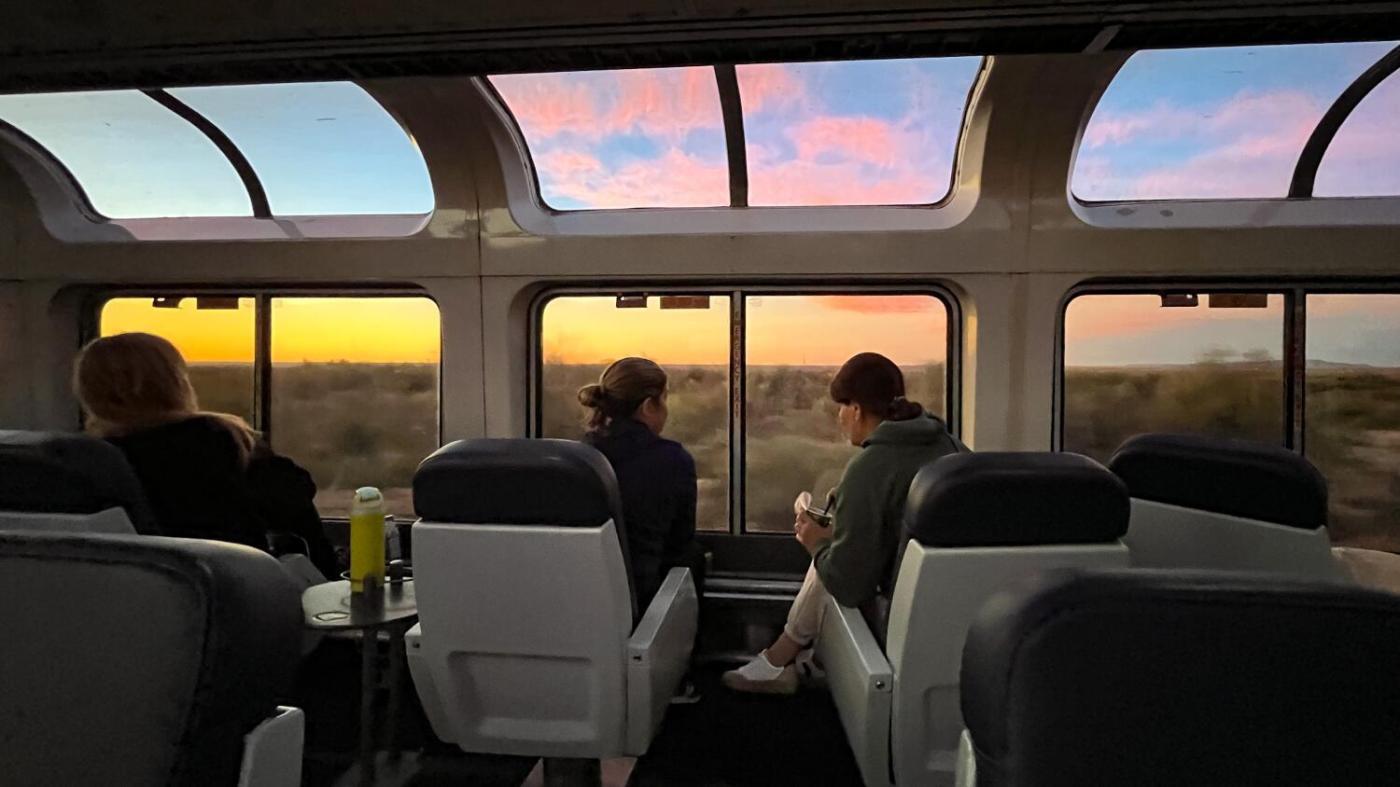
Passengers relax in the Sightseer Lounge on Amtrak’s Southwest Chief. (Christopher Reynolds/Los Angeles Times/TNS)
Flagstaff by dawn
There’s one Southwest Chief departure from Los Angeles every day (and one from Chicago). If everything goes right, the 2,265-mile, 32-stop trip takes about 43 hours.
But only a rookie would count on that. About 60% of the time, the Southwest Chief arrives at least 15 minutes late.
Back in 1936, when the Atchison, Topeka & Santa Fe Railway introduced Southwest Super Chief service between Los Angeles and Chicago, this was a roughly 40-hour journey. The passenger list included plenty of show-biz people and the first stop was in Pasadena.
Nowadays, the Southwest Chief is run by Amtrak (which gets government funding but operates independently enough to be unaffected by recent government shutdowns). There are not so many show-biz people now, not as many frills. Instead of Pasadena, its first stop after Los Angeles is Fullerton, followed by a bend to the northeast. By the time I arrived in the dining car for my first dinner aboard, we were nearing Barstow.
“This way, young man,” lied the server winningly as he steered me to a table. (I am 65. In the dining car, every traveler, no matter how aged, gets greeted as a young man or young lady.)
Since booths hold four people, dining car stewards like Chuck Jones manage the delicate task of putting travelers together. Through PA announcements and whispers in the aisles, he encouraged us to introduce ourselves and keep phones off tables.
He also suggested we steer clear of politics — a tall order when traveling through a government shutdown from a city the president had just called “lawless” to one he had just called “the worst and most dangerous city in the world.”
Surprise: Almost everyone complied.
Over the course of six dining car meals as a solo traveler, I heard no political disagreements and met travelers from their 20s to their 80s.
A meal is served in the dining car of Amtrak’s Southwest Chief train from Los Angeles to Chicago. (Christopher Reynolds/Los Angeles Times/TNS)
Claudette Toth, a senior from Massachusetts, estimated that she’d only flown three or four times in her life. William Angus, a 24-year-old returning to Chicago from a pilgrimage to the San Diego Model Railroad Museum told of how much he loved running a 1/87 scale model of the Bakersfield-Mojave rail system, re-enacting operations from February 1953.
As Angus spoke, Ernie Haecker, a longtime train lover, nodded in understanding, grinning beneath a handlebar mustache. Haecker, 77, an audiologist, told us he takes the train every six weeks, splitting time between Santa Fe and New York. After so many trips, he knows the crew, knows where the train will pause long enough for him to shave, knows he can count on chatting with “a whole panoply of folks every time.” He even knew the spot in Illinois where the train would switch from one old company’s tracks to another’s.
“We just left the old Santa Fe,” he would say when the moment came. “Now we’re on Burlington.”
My dinner on the first night was another happy surprise — a fairly tender and flavorful flat iron steak. There was a vase holding flowers at every table, along with white tablecloth.
Still, nobody should expect a Michelin-star meal in an Amtrak dining car. It’s common for servers to bring out dessert before the main dish (to avoid running behind later) and at one meal, someone forgot my order and I had to start over half an hour later.
By the time we crossed into Arizona that first night, I was back in my roomette nodding off, lulled like a baby atop a washing machine.
We were near Flagstaff when I blinked awake, glad to catch sight of the sunrise and grateful to have a sleeping area of my own.
Arizona sprawl and the Amtrak class system
Of the three ways you can travel long-distance on Amtrak, the fanciest option is a private room that’s about 50 square feet (including private bath). The cost — about $3,200 for a couple, one way, when I booked — includes meals in the dining cars. (Family rooms, which hold four people but share bathrooms, cost about the same. All rates fluctuate by season and demand.)
That was too pricey for me and my expense account, so I booked a roomette. The roomettes are about half the size of a private room, with dining-car access and upper and lower berths that allow two travelers to lie flat (or one to spread out). These share toilets and showers. This cost me $809. (For a couple, the tab would have been $1,112.)
Roomettes measure about 23 square feet in Amtrak’s Southwest Chief train from Los Angeles to Chicago. (Christopher Reynolds/Los Angeles Times/TNS)
The third option was coach class, which means sleeping in your seat. It’s a sensible choice if you’re traveling only a portion of the route, and it’s what I did when traveling this route as a college student 45 years ago.
I was intrigued to see that coach fares start at $198 — only a bit more than the starting price for a flight. But no, not intrigued enough.
As a coach passenger, you don’t get access to the dining car (unless there’s room and you’re willing to pay $20-$45 for a meal). Instead, you bring food, buy snacks in the cafe car below the Sightseer Lounge or, if truly desperate, try to arrange a restaurant delivery to an upcoming fresh-air stop.
Fortunately, all classes get access to the Sightseer Lounge, where armchairs and couches face big windows. I’ve heard of lounges getting pretty crowded and ripe on heavily booked trips, but our trained seemed less than half-full. A few coach passengers dozed in the lounge overnight (which is officially forbidden) and nobody seemed bothered.
That first morning, with coffee in hand, I tiptoed into the lounge, sank into an armchair and watched the desert sprawl while wispy clouds clung to the horizon under a brightening sky.
For much of Amtrak’s Southwest Chief train’s route through Arizona, the route is flanked by old Route 66 and other lonely desert roads. (Christopher Reynolds/Los Angeles Times/TNS)
This postcard (or rather Instagram) moment came somewhere between Winslow and Holbrook. I’m told the scenery is more dramatic on the Coast Starlight (from Los Angeles to Seattle) and the California Zephyr (from Emeryville through the Rockies to Chicago). But this comes down to taste. If you like deserts, the Chief is hard to beat. (Though no matter the route, if you like photography, the train is a challenge: no open windows, so you’re always shooting exteriors through glass.)
As Arizona yielded to New Mexico, the dirt seemed to get redder and the ridges rose to form buttes. Along rivers and creeks, bright yellow cottonwood trees congregated in bursts of yellow. Occasionally we’d glimpse small towns and timeworn roadside attractions — a reminder that Old Route 66 basically follows Southwest Chief’s path between the West Coast and Albuquerque, New Mexico.
Amish in transit, elk at sunset
“Living in L.A., you forget all this space,” said Kim Rinauro, a nurse from Los Feliz. “When you come out and see how vast this is, it really gives you a different perspective.”
“America is so ginormous,” said Jeanine Bass, a softball coach from Costa Mesa who was on her way to see family in upstate New York.
Meanwhile, one end of the observation car had been filled by several women in white bonnets, joined by men with straw hats, footlong beards and no mustaches. Occasionally I’d hear a sort of clapping sound. Amish families. Playing dominoes.
Amish travelers have been using this route for decades, one of the men told me, on their way to and from doctors in Tijuana. Seeking medical treatment that’s more affordable and easier to schedule than in the U.S., they take trains to Southern California, then continue overland across the border.
Just before we made a 45-minute stop at the station, which is surrounded by a grim neighborhood, an Amtrak staffer took the microphone to sternly address the coach-class travelers.
“Coaches: No alcohol,” she said. “If you bring alcohol, you can stay and spend all night here with the transients.” For those in rooms and roomettes, she continued, booze in private rooms is OK, but not in public spaces.
Farther into New Mexico, we passed the other Southwest Chief train, carrying passengers west.
Between Raton, New Mexico, and Trinidad, Colorado, amid a gaudy sunset, we crept past a herd of elk, then plunged into a tunnel. Emerging, we caught a last bit of sunset, some of the most gorgeous miles of the trip.
Yet this, I learned later, is the part of the trip that Amtrak’s chief executive tried to replace with bus service in 2018. The effort failed and that executive is no longer in the job. But the battles in Washington over Amtrak funding and mission never end, which is why so many cars, like the Superliners on the Southwest Chief, were built between 1979 and 1996. Amtrak leaders have set a goal of replacing their older long-distance cars by 2032.
Speaking of hardware: Eventually I tried the shower. It didn’t go well. First, I saw that someone had stolen the shampoo dispenser. Then I couldn’t find a way to cool the scalding-hot water. I stood as far back as I could in the snug compartment and grimaced my way through it.
Missouri, Iowa and Illinois: The final miles
On arrival day, I woke just as we reached the station in Kansas City, another gritty neighborhood along the tracks. Our news feeds were filled with fresh reports of nationwide flight delays because of the government shutdown.
Soon we were crossing the Missouri River, roaring through forest and skirting naked farmland where this year’s corn crop had just been cut. Then came Fort Madison, Iowa; the Mississippi River and the beginnings of Illinois. Water towers and grain elevators.
I zipped my bags shut, tipped the roomette attendant and dining car team. Soon I’d be stretching my legs at the Art Institute of Chicago, walking Millennium Park and along the Chicago River, checking out the skyline from Navy Pier.
We pulled into Union Station within an hour of our target time.
Was it a perfect trip? No. But it was full of humanity, scenery and comforting clangs and rumbles. I even liked the lurching way you had to walk down the corridors, adjusting balance as the train shifts. And then, to step off the train after two days into a brisk Chicago afternoon, 2,265 miles from home, having never left the ground? That’s almost magic.
Travelers head toward seats at Chicago Union Station. (Christopher Reynolds/Los Angeles Times/TNS)
©2025 Los Angeles Times. Visit at latimes.com. Distributed by Tribune Content Agency, LLC.