Big federal dollars for small state projects aim to get more cars off the roads

posted in: All news | 0

By Erika Bolstad, Stateline.org

A 60-mile pedestrian and cycling trail in Arkansas, an electric street sweeper in Oregon and truck parking facilities in Florida don’t appear to have much in common — let alone any similarity with a conversion of California highways to toll roads or a roundabout in Michigan.

But all of the projects will be paid for by the Carbon Reduction Program, a five-year, $6.4 billion federal program to reduce the tailpipe emissions that contribute to global warming. The program, known as the CRP, was authorized in the 2021 Bipartisan Infrastructure Law, the $1.2 trillion federal investment in everything from roads and bridges to the electrical grid.

The CRP is small in comparison to, say, the infrastructure law’s $40 billion pledge to fix the nation’s bridges. Yet it could be mighty for bringing to life what are known as transportation alternatives, or small-scale infrastructure designed to take cars off the road and therefore reduce emissions. They include sidewalk installation and improvements, pedestrian walkways, bike lanes and trails, and bike share programs.

It takes much less money to make an impact on transportation emissions with such programs, said Kevin Mills, vice president of policy at Rails-to-Trails Conservancy, which advocates for money for walking and bicycling trails and has been keeping a close eye on how the CRP will boost funding for its priorities.

“This program has a big purpose and not a great amount of money given the task before us,” Mills said. “What becomes important is that we make the most of what’s a fairly modest-sized new program so that we can prove its value and hopefully grow it going forward. That puts a premium on things that will give you a big bang for the buck.”

While the broader infrastructure bill was under consideration, many U.S. House Democrats wanted it to devote even more money to climate change-related measures and less to highway projects. After it passed, 16 Republican governors grumbled about an internal Federal Highway Administration memo that encouraged states to emphasize existing repairs, public transit and bike lanes over projects to expand highways.

In the coming weeks, states must submit carbon reduction strategies that demonstrate how they’ll use federal money to reduce transportation emissions. In their strategies, states will be required to identify specific projects and approaches to reach the goals in their CRP plans, said Elle Segal, an advocacy outreach director at Rails-to-Trails Conservancy. The federal program requires that states explain by Nov. 15 how they’ll reduce emissions.

States have some leeway to shift as much as 50% of the money for carbon reduction toward other federally funded transportation projects that don’t have an explicit greenhouse gas reduction component. Some states have done just that, to the disappointment of climate activists and progressive transportation planners. (States also can transfer money from those other federal formula programs to the carbon reduction program.) In some cases, a transfer is a temporary measure and money will shift back; dollars for carbon reduction began flowing to states a year before the carbon reduction strategy plans were due and some states hadn’t yet outlined their priorities for cutting emissions.

In Maryland, the state is focusing on three areas to reduce transportation sector emissions, said Deron Lovaas, who leads the Environment and Sustainable Transportation program for the Maryland Department of Transportation. The most pressing strategy, he said, is to increase the number of electric vehicles on the road, beginning with cars, sedans, pickup trucks and SUVs, followed by medium- and heavy-duty vehicles. That includes steering federal money to electrify the vehicle fleet used by state and local governments.

Up next is reducing overall traffic or vehicle miles traveled. That involves an “array of measures,” Lovaas said, including investments in public transportation, such as rail, bus and shuttle service, and making sidewalks and roads safer for bicyclists and pedestrians and those in wheelchairs.

It’s critical that states go on the record about what they’re doing with their carbon reduction strategies, he said. That will allow states to learn from each other and will provide accountability for how federal money is being spent to reduce greenhouse gas emissions.

“It’s an important document because carbon reduction from transportation is challenging and requires a multi-year strategy,” Lovaas said. “So that’s how we’re seeing this document. We’re seeing it as important not just for informing the Carbon Reduction Program, but also reflective of Maryland’s broader strategy to decarbonize transportation.”

Many states ­— including California, Colorado and Massachusetts — already had laws in place that address transportation emissions. Washington’s approach to its CRP strategy, for example, builds upon its 2021 State Energy Strategy. In Oregon, the state’s Carbon Reduction Strategy evolved from its 2013 plan to reduce carbon emissions by 2050 and a statewide transportation strategy that was updated this year. Statewide greenhouse gas emissions goals are codified in state law and executive order in Oregon, as well.

“We built the carbon reduction program on that strong base of actions,” said Brian Hurley, a mitigation program manager with the Oregon Department of Transportation. “We did not have to start from scratch.”

A description by the Minnesota Department of Transportation may best reflect a hard truth in many parts of the country when it comes to carbon reduction policies, regardless of political affiliation: “Land use patterns and unsafe, inconvenient alternatives make driving alone the most convenient choice for many Minnesotans. Cars in Minnesota are mostly powered by fossil fuels, which emit carbon pollution and other air pollutants.”

“Some states are actually way ahead of us federally, in terms of their level of climate ambition and the creativity that they’ve brought to this and the steps they’ve taken,” Transportation Secretary Pete Buttigieg told The Washington Post last year. “Others, we’re pulling along and really working to encourage them.”

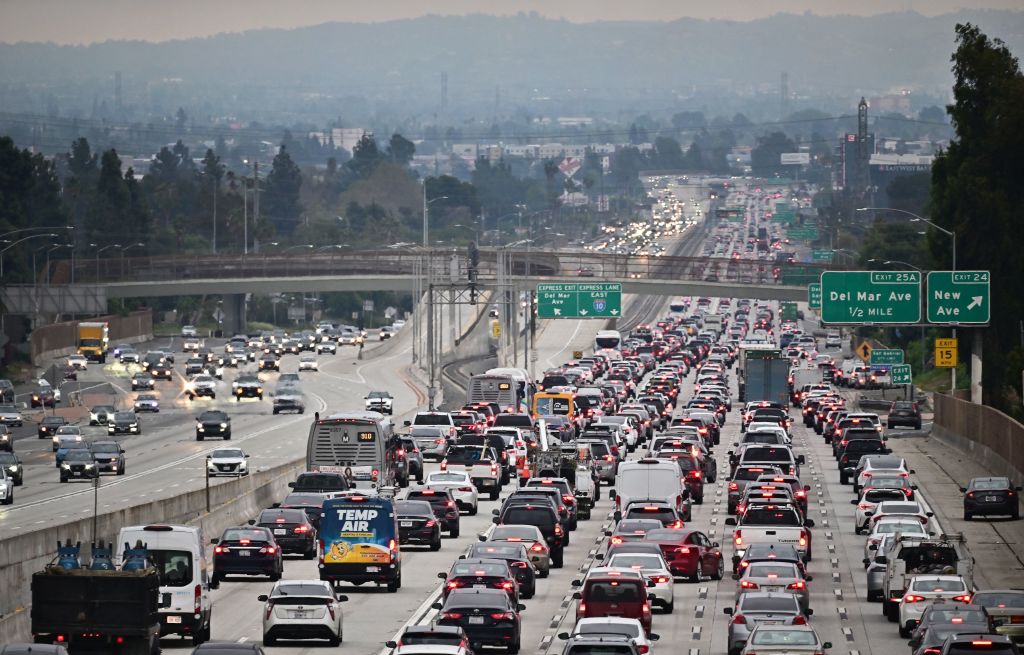
The Carbon Reduction Program is a five-year, $6.4 billion federal program to reduce the tailpipe emissions that contribute to global warming.

Florida Gov. Ron DeSantis, a Republican, this summer vetoed a budget provision that would have allowed state agencies to seek federal money through a U.S. Environmental Protection Agency grant to improve energy efficiency in buildings. But Florida hasn’t turned down $320.4 million in CRP transportation funding the state will receive over five years. In its Carbon Reduction Strategy, Florida plans to call for reducing single-occupancy vehicle trips as well as for making it easier to use vehicles or modes of travel with lower emissions. The state’s strategy will also call for using construction techniques with lower emissions.

Florida will use $46 million to build 26 truck parking areas with commercial EV charging stations and other amenities. Safe places for truckers to rest have long been at a premium, but the growth in e-commerce has put even more trucks on the road, further straining the parking supply. And without a place to stop for federally mandated rest periods, truckers spend additional time on the road looking for safe places to park, which means more time spewing CO2 out of tailpipes. Truck parking shortages are considered a “national safety concern” by the Federal Highway Administration’s Office of Freight Management and Operations.

Florida is also planning to invest big in its SUN Trails system, Huiwei Shen, the chief planner at the Florida Department of Transportation, said during a Rails-to-Trails Conservancy seminar earlier this year. The non-motorized, shared-use paths received a one-time infusion of $200 million from the state legislature this year.

“It’s a great time for trails in Florida,” Shen said. “It would contribute greatly towards the vision of a statewide interconnected trail system in Florida, and we want to be the No. 1 trail destination internationally.”

In Oregon, the state has $82 million to spend over five years. It set aside $13 million of that for projects in smaller cities and rural areas and for tribes; the federal program requires 65% of the money to go to larger metropolitan areas. Since the bulk of the money will go to parts of the state with more congestion, the state DOT wanted to help smaller communities make some progress on reducing carbon emissions, too, said Rye Baerg, a climate program coordinator with the Oregon Department of Transportation. Among the projects are e-bike lending libraries, solar streetlights and even electric-powered street cleaners sized specifically to clean pedestrian and bike paths so that they’re safer and therefore more attractive to users.

“We had a lot of counties, a lot of small cities, interested in charging and those types of things,” Baerg said. “I think that we saw a lot of interest in our first round of call for projects and I expect to see even more interest now that people know what types of things we’re funding and have a better sense of what the program is next year.”

The small changes add up, said Lovaas, with the Maryland transportation department. For example, if Maryland invests in a new transit line using Carbon Reduction Program money, it can multiply the effect of municipal or state policies that encourage transit-oriented development, Lovaas said. Invest in safe street programs, he added, and it reduces the number of trips people make by car and reduces their emissions.

“So for the short trips, you actually can replace them with walking or biking or rolling or some non-motorized mode,” he said. “You add all that together and you get a pretty big effect.”

Stateline is part of States Newsroom, a national nonprofit news organization focused on state policy.

©2023 States Newsroom. Visit at stateline.org. Distributed by Tribune Content Agency, LLC.

High school football: Wisconsin first-round playoff predictions

posted in: All news | 0

Here are some of the top high school football first-round playoff games involving teams from western Wisconsin, (* Teams listed by playoff seeds.)

No. 6 River Falls vs. No. 3 Menomonie, at University of Wisconsin-Stout, 7 p.m.

Menomonie beat River Falls 39-15 in the regular season just two weeks ago. That victory is the reason the Mustangs are hosting Friday’s game. River Falls enters the game knowing it moved the ball on the ground in the last meeting. But the Wildcats must convert drives into touchdowns, and hope they can slow the game down enough to keep the ball away from Menomonie’s suddenly potent offense. OUR PICK: Menomonie 28, River Falls 24

No. 8 Chippewa Falls (4-5) at No, 1 Hudson (8-1), 7 p.m.

Hudson had to work to edge Chippewa Falls 13-8 on Sept. 1. But Hudson’s offense clicked shortly after that game, and hasn’t slowed dow since. The Raiders are a lock to score 30-plus points on a nightly basis. Still, you cannot underestimate Chippewa Falls, which had to win its final two regular-season games to squeeze into the playoffs. OUR PICK: Hudson 31, Chippewa Falls 14

No. 5 Ellsworth (5-4) at No. 4 Baldwin-Woodville (7-2), 7 p.m.

Baldwin-Woodville blitzed Ellsworth 49-0 on Sept. 8. Baldwin-Woodville quarterback Cal Smith had a hand in six touchdowns — five through the air and one on the ground — in that game. But Smith didn’t take all the snaps as Baldwin-Woodville narrowly escaped against Amery last week. If Smith isn’t at full health, or doesn’t play altogether, against Ellsworth, the outcome of this game comes into question. OUR PICK: Baldwin-Woodville 18, Ellsworth 14

No. 7 Marshfield (4-5) at No. 2 New Richmond (8-1), 7 p.m.

New Richmond beat Marshfield 31-10 in Week 2 of the regular season. That helped set the tone for a phenomenal season for New Richmond. But can it quickly move past its Big Rivers Conference title game defeat to Hudson in time to get back up for a Marshfield team that has won three of its past four games? OUR PICK: New Richmond 21, Marshfield 14.

Related Articles

High School Sports |


HIgh school football: Two Rivers tops Simley, makes case for high playoff seeding

High School Sports |


High School Football Roundup: Johnson secures best regular season since 2017, possible home playoff game

High School Sports |


High school football: Will this week’s games sort out scrambled section seeding scenarios?

High School Sports |


High school football: Week 8 predictions

High School Sports |


High school football: Hudson earns No. 1 seed in playoffs. Here are other Western Wisconsin first-round matchups

How to protect yourself from student loan scams as bills resume

posted in: All news | 0

By Eliza Haverstock | NerdWallet

As borrowers gear up for federal student loan bills resuming this fall, they face a revamped landscape that includes a new repayment plan, servicer switches and long call wait times. Another imminent concern: scammers who want to take advantage of the moment.

“Whenever there’s confusion in the marketplace, that’s when the criminal fraudsters get active,” says Clayton LiaBraaten, senior executive advisor at Truecaller, an app that blocks spam calls.

Borrowers need to protect themselves, even as regulators crack down on scammers. In August, the Federal Trade Commission (FTC) caught a group of scammers who brought in roughly $8.8 million with false promises of “Biden Loan Forgiveness” in exchange for hefty upfront fees. The group claimed to be affiliated with the U.S. Department of Education and primarily targeted borrowers via calls and texts, the FTC said.

If you receive an unsolicited call or text about your student loans, it’s probably a scam. Here’s how to spot and avoid a student loan repayment scam — and what to do if you think you’re a victim of one, according to experts.

What to watch out for

Student loan scams vary widely, but they often contain a few key ingredients. Here are some common red flags.

Advertising from the ‘government’

Scammers will often use the word “federal” in their communications, LiaBraaten says. They might claim federal or government affiliation, or they could claim to be connected with the Education Department or your student loan servicer.

Aggressive advertising language can also indicate that communication isn’t from the government.

“If you are a student loan borrower, you need to be aware that the federal government isn’t soliciting you,” says Leslie Tayne, a financial debt attorney. “If it sounds like a sales pitch with guarantees and promises, that’s not coming from the federal government.”

Relief that costs money

If someone asks you to pay an upfront or monthly fee to access debt relief, it’s a scam.

It’s always free to enroll in or benefit from any legitimate federal student loan relief, such as income-driven repayment (IDR) plans, borrower defense to repayment, Public Service Loan Forgiveness and the IDR account adjustment.

And if you have questions about your loans or repayment options, you can call your servicer for free guidance.

Promises that are too good to be true

Keep your guard up if you receive calls with promises of instant student loan relief. Most federal relief programs require at least a decade of payments to qualify — and no company or person has the ability to negotiate a special deal with your loan servicer or the government, warns the Education Department.

“Legitimate loan forgiveness programs usually have these strict eligibility criteria, so any sort of instant forgiveness is a red flag,” says Ally Armeson, program director of the nonprofit Cybercrime Support Network. Scammers see an opportunity with people panicking around repayment and try to position themselves as saviors, she says.

How scammers reach you

Student loan scammers can get creative with their contact methods. Here are a few to watch out for.

Robocalls

Think twice if your phone rings with an unknown number. In the first half of September, scammers placed more than 350,000 student loan-related robocalls, according to Transaction Network Services, a financial infrastructure firm.

“Beware of unsolicited calls or communication,” Armeson says. “That is the number-one way that a scammer will weasel into your life.”

Snail mail

Scammers may also send letters through the mail. Read them closely. Even if it seems official or formal, a scam letter will often include grammatical or spelling errors, the Education Department says.

Texts and social media

Increasingly, scammers are also targeting borrowers with texts and social media messages, Tayne says. Scams that began on social media have accounted for $2.7 billion in reported losses since 2021, more than any other contact method, the FTC said earlier this month.

Official Education Department text messages will only come from the numbers 227722 or 51592.

Email

Scammers may try to sneak into your inbox. If an email looks suspicious, double-check the sender.

Legitimate emails from the Education Department will only come from these senders:

noreply@studentaid.gov.
noreply@debtrelief.studentaid.gov.
ed.gov@public.govdelivery.com.

Protecting yourself from a student loan scam

Don’t engage if you receive a call about your student loans out of nowhere. Hang up if it’s a robocall; if a person is on the other side, quickly end the call.

“If someone says they are from a specific agency, department or loan servicer, just say, ‘you know what, let me hang up and do my research, and I’ll go from there by myself,’” Armeson says.

If you get an email or text about your student loans, don’t click on any links.

Use strong passwords and enable two-factor authentication on all of your online financial accounts, including your StudentAid.Gov and student loan servicer accounts, LiaBraaten says.

Never share your login information. With just your username and password, scammers can sign legally binding student loan documents electronically and make changes to your federal student loan account.

The Education Department and your servicer will never ask for your password.

What to do if you’re a student loan scam victim

If you believe a scammer has targeted you, immediately stop communicating with them. Then, take the following steps to get help and protect yourself from any further harm:

Contact your student loan servicer. Call your servicer and tell them what happened. Check the status of your loan and ask if the scammer did anything to your account.
Call your bank and credit card company. Ask them to stop any payments to a scammer.
Change your passwords. Change all passwords associated with your financial accounts and student loans, like your StudentAid.gov and servicer accounts.
Monitor your finances. Check to see if anyone has opened an unauthorized account or line of credit in your name. You can check your credit report for free each week on AnnualCreditReport.com.
Consider freezing your credit. If you think the scammer may have personal information, like your Social Security number, freeze your credit to prevent identity theft and fraud.
Save all communication records. If the scammer has texted or emailed you, save these records to send the information to the FTC and other law enforcement agencies.

Report possible scams to the FTC, which may use the report to spot trends, educate the public and bring cases against fraudsters in partnership with more than 2,800 law enforcement organizations.

If scammers took your money, the FTC will also give you advice on how to recover it. “The quicker you act, the better your chance of getting your money back,” the FTC website says.

You can also report the student loan scam to your state’s attorney general’s office or the Consumer Financial Protection Bureau for further assistance and investigation.


Eliza Haverstock writes for NerdWallet. Email: ehaverstock@nerdwallet.com. Twitter: @elizahaverstock.

How to protect yourself from student loan scams as bills resume

posted in: All news | 0

By Eliza Haverstock | NerdWallet

As borrowers gear up for federal student loan bills resuming this fall, they face a revamped landscape that includes a new repayment plan, servicer switches and long call wait times. Another imminent concern: scammers who want to take advantage of the moment.

“Whenever there’s confusion in the marketplace, that’s when the criminal fraudsters get active,” says Clayton LiaBraaten, senior executive advisor at Truecaller, an app that blocks spam calls.

Borrowers need to protect themselves, even as regulators crack down on scammers. In August, the Federal Trade Commission (FTC) caught a group of scammers who brought in roughly $8.8 million with false promises of “Biden Loan Forgiveness” in exchange for hefty upfront fees. The group claimed to be affiliated with the U.S. Department of Education and primarily targeted borrowers via calls and texts, the FTC said.

If you receive an unsolicited call or text about your student loans, it’s probably a scam. Here’s how to spot and avoid a student loan repayment scam — and what to do if you think you’re a victim of one, according to experts.

What to watch out for

Student loan scams vary widely, but they often contain a few key ingredients. Here are some common red flags.

Advertising from the ‘government’

Scammers will often use the word “federal” in their communications, LiaBraaten says. They might claim federal or government affiliation, or they could claim to be connected with the Education Department or your student loan servicer.

Aggressive advertising language can also indicate that communication isn’t from the government.

“If you are a student loan borrower, you need to be aware that the federal government isn’t soliciting you,” says Leslie Tayne, a financial debt attorney. “If it sounds like a sales pitch with guarantees and promises, that’s not coming from the federal government.”

Relief that costs money

If someone asks you to pay an upfront or monthly fee to access debt relief, it’s a scam.

It’s always free to enroll in or benefit from any legitimate federal student loan relief, such as income-driven repayment (IDR) plans, borrower defense to repayment, Public Service Loan Forgiveness and the IDR account adjustment.

And if you have questions about your loans or repayment options, you can call your servicer for free guidance.

Promises that are too good to be true

Keep your guard up if you receive calls with promises of instant student loan relief. Most federal relief programs require at least a decade of payments to qualify — and no company or person has the ability to negotiate a special deal with your loan servicer or the government, warns the Education Department.

“Legitimate loan forgiveness programs usually have these strict eligibility criteria, so any sort of instant forgiveness is a red flag,” says Ally Armeson, program director of the nonprofit Cybercrime Support Network. Scammers see an opportunity with people panicking around repayment and try to position themselves as saviors, she says.

How scammers reach you

Student loan scammers can get creative with their contact methods. Here are a few to watch out for.

Robocalls

Think twice if your phone rings with an unknown number. In the first half of September, scammers placed more than 350,000 student loan-related robocalls, according to Transaction Network Services, a financial infrastructure firm.

“Beware of unsolicited calls or communication,” Armeson says. “That is the number-one way that a scammer will weasel into your life.”

Snail mail

Scammers may also send letters through the mail. Read them closely. Even if it seems official or formal, a scam letter will often include grammatical or spelling errors, the Education Department says.

Texts and social media

Increasingly, scammers are also targeting borrowers with texts and social media messages, Tayne says. Scams that began on social media have accounted for $2.7 billion in reported losses since 2021, more than any other contact method, the FTC said earlier this month.

Official Education Department text messages will only come from the numbers 227722 or 51592.

Email

Scammers may try to sneak into your inbox. If an email looks suspicious, double-check the sender.

Legitimate emails from the Education Department will only come from these senders:

noreply@studentaid.gov.
noreply@debtrelief.studentaid.gov.
ed.gov@public.govdelivery.com.

Protecting yourself from a student loan scam

Don’t engage if you receive a call about your student loans out of nowhere. Hang up if it’s a robocall; if a person is on the other side, quickly end the call.

“If someone says they are from a specific agency, department or loan servicer, just say, ‘you know what, let me hang up and do my research, and I’ll go from there by myself,’” Armeson says.

If you get an email or text about your student loans, don’t click on any links.

Use strong passwords and enable two-factor authentication on all of your online financial accounts, including your StudentAid.Gov and student loan servicer accounts, LiaBraaten says.

Never share your login information. With just your username and password, scammers can sign legally binding student loan documents electronically and make changes to your federal student loan account.

The Education Department and your servicer will never ask for your password.

What to do if you’re a student loan scam victim

If you believe a scammer has targeted you, immediately stop communicating with them. Then, take the following steps to get help and protect yourself from any further harm:

Contact your student loan servicer. Call your servicer and tell them what happened. Check the status of your loan and ask if the scammer did anything to your account.
Call your bank and credit card company. Ask them to stop any payments to a scammer.
Change your passwords. Change all passwords associated with your financial accounts and student loans, like your StudentAid.gov and servicer accounts.
Monitor your finances. Check to see if anyone has opened an unauthorized account or line of credit in your name. You can check your credit report for free each week on AnnualCreditReport.com.
Consider freezing your credit. If you think the scammer may have personal information, like your Social Security number, freeze your credit to prevent identity theft and fraud.
Save all communication records. If the scammer has texted or emailed you, save these records to send the information to the FTC and other law enforcement agencies.

Report possible scams to the FTC, which may use the report to spot trends, educate the public and bring cases against fraudsters in partnership with more than 2,800 law enforcement organizations.

If scammers took your money, the FTC will also give you advice on how to recover it. “The quicker you act, the better your chance of getting your money back,” the FTC website says.

You can also report the student loan scam to your state’s attorney general’s office or the Consumer Financial Protection Bureau for further assistance and investigation.


Eliza Haverstock writes for NerdWallet. Email: ehaverstock@nerdwallet.com. Twitter: @elizahaverstock.