Bailey Zappe unsure if he’ll remain Patriots’ emergency third QB

posted in: All news | 0

FOXBORO — The Patriots have not publicly fully explained why they made a quarterback change in Week 6, but Bailey Zappe was demoted.

The second-year pro had been Mac Jones’ backup quarterback through the first five weeks of the season before being made inactive as the team’s emergency third QB against the Raiders with hybrid quarterback/wide receiver Malik Cunningham serving as the backup.

Related Articles

New England Patriots |


Callahan: It’s time for a Patriots kitchen sink game against Buffalo

New England Patriots |


Patriots extra points: Running back, pass rusher replace wide receiver, D-tackle

New England Patriots |


How Patriots are using Malik Cunningham in practice ahead of Bills game

New England Patriots |


Patriots-Bills injury report: Rhamondre Stevenson among 20 players listed after Wednesday practice

New England Patriots |


Patriots get bad news at Wednesday practice ahead of Bills game

Head coach Bill Belichick would only say after the game that “there’s a lot of people that are hurt” when asked why Cunningham was signed to the 53-man roster and made the backup.

“They had an idea,” Zappe told the Herald this week. “They told me about it. That’s between me and the coaches. So, I’m sure if anything happens this week, we’ll talk about it. I’m not sure what’s going on. I’ll leave that up to the coaches, and they’ll let me know like they always do.”

A source told the Herald that the Patriots viewed Cunningham as having more upside based on his athleticism and that the biggest risk was the rookie turning the ball over, which the team has already had issues with anyway.

“I prepare like I usually do, but of course, it’s a lot different from being an emergency and being a 2,” Zappe said. “Because I don’t know how the rules are stated. It’s something like the No. 1 and 2 both have to get injured for the 3 to go in. And then if the 1 or 2 is able to go back into the game, 3 has to come out. I don’t know.

“I don’t know if it’s just for that one week or whatever, but I’m still preparing like I’m getting an opportunity to go out there and play, and then do my job.”

Zappe has struggled in new offensive coordinator Bill O’Brien’s system since the offseason. There was expected to be a competition between Zappe and Jones for the starting role, but that never materialized.

Zappe was cut out of training camp and signed to the team’s practice squad before being called up to the 53-man roster before Week 1.

Zappe said he was informed that would be the No. 2 at some point last week.

“They talked about it,” Zappe said. “Told me it was a possibility. Do whatever I can for the team, whatever I can to help the team win. I’ve been preparing like I’m the starter. Everybody does that. That doesn’t really change my mind of how I prepare during the week.”

Jones was benched for Zappe in two straight weeks in blowout losses to the Cowboys and Saints that saw the starter turn the ball over three times in each game. Zappe did not provide a spark off of the bench, however, completing just 38.9 percent of his passes.

Jones threw another interception in Sunday’s loss to the Raiders. So, does Zappe believe there’s a greater chance for a competition?

“That’s up to the coaches,” Zappe said. “Whenever I get my opportunities in practice or the game, I try to take advantage of it, make the throws, try to do my job. Whenever the opportunities come again, I’m going to try to take advantage of it.”

Belichick has talked multiple times now about how difficult it is for a player, especially a quarterback, to move up the depth chart with a lack of reps in practice. The Patriots also have Will Grier, but it’s hard for him to compete with Jones or Zappe with four quarterbacks on the roster.

Zappe wasn’t complaining about a lack of reps in practice.

“Whatever reps I get, I try to take advantage of it, whether it’s with the first-team offense or with the scout team,” Zappe said. “I feel like every rep for me is like an audition. I go out there and make the throws that sometimes in the game I’m not truly wanting to make. Scrambling around, just doing stuff like that. Just doing stuff that you don’t usually get to do. For me, I try to take every rep whether it’s scout or with the first-team offense like a game rep and choose it as an opportunity for me to show Coach Belichick and OB (O’Brien) what I can do.”

Zappe started and won two games last season in reserve of Jones. He mounted a comeback in his first NFL action while backing up Brian Hoyer last season against the Packers and then struggled while relieving Jones against the Bears.

But there seemed to be a legitimate competition between Zappe and Jones. This year has been a lot different for Zappe from struggling in camp and the preseason, getting cut and being demoted. So, how has he viewed the last six months?

“I mean, just like every other year. Just trying to get better,” Zappe would only say.

Pentagon scours weapons stockpiles for Israel, even as Ukraine stresses industry

posted in: All news | 0

The U.S. has launched a new effort to quickly find more precision weapons and artillery shells to rush to Israel as the Middle Eastern country conducts hundreds of strikes a day against Hamas targets in Gaza.

A newly formed team inside the Pentagon has been tasked with scouring U.S. stockpiles, searching for ammunition to resupply Israel as it fires off munitions at a frantic pace, according to three people familiar with the effort.

The move comes as the defense industry and the Pentagon scramble to send weapons to Ukraine and keep U.S. shelves stocked.

The group leading the effort comprises officials from across the Pentagon, including the acquisition and policy offices, as well as the armed services. They seek to replicate the efforts of another team of Defense and State Department officials that has been working on military aid for Ukraine, according to the people, one of them an administration official, granted anonymity to speak about internal matters that have not been announced. The existence of the group has not been previously reported.

The new effort is the latest sign of the administration’s urgency when it comes to arming Israel, and also gives an early look at the challenge facing the U.S. as it speeds weapons and equipment for two overseas wars at once.

Israel has already used up more than 8,000 precision munitions, and with Hezbollah looming on its northern border and the war showing little sign of ending, the government is eager to restock.

Many of those same munitions are also key to American war plans in the Indo-Pacific and elsewhere and have been rushed to Ukraine over the past year.

The need to shuttle supplies for the Ukraine and Israeli wars is creating an “inflection point” for America’s defense industry, said Dak Hardwick, vice president of International Affairs at the Aerospace Industries Association, an industry trade group.

“There has not been a time in the past 30 years where you essentially have had two real conflicts happening at the same time with a potential third one in three different regions of the world,” he said, referring to a potential Chinese invasion of Taiwan.

Within a day of Hamas’ initial attack on Israel, the Biden administration told lawmakers that Israel desperately needed more interceptors for its Iron Dome air defense system, along with artillery shells and precision-guided munitions.

While Ukraine is fighting a different type of war than Israel, there are weapons that both countries want from the U.S. Those include 155mm artillery shells, along with air-launched small diameter bombs, joint direct attack munitions and Hellfire missiles, demands that will only grow as the two wars grind on and the U.S. continues to ready itself for any potential clash with China.

Given these competing priorities, it is past time for Pentagon leadership to have a “first supper” with industry leaders to speak frankly about what can be done to increase production to restock U.S. military warehouses, said Josh Kirshner, managing director at Beacon Global Strategies, a national security consulting firm.

The idea is a reversal of the infamous “last supper” dinner meeting then-Defense Secretary Les Aspin held with defense contractors in 1993 warning them that big budget cuts were coming and urging them to consolidate.

“There’s frustration on both sides as DoD and industry seem to be talking past each other,” Kirshner said. “We need to figure out how to put the defense industry on a wartime footing even if U.S. troops aren’t at war. It’s not something the system is designed for but needs to change if we’re serious about supporting partners.”

While Defense Department officials, including Defense Secretary Lloyd Austin, say the U.S. can handle Ukraine and Israel at the same time, there is increasing skepticism about the base’s ability to keep up, especially when the Ukraine demand was already straining the system.

Experts have warned that this problem is coming, if not already here. In January, Seth Jones, an analyst with the Center for Strategic and International Studies, released a study saying the Pentagon would quickly face some major weapons shortages if it were to fight a major power such as China due to the current peacetime-levels of production of precision weapons.

Ramping up to wartime levels means opening new production lines, signing contracts quickly and hiring more workers — a tall order for a country not actually at war.

Just days into such a fight, “the U.S. use of munitions would likely exceed the current stockpiles of the U.S. Department of Defense, leading to a problem of ‘empty bins.’”

The sheer volume of munitions being fired in Ukraine alone has been a wake-up call for America’s defense community, according to Patrick Mason, a deputy assistant secretary of the Army.

“The scale is phenomenal when you look at the consumption of 155 [millimeter artillery] rounds,” he told an Army conference last week. “We have not seen anything like that, and the scale is incredibly daunting, especially when you’re in those meetings and you talk about what we need to do to increase our artillery production.”

Meanwhile, the U.S. arsenal continues to churn out munitions for allies and partners, and has pumped more money into the defense industry to increase production of items such as artillery shells and Patriot missiles. But those investments take time to bear fruit.

The Pentagon is expected to announce another $150 million shipment of weapons to Kyiv this week that includes those 155mm shells, along with Patriot and other air defense missiles.

Army officials have committed to increasing the output of 155mm shells to 100,000 per month by 2025, up from about 14,000 per month at the start of this year.

The differences between Ukraine and Israel mean they will restock at different speeds, making it difficult to predict if or when ammunition production falls short. Unlike Ukraine, Israel has one of the most advanced and well-resourced militaries in the world, and shares deep ties with American companies who produce military hardware.

Ukraine, meanwhile, is in the early stages of trying to build ties with the U.S. defense industry.

A defense industry conference in Kyiv this month was meant to forge some of those connections that would allow Ukraine to begin producing more weapons at home.

American and Ukrainian officials are also working on another high-level meetup between the industry leaders in Washington in the coming weeks, according to two people with knowledge of the planning, who requested anonymity to acknowledge the ongoing work.

The Biden administration is also expected to send Congress a $100 billion supplemental request as early as Thursday, including Israel and Ukraine aid, that would span an entire year, along with beefed-up security along the southern U.S. border.

Members of Congress have made the point this week that even if the Pentagon doesn’t come through with the money to support Israel, they’ll make sure that the military is supplied.

Visiting Israel over the weekend with a group of U.S. lawmakers, Sen. Chuck Schumer pledged that the upper chamber “will not just talk, we will act.”

Sen. Mark Kelly (D-Ariz.), who joined Schumer’s Israel trip, said he relayed Israeli Defense Minister Yoav Gallant’s aid request to the White House on Tuesday.

That list, with $10 billion or more in hardware, includes Iron Dome interceptors, joint direct attack munition conversion kits, which turn unguided bombs into precision munitions, and other weaponry Kelly didn’t name for Israel’s airstrikes on Gaza and forthcoming ground offensive.

“They’re going to need munitions,” Kelly told reporters at the Capitol Tuesday, adding that in two Hamas airstrikes during his visit, Israel launched dozens of Iron Dome interceptors. “They expended a lot of rounds, and they’re doing that every single day.”

Israel’s need for precision weapons will likely remain constant, as its military relies heavily on precision airstrikes, and will only increase in the event of a ground incursion by the Israel Defense Forces.

Despite assurances from U.S. leaders, the war in Israel has led to some nervousness in Europe over what it may mean for the American aid for Ukraine.

In an interview with POLITICO during a visit to Washington on Wednesday, British Secretary of State for Defense Grant Shapps warned that Kyiv is still critically important.

“Let’s not forget about Ukraine,” Shapps said. “It’s really important that we keep the world’s focus there as well. We can do this. We can focus on both Europe and the Middle East at the same time and I just wanted to be here to work on some of that coordination.”

The specter of a ground operation in Gaza, meanwhile, presents a whole new set of challenges and a need for certain types of weapons, not necessarily being sent by the U.S. now.

The fight will require more precision munitions fired by aircraft and helicopters, along with precision artillery and plenty of munitions fired by tanks and armored vehicles in the streets.

Fighting through dense urban streets still populated by civilians “is the hardest kind of combat there is on the planet,” Frank McKenzie, a retired Marine Corps general who served as the chief of U.S. Central Command until last year, said in an interview.

If Israel intends to follow through on its promises to destroy Hamas, the battle won’t soon be over, requiring consistent, long-term support from the U.S. and the defense industry to keep up with what is expected to be a slow, grinding fight.

“It’s an environment where all the advantages of a modern, highly capable, high tech force are muted” by the close quarters of the enemy and the preparations Hamas has undoubtedly made to Gaza in anticipation of an Israeli invasion, he said.

“It will be a combined arms battle. You’ll have tanks in the streets, you’ll have armored breaching vehicles in the streets, you’ll have artillery behind you that will hopefully be able to fire very accurate rounds. But it’s gonna be as tough a fight as you can imagine.”

Joe Gould contributed to this report.

Israel-Hamas war tests California’s response to hate crimes

posted in: All news | 0

SACRAMENTO, Calif. — War in the Middle East is testing a new system in California to track and respond to hate crimes.

The state has launched a hotline to report incidents linked to racial or ethnic bias, a tool created in response to attacks on Asian Americans during the pandemic. It’s poised to provide real-time indications as officials are concerned the conflict could reverberate throughout California, home to some of the largest Jewish and Muslim communities in the U.S.

Aside from vandalism, there have been no significant bias incidents in California — nothing akin to the stabbing of a 6-year-old boy in Illinois.

But that could change. “We have been anticipating that we may see an increase,” said Becky Monroe, a senior official at the California Civil Rights Department.

California is better prepared to deal with bias attacks that have typically surged as a result of war and terrorism overseas. The state now has the hotline, increased security thanks to state and federal grants, and a legal framework that has emerged in recent years to prosecute hate crimes following a spike in anti-Asian attacks.

The “California vs Hate” hotline has gotten over 400 reports since it launched in May, according to preliminary data. Unlike law enforcement statistics, the hotline collects reports of any incident, whether it rose to the level of a crime or not. Callers can get help finding mental health resources or navigating the criminal justice system if they want to report a crime.

In anticipation of a spike, case workers at the Civil Rights Department have been reaching out to mosques, synagogues, and cultural groups that serve Muslim or Arab-American Californians and are concerned about hate crimes, Monroe said.

The idea for the hotline was first floated in 2017 by then-Assemblymember David Chiu (D-San Francisco) in response to the skyrocketing number of hate crimes he said were a result of rhetoric from the Trump administration, but legislators weren’t convinced a hate crime hotline was necessary, Chiu recalled. He revived the idea in 2021 along with Assemblymember Al Muratsuchi (D-Torrance) amid an uptick in hostility against Asian Americans and a racially motivated spa shooting in Atlanta that killed eight people — six of Asian descent.

Chiu, who is now the city attorney of San Francisco, said he’s worried about an increase in hate incidents as a result of the war. “I see a direct throughline,” he said. “Our society has become all too accustomed to shocking examples of intolerance and hate.”

Jewish schools across the Bay Area have canceled classes or increased security in recent days out of an abundance of fear over violence.

Since 2019, the state has set aside about $135 million in grants to enhance security for nonprofit and religious organizations at risk of hate crimes. The program — which covers equipment like reinforced doors, security lighting and mass notification alert systems — was expanded this year after Jewish and Catholic religious groups appealed for more support in response to a rise in mass shootings and other targeted attacks.

On Wednesday, Newsom announced that he was adding an additional $20 million to the program, doubling what had been allocated for this year. He also announced an immediate infusion of $10 million to increase police presence at houses of worship, directly citing the ongoing violence in the Middle East as the reason.

California Attorney General Rob Bonta in 2021 also launched a racial justice bureau to prosecute hate crimes.

Hate crimes were on the rise in California before hostilities erupted in Israel, increasing by over 20 percent from 2021 to 2022, with 26 reported incidents against Muslims last year.

The stabbing death this month of 6-year-old Wadea Al-Fayoume in Chicago, apparently fueled by anti-Muslim hatred, has sparked fear of similar incidents in California.

California’s Sen. Laphonza Butler signaled that she is monitoring security in the state, posting online that “a wave of hate has emerged here at home.” And Gov. Gavin Newsom promoted the hotline as he assured the public that state officials, religious and educational leaders were working to bolster security and respond to threats of violence.

Amr Shabaik, the legal and policy director for the Council on American-Islamic Relations in Los Angeles, said since the violence broke out overseas, his group has gotten reports of anti-Palestinian, anti-Arab and Islamaphobic threats.

“We have received reports of students being bullied, college students being harassed, employees being discriminated against, folks facing harassment, intimidation, and threats in public places and online, and mosques and Islamic schools adding additional security,” he said in an email Monday.

Lara Korte contributed to this story.

Palestinians in Gaza find nowhere is safe amid steady bombing, as Israeli ground invasion looms

posted in: All news | 0

By NAJIB JOBAIN, SAMYA KULLAB and RAVI NESSMAN (Associated Press)

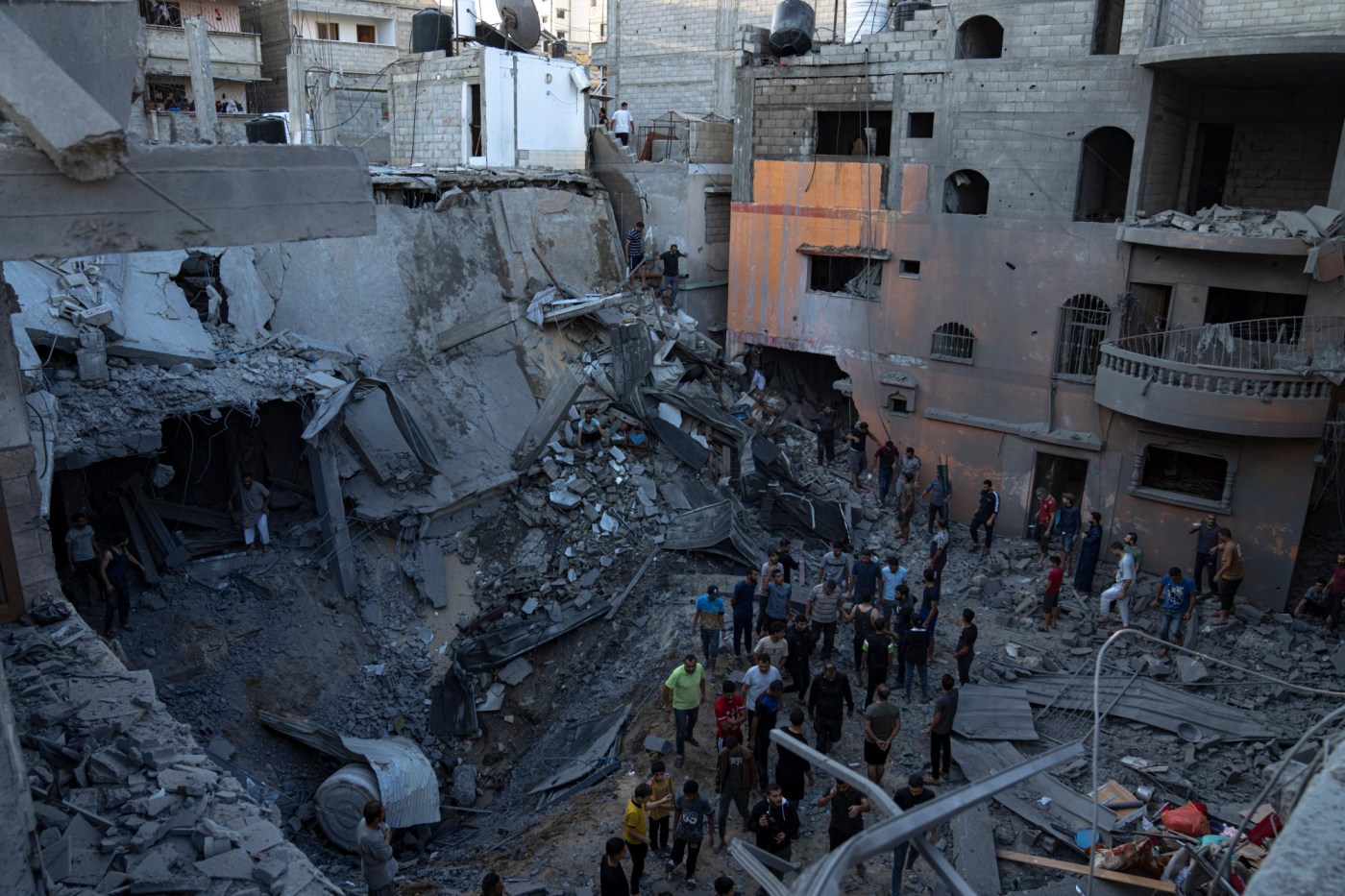
KHAN YOUNIS, Gaza Strip (AP) — Israeli airstrikes pounded locations across the Gaza Strip on Thursday, including parts of the south that Israel told Palestinians to take refuge, heightening fears among more than 2 million Palestinians trapped in the territory that nowhere was safe. Israel’s defense minister told ground troops to be ready to enter Gaza, though he didn’t say when the invasion will start.

With authorities still working out logistics for a delivery of aid into Gaza from Egypt, overwhelmed hospitals tried to stretch out ebbing medical supplies and fuel for diesel generators to keep the equipment running. Doctors in darkened wards stitched wounds by mobile phone light. A doctor at the largest hospital said staff were using vinegar from the corner store to treat infected wounds.

The Israeli military has relentlessly attacked Gaza in retaliation for a devastating Hamas rampage in southern Israel almost two weeks ago. Even after Israel told Palestinians to evacuate the north of Gaza and flee south, strikes extended across the territory and Palestinian militants continued firing rockets into Israel. Hamas has been designated as a terrorist organization by the United States, Canada and the European Union

Meeting with Israeli infantry soldiers on the Gaza border Thursday, Defense Minister Yoav Gallant urged the forces to “get organized, be ready” for an order to move in. Israel has massed tens of thousands of troops along the border.

“Whoever sees Gaza from afar now, will see it from the inside,” he said. “I promise you.”

Israel’s consent for Egypt to let in food, water and medicine provided the first possibility for an opening in its sealing off of the territory. Many among Gaza’s 2.3 million residents are down to one meal a day and drinking dirty water.

Israel did not list fuel as a permitted item, but a senior Egyptian security official said Egypt was negotiating for the entry of fuel for hospitals. The official spoke on condition of anonymity because he was not authorized to talk to the press.

With the Egypt-Gaza border crossing in Rafah still closed, the already dire conditions at Gaza’s second-largest hospital deteriorated further, said Dr. Mohammed Qandeel of Nasser Hospital in the southern town of Khan Younis. Power was shut off in most departments to save it for intensive care and other vital functions, and staff members were using mobile phones for light.

At least 80 wounded civilians and 12 dead flooded into the hospital Thursday morning after witnesses said a strike hit a residential building in Khan Younis. Doctors had no choice but to leave two of the incoming to die because there were no ventilators left, Qandeel said.

“We can’t save more lives if this keeps happening, meaning more children … more women will die,” he said.

The Gaza Health Ministry pleaded with gas stations to give whatever fuel they had left to hospitals. The U.N. agency for Palestinian refugees, UNRWA, gave some of its little remaining fuel stores to hospitals, according to spokesperson Juliette Touma.

The agency’s donation to Gaza City’s Shifa Hospital, the territory’s largest, would “keep us going for another few hours,” hospital director Mohammed Abu Selmia told The Associated Press.

The Gaza Health Ministry said 3,785 people have been killed in Gaza since the war began, the majority of them women, children and older adults. Nearly 12,500 others were injured, and another 1,300 people were believed buried under the rubble, health authorities said.

More than 1,400 people in Israel have been killed, mostly civilians slain during Hamas’ deadly incursion on Oct. 7. Roughly 200 others were abducted. The Israeli military said Thursday it had notified the families of 203 captives.

More than 1 million Palestinians, roughly half of Gaza’s population, have fled their homes in Gaza City and other places in the northern part of the territory since Israel told them to evacuate. Most have crowded into U.N.-run schools-turned-shelters or the homes of relatives.

The deal to get aid into Gaza through Rafah, the territory’s only connection to Egypt, remained fragile. Israel said the supplies could only go to civilians in southern Gaza and that it would “thrwart” any diversions by Hamas. U.S. President Joe Biden said the deliveries “will end” if Hamas takes any aid.

Egypt must still repair the road across the border, which Israeli airstrikes cratered in a no-man’s land and on the Gaza side. No equipment had arrived to start the repair work as of Thursday afternoon, the Hamas spokesman for the crossing, Wael Abu Omar, said.

More than 200 trucks and some 3,000 tons of aid were positioned at or near Rafah, according to Khalid Zayed. the head of the Red Crescent for North Sinai.

U.S. officials said the first deliveries would likely take place Friday at the earliest, with an initial group of 20 trucks. The Egyptian security official also said the first trucks were expected to go in Friday.

Asked if foreigners and dual nationals seeking to leave would be let out of Gaza, Egyptian Foreign Minister Sameh Shoukry told Al-Arabiya TV: “As long as the crossing is operating normally and the (crossing) facility has been repaired.”

Israel had previously said it would let nothing into Gaza until Hamas freed the hostages taken from Israel. Relatives of some of the captives reacted with fury to the aid announcement.

“Children, infants, women, soldiers, men, and elderly, some with serious illnesses, wounded and shot, are held underground like animals,” the Hostage and Missing Families Forum said in a statement. But “the Israeli government pampers the murderers and kidnappers.”

The Israeli military reported Thursday that it killed a top Palestinian militant in Rafah and hit hundreds of targets across Gaza, including militant tunnel shafts, intelligence infrastructure and command centers. It said it also hit dozens of mortar-launching posts, most of them immediately after they were used to fire shells at Israel. Palestinians have launched barrages of rockets at Israel since the fighting began.

Israel has said it is attacking Hamas wherever they may be in Gaza. It has accused the group’s leaders and fighters of taking shelter among the civilian population, leaving Palestinians feeling in constant danger.

After Thursday’s strikes in Khan Younis, sirens wailed as emergency crews rushed to rescue survivors from the crushed apartment building. Many residents were believed trapped under twisted bed frames, broken furniture and cement chunks. A small, soot-covered child, dangling in the arms of a rescue worker, was taken out of a damaged building.

Gaza’s Hamas-led government said several bakeries in the territory were hit in the overnight strikes, making it even harder for residents to get food.

Violence was also escalating in the West Bank where Israel carried out a rare airstrike Thursday, targetting militants in the Nur Shams refugee camp. Israeli troops raided the camp the previous night and were still battling Palestinian fighters inside. Six Palestinians were killed in the camp, the Palestinian Health Ministry said, and the Israeli military said the strike killed militants. Ten Israeli officers were wounded when fighters threw explosives at the troops. More than 74 Palestinians have been killed in the West Bank since the war started.

Hezbollah militants in Lebanon on Thursday said it fired missiles into northern Israel, hitting a kibbutz. The Israeli military said no one was injured and responded with shelling on border areas in Lebanon. Hamas also fired 30 rockets from southern Lebanese toward Israeli towns. Violence on the border comes amid fears the Hamas-Israel conflict could spread across the region.

___

Nessman reported from Jerusalem and Kullab from Baghdad. Associated Press journalists Amy Teibel and Isabel Debre in Jerusalem; Samy Magdy and Jack Jeffrey in Cairo; and Ashraf Sweilam in el-Arish, Egypt, contributed to this report.