Tyson Bagent prides himself on his preparation.
It is, he says, a big part of what has propelled him from being a zero-star high school recruit in West Virginia to the verge of his first NFL start Sunday at Soldier Field.
So when the question came to Bagent on Wednesday during his first news conference as the Chicago Bears Week 7 starting quarterback, he responded as if he had prepared for this too.
What was his backup plan if this dream to play in the NFL didn’t materialize out of his unusual path through Division II football?
“I was going to basically just CrossFit my life away, get as ripped and jacked as I possibly could,” Bagent said without missing a beat. “And be a teacher at Martinsburg High School.”
Martinsburg High, located in eastern West Virginia about 80 miles from Washington, D.C., will have to wait to hire its ripped alumnus.
Bagent, 23, has more odds to defy.
Five years ago, Bagent was beginning his collegiate career at Division II Shepherd, in Shepherdstown, W.Va., his local university and the alma mater of his parents. He had received just two Division I FCS offers — and no FBS offers — despite leading his high school team to two state championships. Less than six months ago, he went unselected in the NFL draft despite a record-breaking collegiate career and solid performance at the Senior Bowl. Seven weeks ago, after a strong training camp and preseason, he beat out veteran PJ Walker to make the Bears roster despite entering camp as the fourth quarterback.
Now, on Sunday when he takes the field against the Las Vegas Raiders, Bagent will become just the fourth undrafted rookie quarterback since 1990 to start within the first seven games of the season, the last Devlin Hodges in 2019, according to NFL Communications.
The duration of this opportunity is unclear. The Bears have said starter Justin Fields’ return from a thumb injury will depend on his grip strength, and coach Matt Eberflus offered an encouraging update Friday, saying Fields is not headed toward injured reserve or surgery as of now.
But regardless of how long Bagent has, he hopes to lead the Bears with a confidence that has impressed teammates and coaches — and that he says comes from being prepared for a moment he and his father, a world champion arm wrestler, always believed was going to arrive.
“Me and my dad really were the only ones who thought that this was going to happen,” Bagent said. “After that, it was just figuring out how I could outwork everybody that maybe had more things than I did, had better facilities and all that stuff. It was really just trying to get it out of the mud, putting a lot of work in the shadows, just so I’d be ready for this week.”
‘Working his tail off’
On the short break NFL rookies get between minicamp in June and the beginning of training camp in July, Bagent knew he needed to practice relaying play calls, so he enlisted the help of Michael McCook, a former Shepherd tight end, current assistant and the son of head coach Ernie McCook.
Bagent stood in the middle of the football field wearing an earpiece and took phone calls from his friend.
Michael McCook delivered the play call to Bagent, who then went through the presnap process, approaching the invisible huddle to give the call, putting his imaginary teammates in motion and making adjustments at the line of scrimmage.
“They did it in person, and then if one was on vacation or at the beach, they would do it by telephone,” Ernie McCook said. “And that’s who he is. I told every NFL scout that came in here, ‘You are never going to embarrass yourself by bringing him up, jumping on the table for him. I don’t know if he can make your team. But nobody is ever going to say, why did we bring this guy into camp?’ And I think that’s showing up.”
Ernie McCook watched Bagent grow up. He went to the same church as the Bagent family and taught Bagent’s father, Travis, at Shepherd. He observed the family’s oldest child from afar, noting the way he carried himself with poise as a high school student who was well known in the area because of his prep success.
And as soon as Bagent signed with Shepherd, McCook saw the work the quarterback was willing to put in. Bagent, still a high school senior, arrived at spring practices to stand behind the huddle and observe.
McCook likes to tell a story from July of Bagent’s sophomore year. The Friday before offensive coordinator Tye Hiatt left for a family vacation, Bagent called to see if he could go over to his house to review some things on offense. That night, Hiatt’s wife made dinner and packed the van so the pair could talk football. It was the middle of summer, but Bagent couldn’t wait a week to confer with his coordinator.
Bagent sees work like that as a fuel for his confidence, especially going up against competition that is far superior to what he has faced for most of his career.
“Going through college football, you start to see guys who are really good that don’t make it because they don’t know where they’re going,” Bagent said. “So if you’re not the fastest guy here and you’re not the best athlete on the field, as long as you know where you’re going … or know what everybody’s doing, you’re usually going to operate a little bit better than guys that might be a little bit better than you physically.
“Especially at this level, everybody’s really smart and really fast, so really understanding what’s going on around me has been the only real focal point since I’ve been here.”
When Bears offensive coordinator Luke Getsy first got to know Bagent while coaching at the Senior Bowl in January, Getsy thought the quarterback was a little nervous. But as he got to know Bagent better throughout the week, he realized Bagent was simply ultrafocused on his preparation.
“It was because he was working his tail off so much by the time we got to Wednesday, Thursday (of that week) I saw a guy ready to rock and roll,” Getsy said.
That work has carried over to preparing in his role with the Bears.
Wide receiver Tyler Scott sat next to Bagent on a couple of plane rides home from games, and Bagent already was diving into film. When Bagent watched Fields take starters reps during practices earlier this season, Eberflus asked the backup two or three times per period to tell him about a play — and Bagent always was on it. And tight end Cole Kmet said Bagent didn’t mess up a play call in the huddle during the last week of practice.
“And these are long play calls,” Kmet said. “You’d have a tough time repeating these things.”
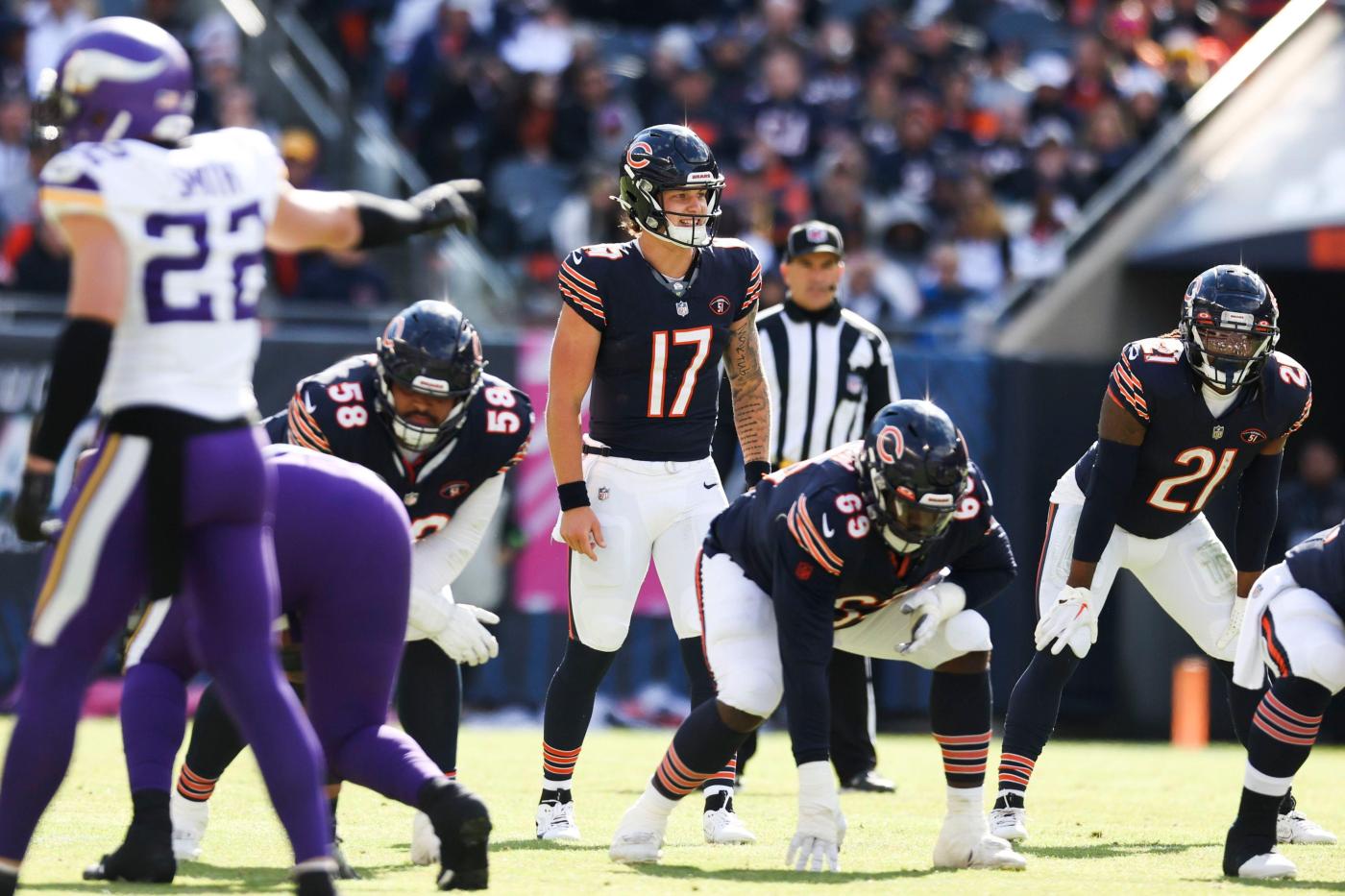
Bagent said when the Bears needed him to play when Fields was injured in the third quarter Sunday against the Minnesota Vikings, he reassured them he was ready.
“Whatever they want to put on that call sheet will be understood through and through by myself,” he said. “I put that on me going into the game last week. I just told them, ‘I know you guys have a lot of faith in me, but I want to let you know I know the whole call sheet so don’t be afraid to do your thing, call your plays. Don’t hinder the offense just because I’m going in there because I’ve prepared for this all week.’ So I take pride in doing that.”
Along with his preparation, Bagent has something else that gives him confidence — a whole lot of football under his belt, even if it was against lesser competition.
A record-breaking career
The throw Brian Walker calls “arguably the greatest pass in Division II history” came against Notre Dame in the final seconds of the second round of the 2021 playoffs. To be clear, that’s Notre Dame College of South Euclid, Ohio.
Notre Dame took a 34-31 lead with 28 seconds to play. But after a kickoff return and a 32-yard Bagent pass, Shepherd had the ball at the Falcons 23-yard line with 10 seconds to play. As the pocket collapsed, Bagent broke right and delivered a strike in the final second to Josh Gontarek, who made the leaping catch in the end zone, tumbled down and ran to the fence, where exuberant fans watching from a hill scrambled down to celebrate.
“The stadium goes crazy,” Walker said.
A few weeks later, Bagent won the Harlon Hill Trophy, given to the best player in D-II football.
That touchdown pass was one of an NCAA all-divisions record 159 Bagent threw during his career at Shepherd. Walker, a tight end, caught No. 149, which set the D-II record against East Stroudsburg, whose coach, Jimmy Terwilliger, held the previous record. And Walker also caught No. 158 against Indiana (Pa.), which broke the NCAA all-divisions record held by Monmouth’s Alex Tanney, now the Philadelphia Eagles quarterbacks coach.
“We knew a long time ago that Tyson was the real deal,” said Walker, who spent the offseason program with the Baltimore Ravens. “What he’s doing right now is nothing but excellent, but not surprising for guys that have seen him for so long.”
Out of high school, Bagent only received offers from FCS Albany and Robert Morris, an obvious “mistake” by other programs, McCook declared.
“Their decisions made me very lucky and our program very lucky,” he said.
Bagent seized Shepherd’s starting role as a freshman, throwing for 518 yards in his first game, and by the end of that season, McCook realized Bagent was his best player and leader on the field. His stats got better each season, getting to 5,000 yards and 53 touchdowns in his junior year.
“We never felt we were out of a game,” McCook said. “He has a way to will teams to win. He has great poise and composure. He has a tremendous competitiveness. And he’s one of these players I truly believe make people around them better.”
After that 2021 season, Bagent entered the transfer portal to weigh going to a Division I school and made official visits to West Virginia and Maryland. He strongly considered Maryland but eventually decided to stay at Shepherd because the path to graduation would have required significantly more credit hours if he transferred and he wanted stay near his sick grandfather.
“I didn’t think it would affect my ability to get (to the NFL). I thought it might affect the stock a little bit,” Bagent said of not transferring. “But I felt like I was already playing for the best coaching staff. I felt like I was already in a winning situation. In hindsight, I definitely made the right decision in staying and coming back.”
McCook had listened to Bagent throughout the whole process as a high school coach might advise his recruit, trying to remove his viewpoint from the situation, but when Bagent called to tell him he was staying at Shepherd it was a relief for both. Bagent was set to go to the compliance office to be removed from the portal the following Monday, but snow blanketed the Shepherd campus, shutting down the facilities and delaying the move.
The next day when Bagent went into the athletic offices, an anxious McCook offered to walk him down to the compliance office.
“It was one of those things I wanted to make sure it happened,” McCook said with a laugh. “It was something I’m glad he did because he got a chance to explore it. … I just wanted to make sure he had an opportunity to get into an NFL camp.”
McCook said they tried to “roll out the red carpet” for the scouts from every NFL team that traveled to Shepherdstown over the next year as Bagent threw for 4,580 yards, 41 touchdowns and eight interceptions as a senior. That Bagent wasn’t one of 14 quarterbacks drafted this year was a surprise to those at Shepherd who saw him throw for 17,034 career passing yards — the Athletic had given him a seventh-round grade — but it paved the way for the Bears to step in and sign him as an undrafted free agent.
Poise needed
During Bagent’s college career, Shepherd had a football fundraiser called “Pulling for the Rams,” at which players competed in tug of war in front of fans. At the end, Travis Bagent lined up all of the players and arm wrestled each one by one.
“He put us all down,” Walker said. “We’ve all had our taste of the arm wrestling, and none of us have been pursuing it since.”
In the few meetings with Chicago reporters so far, Tyson Bagent is quick to connect his family’s support to his success and motivation. Travis Bagent, whom Walker called “everything you’d want in a dad, everything you’d want in a sports agent, marketer,” is a loud, outgoing man who earned a name through his arm-wrestling prowess well before his son became known.
Bears wide receiver Darnell Mooney had seen a video of Travis arm wrestling NFL Network host Tom Pelissero at the scouting combine this year. When Mooney put it together that Travis was Tyson’s father, it made sense.
“I’m like, ‘Oh, I see where you get your confidence from,’ ” Mooney said.
As McCook sees it, Travis has been a driving force in his son’s competitive nature, while Tyson’s mother, Casey, is the more laid-back, calming presence. Tyson, he said, is a mix of both.
And Bagent certainly will need both this weekend.
Bagent didn’t brush off the questions this week about the differences between playing West Chester (Pa.) one year ago and the Raiders and Pro Bowl defensive end Maxx Crosby this week.
He was made aware of what he was facing three snaps into replacing Fields against the Vikings, when safety Josh Metellus knocked the ball from his hands and linebacker Jordan Hicks returned it for a touchdown.
Bagent bounced back to lead a touchdown drive but then threw an interception to Byron Murphy Jr. on an underthrown deep shot to DJ Moore as the Bears were trying to take the lead. It was one of many learning experiences he’s sure to face for as long as he’s starting for the Bears.
“He’s right in the middle of the pocket and he took three hitches,” Getsy said. “He really ran himself into the left guard. So, it’s one hitch, let it fly. … If you get the hesitation, then you’ve got to go get your checkdown, and he didn’t do that.”
Poise has been a common descriptor among those who know Bagent well and those still getting to know him. It’s sure to be tested Sunday, but Walker said he always passed the challenge at his previous stop.
“Cool as a cucumber,” Walker said. “That’s not coachable. That’s something you’re born with and you develop on your own. … He can throw an interception and he’s not going to come to the sideline and start screaming and yelling, throwing stuff around, nothing like that. He evaluates what happens, takes it, gets back out there and makes the correction.”
Bagent’s opportunity in the starting role might be short-lived. Eberflus said the swelling in Fields’ hand has gone down and Fields is getting some strength back in it. The Bears will give him the reins back when he’s healthy. So Bagent will have to take advantage of what he is given to make an impression.
Bagent said his family members checked in with him all week to make sure he wasn’t “freaking out behind the scenes” as he prepared.
He told them he was good.
“Coming from where I come from, I’ve pretty much beat every odd that there was for me,” Bagent said. “So I’ve got nothing to lose. I’m going to go out there and fight with these guys to the death and try to stack up as many wins as I can until we get Justin back.”
()