NYT admits error in Gaza hospital report

posted in: News | 0

The New York Times walked back its initial coverage on the explosion that killed hundreds of Palestinians at a Gaza Strip hospital last week, saying in an editors’ note that the newspaper “relied too heavily on claims” made by the Hamas militant group.

Soon after a huge blast rocked the al-Ahli Hospital on Tuesday, finger-pointing over its source began.

Hamas, which has been battling Israel since its Oct. 7 surprise attack on Israeli soil, called the blast a “horrific massacre” and blamed the Israeli government. Israel, however, blamed the Islamic Jihad, a smaller, more radical group that often works with Hamas.

Several news outlets, including The Times, Reuters and The Associated Press faced criticism for publishing Hamas’ viewpoint prominently in articles and on social media.

“The Times’s initial accounts attributed the claim of Israeli responsibility to Palestinian officials, and noted that the Israeli military said it was investigating the blast,” reads the Times’ editors’ note published on Monday. Early coverage “relied too heavily on claims by Hamas, and did not make clear that those claims could not immediately be verified.”

The newspaper’s coverage had a clear impact, according to the note: “The report left readers with an incorrect impression about what was known and how credible the account was.”

It’s still unclear exactly how the explosion at the hospital occurred, but it doesn’t appear that Israel was at fault.

An Associated Press analysis found that a rocket fired from within Palestinian territory that broke up while in the air likely fell onto the hospital, causing the catastrophe. Citing U.S. intelligence, President Joe Biden told Israeli Prime Minister Benjamin Netanyahu on Wednesday that it looks like “the other team did it.”

“While we continue to collect information, our current assessment, based on analysis of overhead imagery, intercepts and open source information, is that Israel is not responsible for the explosion at the hospital in Gaza yesterday,” National Security Council spokesperson Adrienne Watson tweeted after Biden’s statement.

The Times stopped short of an apology for its initial coverage but said editors should have been more careful with the way the blast was represented.

“Given the sensitive nature of the news during a widening conflict, and the prominent promotion it received, Times editors should have taken more care with the initial presentation, and been more explicit about what information could be verified,” the note reads.

A Former House Moderate Republican Warns of Lasting Damage in Speaker Fight

posted in: Politics | 0

ALBANY, N.Y — Former Rep. John Katko is rooting for the Republican moderates as the House speaker fight drags on without a resolution in sight.

Katko cheered Republicans from New York who represent swing districts around the New York City area for opposing Rep. Jim Jordan’s bid for speaker. For him, it’s a sign that hardball tactics from the far right in the conference won’t always work.

Katko knows a lot about swing district politics: For four terms, he represented a battleground seat in the Syracuse area. He was willing to oppose fellow Republicans’ proposals for Obamacare and cast a vote to impeach former President Donald Trump following the Jan. 6 attack on the U.S. Capitol.

In an interview with POLITICO, Katko lauded New York freshman Reps. Anthony D’Esposito, Nick LaLota and Mike Lawler as well as second-term New York lawmaker Andrew Garbarino for opposing Jordan’s bid on three ballots.

The narrow Republican majority in the House could hinge on whether those lawmakers are reelected next year because New York is a vital swing state in six races in 2024.

House Republicans on Monday are set to try again and find a new speaker with a field of nine candidates. But Katko is also worried the impasse will have long-lasting effects for Republicans going forward and has exposed deep divisions within the party.

The interview is edited for length and clarity.

Nick Reisman: Why is this happening now in the House?

John Katko: I think what’s happened is that a very small number of members of the far right took it upon themselves to use a motion to vacate, and they never had a plan for what would come after they were successful.

The chaos that’s ensued has really illuminated the divisions in the party. Not only has it illuminated them, it’s kind of deepened and hardened those divisions.

Now we’ve got a real problem because the moderates have finally pushed back and said enough’s enough. The far right feels falsely empowered because of concessions made to them by Kevin McCarthy to get the speakership.

They’ve just got to hope sanity will prevail at some point and someone will emerge to lead this group out of this mess. But make no mistake: There’s going to be a lot of scars in this fight and those scars are going to last a long time in the party.

Reisman: What are those scars going to look like?

Katko: I think it’s going to be harder to get some consensus on things, because the battle lines are now firmly drawn. Jordan did some damage with his heavy-handed tactics that turned off a lot of people. It’s going to take someone who is truly a great leader to emerge and cut through the nonsense so we can get some things done.

I can’t imagine, for example, them working through any bills of consequence given the divisions they have right now.

Reisman: That’s something of a problem right now, given the upheaval we’re seeing in the world right now in Ukraine and Israel.

Katko: If they get an aid package passed, someone from the far right could easily move to vacate the chair again. But they’ve got to try and lead, they’ve got to try and govern.

Reisman: What options exist for vulnerable freshmen from swing districts who didn’t support Jordan for speaker? What do they need to do?

Katko: They already made their stand. They showed their independence. They bucked the far right and stood up to their party. I think they’ve got a very good narrative going into the election year that they’re part of the solution, because they’re not going to allow the far right to take over the party.

Good for them. It’s going to help them going forward. For Lawler, D’Esposito, LaLota and Garbarino — those guys all stood firm and said we’re not taking this anymore from the far right. I dare say you even look at people like them and say they’re the heroes, because they prevented the party from going too far to the right.

Reisman: How would you describe the factions within the House Republican conference? Have they gotten worse since you were in office?

Katko: I think the far right had an overblown sense of self-importance that was sprung from concessions they wrung from Kevin. But now they’ve found out they’re not going to get their own way, and that’s a good thing.

What the far right figured out on this one is you can only push the moderates and other elements of the party so far before they’re going to stand up and push back. They did, and that’s why Jordan failed.

Reisman: Will the speaker fight cost the party control of the House next year?

Katko: I think it’s too early to tell, and it ultimately depends on whether Trump ends up as the nominee or not. I think Trump being the nominee is going to have a far greater negative impact on these seats than the shenanigans that have taken place in the House.

But make no mistake about it: The shenanigans that have taken place are not going to help. Trump being on the ticket in moderate districts is going to be a very, very difficult thing.

2024 NFL draft watch: Caleb Williams’ clunker at Notre Dame doesn’t deter evaluators that the USC QB will be the No. 1 pick

posted in: News | 0

Josh Lucas was sitting in his Halas Hall office, engaged in the tedious process of going through film, when he was gobsmacked.

Play, rewind, play, rewind, play. With each click of the remote, his amazement grew.

Caleb Williams, in his second start for Oklahoma on Oct. 23, 2021, handed the ball off to running back Kennedy Brooks on fourth-and-1 with the Sooners, a 38 1/2-point favorite, clinging to a 28-23 lead at lowly Kansas. Less than six minutes remained and the ball was at midfield.

Brooks was stacked up by the Jayhawks, about to be dropped for a loss, when Williams ran up, ripped the ball from his teammate’s clutches, spun forward for a first down and propelled the Sooners to victory.

“I got up out of my seat,” said Lucas, then the Chicago Bears director of player personnel, “and I walked into (assistant director of player personnel) Champ Kelly’s office and I was like, ‘In three years, this guy will be the first pick in the draft.’

“To have the wherewithal, instincts and awareness to do what he did, combined with the throws he was making …”

Inserted into the Red River Rivalry against Texas two weeks earlier for a fourth-and-1 play, Williams shook a couple of Longhorns at the line of scrimmage and raced 66 yards for a touchdown, sparking Oklahoma’s comeback from a 28-7 deficit to a 55-48 win. The true freshman from Washington, D.C., quickly took over from Spencer Rattler and carried the Sooners to an 11-2 record.

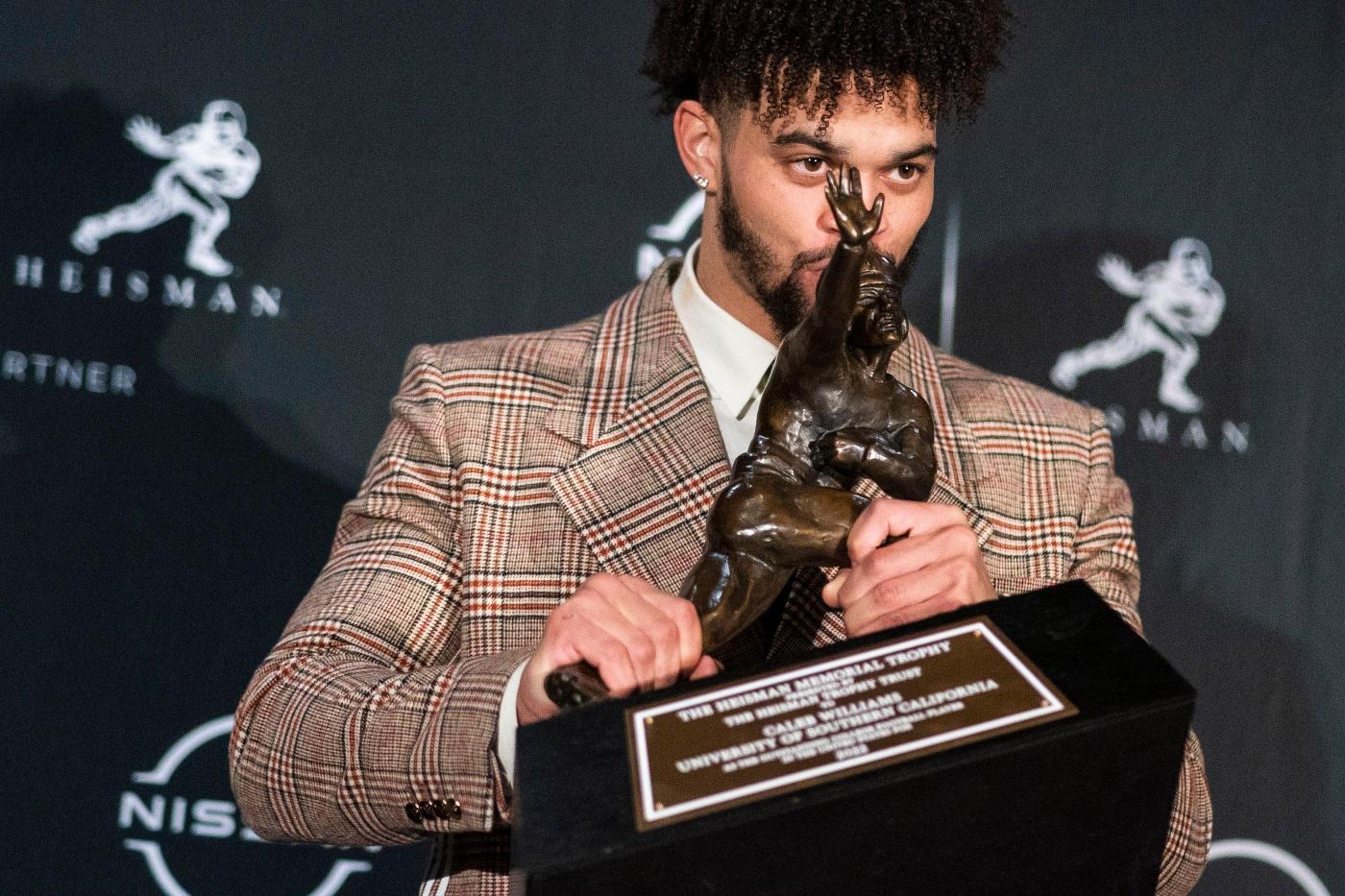
The internet is packed with videos of dazzling throws from all platforms, off-schedule plays careening toward disaster that turn into highlights and big-armed shots downfield. Williams transferred to USC after his freshman season, following Sooners coach Lincoln Riley to Los Angeles, and threw 42 touchdown passes with only five interceptions and ran for another 10 scores en route to winning the Heisman Trophy.

All of that made the first half last Saturday at Notre Dame Stadium as jarring as an uppercut to the jaw. Had the Irish, who romped to a 48-20 victory while handing the Trojans (6-1) their first loss, discovered the kryptonite for Williams, who has been nicknamed Superman?

Williams was sacked on his first dropback. Two snaps later, with defensive end Javonte Jean-Baptiste bearing down, he backpedaled before lofting a pass to tight end Luke McRee that safety Xavier Watts intercepted.
On the second series, facing third-and-8, Williams threw back across the field to wide receiver Tahj Washington, netting only 5 yards. It appeared there was ample room to run for the first down.
Deep in his own territory in the second quarter, Williams tried connecting with wide receiver Dorian Singer, launching a ball into traffic for Watts’ second interception. The pass was tipped at the line of scrimmage, but Singer was double-covered.
Rolling left on the next possession, Williams was falling back when he forced another throw. Cornerback Benjamin Morrison picked it off.

Notre Dame turned all three interceptions into touchdowns, and the rout was on after a calamitous 30 minutes for Williams, who entered the prime-time showdown with 85 career touchdown passes versus 10 interceptions.

“I made mistakes that I usually don’t make,” Williams said afterward. “I’ve been in college for three years now and I don’t think I’ve ever had a season or a game or anything like that. So nights like that happen.

“You’ve got to get through it, you’ve got to keep fighting, you’ve got to be a leader. It starts at the head of the snake and I’ll be better.”

Bears general manager Ryan Poles and co-director of player personnel Jeff King watched it unfold from the press box, where three other GMs were present: Kwesi Adofo-Mensah (Minnesota Vikings), Brandon Beane (Buffalo Bills) and Joe Schoen (New York Giants).

A rugged Notre Dame defense — certainly more physical than any the Trojans faced against San Jose State, Nevada, Stanford, Arizona State, Colorado and Arizona — flustered Williams into 23-of-37 passing for 199 yards with one touchdown, the three interceptions and six sacks.

Williams was plagued by poor decision-making. He didn’t manage the pocket well when there was time. He was inclined to play off schedule, and more times than not it played in the defense’s favor — something Bears fans have seen too often with Justin Fields.

“There were team meetings where he was throwing some of his passes,” one scout said of Williams throwing into traffic.

Nonetheless, as the Bears prepare for the 2024 NFL draft — they would be selecting first and second based on the current standings — Williams looms as a tantalizing possibility for Poles and an organization that’s struggling to get it right 2 1/2 seasons into Fields’ tenure.

In a scouting process that encompasses everything — NFL teams are likely to chart every throw a quarterback makes in college and will plunge deep into personal background — what does Williams’ clunker in South Bend mean in the big picture? The Trojans’ last five regular-season games include meetings with No. 14 Utah, No. 5 Washington and No. 9 Oregon.

There hasn’t been a quarterback more consistently compared to Patrick Mahomes, the two-time MVP and two-time Super Bowl MVP the Bears passed on in the 2017 draft when they chose Mitch Trubisky. Was this a potential red flag?

“They all have those kind of games,” an AFC assistant GM said. “Josh Allen had one. Mahomes did. It didn’t move me a particular way. Didn’t change anything. Caleb is the No. 1 pick.”
“I hope that game turns 31 other teams off,” one national scout mused.
“No,” an NFC general manager said. “I have seen too much from him over the last two years.”
“They’re not really a good team,” another national scout said. “It’s just him. The game before (a 43-41 triple-overtime victory over Arizona), they almost lost. He put the team on his back. They struggled and he said, ‘I got this.’ To have that competitive fire and to be talented, that’s where the special matches up. I think he’s going to be great.”
“You have to look at it,” one high-level scout said. “It’s the first time I’ve seen batted balls and bad decisions, and they are going to be playing some other good teams coming up.”

Superlatives for Williams are through the roof. He has been called the kind of prospect that comes around once a decade. Some have said he’s the best quarterback prospect since Andrew Luck in 2012. Others have dared to go all the way back to John Elway in 1983.

Sean Payton, in an appearance on Fox Sports’ “The Herd” last November, labeled Williams a “generational” talent. Now the coach of the 1-5 Denver Broncos, Payton’s team could be in the running for the No. 1 pick.

“At some point we’re going to move to a lottery system in the NFL because this is a player that possibly does that,” Payton said last fall. “Here you are in Weeks 14, 12, and clubs begin to lose to try and put themselves in that position. That’s not been a problem to date with our league as we know it.”

A college scouting director said debating where Williams stacks up in the last 10, 20 or 40(!) years is a talking point for media, not germane to the pre-draft process.

“But he is everything everyone says he is,” the scouting director said. “Once a decade or generational? Who the hell knows. They said the same stuff about five other dudes in the last 10 years.

“He is more mechanically clean than Mahomes was coming out. Mahomes would put the ball in harm’s way a lot. He was throwing the ball 60 times a game sometimes because he was pressed to put points on the board. He didn’t have a conscience when he was in college: ‘So what if I throw three picks? I’ve got to throw eight TDs to win.’”

The nitpicking — and it’s real even for such an uber-talented player — will focus on Williams’ ability to produce from the pocket. Can he be coached to play there more? USC lists him at 6-foot-1 and 215 pounds. He’s probably just a shade over 6 feet, but scouts love his lower-body build and strength.

“Really, really talented,” an AFC general manager said. “You can’t deny it. He can play in the pocket. He likes to get out, he likes to be off schedule. He’s dangerous with his legs. He probably takes too many sacks, but the line isn’t great. It’s a matter of what you’re doing. He’s not your typical pocket quarterback, but he can play in the pocket and he’s got a good arm. He likes the weight room.”
One national scout, when he first watched Williams in person last season, punctuated the first three words of his reaction: “This. Is. Mahomes.”
“He has that thing that the really good ones have that at any moment they can make a big play if you don’t play the defense perfectly,” an assistant GM said. “That’s one of those tough-to-measure qualities, but he’s got it and you see it time after time after time. There are some instances, just like last week, where it doesn’t work. But he just has that it, man. I don’t know what it is and I can’t put a value on it, but I know he’s got it.”
“He’s more advanced,” a national scout said. “It’s almost like he’s where Mahomes was after two years in the league.”

Former Miami Dolphins and Vikings GM Rick Spielman, who was the Bears director of pro personnel from 1997-99, found a positive takeaway in the loss to the Irish.

“Caleb is a unique talent,” Spielman said. “Arm talent, off-schedule throws, playmaking ability. I guess the negative is he can’t hold the ball as long as he can now, and that’s the thing that most of these college quarterbacks need to learn. The ball has got to be out. He has the luxury of being able to do that because he’s such a good athlete. But I think he can get through his progressions better than Justin Fields did when he came out.

“All the physical tools are there. For as bad as he played at Notre Dame, the one thing that told me about the kid’s competitiveness is that in the second half, he played like he played all year — made really good throws, made really good decisions — which showed me the maturity level after having such a crappy first half and not letting it affect him. That was a huge positive in my mind.”

So does Spielman see Mahomes when he watches Williams?

“I may be out of whack,” Spielman said, “but Andrew Luck. Andrew wasn’t as athletic, but he could move around, he was a very good thrower, he could do it from the pocket and outside. He did a lot of similar stuff as a thrower. That’s the first guy that popped into my head.”

Williams’ arrival last year restored luster to the USC program that had been mostly missing after coach Pete Carroll’s run (2001-09), which included seven consecutive seasons of 11 or more wins. Williams set most of the school’s major single-season passing records while leading the Trojans to an 11-3 record, and remember, it was his first year as a full-time starter after beginning behind Rattler at Oklahoma.

He made Trojans games at the LA Coliseum a place for A-list stars again. He walked the Hugo Boss runway at a fashion show in Miami. The Los Angeles Dodgers had a Caleb Williams bobblehead giveaway. He threw out a first pitch at a Washington Nationals game. He possesses the media savvy of a 10-year NFL veteran.

“It’s something and someone to get excited about,” said Mark Sanchez, the former Bears quarterback who compared the vibe around the USC program to his freshman season in 2005, when Matt Leinart and Reggie Bush led the Trojans to the national championship game. “The style of play adds to it. It kind of punctuates this whole Caleb Williams phenomenon. He’s not just your average kind of player that is going to concede a snap here or there to the defense. This dude is going to try to win every snap.

“It is a fun style of play, and as soon as the initial read or couple reads are done, that thing totally transforms and he becomes an artist out there. That’s added to this persona and figure that he’s created.”

Said former Bears quarterback Vince Evans, who was MVP of the 1977 Rose Bowl for USC: “He’s the face of the university, he’s the face of Los Angeles. He’s an exceptional talent. He’s a great leader, great motivator. Seems to be a solid role model. I don’t get very moved by many players, but he’s magical in some plays.”

In New York to accept the Heisman in December, Williams was humble in front of the three other finalists — C.J. Stroud, Max Duggan and Stetson Bennett — whose teams remained in national title contention.

“I may be standing up here today, but y’all get to go to the College Football Playoff,” Williams said. “Guess you can’t win them all.”

That competitive streak no doubt resonated with NFL teams.

Williams is just the second Heisman winner to be able to profit from NIL (name, image, likeness) money while in school, and On3.com estimates his valuation at $2.7 million. He has deals with Wendy’s, Beats by Dre, United Airlines and others.

An NFC GM scoffed at that figure — suggesting Williams is raking in significantly more.

The point is Williams could return to USC for his senior season in 2024 — something his father, Carl, didn’t rule out in a GQ profile published last month — and still be well-compensated. Carl lamented the way the draft is structured with the best player going to the worst team.

“He’s got two shots at the apple,” Carl said. “So if there’s not a good situation, the truth is, he can come back to school.”

NFL types don’t seem concerned Williams would bypass the draft. The real money elite quarterbacks are chasing is the windfall that comes with a second contract. Jalen Hurts’ second contract with the Philadelphia Eagles guaranteed him $180 million, Justin Herbert got $218 million guaranteed from the Los Angeles Chargers and Joe Burrow received $219 million from the Cincinnati Bengals. All three deals were signed since April.

If Williams enters the NFL in 2024, he would be eligible for a second contract in 2027. Guarantees for quarterbacks could approach $300 million by then. Returning to school could expose Williams to injury. The team with the No. 1 pick in 2025 is unlikely to be in a much better position than the one next April.

“Whoever has the No. 1 pick, he’s it by far,” another NFC GM said. “There’s no question he would have been the first pick this year.”

()

Five things we learned from the Ravens’ 38-6 win over the Detroit Lions

posted in: News | 0

The Ravens met their greatest test of the season with their best performance, beating the Detroit Lions, 38-6, thanks to imaginative offense and a vicious pass rush.

Here are five things we learned from the game.

This was the complete effort the Ravens had been after

They had chased this feeling.

The Ravens came into this season believing they were designed for greatness. For six weeks, however, every step in that direction was undercut — by injury, by carelessness, by lack of imagination. They outplayed each opponent, but their record, solid as it was, did not reflect this.

Tight end Mark Andrews called them a “sleeping giant.”

They knew they could not afford to be their own worst enemies against the Lions. Strange as it sounds to fans who have followed football for the past 60 years, no team was playing better than Detroit on both sides of the ball. Every metric said a new NFL power had roared forth from the Motor City.

The Ravens, by contrast, seemed like an afterthought in discussions of possible Super Bowl contenders. They did not have a signature win to push them to the forefront.

Now, they do.

The score, against an opponent that had won each of its past four games by at least two touchdowns, was impressive enough. But the Ravens did so many things so well. That’s what will resonate as we consider their potential going forward.

Their ballyhooed receivers dashed into open spaces. Their big men owned both lines of scrimmage. They shook the efficiency right out of the Lions’ passing game with pressure. They finished each relentless drive in the end zone. Lamar Jackson was equal parts sharpshooter and puppet master.

Lions coach Dan Campbell put it more succinctly: “They kicked our [butts]. It’s a credit to them.”

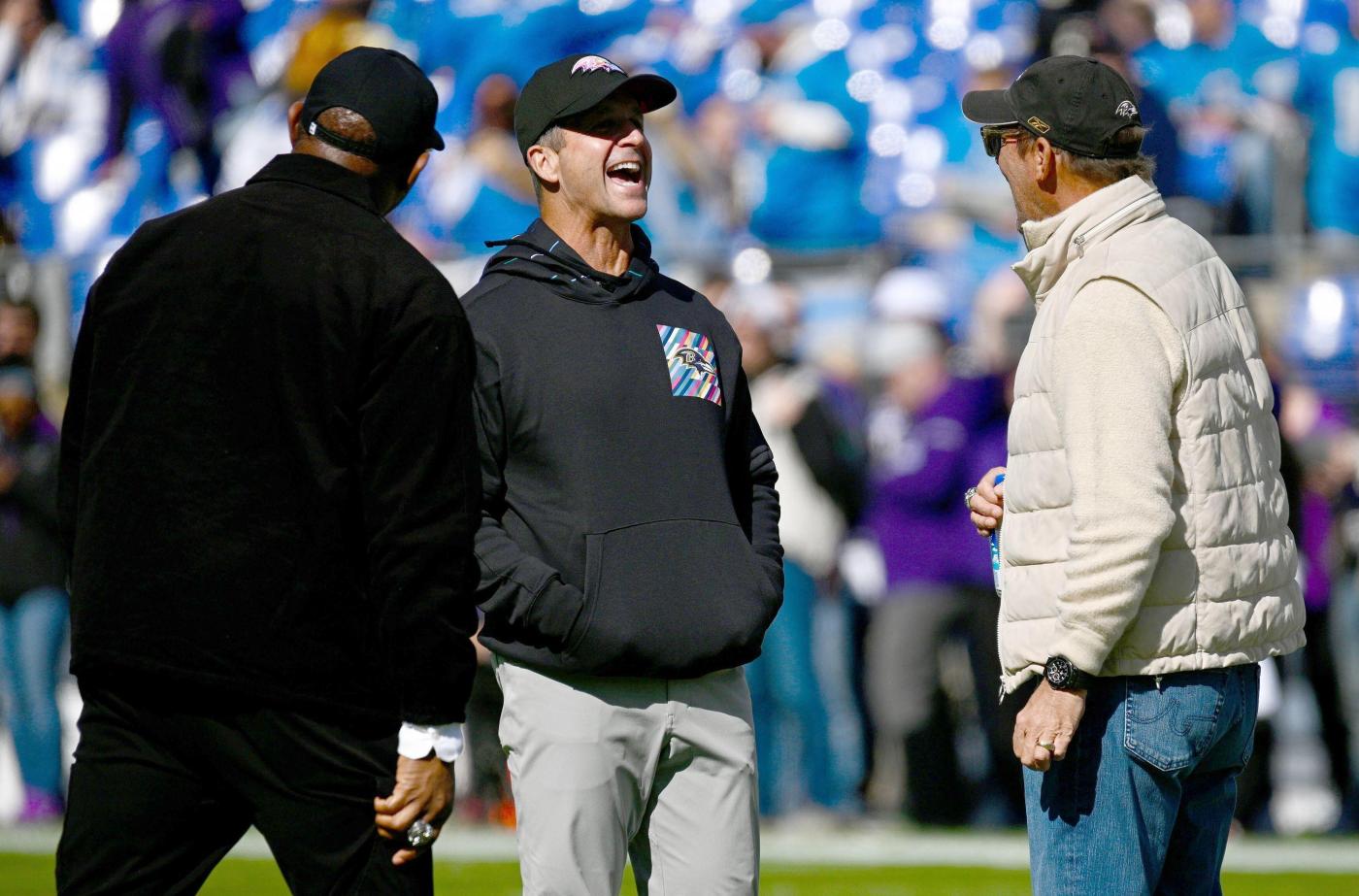
Was it a grand statement? “We’re just going to define it in terms of what we think we’re capable of playing like,” coach John Harbaugh said. A good answer.

Did the Ravens become a closer team in London, sifting through the ashes of their terrible collapse against the Pittsburgh Steelers? Several players suggested they came back from their overseas trip with more cohesion and purpose.

“I can tell you right now, the focus throughout the week — in walk-throughs and meetings, players asking questions, clarifying what needed to be done, things that need to be fixed — when you can do that as a collective group, you know you’re always striving to get better,” right tackle Morgan Moses said.

Many teams take a bye to recover from the long journey, but the Ravens were too concerned about the Lions, 5-1 thanks to an efficient offense and a punishing defense, to worry about jet lag. They knew that if they did not play with purpose, they could be embarrassed. Instead, they did the embarrassing.

The giant stayed wide awake for 60 minutes.

Execution matched design on a pristine day for Todd Monken’s offense

Here, finally, the Ravens brought to vivid life the vision that had danced in fans’ heads since Monken replaced Greg Roman as offensive coordinator.

Pass fed into run, fed back into pass. Every trick produced magic. Jackson had as much time and as many free targets as he needed.

The Lions had allowed 4.7 yards per play over their first six games. The Ravens averaged 9.6 in the first half. Jackson’s full-game high coming in was 237 passing yards. He threw for 255 before halftime. Only his botched exchange with running back Justice Hill kept the Ravens from scoring on their first five drives.

Harbaugh gave Monken and his staff a game ball afterward.

“We took advantage of what Todd saw,” Andrews said. “He called a really good game.”

Jackson made a sharp read to get their initial drive going, pulling up on what looked like a run and flicking the ball to Odell Beckham Jr. for 11 yards. On the very next play, Zay Flowers found a vast opening in the middle of Detroit’s zone, and Jackson found him for 46 yards. The Ravens were in danger of stalling in the red zone, as they had too often over the previous two weeks, but Harbaugh went for it on fourth-and-1, and Jackson scored easily off a bootleg.

By their third drive, the Ravens felt comfortable digging deep into their bag. Fullback Patrick Ricard rumbled 28 yards after Jackson found him with no defender in sight. Rookie running back Keaton Mitchell, playing the first offensive snaps of his career, lined up in the slot, then motioned toward Jackson to take a jet sweep for 9 yards.

The fourth time they had the ball, it was a running back party, with Gus Edwards and Hill gashing the Lions for gains of 20 and 27 yards, respectively.

On the Ravens’ first drive of the second half, Jackson drew the Lions to him with the threat of a run, then lofted the ball to Edwards, who had run behind the entire defense, for an 80-yard gain to set up another touchdown. It was a nifty play that leveraged Jackson’s best qualities, though he hinted there was improvisation involved.

“We had a success with it,” Jackson said with an eyebrow raised. “So I’m gonna say it was schemed up.”

Campbell watched Jackson toy with his defense in a way no quarterback, not even Patrick Mahomes, had all season. “Lamar beat us,” he said. “He hammered us with his arm. He threw the ball extremely well. He ran when he needed to, and we did not handle it well.”

Monken would be the first to say he merely sets up the canvas on which Jackson performs his artistry. Credit is irrelevant. Both men worked at their highest levels against Detroit.

The offensive line deserved its own game ball

Monken’s designs could not have sprung to life if Jackson had no time to orchestrate them against a rugged Detroit front. He frequently had eons to dance around, waiting for a receiver to pop open.

The Lions, fifth in pass DVOA through six games, finished with no sacks and one quarterback hit. Their rising superstar, defensive end Aidan Hutchinson, hardly got near Jackson. You don’t get much cleaner than that.

“Ten out of 10,” Andrews said when asked to grade the offensive line’s performance.

They had foreshadowed this effort with a stellar pass blocking performance in London against the Tennessee Titans. All five starters were healthy for the second week in a row, vital for a unit that depends on chemistry more than any other on the team.

“We’re jelling, man,” Moses said. “That’s the part of offensive line, right, you’ve got to grow; you’ve got to jell. We operate as five, not as one individual. When Tyler [Linderbaum] gets up there and gives us the calls, and we’re all in one sync, we can play a lot faster.”

With five sacks against a top offensive line, the Ravens showed their pass rush can’t be called a fluke

The Ravens came in tied for the league lead in sacks. Detroit’s offensive line had pass blocked about as well as any in the league.

Defensive coordinator Mike Macdonald attacked this problem with his usual array of stunts and simulated pressures, at times loading his pass rushers on one side to create mismatches. His tactics worked like a charm, fueling talk that he will be a head coaching candidate sooner rather than later. The Ravens put immediate heat on Jared Goff, one of the league’s most accurate passers when he’s in rhythm.

“Mike [Macdonald] reiterated all the time throughout the week that if you startle Goff early, he starts to get panicky,” defensive tackle Justin Madubuike said. “That’s exactly what happened.”

Madubuike sacked Goff to close out Detroit’s first drive, continuing his quiet ascent as one of the league’s most productive interior pass rushers. Cornerback Arthur Maulet picked up his second sack in the past three weeks off a blitz the Lions simply did not pick up. Odafe Oweh dropped Goff in his first game back from a bad ankle sprain. Kyle Van Noy, an astute free agent addition prompted by the injuries to Oweh and David Ojabo, picked up his second and third sacks of the season.

In this case, Harbaugh did not want the kudos going to his staff or the scheme. “Just give the guys credit,” he said. “Start talking about them.”

It’s a fair point. Just because the Ravens do not have a Myles Garrett or a T.J. Watt (or a No. 2 overall pick such as Detroit’s Hutchinson) does not mean they lack talented pass rushers. They have a lot of them, from Madubuike on the interior to Van Noy, Oweh and Jadeveon Clowney on the edges to Patrick Queen at inside linebacker to half the secondary. Their threat does not come from one point but from many, and opponents have yet to discover a counter. Only in their Week 2 win over the Cincinnati Bengals did they pile up fewer than three sacks. They have done it against so-so offensive lines and excellent ones.

Analysts looked at this defense before the season and saw the potential for mediocrity, noting a lack of proven talent on the edges and suspect depth in the secondary. Well, the Ravens had allowed 4 yards per pass attempt coming in, and they just rattled one of the hottest quarterbacks in the sport. Questions answered.

Now that the Ravens played the game they’ve chased, they have to forget it

This performance evoked memories of two others from earlier in Jackson’s career.

The first was the Ravens’ 45-6 annihilation of the Los Angeles Rams on “Monday Night Football” in which they rolled up more than 400 yards before halftime. That was the apotheosis of their 14-game winning streak to close out the 2019 regular season. The other, from 2021, was their 34-6 beatdown on the Los Angeles Chargers, who arrived in Baltimore 4-1, riding a wave of Justin Herbert hype. That victory did not foreshadow a wondrous streak; they lost 41-17 to the Cincinnati Bengals the next week.

The point is that for now, we should not treat this as anything more than an exceptionally good week. We know the Ravens are good enough to run away from a quality opponent, but they’ll have to show they can do it twice.

They’re well aware, hence the lack of euphoria from Jackson and his mates in the wake of their masterpiece. Asked why he wasn’t bubbling over, Jackson said, “I’m all right with winning, but still it’s [the] regular season. We made strides for improvement last week and earlier in the season. I believe we did, but it’s just one regular-season game.”

They will be heavily favored when they travel to Arizona to play the Cardinals next weekend, but they need only look back to their squandered opportunities against the Steelers and the Indianapolis Colts to remind themselves how little that means.

Harbaugh likes to say the story of the NFL changes every week, and it’s a message his team takes to heart. They’ve answered questions about moving on from dreary weeks. Now, they must put a splendid one behind them.

“There’s a lot of things we still think we can better at, and that’s the beauty of it, right?” Moses said. “We fixed some things that we lacked last week in the red zone. Every week, there’s something we’ve got to work on.”

Week 8

Ravens at Cardinals

Sunday, 4:25 p.m.

TV: CBS

Radio: 97.9 FM, 101.5 FM, 1090 AM

()