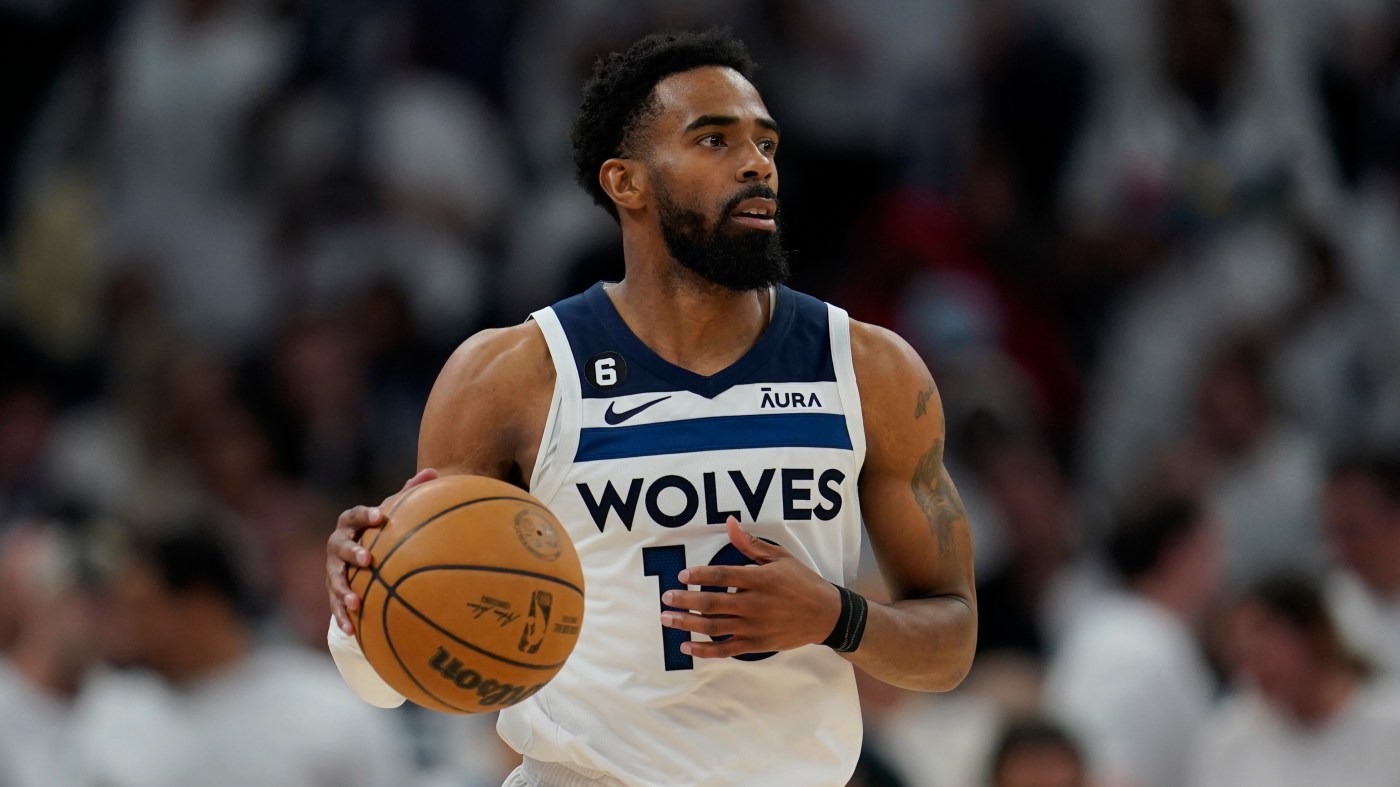
EDITOR’S NOTE: Mike Conley is one of the best sources of information in the NBA.
Entering his 17th NBA season, the 36-year-old Timberwolves point guard has seen it all, and has the knowledge and willingness to explain what’s taken place and what’s to come with the media and, thus, the fans. That breadth of insight and analysis extends from the on-court Xs and Os to team dynamics and development.
Conley is just as good at explaining why two teammates came to blows in the middle of a timeout as he is on what the team needs to do to decode a switch-heavy defense.
So who better to sit down with twice a month to tackle different topics ranging from the Timberwolves to the league at large to, well, Mike Conley, than Conley himself.
This is the second installment of Conley’s Corner.
CHASING A CHAMPIONSHIP
It determines his diet. It’s the reason he uses spare moments around his house to stretch. It’s why he’s constantly thinking of ways to improve his game and better prepare himself for the next day.
Winning an NBA championship is not at the forefront of Mike Conley’s mind on a daily basis.
But the point guard admitted it has “unconsciously” impacted his lifestyle.
“That’s stuff you do thinking about a championship,” Conley said. “Ultimately, it runs my life.”
Entering his 17th NBA season, the lack of a title is the one hole remaining on Conley’s illustrious basketball career resume. He prescribes to the theory that his career wouldn’t quite be complete without a championship, only because that’s how he’s always viewed the game.
“That’s exactly how I felt since I came into the league. My whole mindset was championship. I want to be one of those guys that has a ring one day, has multiple. That kind of career is what you think of as a kid,” Conley said. “I haven’t wavered from that. That’s been my only goal, in a sense. And everything in between is cool — individual accolades are cool, contracts are cool, but the kid part is still in me, like, ‘Man, I just want to win the big game.’ ”
That ultimate goal means more now than ever before. Conley’s children have reached the age where they are very into dad’s profession, and his team’s success. Conley said if you watched his kids during the team’s preseason game against Maccabi Ra’anana, “you could’ve thought it was Game 7 of the NBA Finals.”
“They were super into it,” he said. “They love just being around it — being around the game, the people and fans and stuff — but they’re starting to love basketball and watching dad play.”
How cool it would be for them to see him lift a trophy at season’s end. There have only been a handful of times in Conley’s career where he’s entered the season thinking that was a legitimate possibility.
This is one of them.
“I honestly feel like this team, and the way the NBA is set up — the parity that’s come out — it’s more open and there’s more opportunity for more teams than usual, so why not (put) us in that category?” Conley said. “I feel like we’ve got a good chance to make those jumps to hopefully get to that point.”
The Timberwolves, while receiving credit as a potential top-four seed in the Western Conference, haven’t really been mentioned as a title contender by prognosticators entering the season, which opens for Minnesota on Wednesday in Toronto.
But Conley noted the Timberwolves have a roster — No. 1 through No. 15 — with the talent, length, athleticism and depth to go out and compete on a nightly basis.
“You’ve got young superstars in Ant and KAT and Rudy. You’ve just got a good mix of people’s games together. And you’ve got a little bit of that continuity, too, having a lot of guys returning,” Conley said. “And Coach (Chris) Finch, you’ve got to have a guy that can lead the ship and manage these guys and the egos and all things that come with the NBA lifestyle and game.”
He hopes the Timberwolves can stay healthy and mesh together at the right time. Those are two key factors in winning a title. Health has stood in the way of a couple of Conley’s best chances to claim a ring.
In 2015, Memphis took on Golden State in the Western Conference semifinals. The Warriors won Game 1, which Conley missed with a facial fracture. But the point guard returned for Game 2, which Memphis stole in Oakland. The Grizzlies claimed a 2-1 series advantage after Game 3. But Memphis lost star defender Tony Allen to a hamstring injury in Game 4, and didn’t win another game in the series.
“It was hard to guard Klay and Steph (without him),” Conley noted.
Then in 2021, Utah sported the best regular-season record in the Western Conference. But Conley, an all-star that season, aggravated a hamstring injury in Game 5 of the Jazz’s first-round series victory. He missed the first five games of the conference semifinals against the Clippers, only to return in Game 6, which Los Angeles won to claim the series.
“I played the sixth game at like 40 percent. I was like, ‘I’ve got to try it.’ But at that point, it was like, ‘Man, if I was healthy from that first game on, man, we were rolling.’ So we had a real chance. A lot of us talk about it,” Conley said. “It was wide open. We were like, ‘We can do this thing.’ And then that injury just hit at the worst time.”
Which happens to many teams each season. All you can continue to do is give yourself as many bites at the apple as possible in hopes of eventually breaking through.
Denver was probably the healthiest team in last year’s playoffs. When you combine that with the Nuggets’ talent level and overall quality of play, it’s a championship recipe. The Timberwolves, meanwhile, were decimated by injuries prior to and during their first-round series with the Nuggets. But Minnesota — Conley included — took a number of positives away from the challenges it presented to Denver.
That seems to be the root of much of the optimism surrounding the team this fall. Conley is encouraged by the actions everyone is putting behind that belief.
“I think that everybody has kind of taken it upon themselves for a little bit more accountability on their side to be better at the smaller things,” he said. “This team last year, from my perspective, we had times where it looked like we couldn’t be beat. And then there were moments and quarters where it was like, ‘What are we doing? We don’t know how to pass, we don’t know how to shoot.’ So I think having less of those moments comes with the attention to detail. … You’re just seeing it … guys are just paying more attention to it.”
But there will be trials and tribulations. There always are throughout the course of a season. Conley noted it’s how you handle those that determine your fate.
“It’s the ability to go on a two- or three-game losing streak, snap out of it and have team meetings, talk to each other. The media is tackling you and trying to split you apart, and you band together and have moments in the season that become those signature moments that you can look back at and say, ‘Hey, this is when they became who they were,’ ” Conley said. “And then, boom, it pops. I think a lot of teams go through that stage and they figure it out. We’re a team that I think we check some of those boxes — we’ve got the talent, we’ve got the bodies, we’ve got the depth — but can we withstand adversity? Can we get through it when things go rough?”
It’s all to-be-determined, but the 36-year-old floor general is excited to find out. A year ago at this time, he was the point guard for a rebuilding Utah team that traded away its two premier players in the offseason. Title contention was not on the menu for that team. And it was fair to wonder if Conley would ever again be in such a position again.
“Yeah, at that time, I honestly had kind of switched my mindset to just enjoying the game, you know what I mean?” Conley said. “I love to hoop, just as it is, so I get to go out here and just hoop every day. So I’m not going to trip if we’re winning 40 games or 60 games, if we’re in the playoffs or not. But I’m going to try to win and get this team into the playoffs. I’m not going to just sit here and lose. … That was kind of my mindset. Go out there, have fun and hoop. Be the best we can be and see what happens.”
That still is his mindset to a large degree. He goes into each day with a big smile on his face, eager to grow, improve and enjoy the game.
“I’m still out here with the guys, I’m doing something that not a lot of people get to do. Not only that, we’re working towards something — playoffs, Western Conference finals, championship aspirations — all these aspirations that we have together as a team,” Conley said. “That just kind of gets me up in the morning. Like, man, I’ve got something to reach for right now. It’s really cool.”
Past editions of Conley’s Corner:
Related Articles
Timberwolves, Jaden McDaniels agree to long-term extension
Timberwolves firmly believe in Nickeil Alexander-Walker. He does, too
‘It’s light, it’s fun, it’s stress-less’: Timberwolves coaching staff has formed a ‘super rare’ bond
Healthy again, Timberwolves’ Jordan McLaughlin looks like the player of old
Timberwolves’ preseason victory provides young guys a chance to show their stuff