6 takeaways from the Chicago Bulls’ 130-113 win over the Utah Jazz, including Andre Drummond’s 10K rebound milestone

posted in: News | 0

The Chicago Bulls snapped a short losing skid with a decisive 130-113 win over the Utah Jazz on Monday night.

It was a season-high in scoring for the Bulls as eight players scored in double digits. Zach LaVine logged 24 points and DeMar DeRozan added 21 points while Coby White dished out eight assists.

Here are six takeaways from the game:

1. Bulls capitalize on Jazz mistakes

One single scoring margin set the tone for the entire game — points off turnovers.

The Bulls dominated this category, taking advantage of a plentiful supply of Utah mistakes. The Jazz turned the ball over 22 times resulting in 30 points. The Bulls turned the ball over eight times, but the Jazz only scored one point off those mistakes.

Scoring off opponent mistakes had already been a strong suit for the Bulls, who averaged 19 points (11th in the NBA) off turnovers entering Monday’s game. But this was their most clinical display of making an opponent pay for their errors.

2. Heating up behind the arc

The Bulls have not been a strong 3-point shooting team this season, shooting at a 34% clip in their first seven games. But Monday the shooting scales began to tip in their favor as the offense finished 18-for-34 from behind the arc. White went 4-for-6 from 3-point range and Jevon Carter went 4-for-8 from behind the arc.

The total tally of 3-point attempts reflected improvement upon the team’s goal to take more 3-pointers this season, especially in a game dominated by open-court play.

3. Lauri Markkanen stood out against his former team

The one bright spot for the Jazz was Lauri Markkanen, who dished out another explosive performance against his former team.

Markkanen was drafted No. 7 in the 2017 draft, then acquired by the Bulls in the same trade that brought Zach LaVine to Chicago. He struggled with a stagnant start to his career with the Bulls and watched his scoring numbers dwindle in a frustrating stretch from 2019 to 2021, when he was traded to the Cleveland Cavaliers.

But in Utah, Markkanen has found himself. He earned his first All-Star selection last year while averaging 25.6 points, forging an identity as one of the most efficient scorers in the league.

Markkanen led the Jazz with 29 points Monday, adding five rebounds, three assists and a blocked shot.

“You knew how good he was when he was here, and then you really didn’t get to see how good he was until he left,” LaVine said. “It’s unfortunate but I’m so happy for him and his career and his development and the type of person he is. We still talk and text to this day. It’s great to see the man he’s become.”

4. Jevon Carter leads the bench unit

Carter continues to bring an immediate lift to the Bulls off the bench as the primary guard of the secondary rotation.

Carter scored 12 points on 4-for-8 shooting from 3-point range, taking all of his shots against the Jazz from behind the 3-point arc.

He was the defensive marshal of the bench unit as they pressured the Jazz along the perimeter to force errors, then immediately pushed the pace in the open court once a turnover occurred.

5. Andre Drummond records 10,000th career rebound

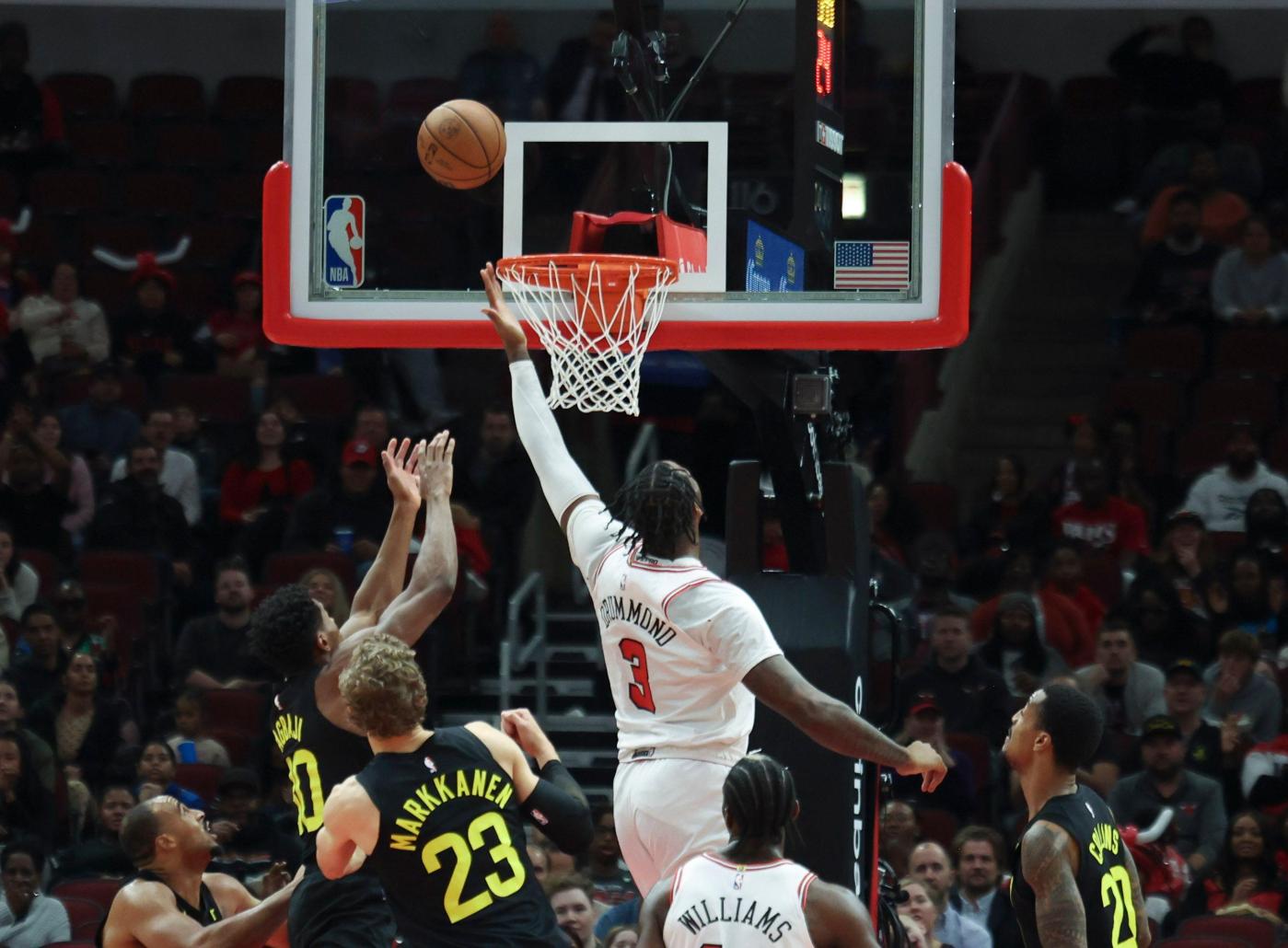
Andre Drummond etched himself into the league’s history books in the first half of Monday’s game as he recorded his 10,000th career rebound.

Drummond is the 43rd player in NBA history to record 10,000 or more rebounds in his career — and one of only three active NBA players alongside DeAndre Jordan and LeBron James. Pau Gasol and Dennis Rodman are the only other players to reach the milestone while playing for the Bulls.

Drummond finished the game with seven rebounds.

6. Alex Caruso plays through a bruised right arm

Alex Caruso played a normal rotation while he continued to nurse a bruised right arm, which he originally banged up after a hard collision while completing a dunk in Saturday’s game against the Denver Nuggets.

The injury was enough to keep Caruso out of the remainder of Saturday’s game. He attempted to return for one minute, but coach Billy Donovan quickly pulled him when it became clear Caruso was still playing through pain.

Opinion | How the Israel-Gaza Conflict Can Avoid Ending in Stalemate

posted in: Politics | 0

The brutality of the Oct. 7 Hamas attack, and the ruthlessness of the Israeli response, has made some observers wonder if this time, the severity of the violence will finally force Israelis and Palestinians to come up with a real and lasting solution to the conflict over Gaza.

The problem is, all previous wars between Israel and Hamas have ended up with the status quo ante, and there’s no convincing reason to think this time will be any different. Wars between Israel and Hamas in 2008, 2008-09 and 2014 all ended in ceasefires that have done nothing to resolve the conflict. The result has been ongoing clashes, rocket fire on Israel, Israeli air strikes on Gaza and skirmishes between fighters, all of which have continually led to the killing of civilians.

A real change in the regional order requires either a political process between Israel and Hamas, or the complete destruction of the latter. Neither of these scenarios is likely, even now — unless diplomats choose to reject this old pattern and replace it with something new.

Why are we likely to end up in the same pattern this time?

First, despite the fact that it can claim a devastating number of lives, Hamas does not pose an existential threat to Israel. The State of Israel is a fully integrated member of the international community. It has the region’s most powerful military and a nuclear arsenal, and an American security umbrella. Under these conditions, the most that Hamas can do is engage in intermittent “small” attacks against Israel. All it wants is to survive the current Israeli response so it will be back in position to strike again.

This means that there is no way for Hamas to force Israel to make real concessions. The most that Hamas has achieved is to exchange kidnapped Israelis for Palestinian prisoners in Israel. But that doesn’t do anything to tamp down the specific disputes between the two.

Second, neither side has expressed any interest in a genuine political process. Hamas has built its reputation and very purpose on its ability to “resist” Israel. Further, Hamas’ oppressive rule in Gaza has deprived it of the legitimacy it once had as a serious political alternative to Fatah, leaving its legitimacy tied only to such resistance.

Research has shown insurgent groups only agree to participate in a diplomatic process if they are allowed to share in governing. Yet for Hamas to do so would be to give up its emphasis on violence, its sole reason for existence. The most Hamas has been willing to consider has been negotiations toward a ceasefire or an exchange of captives and prisoners — and that only through an intermediary.

For its part, no Israeli government from anywhere on the political spectrum has ever indicated any interest in negotiating with Hamas. It, too, has only been willing to consider talks limited toward ceasefires or the release of hostages.

Third, the status quo ante has been beneficial for the political right in Israel, in the sense that having Hamas in Gaza absolves Israel of having to negotiate with the moderate Fatah over division of the West Bank. So long as a terrorist organization exists on its borders these governments have argued that a peace process is impossible, and no Palestinian state is viable.

There are reports that Israeli Prime Minister Benjamin Netanyahu himself has been clear about this strategy. He has been quoted as saying in 2019 that anyone who opposes a Palestinian state should strengthen Hamas at the expense of Fatah. A manager who is most skilled at maintaining the status quo rather than a visionary or statesman who can make bold moves toward peace, Netanyahu is not likely to disrupt a system that has allowed him to avoid making concessions in a peace process. A militarized response that degrades Hamas’ capabilities is a way for him to claim that he has taken action against the organization without addressing concessions on statehood that Netanyahu is clearly unwilling to deliver. The price of Hamas terrorism is one he has been willing to pay.

If the scale and brutality of Hamas’ attack this time has convinced Israel that the status quo ante really is untenable, Hamas would have to be militarily defeated. But doing so would be extraordinarily difficult — which is the fourth reason change is unlikely.

Israel’s primary responses to previous Hamas attacks have been the use of air power. But air strikes alone are not enough to eliminate the organization. Even if Israel could demolish all of the above-ground structures that Hamas could use, the organization still has its network of tunnels beneath Gaza that it could use as a base of operations to launch a prolonged guerilla war.

The only sure way to defeat Hamas is through a sustained ground invasion and long-term occupation. This would require the Israel Defense Forces to move slowly and methodically through both open spaces and urban areas to capture or kill Hamas fighters and leaders. This will put Israeli lives at risk — a risk that Netanyahu has tended to avoid — and lead to more Palestinian casualties, both civilians and militants. The longer such an operation continued, the more likely Israel would be subject to increasingly heavy international pressure to end the operation, probably before the military objective is met.

Fifth, defeating Hamas on the battlefield would be inadequate to change the status quo because the conditions that have strengthened it over the years would remain in place. Studies of past counter-insurgency and counter-terrorism campaigns all stress the importance of long-term planning regarding the post-war settlement.

It does not appear that Israel has a plan for stabilizing and governing Gaza after the war. Neither the Israeli public nor Israeli leaders have any appetite for administering a territory so damaged from years of war and blockade.

A possible alternative is a coalition of actors including some combination of Arab states, Fatah, some European states, the Arab League and the United Nations. But the taint of colonialism would probably stick to the endeavor. Palestinians are also unlikely to view this as anything other than demeaning.

Perhaps the best alternative is a multi-stage process, each phase building on the previous one. The first stage would be Israel convincing Hamas that its destruction really is imminent unless it is willing to engage in a political process, by a relentless military campaign that targets Hamas in Gaza and a diplomatic initiative to convince the international community to undercut Hamas’ finances and to stop hosting Hamas leaders.

Such a process would require that the Israeli government reduce its commitment to expanding settlements in the West Bank and stop allowing right-wing Jews to march toward the Dome of the Rock, one of the holiest Islamic sites that sits atop the Western Wall, one of the holiest places for Jews. It would also require that Israel remove the blockade on Gaza. All of these policies convince Palestinians that Israel has no interest in peace. The removal of the blockade could be done piecemeal, in tandem with or in response to steps taken by Hamas to end its commitment to violence and improve governance of Gaza.

Despite a few calls for such a process among Israelis and Palestinians, doing so in the immediate aftermath of Hamas’ murderous violations and the ongoing deaths of thousands in Israel’s bombing campaign does not seem possible. But ultimately, the sheer number of deaths since Oct. 7 might finally be enough to make leaders and the public on both sides accept both the need and the hope for change — if everyone involved understands the deeper causes that have actually hobbled past attempts at peace.

‘We’ve got some holes to fill’: Offseason work continues for the Chicago White Sox with the GM meetings

posted in: News | 0

The Chicago White Sox have been busy since the World Series wrapped up.

Thursday, they introduced Paul Janish as the organization’s director of player development.

The next day, the Sox declined the club option on closer Liam Hendriks for 2024 while starter Mike Clevinger declined a mutual option. The changes continued Saturday when the Sox declined shortstop Tim Anderson’s club option for 2024.

All that activity came ahead of the MLB general managers meetings, which formally begin Tuesday at a resort in Paradise Valley, Ariz.

It will be Chris Getz’s first since being promoted to Sox GM on Aug. 31.

“I’ve had a lot of conversations with other general managers around the league, just understanding their needs and conveying what we’re set out to do as well and see if we match up,” Getz said during a video conference Thursday. “Clearly, we’ve got some work to do based on the production we’ve had on the field the last two years.”

The Sox followed up an 81-81 season in 2022 with 101 losses in 2023.

The offseason work includes determining the best fits at shortstop, second base, right field and catcher, along with openings in the starting rotation and bullpen.

“I certainly have a vision for our club for next year and years after,” Getz said. “Some of it is going to be at the mercy of perhaps some other clubs and what their willingness is to do.

“We’ve got some holes to fill. We may have to get fairly creative on how we tackle some of those holes, but I look forward to really diving in deeper and getting in front of some of these other general managers and seeing what we can accomplish.”

The Sox know the defense must improve. They were tied for 10th in the American League with 95 errors and tied for 11th in the league with a .983 fielding percentage.

“Generally speaking, we certainly on the defensive side need to improve at many spots,” Getz said. “Fundamentally there were some breakdowns that led to some really ugly games.

“We have some talent on the roster but it’s not a team that has come together and produced on a consistent basis and that’s why we’re in the position that we’re in. So they’re certainly a short-term, midterm and long-term goal. It’s going to take a little bit of time to certainly present itself, but there is a plan in place. I look forward to executing it.”

The Sox will have a new look at shortstop after penciling Anderson in as the Opening Day starter in six of the last seven seasons (he missed the first two games of 2022 serving a suspension). Second base and right field continue to be spots where the Sox look for a consistent answer.

Korey Lee did a bulk of the catching down the stretch after arriving via a trade from the Houston Astros. He displayed a strong arm, but hit .077 (5-for-65) in 24 games.

Three of the team’s five starters from the beginning of 2023 (Lucas Giolito, Lance Lynn and Clevinger) are no longer around. Ditto with three of the top five relievers (Kendall Graveman, Reynaldo López and Keynan Middleton) based on appearances for the Sox.

“There is talent on this club,” Getz said. “Perhaps, you use some of that talent to plug into other holes. But deeper than that, there were players postgame in Texas (after Game 5 of the World Series) who pointed to (Rangers GM) Chris Young’s sentiment last offseason with some of the foundational values that he really prioritized. I felt when those players highlighted it, it was very powerful and when I was named to this position, establishing the values for the White Sox in who we are going to be is very important to me.

“That’s something that I’ve set out to do. We are in meetings right now with department heads and really establishing how we are going to operate. That will bleed into our players and continue to operate that way through the offseason as we execute in a way to improve our roster.”

()

Chicago Cubs hire Craig Counsell to replace manager David Ross, who is out after 4 seasons on the job

posted in: News | 0

In a shocking twist, the Chicago Cubs are hiring Craig Counsell as their manager.

The Cubs announced Monday they are bringing in the former Milwaukee Brewers manager, whose contract expired at the end of this past season, and moving on from David Ross, who was under contract through next season with a club option for 2025.

Counsell will get a five-year contract worth more than $40 million that would make him the major leagues’ highest-paid manager, The Athletic’s Ken Rosenthal reported. Counsell’s agency, Meister Sports, confirmed that report.

“Today we made the difficult decision to dismiss David Ross as our major-league manager,” Cubs President Jed Hoyer said in a statement. “On behalf of the Cubs organization, we express our deep gratitude for David’s contributions to our club, both on and off the field.

“First as a player and then as a manager, David continually showcased his ability to lead. David’s legacy will be felt in Chicago for generations and his impact to our organization will stack up with the legends that came before him.”

It’s an abrupt ending to Ross’ tenure in Chicago that saw the Cubs go 262-284 (a .480 winning percentage) under his direction the last four years. They were poised to reach the postseason this year for the first time since 2020, Ross’ debut season as manager, before they collapsed during the final three weeks to squander their wild-card position.

Despite the painful ending, Ross received public support from Chairman Tom Ricketts and Hoyer when both were asked whether the former catcher on the 2016 World Series champions would return for the final year of his deal.

“Rossy had a great season and the players play hard for him,” Ricketts said on the final day of the season in Milwaukee. “He’s our guy, so I like him a lot. … He’s a great manager. He creates a great clubhouse culture. The players love playing for him.”

Hoyer echoed Ricketts’ sentiment while acknowledging the expectations going forward.

“He’s not a new manager anymore,” Hoyer said. “He’s going into his fifth season. I think he’s really matured in the job and developed. Like all of us, I think he wants to get better every year. … One of his greatest skills is he’s self-critical. He wants to continue to get better. And I know he’s going to spend the winter thinking about how he could have done things differently.

“Do we have disagreements and do we have heated conversations? Of course we do, but you will with any manager. They have to make so many different decisions. You have so many things to weigh, so obviously we work hard all the time to give the right information and if there are things that we disagree with or things that we can do better, he’s very open-minded to that. He’s constantly trying to improve.

“But ultimately we’re very pleased with the job he did this year and I think that he should be proud of the fact that that group kept fighting for him.”

Ricketts and Hoyer commended the job Ross did in leading the Cubs turnaround this past season, going from 10 games under .500 in June to 12 games over .500 in early September, a first in franchise history.

Ross’ strengths centered on managing the player and clubhouse element of the job and he was well-liked by the team, with Hoyer noting during his end-of-season news conference in October that “creating that type of culture is incredibly difficult and he does a fantastic job of that.”

“Fifty to sixty people are down here every single day. All those people at some point in that day want or need his time, his mood, his direction,” Hoyer said. “Everything about the manager, it just defines what happens in the clubhouse.

“And this game is so up and down all the time, to be able to bring a positive, productive energy every single day to stay on message all the time, to be encouraging the players and to keep their respect all the time — there’s not a lot of groups of humans that are more cynical than a group of major-league players, and if they sense any weakness, that any part of you is not genuine at all, you can lose that group of players really quickly.

“No one’s more self-deprecating about their own (playing) career than Rossy, a guy that got carried off the field after his last game and somehow he’s incredibly self-deprecating and talks about knowing how hard the game is, and that’s something that really resonates with the players.”

The Brewers went 707-625 (.531) in Counsell’s nine seasons as their manager and made the playoffs five of the last six years, including three National League Central titles.

His departure for a division rival will add spice to Brewers-Cubs series. The Cubs’ first series in Milwaukee next year is scheduled for May 27-30.

Brewers owner Mark Attanasio told Milwaukee reporters on a Zoom call that when Counsell informed him Monday morning he would be joining the Cubs, he replied, “Are you messing with me?”

“We’re all here today because we lost Craig,” Attanasio said. “But I’ve reflected on this. Craig has lost us and he’s lost our community. It’s a really special place to be.”

Minor moves were overshadowed Monday amid Counsell’s stunning hiring. The Cubs had two players claimed off waivers — right-hander Jeremiah Estrada by the San Diego Padres and first baseman Jared Young by the St. Louis Cardinals — and they traded left-hander Brendon Little to the Toronto Blue Jays for cash considerations.

Right-hander Nick Burdi cleared waivers and was outrighted to Triple-A Iowa, and infielder Luis Vázquez was added to the 40-man roster to prevent him from becoming a minor-league free agent.

The Cubs reportedly extended a qualifying offer to outfielder Cody Bellinger, who is expected to decline it. If Bellinger signs elsewhere this offseason, the Cubs would receive a compensatory draft pick in 2024.

()