Best team in NFL? Ravens not concerned with ‘irrelevant’ standings as they enter midseason on a tear.

posted in: News | 0

The Ravens are tied for the best record in the AFC. They have a 1 1/2 game lead in the AFC North. Their defense, by any number of metrics, is the best in the NFL. And quarterback Lamar Jackson’s career-best 71.5% completion rate leads the league.

Unsurprisingly, coach John Harbaugh, who is fond of saying teams don’t win a championship during the regular season, is unstirred.

Asked Monday if his team has played at an “elite” level and done so against some of the best teams in the NFL, the third-longest tenured coach in the league essentially said it doesn’t matter.

“It’s really not a measuring stick against the other teams,” he said. “It’s irrelevant that way because it doesn’t matter until the end.”

Still, the Ravens (7-2) have stood out through the first half of the season, most notably on defense.

They are first in sacks (35), points allowed per game (13.8), points allowed per play (0.214), yards allowed per play (4.1), red zone defense (33.3%) and touchdowns allowed per game (1.1). Baltimore has also allowed the fewest yards per pass (4.6), is second in passing yards allowed per game (170.7) and is eighth in rushing yards allowed per game (91.9).

Many of those numbers are borne out of having success on all three levels of the defense.

Defensive tackle Justin Madbuike is tops among interior linemen and tied for ninth overall in the NFL with 7 1/2 sacks, already a career high. Inside linebacker Roquan Smith, the physical and emotional leader of the defense, is fourth in the league in tackles with 87, while his running mate Patrick Queen is 15th with 75.

In the secondary, Geno Stone has emerged as far more than a reliable fill-in with a league-leading six interceptions, while Kyle Hamilton continues to be one of the most versatile and talented safeties in the league. There have been plenty of other significant contributors, too, including veteran edge rushers Jadeveon Clowney and Kyle Van Noy along with the emerging Odafe Oweh, as well as cornerbacks Marlon Humphrey and Brandon Stephens.

“‘Beeks’ was a problem in camp [and] OTAs,” Ravens center Tyler Linderbuam, himself a budding star, said Wednesday when asked what it’s been like to go against Madubuike in practice. “He’s been a problem for us [on the] O-line for a while now. We’ve all seen the issues that he’s caused — the havoc that he’s caused in games, and we’ve gone against that in practice.”

The man behind the scheme, defensive coordinator Mike Macdonald, has also emerged over the past two seasons as one of the game’s bright young minds and a potential NFL coach.

Yet the defense continues to find ways to play with a chip on its shoulder.

“I feel like we are getting more respect, but I feel that it’s still not the respect that we want,” Queen said. “Honestly, we haven’t accomplished the things that we want to accomplish yet, so I feel like there is a lot of respect out there to still be taken.”

The same can certainly be said of the offense.

Though Jackson leads the league in completion percentage, he has more fumbles this season (10, six of them lost) than touchdown passes (nine). Baltimore is also just 20th in passing yards per game (208.7) and at times has struggled in the red zone or with dropped passes, albeit briefly in both cases.

Still, Baltimore is first in yards per game on the ground (160.3). Jackson’s 440 rushing yards also lead all quarterbacks by a wide margin, and his five rushing scores are third-most among quarterbacks. His 100.8 passer rating is his highest mark since 2019, when he was the unanimous NFL Most Valuable Player.

“It’s just [that quarterbacks coach Tee Martin] wants us to be perfect,” Jackson said. “Every morning, he’s got something [about] championship quarterbacking, and ‘I want you to be a championship quarterback.’ He always tells me, ‘I’m going to grade you harder than probably anybody else will.’”

It perhaps helps, too, that Jackson faces the league’s best defense every day in practice.

“Not trying to toot our own horn, but I believe our defense has no weakness,” he said. “Just from the defensive line, the linebackers, the secondary, how they’re flying around and disguising defenses — making it look like one coverage, but it’s something else — and how they time up their blitzes, it helps us out a lot, because when we’re playing other teams, they’re flying around and giving us their best shot.”

Baltimore’s special teams, meanwhile, have been inconsistent at times — particularly allowing a punt return for a touchdown against the Bengals in Week 2 and having a punt blocked by the Steelers for a safety in Week 5 — but have also excelled.

Kicker Justin Tucker has connected on 16 of 19 field goal attempts. Jordan Stout is averaging 48.5 yards per punt and has often flipped the field or pinned the opposition deep with 17 punts inside the 20-yard line.

But to Harbaugh, all that matters is what’s ahead, including two important games against the Cleveland Browns on Sunday and the Cincinnati Bengals four days later in prime time on “Thursday Night Football.”

“What the standings are now are not important,” he said. “It’s what the standings are after the last regular-season game that matter. Our guys really understand that.”

Week 10

Browns at Ravens

Sunday, 1 p.m.

TV: Fox

Radio: 97.9 FM, 101.5 FM, 1090 AM

Line: Ravens by 6 1/2

()

Sturgeon stocking in Red Lake River marks new phase in recovery efforts

posted in: Adventure | 0

Ongoing efforts to re-establish lake sturgeon populations in the Red River Basin have entered a new phase, with the recent stocking of lake sturgeon fingerlings into two key rivers within the basin.

According to Nick Kludt, Red River fisheries specialist for the Minnesota Department of Natural Resources in Detroit Lakes, stocking efforts from 2002 up until 2022 largely focused on lakes within the basin. That included Otter Tail Lake, Detroit Lake, Round Lake and Red and White Earth lakes, Kludt said, the latter two in cooperation with the Red Lake and White Earth nations.

Nick Kludt, Red River fisheries specialist for the Minnesota Department of Natural Resources, stocks fingerling lake sturgeon into the Red Lake River in Crookston on Wednesday, Oct. 18, 2023. Staff from the DNR and the U.S. Fish and Wildlife Service stocked the fingerlings at the Central Park public access in Crookston. (Deborah Rose / Minnesota DNR)

On Sept. 12, the North Dakota Game and Fish Department stocked 1,000 lake sturgeon fingerlings measuring 6 to 9 inches long into the Pembina River. That was followed Oct. 18 with the stocking of 1,548 lake sturgeon fingerlings by DNR and U.S. Fish and Wildlife Service personnel into the Red Lake River at Central Park in Crookston, Minn.

Both stocking efforts resulted from lake sturgeon eggs collected last spring at Franz Jevne State Park on the Rainy River and raised at the Valley City National Fish Hatchery in North Dakota, Kludt said. Staff from the Minnesota DNR and the U.S. Fish and Wildlife Service collected the eggs, he said, and tribal partners contributed equipment and funding.

The hope, Kludt says, is that lake sturgeon will develop “site fidelity” to the rivers where they are stocked – essentially a homing instinct.

“We suspect – we don’t know – that a lot of the site fidelity that lake sturgeon develop comes at the larval or very early juvenile stage, based on some experimental work on their ability to detect smells,” Kludt said. “However, we know that some learning also occurs with adult fish, based on examples from Red River tributaries where they are now using sites. Of course, it wasn’t possible for them to develop that site fidelity as larvae or very early juveniles because they’re stocked fish.”

On the rebound

Native to the Red River and its tributaries, lake sturgeon were all but gone from the basin by the early 1900s, the result of low-head dams that blocked access to key spawning sites and habitat degradation resulting from settlement of the Red River Valley.

Through a partnership between the Minnesota DNR, U.S. Fish and Wildlife Service, North Dakota Game and Fish Department and the Red Lake and White Earth nations, among others, sturgeon recovery efforts have been underway across the Red River Basin since about 1997.

The efforts are paying dividends, and the basin’s first verified lake sturgeon spawning run in more than 100 years was observed in May 2022 in the upper Otter Tail River, a Red River tributary.

Fishable populations now exist in parts of the Red River Basin, and sturgeon in excess of 50 inches have been documented both by anglers and fisheries crews.

The recent stocking of lake sturgeon fingerlings in the Pembina River – the first of its kind in North Dakota – was done in anticipation of a low-head dam in the city of Pembina being modified into a fish passage structure.

Nick Kludt, Red River fisheries specialist for the Minnesota Department of Natural Resources, holds a 5- to 6-month-old lake sturgeon fingerling Wednesday, Oct. 18, 2023, before it was stocked into the Red Lake River in Crookston. (Deborah Rose / Minnesota DNR)

“That’s really exciting,” Kludt said. “No. 1, because the program is now expanding into North Dakota, and the North Dakota Game and Fish has been working with the U.S. Fish and Wildlife Service, as well as the city of Pembina, to come up with an alternative plan at the permanent dam for fish passage.

“That’s extremely important because the Pembina River is about 125 miles of extremely good lake sturgeon spawning habitat. So, if they’re able to modify that within the next handful of years, that is going to be another well-timed fish passage project, given the need for access to that spawning habitat.”

All eight of the low-head dams on the mainstem Red River, most recently the Drayton Dam, and dams on numerous tributaries within the basin, also have been modified or replaced with rock fishway structures that accommodate fish passage and improve safety while still holding back water for human use.

“As the last of the mainstem dams, it’s been a long time coming and a longtime target,” Kludt said of the Drayton Dam project. “But given the maturity cycle of those females, the ability for them to transition freely about the basin to complete their migrations, we achieved that milestone right on schedule with when it needed to be achieved.”

Lake sturgeon don’t reach sexual maturity until 15 years for males and 25 years for females, according to the DNR.

Looking ahead

River stockings will continue until 2029, Kludt said, at which time project partners will assess whether future efforts are necessary or if there’s enough natural reproduction to sustain and grow the lake sturgeon population within the basin.

The Red Lake River will be the focus of stocking efforts in Minnesota, Kludt says, although the Otter Tail, Buffalo and Roseau rivers also are potential sites if production allows.

The future of lake sturgeon populations in the Red River Basin indeed looks bright.

“The remarkable thing is, how positive it is,” Kludt said. “This is a program that is showing excellent signs of success. It’s been a longtime positive collaboration between DNR, Fish and Wildlife Service and the tribal agencies. And it should be noted that over the course of this whole recovery program, we didn’t always see eye to eye on various other natural resource issues, but this one has really been a positive focal point of us all working together toward common goals for over 20 years now.”

Related Articles

Outdoors |


Minnesota opening weekend deer harvest down 13% from 2022

Outdoors |


One of 2 missing canoeists from Minnesota is found dead in northwestern Wisconsin

Outdoors |


Catholic group that wanted Wilder Forest now plans to purchase Wisconsin resort

Outdoors |


Skywatch: Best constellation of autumn? A horse, of course

Outdoors |


Minnesota DNR approves Twin Metals plan for mineral exploration in shadow of Boundary Waters

One year after liberation, Ukrainians in Kherson hold on to hope amid constant shelling

posted in: Politics | 0

KHERSON, Ukraine — One year since Ukraine retook the city of Kherson from occupying Russian forces, residents have grown accustomed to hearing outgoing fire from the left bank of the Dnieper river, where Russian troops are positioned. They know that familiar crackle means they have seven seconds to find a shelter, or a sturdy wall to hide behind.

Their lives are mostly limited to the comfort of home and the necessity of the supermarket. Many shops are still shuttered. Municipal workers wear bullet-proof vests and wait to be dispatched to sweep up the rubble from yet another impact.

Between lulls of artillery fire coming from the river, which marks the contact line between battling armies in the Kherson region, Ukrainians venture out to buy food, bicycle down grassy residential lanes or convene in the few restaurants that dare to remain open.

Marking the anniversary of Russia’s defeat on Nov. 11 is a bittersweet occasion, many residents say, as Ukraine’s counteroffensive grinds on without producing the spectacular gains many had hoped for. But those who stay are steadfast in their belief that one day normal life will return.

“When you have lived under occupation, you know what freedom means,” said Grigori Malov, who owns one out of three restaurants still operating in the city. “It’s why we have a special attitude toward the continued shelling. We can withstand it because we know how it could be worse.”

The flight of Russian troops from Kherson under prolonged Ukrainian assault a year ago was one of Ukraine’s biggest successes in the war and was seen as an inflection point. President Volodymyr Zelenskyy triumphantly walked the streets of the newly liberated city back then, hailing Russia’s withdrawal as the “beginning of the end of the war.” Many hoped it would serve as a springboard for more advances into occupied territory.

Today, both sides are locked in a stalemated battle of attrition.

On Saturday, a rainy and cloudy day, the atmosphere was muted and few residents came out to mark the occasion, fearing Russian attacks. A handful of people came draped in Ukrainian flags and stood for a while at a monument in front of the administrative building, then walked away.

Malov didn’t work during the nine months he lived under Russian occupation. After the city fell back to Ukrainian control, he opened his eatery, which contains a cafe on the top floor and a restaurant in the basement, to help bring the city back to life. Residents celebrate birthdays, clinking glasses, as the fighting continues only a few miles away.

Ukrainian soldiers, resting between front-line stints, are frequent patrons, and come to Malov’s restaurant to eat bowls of pasta or cheesy pizzas and to share a laugh. Sometimes Malov even organizes stand-up comedy nights, when he can find an entertainer.

“I think we are fulfilling an important function, we are giving people the opportunity to relax,” he said. “Now it’s even more important than before.”

The sounds of incoming and outgoing fire resound continuously and residents have to organize their days in anticipation of them. They are most frequent in the morning and late afternoon, residents said. Air raid alarms echo almost incessantly, at all hours of the day.

Between 40-80 shells of different varieties land in Kherson city on a daily basis, said Oleksandr Tolokonnikov, a spokesperson for the Kherson Regional State Administration.

“Every day people must take into consideration the shelling,” he said. Tolokonnikov was in the city on Nov. 12, one day after it was retaken, and recalled the joy of the crowds welcoming Ukrainian forces back.

A few days later, the shelling started, and it hasn’t stopped since, he said.

Security concerns aside, he says earning an income is another challenge for Ukrainians living in Kherson. There are no jobs for the nearly 71,000 residents in the city, which had a prewar population of 300,000. Most of those who remain are elderly, he said.

Dmytro and Olena were a rare sight: a young couple on a date. They went to the Kherson regional administrative building to hold up the Ukrainian flag and take photos ahead of the anniversary of the city’s liberation.

“It’s not safe in the city, maybe, but we are at home, we don’t want to move anywhere else,” said Olena. “We are spending time at home, we are trying to live, work and not leave.”

They spoke on the condition that only their first names be used. Their families are still living under occupation on the left bank of the river, they said.

Konstantin Krupenko supervised municipal workers as they cleaned the streets, clearing fallen autumn leaves ahead of the anniversary celebration. The men wore bulletproof vests, smoking in between hauling bags of foliage. Over the summer, Krupenko lost one of his workers who was struck by shrapnel from a Grad rocket. Another worker suffered a concussion.

Clearing leaves is an unusual task for municipal workers in Kherson, Krupenko said. Usually they are dispatched to remove rubble from explosion sites.

“Sometimes it’s big, sometimes it’s smaller, on houses,” he said, matter-of-factly describing their work routine.

“Day after every day, there is something.”

Gaza’s main hospital goes dark in intense fighting as Israel’s attacks put it at odds with allies

posted in: Politics | 0

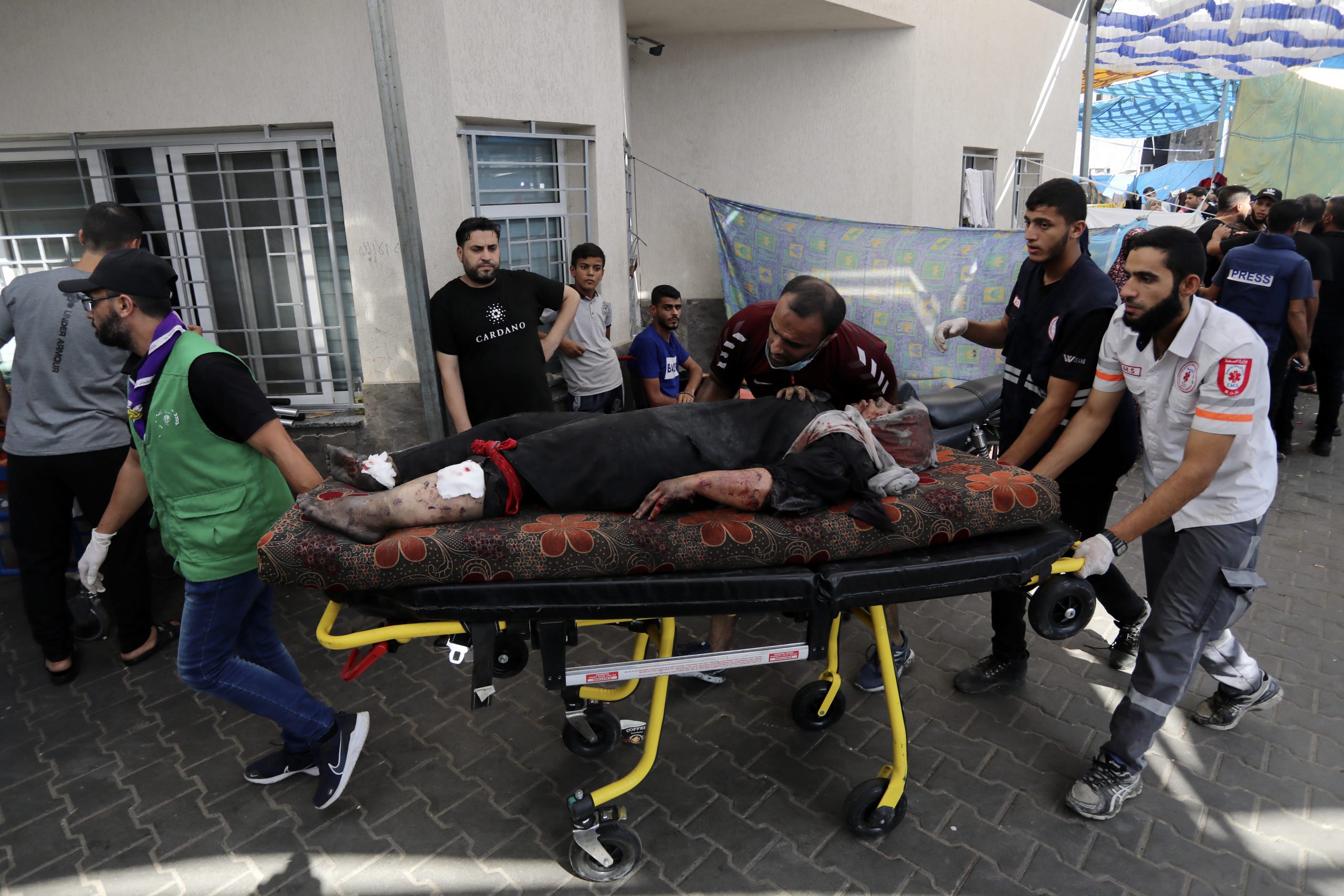
DEIR AL-BALAH, Gaza Strip — Israel’s prime minister pushed back Saturday against calls from Western allies to do more to protect Palestinian civilians, as troops encircled Gaza’s largest hospital where doctors said five patients died, including a premature baby, after the last generator ran out of fuel.

Israel has portrayed Shifa Hospital as Hamas’ main command post, saying militants were using civilians as human shields there and had set up elaborate bunkers underneath it. In recent days, fighting near Shifa and other hospitals in the combat zone of northern Gaza has intensified and supplies have run out.

“There is no electricity. Medical devices stopped. Patients, especially those in intensive care, started to die,” said Mohammed Abu Selmia, the director of Shifa, speaking by phone over the sound of gunfire and explosions.

Abu Selmia said Israeli troops were “shooting at anyone outside or inside the hospital,” and prevented movement between the buildings in the compound.

The claim that Israeli troops were the sole source of fire could not be verified independently. Asked about reports of troops firing into the Shifa courtyard, Peter Lerner, an Israeli military spokesman, would only say that troops are “in the midst of ongoing intense fighting against Hamas in the vicinity of the area in question.” He said the military takes all feasible measures to prevent harm to civilians.

Five patients died after the generator shut down, including a premature baby, said Medhat Abbas, a spokesman for the Health Ministry. He said Shifa had cared for 37 premature infants in total.

Israel has been opening the main road leading south each day for several hours to allow civilians to flee. On Saturday, the military for the first time announced a brief pause in combat as part of an evacuation window, specifically naming the urban refugee camp of Jabaliya next to Gaza City.

Prime Minister Benjamin Netanyahu said the responsibility for any harm to civilians lies with Hamas, repeating long-standing allegations that the militant group uses civilians in Gaza as human shields. He said that while Israel has urged civilians to leave combat zones, “Hamas is doing everything it can to prevent them from leaving.”

His statement came after French President Emmanuel Macron pushed for a cease-fire and urged other leaders to join his call, telling the BBC there was “no justification” for Israel’s ongoing bombing.

Following Hamas’ deadly Oct. 7 attack on Israel, in which at least 1,200 people were killed, Israel’s allies have defended the country’s right to protect itself. But now into the second month of war, there are growing differences in how many feel Israel should conduct its fight.

The U.S. has been pushing for temporary pauses that would allow for wider distribution of badly needed aid to civilians in the besieged territory where conditions are increasingly dire. However, Israel has so far only agreed to the brief daily periods during which civilians are able to flee the area of ground combat in northern Gaza and head south on foot along the territory’s main north-south artery.

Since these evacuation windows were first announced a week ago, more than 150,000 civilians have fled the north, according to U.N. monitors. On Saturday, the military announced a new evacuation window, saying civilians could use the central road and a coastal road. Tens of thousands more remain in northern Gaza, many sheltering at hospitals and overcrowded U.N. facilities.

Palestinian civilians and rights advocates have pushed back against Israel’s portrayal of the southern evacuation zones as “relatively safe,” noting that Israeli bombardment has continued across Gaza, including airstrikes in the south that Israel says target Hamas leaders, but that have also killed women and children.

The U.S. and Israel also have diverging views on what a post-war Gaza should look like. Netanyahu and military leaders have said this needs to be dictated solely by Israel’s security needs, such as ensuring no threats emerge from the territory. Israel has said a key goal of the war is to crush Hamas, a militant group that has ruled Gaza for 16 years.

Secretary of State Antony Blinken, speaking to reporters Friday during a tour of Asia, laid out what he said were fundamental principles for a post-war Gaza, some of which seemed to run counter to Israel’s narrow approach.

Blinken said these principles include “no forcible displacement of Palestinians from Gaza, no use of Gaza as a platform for launching terrorism or other attacks against Israel, no diminution in the territory of Gaza, and a commitment to Palestinian-led governance for Gaza and for the West Bank, and in a unified way.”

FIGHTING AROUND HOSPITALS

Concern has grown in recent days as fighting through the dense neighborhoods of Gaza City has come closer to hospitals, which Israel claims are being used by Hamas fighters.

On Saturday, Palestinians said Israeli troops were within view of Shifa Hospital, Gaza’s largest. Israel has said Hamas’ main command center is located underneath the hospital, claims Hamas and Shifa staff deny.

Thousands of civilians had been sheltering in the Shifa compound in recent weeks, but many fled Friday after several nearby strikes in which one person was killed and several were wounded.

Abbas, the Health Ministry spokesman, told the satellite television channel Al Jazeera that there are still 1,500 patients at Shifa, along with 1,500 medical personnel and between 15,000 and 20,000 people seeking shelter.

“The complex now lacks food, water and electricity,” he said. “Intensive care units have stopped working.”

Abdallah Nasser, who lives near Shifa, said by phone that the Israeli military was advancing deep into the city from its southern and northern flanks.

“They are facing stiff resistance, but they are advancing,” he said.

Mohammed al-Masri, one of thousands still sheltering at the hospital, said that from a higher floor he could see Israeli troops approaching from the west. “They are here,” he said. “They are visible.”

Thousands have fled Shifa and other hospitals that have come under attack, but physicians said it’s impossible for everyone to get out.

“We cannot evacuate ourselves and (leave) these people inside,” a Doctors Without Borders surgeon at Shifa, Mohammed Obeid, was quoted as saying by the organization.

“As a doctor, I swear to help the people who need help.”

The organization said other doctors reported that some staff had fled to to save themselves and their families, and urged all hospitals be protected.

CASUALTIES RISE

More than 11,070 Palestinians, two-thirds of them women and minors, have been killed since the war began, according to the Health Ministry in Hamas-controlled Gaza, which does not differentiate between civilian and militant deaths. About 2,700 people have been reported missing and are thought to be possibly trapped or dead under the rubble.

The Hamas-run Interior Ministry said six people were killed early Saturday in a strike on the Nuseirat refugee camp that hit a house. The camp is located in the southern evacuation zone.

At least 1,200 people have been killed in Israel, mainly in the initial Hamas attack, and 41 Israeli soldiers have been killed in Gaza since the ground offensive began, Israeli officials say.

Nearly 240 people abducted by Hamas from Israel remain captive.About 250,000 Israelis have been forced to evacuate from communities near Gaza and along the northern border with Lebanon, where Israeli forces and Hezbollah militants have traded fire repeatedly.