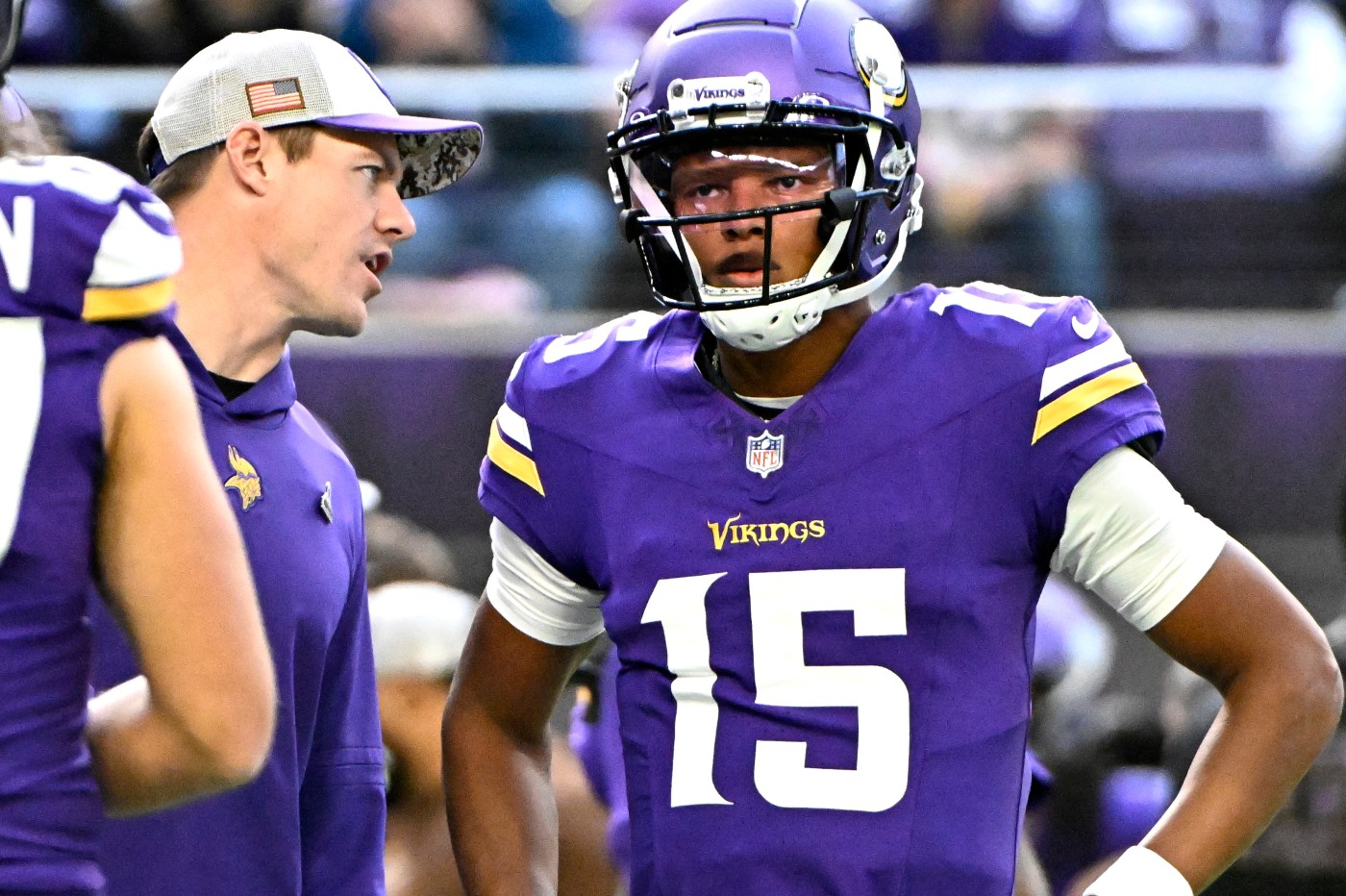
People who make decisions for the Vikings are naturally pleased with the quarterbacking of Josh Dobbs after two games, but also count coach Kevin O’Connell’s play-calling and direction for his success.
Dobbs, 28, who is playing for $1.5 million, can become a free agent after the season. The Vikings understandably want a larger sample than two games before considering a new contract.
Should Dobbs continue to excel, a new contract could be worth as much as $20 million a year. The Vikings also have the option of a franchise tag for him, but that cost would be prohibitive.
— Despite his age (36 next August), if Kirk Cousins fully recovers from his Achilles tear and doesn’t receive an incentive-laden extension, he’ll be the the NFL’s top free agent QB in March. That could cost nearly $45 million a year guaranteed for two years.
— Dobbs, much more mobile than Cousins, and Cousins, a better passer than Dobbs, have, coincidentally, the same agent, Mike McCartney.
— The Vikings probably cannot afford to sign Cousins, Justin Jefferson (probably $30 million a year) and Danielle Hunter (at least $25 million) to new contracts that will be due before next season.
Minnesota Vikings wide receiver Justin Jefferson (18) warms up before an NFL football game against the Los Angeles Chargers, Sunday, Sept.24, 2023 in Minneapolis. (AP Photo/Stacy Bengs)
— Considering the Vikings’ poor start (1-4) and all the injuries (Jefferson and Cousins included), if this team makes the playoffs, O’Connell would seem worthy of a contract extension of at least two years, maybe three with a nice pay bump after this season.
If O’Connell, 38, wanted, he could get a job at a top college probably doubling his $4 million salary. Gophers coach P.J. Fleck, 42, is paid $6 million.
— If the Vikings win four of their final seven games, they probably will get into the playoffs. The Vikings will hope that the first-place Lions have the division wrapped up when they host the Vikings in the final game on Jan. 7 so that Detroit rests some starters for the playoffs.
The Vikings’ playoff chances improved last week with the season-ending wrist injury to Bengals QB Joe Burrow. Minnesota plays in Cincinnati on Dec. 17.
— Dobbs has had alopecia, a chronic skin disease that causes hair loss, since he was a youngster.
— Viking T.J. Hockenson, with a new $66 million, four-year contract, leads NFL tight ends in catches (71) and yards (681).
— Calling Sunday night’s Vikings game in Denver for NBC will be Cris Collinsworth, Mike Tirico and Melissa Stark.
— Hub Meeds, the Vikings’ original mascot, turned 90 the other day and is doing well and resides in White Bear Lake.
— Paul Wiggins, who turned 89 on Saturday, remains as sharp and lucid as ever as a Vikings consultant.
— You won’t hear a more professional and objective radio football broadcast than the Gophers’ Mike Grimm and Darrell Thompson.
— Perhaps college football’s best coaching job this season belongs to Jerry Kill, formerly of the Gophers. Last year, Kill took the worst coaching job in America at New Mexico State and led the team to a Quick Lane bowl victory over Bowling Green.
This year, Kill’s Aggies were 8-3 entering Saturday’s game at Auburn and will play in another bowl game, maybe against Nevada in the New Mexico Bowl next month.
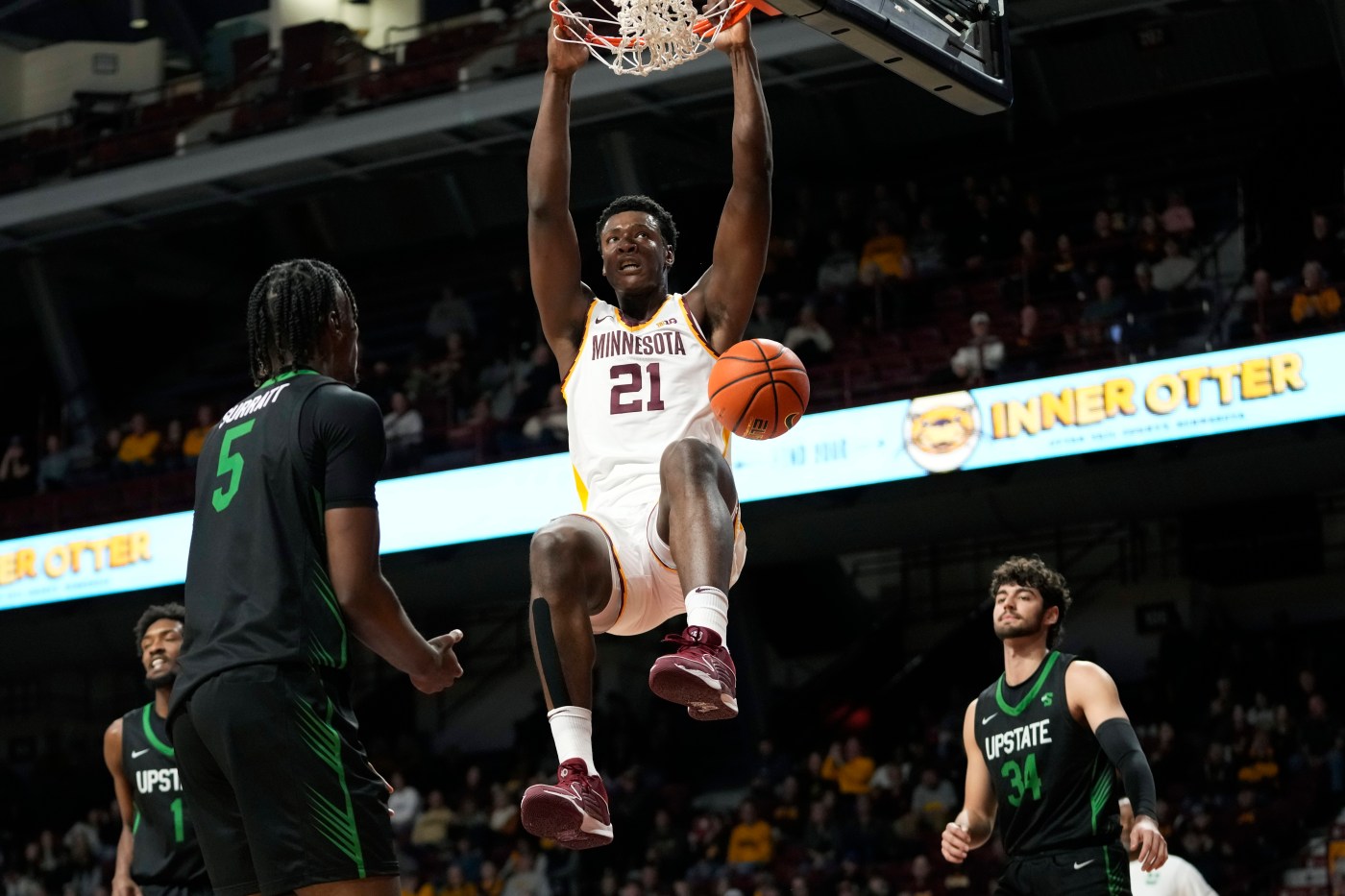
— Announced attendance for the Gophers men’s basketball season opener in an 80-60 victory over Bethune-Cookman was 7,132 in 14,625 capacity Williams Arena. It was 7,975 for Thursday’s 70-68 loss to Missouri.
— Concession sales at Williams Arena are now cashless.
— Prayers are welcome for classy former Gophers football star running back-Packers Pro Bowl linebacker Jim Carter, 75, an extraordinary guy who has a serious health issue.
— Former Gophers wideout Drew Wolitarsky and former Edina defensive back Evan Holm via North Dakota are with the Winnipeg Blue Bombers, who on Sunday play Montreal in Hamilton for the Canadian Football League Grey Cup.
— There has been a myriad of books about Minnesota sports. Many have been unenlightening. But Dave Mona’s vastly entertaining “Beyond the Sports Huddle” is required reading.
— After three games for Louisville, Dennis Evans, the 7-foot-1 freshman center who decommitted from the Gophers, is averaging 12 minutes, three points, two rebounds and .07 blocked shots.
— Ex-Gopher Jamison Battle is averaging 29 minutes, 11 points and five rebounds after three games as a senior for Ohio State.
— Virginia sophomore Andrew Rhode, who transferred from St. Thomas, is averaging 29 minutes, 6.3 points and three rebounds.
— Iowa women’s basketball star Caitlin Clark, who plays at Minnesota on Feb. 28, has a name, image and likeness (NIL) marketing value of $764,000, per On3. Hopkins grad Paige Bueckers, whose UConn team plays at Williams Arena on Sunday, has an NIL valuation of $646,000.
Bueckers has added social media Team Dunkin’ to her NIL deals. Clark has joined QB Patrick Mahomes of the Kansas City Chiefs on State Farm TV ads. Williams Arena tickets for the Feb. 28 game range from $79 to $369. For the UConn game, $59 to $499.
— That was former Gophers-Vikings linebacker Mark Dusbabek from Faribault officiating last week’s inaugural Netflix Cup at the the Wynn course in Las Vegas. Dusbabek, 59, is senior director of TV rules and a video analyst for the PGA Tour.
— Ex-Gopher Angus Flanagan has made it to Stage Two of PGA Tour qualifying school.
— Former Gopher Erik van Rooyen’s recent $1.5 million PGA Tour victory in Los Cabos, Mexico, brings his season’s earnings to $2.5 million, and more significantly a two-year PGA Tour exemption and an invitation to next April’s Masters. The average PGA Tour winnings for players this season are $2.3 million.
— Valpariso fifth-year senior Caleb VanArragon, the 2023 Minnesota State Amateur and State Open golf champion from Blaine, won two tournaments this fall, the second by 17 shots on the 7,054-yard Sand Creek course in Chesterton, Ind.
— St. Cloud State men’s hockey coach Brett Larson headlines the Old Timers Hockey Association luncheon on Monday at Mancini’s.
— Scott Becker, the former St. John’s University football-baseball standout who is an investor in the San Diego Padres, was heartbroken last week with the death of a dear friend, Padres’ owner Peter Seidler, at age 63. “Peter did more for San Diego’s homeless than anyone,” Becker said.
— Condolences to the family of Mike Foley, the 10-year Gophers men’s hockey assistant to Herb Brooks and Brad Buetow. Foley, from West St. Paul, died at age 80 the other day after dementia.
— Twin Cities golfers, including many of Minnesota’s storied players who have relied on expert equipment repair for decades, will miss Stan Steuter, who will retire next September after 42 years operating Golf Club Hospital in south Minneapolis. Steuter, 71, who lives in Elk River, intends to golf and hunt upon retirement.
“The best people in the world are my customers — people always say that, and I’m not just saying that — but golfers appreciate me and I’ve felt appreciated by them,” he said.
— Gary Serum, the former Twins pitcher from Alexandria, Minn., but born in Fargo, has been named to the North Dakota-South Dakota all-time dream baseball team. So was Roger Maris, born in Hibbing but raised in Fargo. Serum, 67, owns Serum’s Good Time Emporium in Anoka.
— For the Twins two seasons ago, catcher Mitch Garver hit .256 with 13 home runs in 68 games. Although he hit just .105 in this year’s World Series, in the regular season for the Texas Rangers he hit .270 with 19 homers in 87 games. And now, at age 32, he has a World Series ring coming.
— There were 38 Minnesota-born players on NHL season-opening rosters, mnhockey life.com points out.
— That was former Gopher-Timberwolf John Thomas making the honorary coin flip before alma mater Minneapolis Roosevelt played South in football the other day.
— Louie Cotroneo, the esteemed Johnson hockey coach who died at age 93 the other day, attended mass every day at the Church of Assumption. “Every day’s a bonus,” Louie would say every time he saw you.
Don’t print that
— The Vikings are the seventh NFL franchise for which Dobbs has played. Considering how talented, bright and analytical he is, he was asked by the Pioneer Press why he’s been in so many different places.
Minnesota Vikings quarterback Joshua Dobbs (15) smiles during warmups before the start of a NFL game against the New Orleans at U.S. Bank Stadium in Minneapolis on Sunday, Nov. 12, 2023. (John Autey / Pioneer Press)
“Teams are aware that I’m searching for an opportunity to play at the end of the season,” he said. “Each stop, each opportunity, my role has grown. I recognized that about a year ago and kind of accepted that was going to be my journey.”
— The NFL Pro Bowl will be Feb. 4 in Orlando. The way it looks now, Hunter, Hockenson and Christian Darrisaw will represent the Vikings. Probably left out but deserving is Josh Metellus. Jefferson has missed too many games.
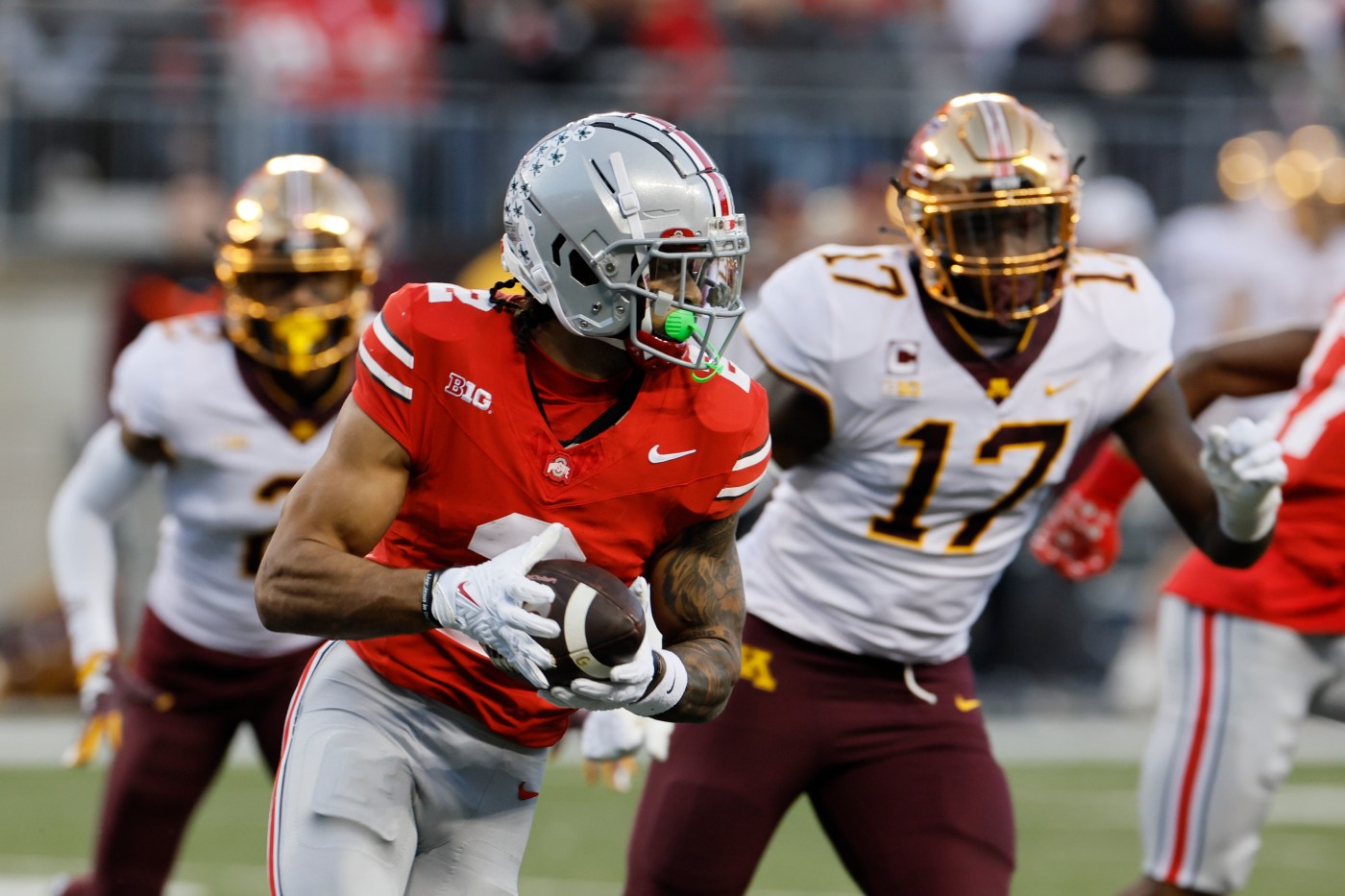
— The unremarkable Gophers football team could see several players transfer for name, image and likeness (NIL) deals.
— The Ohio State football team that was a 27.5-point favorite against the Gophers on Saturday has an NIL deal with a Columbus apparel firm that provides 24 offensive linemen and five QBs with custom outfits that include suits, shirts and shoes.
— Finally, the Gophers are about to return to the Rose Bowl. That’s where UCLA, which hosts Minnesota next Oct. 12, plays home games.
— Gophers football coach Fleck is signed through the 2029 season.
— Dennis Gates, whose Missouri men’s basketball team dramatically rallied to defeat the Gophers at Williams Arena on Thursday night, was considered for the Minnesota job while at Cleveland State three years ago.
— Pssst: Besides full scholarships, some Division I men’s basketball coaches will tell you it takes a $1.3 million September-to-May NIL budget for a 13-player roster just to get enough talent to get to the NCAA Tournament. For a Sweet 16 run, the NIL player price goes to $2.5 million.
— Ex-Twin Torii Hunter, 48, still eligible for 2024 Baseball Hall of Fame election, accepted an invitation to interview for the Angels’ managing job that last week went to ex-Twin Ron Washington, 71.
“It went pretty good, but you had Ron Washington and Buck Showalter who have done it for a while out there,” Hunter, who also played for the Angels, told the Pioneer Press. “Wash is awesome, always been a guy who talked to me, Jacques Jones, Matt Lawton and tries to activate you — that’s what he does. He’s very positive. He’s going to be good for those players.”
Hunter said he wasn’t disappointed he didn’t get the Angels job.
“Why would I be — I was driving to a board meeting and I was asked to interview, so I’m just thankful and honored to be even thought about and considered,” he said. “I thank the Angels for giving me the opportunity to just go through the process and interview.”
— Eric Musselman, the former Timberwolves assistant now head coach at Arkansas, told wholehogsports.com that he was 7 or 8 years old when he attended a camp where his father Bill and Bob Knight were coaches.
“I was in line with the other kids for a drill and a bee landed on my shoulder,” Eric recalled. “Coach Knight saw it and said, ‘What do you do when a bee lands on you and Coach Knight is speaking to us?’
“I said, ‘I don’t know.’ Coach Knight said, ‘Let it sting you.’ So I just stood there, and thankfully the bee flew away.”
— Safety Lewis Cine, 24, who received an $11.5 million, four-year contract that included a $5.5 million signing bonus as the Vikings’ first-round draft pick (No. 32 overall) out of Georgia last year, was again inactive against the Saints last week and probably will be a goner next season. His base salary is $1.23 million this season.
— Besides a $12.7 million contract, Twins free agent Sonny Gray will get a $1 million bonus for being runner-up for the American League Cy Young Award plus $100,000 for pitching more than 180 (actually 184) innings.
— Fired Texas A&M football coach Jimbo Fisher gets a $75 million contract buyout. Fleck’s buyout is $7 million if fired before Jan. 1.
— Of the Gophers’ three revenue-producing sports, football generates 90% with men’s basketball and hockey generating 10%.
— Matthew Hurt, the 2019 Minnesota Mr. Basketball from Rochester John Marshall and Duke, has turned down $600,000 and $500,000 offers from China and Japan, respectively, to play for the Memphis Grizzlies’ G League Memphis Hustle for about $140,000 this season.
— A little birdie says the architect redesigning Interlachen Country Club that is underway is getting paid $600,000 for his work on the $30 million project. There’s a provision that he can’t work for any other Minnesota course during the process.
— Ex-Gophers heavyweight champion Brock Lesnar received $8 million for his Ultimate Fighting Championship match against Mark Hunt and $3 million for his UFC fight against Alistair Overeem, reports the Huddleup newsletter.
— It was a second $12,000 for a week on the Vikings’ practice squad for ex-Gophers QB Tanner Morgan before another release.
— Sixty-nine donors gave $47,586 to the University of St. Thomas baseball program, the most donors among the school’s sports, on Tommie Give Day last Tuesday. Football received $12,318 from 49 donors, men’s basketball $48,850 from 40 donors and men’s hockey $16,109 from 62 donors.
Overheard
— Ex-Twin Hunter on whether he would like to manage in the major leagues: “I have a Ph.D. in baseball. I’ve always been a guy who tried to get the best out of other players, even when I was struggling, telling them they can do more than they could ever imagine. Doing it for other people is way better.”
Charley Walters: Vikings’ QB future as muddled as ever with Cousins’ injury