For one group of trans women, the pope and his message of inclusivity are a welcome change

posted in: Politics | 0

TORVAIANICA, Italy — Pope Francis’ recent gesture of welcome for transgender Catholics has resonated strongly in this working class, seaside town south of Rome, where a community of trans women has found help and hope through a remarkable relationship with the pontiff forged during the darkest times of the pandemic.

Thanks to the local parish priest, these women now make monthly visits to Francis’ Wednesday general audiences, where they are given VIP seats. On any given day, they receive handouts of medicine, cash and shampoo. When Covid-19 struck, the Vatican bussed them into its health facility so they could be vaccinated ahead of most Italians.

On Sunday, the women — many of whom are Latin American migrants and work as prostitutes — joined over 1,000 other poor and homeless people in the Vatican auditorium as Francis’ guests for lunch to mark the Catholic Church’s World Day of the Poor.

The menu was evidence of Francis’ belief that those most on the margins must be treated with utmost dignity: cannelloni pasta filled with spinach and ricotta to start; meatballs in a tomato-basil sauce and cauliflower puree, and tiramisu with petit fours for dessert.

For the marginalized trans community of Torvaianica, it was just the latest gesture of inclusion from a pope who has made reaching out to the LGBTQ+ community a hallmark of his papacy, in word and deed.

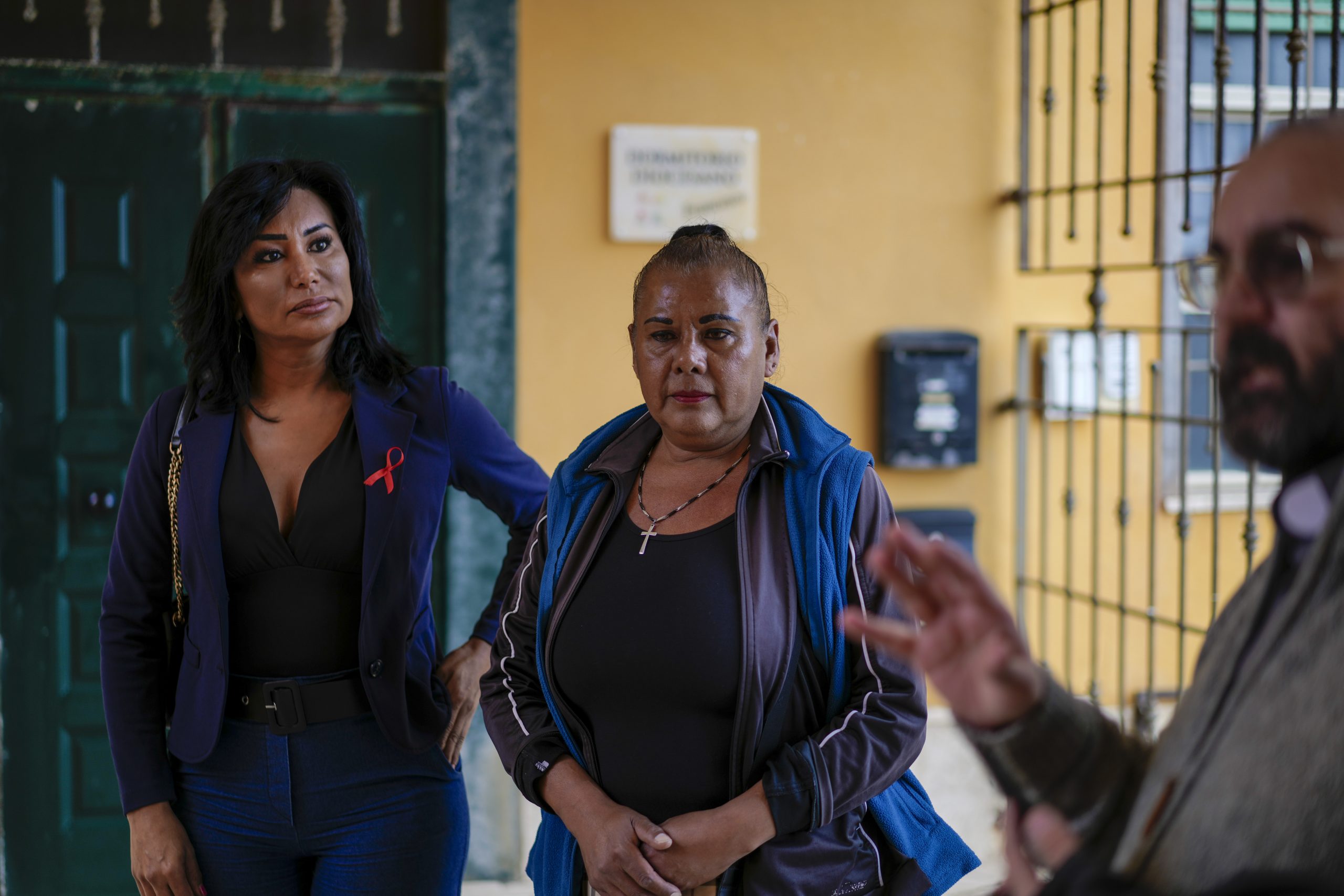
“Before, the church was closed to us. They didn’t see us as normal people, they saw us as the devil,” said Andrea Paola Torres Lopez, a Colombian transgender woman known as Consuelo, whose kitchen is decorated with pictures of Jesus. “Then Pope Francis arrived and the doors of the church opened for us.”

Francis’ latest initiative was a document from the Vatican’s doctrine office asserting that, under some circumstances, transgender people can be baptized and can serve as godparents and witnesses in weddings. It followed another recent statement from the pope himself that suggested same-sex couples could receive church blessings.

In both cases, the new pronouncements reversed the absolute bans on transgender people serving as godparents issued by the Vatican doctrine office in 2015, and on same-sex blessings announced in 2021.

Prominent LGBTQ+ organizations have welcomed Francis’ message of inclusivity, given gay and transgender people have long felt ostracized and discriminated against by a church that officially teaches that homosexual acts are “intrinsically disordered.”

Starting from his famous “Who am I to judge” comment in 2013 about a purportedly gay priest, to his assertion in January that “being homosexual is not a crime,” Francis has evolved his position to increasingly make clear that everyone — “todos, todos, todos” — is a child of God, is loved by God and welcome in the church.

That judgment-free position is not necessarily shared by the rest of the Catholic Church. The recent Vatican gathering of bishops and laypeople, known as a synod, backed off language explicitly calling for welcoming LGBTQ+ Catholics. Conservative Catholics, including cardinals, have strongly questioned his approach.

After his latest statement about trans participation in church sacraments, GLAAD and DignityUSA said Francis’ tone of inclusion would send a message to political and cultural leaders to end their persecution, exclusion and discrimination against transgender people.

For the trans community in Torvaianica, it was a more personal message, a concrete sign that the pope knew them, had heard their stories and wanted to let them know that they were part of his church.

Carla Segovia, a 46-year-old Argentine sex worker, said for transgender women like herself, being a godparent is the closest thing she will ever get to having a child of her own. She said that the new norms made her feel more comfortable about maybe one day returning fully to the faith that she was baptized in but fell away from after coming out as trans.

“This norm from Pope Francis brings me closer to finding that absolute serenity,” she said, which she feels is necessary to be fully reconciled with the faith.

Claudia Vittoria Salas, a 55-year-old transgender tailor and house cleaner, said she had already served as a godparent to three of her nieces and nephews back home in Jujuy, in northern Argentina. She choked up as she recalled that her earnings from her former work as a prostitute put her godchildren through school.

“Being a godparent is a big responsibility, it’s taking the place of the mother or father, it’s not a game,” she said as her voice broke. “You have to choose the right people who will be responsible and capable, when the parents aren’t around, to send the kids to school and provide them with food and clothes.”

Francis’ unusual friendship with the Torvaianica trans community began during Italy’s strict Covid-19 lockdown, when one, then two, and then more sex workers showed up at the Rev. Andrea Conocchia’s church on the main piazza of town asking for food, because they had lost all sources of income.

Over time, Conocchia got to know the women and as the pandemic and economic hardships continued, he encouraged them to write to Francis to ask for what they needed. One night they sat around a table and composed their letters.

“The pages of the letters of the first four were bathed in tears,” he recalled. “Why? Because they told me ‘Father, I’m ashamed, I can’t tell the pope what I have done, how I have lived.’”

But they did, and the first assistance arrived from the pope’s chief almsgiver, who then accompanied the women for their Covid-19 vaccines a year later. At the time of the pandemic, many of the women weren’t legally allowed to live in Italy and had no access to the vaccine.

Eventually, Francis asked to meet them.

Salas was among those who received the jab at the Vatican and then joined a group from Torvaianica to thank Francis at his general audience on April 27, 2022. She brought the Argentine pope a platter of homemade chicken empanadas, a traditional comfort food from their shared homeland.

Showing the photo of the exchange on her phone, Salas remembered what Francis did next: “He told the gentleman who receives the gifts to leave them with him, saying ‘I’m taking them with me for lunch,’” she said. “At that point, I started to cry.”

On Sunday, Salas was seated at Francis’ table in the Vatican auditorium. She said she had woken up at 3 a.m. to make him more chicken empanadas for his dinner. “They’re still hot,” she said.

For Canocchia, Francis’ response to Salas and the others has changed him profoundly as a priest, teaching him the value of listening and being attentive to the lives and hardships of his flock, especially those most on the margins.

For the women, it is simply an acknowledgement that they matter.

“At least they remember us, that we’re on Earth and we haven’t been abandoned and left to the mercy of the wind,” said Torres Lopez.


Yemen’s Houthi rebels hijack Israeli-linked ship in Red Sea, take 25 crew members hostage

posted in: News | 0

JERUSALEM — Yemen’s Houthi rebels seized an Israeli-linked cargo ship in a crucial Red Sea shipping route on Sunday, officials said, taking over two dozen crew members hostage and raising fears that regional tensions heightened over the Israel-Hamas war were playing out on a new maritime front.

The Iran-backed Houthi rebels said they hijacked the ship over its connection to Israel and took the crew as hostages. The group warned that it would continue to target ships in international waters that were linked to or owned by Israelis until the end of Israel’s campaign against Gaza’s Hamas rulers.

“All ships belonging to the Israeli enemy or that deal with it will become legitimate targets,” the Houthis said.

Israeli Prime Minister Benjamin Netanyahu’s office had blamed the Houthis for the attack on the Bahamas-flagged Galaxy Leader, a vehicle carrier affiliated with an Israeli billionaire. It said the 25 crew members had a range of nationalities, including Bulgarian, Filipino, Mexican and Ukrainian, but that no Israelis had been on board.

The Houthis said they were treating the crew members “in accordance with their Islamic values,” but did not elaborate on what that meant.

Netanyahu’s office condemned the seizure as an “Iranian act of terror.” The Israeli military called the hijacking a “very grave incident of global consequence.”

Israeli officials insisted the ship was British-owned and Japanese-operated. However, ownership details in public shipping databases associated the ship’s owners with Ray Car Carriers, which was founded by Abraham “Rami” Ungar, who is known as one of the richest men in Israel.

Ungar told The Associated Press he was aware of the incident but couldn’t comment as he awaited details. A ship linked to him experienced an explosion in 2021 in the Gulf of Oman. Israeli media blamed it on Iran at the time.

The complex world of international shipping often involves a series of management companies, flags and owners stretching across the globe in a single vessel.

Two U.S. defense officials confirmed that Houthi rebels seized the Galaxy Leader in the Red Sea on Sunday afternoon local time. The rebels descended on the cargo ship by repelling down from a helicopter, the officials said, confirming details first reported by NBC News. The officials spoke on condition of anonymity because they were not authorized to publicly discuss the matter.

Twice in the last month, U.S. warships have intercepted missiles or drones from Yemen that were believed to be headed toward Israel or posing a threat to the American vessels. The USS Carney, a Navy destroyer, intercepted three land attack cruise missiles and several drones that were launched by Houthi forces toward the northern Red Sea last month.

On Nov. 15 the USS Thomas Hudner, another destroyer, was sailing toward the Bab-el-Mandeb strait when the crew saw a drone, reported to have originated in Yemen. The ship shot down the drone over the water. The officials said the crew took action to ensure the safety of U.S. personnel, and there were no casualties or damage to the ship.

Satellite tracking data from MarineTraffic.com analyzed by the AP showed the Galaxy Leader traveling in the Red Sea southwest of Jeddah, Saudi Arabia, more than a day ago. The vessel had been in Korfez, Turkey, and was on its way to Pipavav, India, at the time of the seizure reported by Israel.

It had its Automatic Identification System tracker, or AIS, switched off, the data showed. Ships are supposed to keep their AIS active for safety reasons, but crews will turn them off if it appears they might be targeted or to smuggle contraband, which there was no immediate evidence to suggest was the case with the Galaxy Leader.

The British military’s United Kingdom Maritime Trade Operations, which provides warnings to sailors in the Persian Gulf and the wider region, put the hijacking as having occurred some 150 kilometers (90 miles) off the coast of Yemen’s port city of Hodeida, near the coast of Eritrea.

The Red Sea, stretching from Egypt’s Suez Canal to the narrow Bab el-Mandeb Strait separating the Arabian Peninsula from Africa, remains a key trade route for global shipping and energy supplies. That’s why the U.S. Navy has stationed multiple ships in the sea since the start of the Israel-Hamas war on Oct. 7.

Since 2019, a series of ships have come under attack at sea as Iran began breaking all the limits of its tattered nuclear deal with world powers. As Israel expands its devastating campaign against Hamas in the besieged Gaza Strip following the militant group’s unprecedented attack on southern Israel, fears have grown that the military operations could escalate into a wider regional conflict.

The Houthis have repeatedly threatened to target Israeli ships in the waters off Yemen.

Sunday Bulletin Board: Sneaking into the hockey tournament: Those were the days!

posted in: Adventure | 0

In memoriam . . . and: Gee, our old LaSalle ran great!

ZOO LOU of St. Paul writes: “The recent passing of longtime St. Paul Johnson boys’ hockey coach Lou Cotroneo brought back special memories of attending the high-school hockey tournament at the old St. Paul Auditorium in the early ’60s. How we managed to get into this wildly popular event is a highly improbable, if not downright miraculous, saga of good fortune and pure luck. And Lou was a big part of that saga.

“My dad, Joe, my brother Tom and I made our first foray to the tourney on Feb. 14, 1961, after reading in the St. Paul Dispatch that a few tickets remained for the semifinal games. Despite a lobby jammed with desperate fans, a friend was able to procure three precious tickets. The late Doug Woog, who I got to know some years later, was playing for South St. Paul that night — in one of a pair of the best games I ever saw.

“Bolstered by our ‘miracle’ the year before, we found ourselves once more in a jammed Auditorium lobby on Feb. 23, 1962. This time, however, there was no friend or tickets. Then a man gave us three red tickets from the consolation round, pointing out that they were the same color as the semifinal tickets and that we might have a good chance of getting in. With bated breath and pounding hearts, we went through the line. The elderly ticket-taker never even looked at the tickets. Not only that, but we found some empty seats.

“In 1963, just Tom and I went to the semifinals, and it again looked like our miracle run was over. The first game had started, and we were ready to leave when a man approached and said: ‘You boys look like hockey players. Here’s two tickets.’ Yes, Virginia, there is a Santa Claus!

“Enter the coach. It was Feb. 21, 1964, and my dad came home and announced we were going to the tournament, thanks to good friend Lou Cotroneo, who was in his first year as head coach of the Governors. So there we were on the Fifth Street side of the Auditorium when the Johnson bus pulled up. Lou signaled us to come over and gave us each a few sticks.

“‘Keep your heads down,’ Lou said, ‘and blend in with the players.’

“It worked like a charm. After thanking him profusely, Lou, who was clearly tensed-up about the upcoming game with Minneapolis Patrick Henry (the Govs won 9-0), said: ‘Hey, Italians take care of each other. Now you are on your own! Good luck!’ And we were lucky, finding two empty seats (Tom and I took turns sitting on the aisle).

“I encountered Lou several times over the years, and I would always bring up that story. And he would always say he remembered and asked how my papa Joe was doing.

“One of my favorite movies is the 1946 classic ‘The Best Years of Our Lives.’ Well, there is no doubt about what the best years of my life were. Riposare in pace, Lou.”

Our theater of seasons

Welcome back, ARDEN HILLS SWEDE (f.k.a. MOUNDS VIEW SWEDE): “Dear Bulletin Board,

“I apologize for not submitting any photos lately. We have moved from Mounds View to Arden Hills, and downsizing from our five-bedroom home to a two-bedroom apartment took a lot of work and thought. In the process of moving, I lost the adapter that let me download my camera memory card into the computer, and then the memory card got full. A friend of mine found an adapter that would let me get back to downloading so I can continue sharing the beauty of our nature here in this area.

“These first three photos were all taken today, Sunday. The first one looks across Highway 51 just south of Country Road E. I love the varied colors and tree species in this photo.

“I took a walk behind the Anderson Center, not far from our home at New Perspective, to see the fall colors along the path through the woods there. I noticed this pine tree had captured a fall leaf so that it could be part of the fall color scenario, too.

“This scene caught my eye with the full range of tree colors in one photo.

“This fall leaf was the first one I spotted on September 26th, on a newly planted maple tree across from the front entryway from our New Perspective apartment.

“And the pond provided a nice mirror for the fall leaves farther to the east. I’ve always enjoyed the idea of living near the woods, and now they are closer than ever.

“Two of the other trees, I go by as I come to this new place.

“I really enjoyed all the nature near our home in Mounds View, but it doesn’t look like I’ve lost that by moving here.”

Not exactly what he had in mind

RUSTY of St. Paul reports: “Subject: Adventures in chain-sawing.

“My sister-in-law needed a dead tree dropped. I have a chain saw. I don’t have tons of experience running saws, but I’m not a total novice.

“The tree fell 90 degrees from the expected line of falling and took out a portion of the neighbor’s picket fence.

“Time to buck it up for firewood. It lay on a slight slope, so I could tell the tree might roll to the south once I started bucking. I went over to the north side to start cutting. For an unknown reason, I had limbed all the limbs save one. For yet another unknown reason, I straddled the one limb I had left (a baseball bat-sized side branch) and started sawing the main trunk. As the cut went through, the trunk indeed rolled — luckily not so fast, but not in slow motion, either. The branch rolled with it. The urology gods must have been watching, as the branch ran up the inside of my thigh and avoided my boys.

“The saw operator is supposed to fill the gas and bar oil before each session. I checked the fuel and felt I had enough for the job. I ran out one-third of the way in. My gas can was a freebie from the boulevard. I figured out why it was left for free, as the no-spill valve is faulty. I spilled gas all over the machine as I filled it. The foil covering the opening of my plastic oil bottle was torn and folded back to where it impeded a clean flow. I couldn’t grab it with my fingertip to move it, so I used a stick. A half-inch of the stick broke off and fell into the oil bottle. I was certain I could tip the bottle enough to fill the reservoir but not have the stick fall into the machine. The stick fell into the machine.

“I had to drive home to get a needle driver to get the stick out. (A needle driver is a medical instrument used to sew up lacerations, which I did for 34 years of work in the emergency room. Ironically, I learned how to sew people who had lacerated their thighs using chain saws (!) when I did my ER rotation in central Maine. Using this instrument and aiming the light from my cellphone down into the oil, I eventually was able to clamp the stick and fish it out.

“While home, I figured I might as well pee (and make sure my boys were OK from the branch-rolling incident). I undid the waist strap buckle of the Kevlar chaps I was wearing to protect my legs (see above about lacerated thighs) and folded the top portion of them down and commenced. I did not hear the tinkle of urine hitting the water in the bowl, because it was hitting the inside of the chaps and running down them onto my long-johns.

“Now these were all wet, but at least my boys were fine.

“I reached around the back of the chaps to buckle them, but had trouble, so asked my wife for help. She had trouble, too, but finally got it.

“I got back to the site and couldn’t get the saw started. The saw is a hand-me-down from my brother. He told me it is a finicky starter, and he was correct. I tried several times, figured it was now flooded, so aborted the job until tomorrow.

“Please don’t tell my sister-in-law any of this, as she might hire out next time she needs a tree dropped. On second thought. . .”

Where we live

BILL OF THE RIVER LAKE reports: “Subject: Looking to the future.

“This might be a creative and realistic plan.

“I’m looking at a new design for a baseball cap and companion T-shirt.

“The emblems of our Minnesota Twins, Vikings, Wild, Timberwolves and Gophers would be equally spaced around the cap and prominently on the front of the T-shirt.

“I’ll call this my ‘Wait Till Next Year’ wear.

“This might grab the attention of thousands of Minnesota sports fans.

“And, as always in Minnesota, there’s always room for HOPE!”

Our times . . . or: Hmmmmmmmm

THE DORYMAN of Prescott, Wis.: “Subject: Least of three evils?

“I’ve recently read that only about 9 percent of plastic put out for recycling is, in the end, recycled. I suppose it’s still good for the economy, by the amount of equipment it requires and the people it employs.

“It does raise a question for me that complicates my Holiday Wokefulness: Is it better for the environment to buy a plastic tree that is 91 percent destined to end up in a landfill . . . or to destroying a real tree that is biodegradable?

“Hmmm, maybe there is a case for Festivus and the totally recyclable, yet not carbon-neutral, aluminum pole after all.”

What’s in a name?

THE RETIRED PEDAGOGUE of Arden Hills: “Subject: He won’t be stealing any signs — or Christmas.

“This was a headline in the ‘BRIEFLY’ section on Page C3 in Sports of Monday’s STrib: ‘Southern Cal fires Grinch as defensive coordinator.’”

Out of the mouths (etc.) of babes

JB’s WIFE has returned, after many moons unheard from: “Subject: May your buns never lie to you.

“Here’s a conversation between two of my grandsons, who were taking a bath together: the 4-year-old (let’s call him ‘A’) and the 7-year-old (let’s call him ‘B’):

“As the tub was filling with water, B yelled out: ‘A just pooped in the tub!’ Dad walked in, and sure enough, there were some little floaties hanging out in the water, with A propped up against the inside of the tub, squatting over the water, holding himself up, bracing to not fall into the poo water.

“Dad asked A why he’d pooped in the tub, and his answer was brilliant and honest at the same time: ‘Dad, my buns lied to me. They told me they were gonna toot . . . but then they pooped!’”

BAND NAME OF THE DAY: The Little Floaties

Related Articles

Opinion |


Sunday Bulletin Board: Tiny dancer can’t keep up — but can keep spirits up!

Opinion |


Sunday Bulletin Board: Fourscore and one years ago . . . school was out for summer!

Argentines vote in election that could lead Trump-admiring populist to presidency

posted in: News | 0

BUENOS AIRES, Argentina — Voters in Argentina were heading to the polls Sunday in a presidential runoff election that will determine whether South America’s second-largest economy will take a rightward shift.

Populist Javier Milei, an upstart candidate who got his start as a television talking head, has frequently been compared to former U.S. President Donald Trump. He faces Economy Minister Sergio Massa of the Peronist party, which has been a leading force in Argentine politics for decades.

On Massa’s watch, inflation has soared to more than 140% and poverty has increased. Milei, a self-described anarcho-capitalist, proposes to slash the size of the state and rein in inflation, while Massa has warned people about the negative impacts of such policies.

The highly polarizing election is forcing many to decide which of the two they consider to be the least bad option.

“Whatever happens in this election will be incredible,” said Lucas Romero, director of local political consultancy Synopsis. “It would be incredible for Massa to win in this economic context or for Milei to win facing a candidate as professional as Massa.”

Voting stations opened at 8 a.m. (1100 GMT) and close 10 hours later. Voting is conducted with paper ballots, making the count unpredictable, but initial results were expected around three hours after polls close.

Milei went from blasting the country’s “political caste” on TV to winning a lawmaker seat two years ago. The economist’s screeds resonated widely with Argentines angered by their struggle to make ends meet, particularly young men.

“Money covers less and less each day. I’m a qualified individual, and my salary isn’t enough for anything,” Esteban Medina, a 26-year-old physical therapist from Ezeiza, on the outskirts of Buenos Aires, told The Associated Press on the sidelines of a Milei rally earlier this week.

Massa, as one of the most prominent figures in a deeply unpopular administration, was once seen as having little chance of victory. But he managed to mobilize the networks of his Peronist party and clinched a decisive first-place finish in the first round of voting.

His campaign has cautioned Argentines that his libertarian opponent’s plan to eliminate key ministries and otherwise sharply curtail the state would threaten public services, including health and education, and welfare programs many rely on. Massa has also drawn attention to his opponent’s often aggressive rhetoric and has openly questioned his mental acuity; ahead of the first round, Milei sometimes carried a revving chainsaw at rallies.

Massa’s “only chance to win this election when people want change … is to make this election a referendum on whether Milei is fit to be president or not,” said Ana Iparraguirre, partner at pollster GBAO Strategies.

Milei has accused Massa and his allies of running a “campaign of fear” and he has walked back some of his most controversial proposals, such as loosening gun control. In his final campaign ad, Milei looks at the camera and assures voters he has no plans to privatize education or health care.

Most pre-election polls, which have been notoriously wrong at every step of this year’s campaign, show a statistical tie between the two candidates. Voters for first-round candidates who didn’t make the runoff will be key. Patricia Bullrich, who placed third, has endorsed Milei.

Javier Rojas, a 36-year-old pediatrician who voted for Bullrich in October, told The Associated Press he’s leaning toward Milei, then added: “Well, to be honest, it’s more of a vote against the other side than anything else.”

Underscoring the bitter division this campaign has brought to the fore, Milei received both jeers and cheers on Friday night at the legendary Colón Theater in Buenos Aires.

The vote takes place amid Milei’s allegations of possible electoral fraud, reminiscent of those from Trump and former Brazilian President Jair Bolsonaro. Without providing evidence, Milei claimed that the first round of the presidential election was plagued by irregularities that affected the result. Experts say such irregularities cannot swing an election, and that his assertions are partly aimed at firing up his base and motivating his supporters to become monitors of voting stations.

Such claims spread widely on social media and, at Milei’s rally in Ezeiza earlier this week, all those interviewed told the AP they were concerned about the integrity of the vote.

“You don’t need to show statistically significant errors,” Fernanda Buril, of the Washington-based International Foundation for Electoral Systems, said in an e-mail. “If you draw enough attention to one problem in one polling station which likely doesn’t affect the results in any meaningful way, people are likely to overestimate the frequency and impact of that and other problems in the elections more generally.”