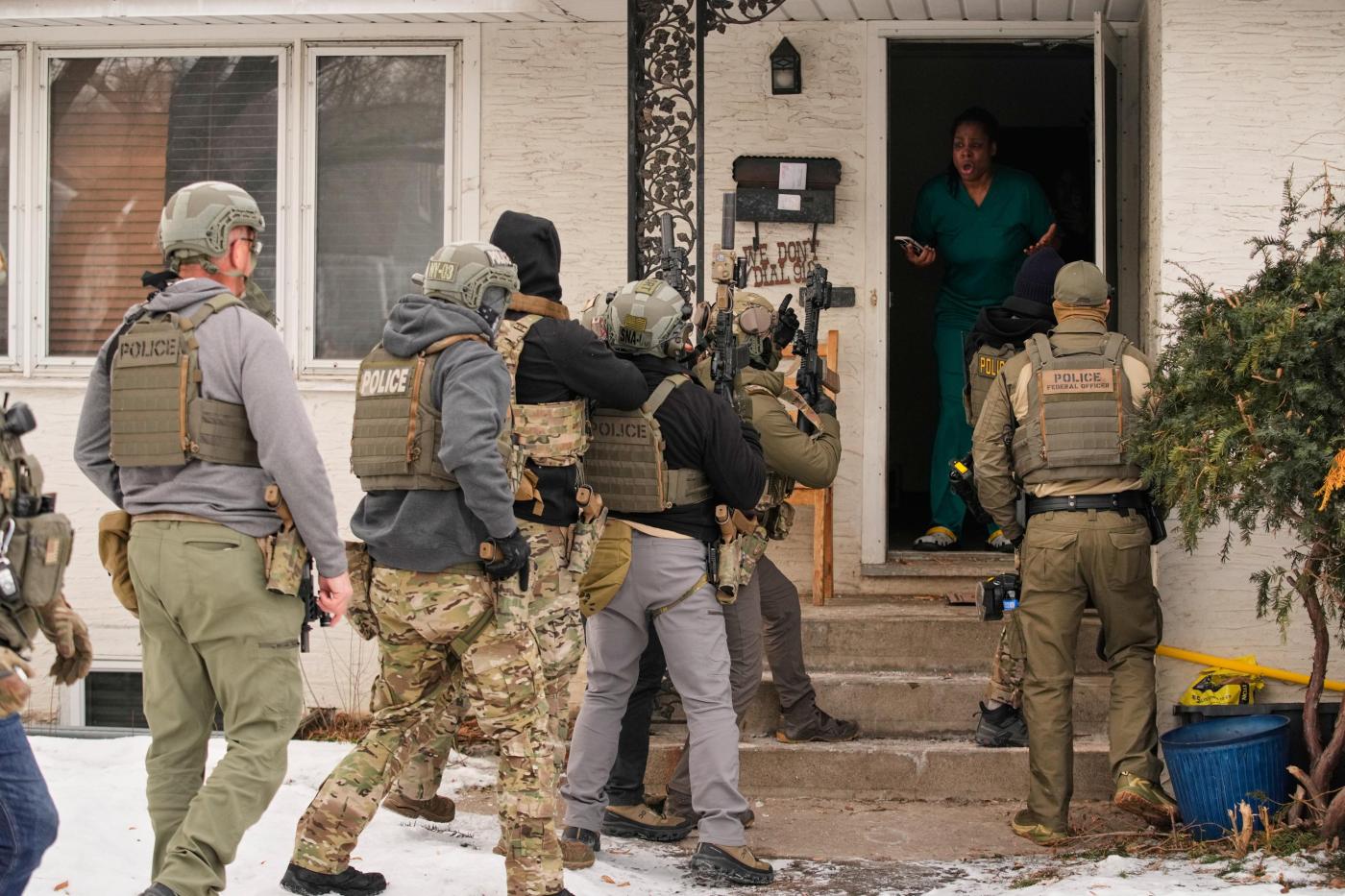
Immigration officers assert sweeping power to enter homes without a judge’s warrant, memo says

posted in: All news | 0

By REBECCA SANTANA, Associated Press

WASHINGTON (AP) — Federal immigration officers are asserting sweeping power to forcibly enter people’s homes without a judge’s warrant, according to an internal Immigration and Customs Enforcement memo obtained by The Associated Press, marking a sharp reversal of longstanding guidance meant to respect constitutional limits on government searches.

The memo authorizes ICE officers to use force to enter a residence based solely on a more narrow administrative warrant to arrest someone with a final order of removal, a move that advocates say collides with Fourth Amendment protections and upends years of advice given to immigrant communities.

The shift comes as the Trump administration dramatically expands immigration arrests nationwide, deploying thousands of officers under a mass deportation campaign that is already reshaping enforcement tactics in cities such as Minneapolis.

For years, immigrant advocates, legal aid groups and local governments have urged people not to open their doors to immigration agents unless they are shown a warrant signed by a judge. That guidance is rooted in Supreme Court rulings that generally prohibit law enforcement from entering a home without judicial approval. The ICE directive directly undercuts that advice at a time when arrests are accelerating under the administration’s immigration crackdown.

The memo itself has not been widely shared within the agency, according to a whistleblower complaint, but its contents have been used to train new ICE officers who are being deployed into cities and towns to implement the president’s immigration crackdown. New ICE hires and those still in training are being told to follow the memo’s guidance instead of written training materials that actually contradict the memo, according to the whistleblower disclosure.

It is unclear how broadly the directive has been applied in immigration enforcement operations. The Associated Press witnessed ICE officers ramming through the front door of the home of a Liberian man in Minneapolis on Jan. 11 with only an administrative warrant, wearing heavy tactical gear and with their rifles drawn.

The change is almost certain to meet legal challenges and stiff criticism from advocacy groups and immigrant-friendly state and local governments that have spent years successfully urging people not to open their doors unless ICE shows them a warrant signed by a judge.

The Associated Press obtained the memo and whistleblower complaint from an official in Congress, who shared it on condition of anonymity to discuss sensitive documents. The AP verified the authenticity of the accounts in the complaint.

The memo, signed by the acting director of ICE, Todd Lyons, and dated May 12, 2025, says: “Although the U.S. Department of Homeland Security (DHS) has not historically relied on administrative warrants alone to arrest aliens subject to final orders of removal in their place of residence, the DHS Office of the General Counsel has recently determined that the U.S. Constitution, the Immigration and Nationality Act, and the immigration regulations do not prohibit relying on administrative warrants for this purpose.”

The memo does not detail how that determination was made nor what its legal repercussions might be.

When asked about the memo, Homeland Security spokeswoman Tricia McLaughlin said in an emailed statement to the AP that everyone the department serves with an administrative warrant has already had “full due process and a final order of removal.”

She said the officers issuing those warrants have also found probable cause for the person’s arrest. She said the Supreme Court and Congress have “recognized the propriety of administrative warrants in cases of immigration enforcement,” without elaborating. McLaughlin did not respond to questions about whether ICE officers entered a person’s home since the memo was issued relying solely on an administrative warrant and if so, how often.

Related Articles


ICE activity increases in Maine as anxiety grows in immigrant communities


Court lifts restrictions on immigration officers’ tactics in Minnesota


Former Iowa superintendent expected to plead guilty to falsely claiming US citizenship


Iconic Coney Island hot dog hawker Nathan’s Famous is sold for $450 million


Jury deliberating case of former Uvalde officer charged over response to 2022 school attack

Recent arrests shine a light on tactics

Whistleblower Aid, a non-profit legal organization that assists workers exposing wrongdoings, said in the whistleblower complaint obtained by The Associated Press that it represents two anonymous U.S. government officials “disclosing a secretive – and seemingly unconstitutional – policy directive.”

A wave of recent high-profile arrests, many unfolding at private homes and businesses and captured on video, has shined a spotlight on immigration arrest tactics, including officers’ use of proper warrants.

Most immigration arrests are carried out under administrative warrants, internal documents issued by immigration authorities that authorize the arrest of a specific individual but do not permit officers to forcibly enter private homes or other non-public spaces without consent. Only warrants signed by judges carry that authority.

All law enforcement operations — including those conducted by ICE and Customs and Border Protection — are governed by the Fourth Amendment of the Constitution, which protects all people in the country from unreasonable searches and seizures.

People can legally refuse federal immigration agents entry into private property if the agents only have an administrative warrant, with some limited exceptions.

Federal agents this month rammed the door of the Minneapolis home of a Liberian man with a deportation order from 2023, who was then arrested. Documents reviewed by The AP revealed that the agents only had an administrative warrant — meaning there was no judge who authorized the raid on private property.

Memo shown to ‘select’ officials

The memo says ICE officers can forcibly enter homes and arrest immigrants using just a signed administrative warrant known as an I-205 if they have a final order of removal issued by an immigration judge, the Board of Immigration Appeals or a district judge or magistrate judge.

The memo says officers must first knock on the door and share who they are and why they’re at the residence. They’re limited in the hours they can go into the home — after 6 a.m. and before 10 p.m. The people inside must be given a “reasonable chance to act lawfully.” But if that doesn’t work, the memo says, they can use force to go in.

“Should the alien refuse admittance, ICE officers and agents should use only a necessary and reasonable amount of force to enter the alien’s residence, following proper notification of the officer or agent’s authority and intent to enter,” the memo reads.

The memo is addressed to all ICE personnel. But it has been shown only to “select DHS officials” who then shared it with some employees who were told to read it and return it, Whistleblower Aid wrote in the disclosure.

One of the two whistleblowers was allowed to view the memo only in the presence of a supervisor and then had to give it back. That person was not allowed to take notes. A whistleblower was able to access the document and lawfully disclose to Congress, Whistleblower Aid said.

Although the memo was issued in May, David Kligerman, senior vice president and special counsel at Whistleblower Aid, said it took time for its clients to find a “safe and legal path to disclose it to lawmakers and the American people.”

ICE officers are told to rely solely on administrative warrants, memo says

ICE has been rapidly hiring thousands of new deportation officers to carry out the president’s mass deportation agenda. They’re trained at the Federal Law Enforcement Training Center in Brunswick, Georgia.

During a visit there by The Associated Press in August, ICE officials said repeatedly that new officers were being trained to follow the Fourth Amendment.

But according to the whistleblowers’ account, newly hired ICE officers are being told they can rely solely on administrative warrants to enter homes to make arrests even though that conflicts with written Homeland Security training materials.

ICE officers often wait for hours for the person they’re hoping to arrest to come outside so they can make the arrest on the sidewalk or at the person’s work — public places where they are allowed to operate without the risk of infringing on the person’s Fourth Amendment rights.

Whistleblower Aid called the new policy a “complete break from the law” and said it undercuts the “Fourth Amendment and the rights it protects.”


Kaohly Her concerned ICE impact on St. Paul businesses, safety

posted in: All news | 0

St. Paul Mayor Kaohly Her and Minneapolis Mayor Jacob Frey on Wednesday addressed the ongoing immigration crackdown in their cities and federal subpoenas brought against their them this week during a public discussion at the University of St. Thomas.

Two weeks after the fatal shooting of 37-year-old Renee Good by a U.S. Immigration and Customs Enforcement agent during a confrontation in Minneapolis, Her said she is “absolutely” concerned that something similar could eventually unfold in St. Paul as thousands of enforcement officers continue to make arrests in the Twin Cities.

“Every single time we get reports that there is a large gathering of ICE vehicles…  I say a prayer, hoping that it doesn’t end the same way,” the new mayor said during a “Breakfast with the Mayors” event moderated by KSTP news reporter Tom Hauser.

St. Paul Mayor Kaohly Her, left, Minneapolis Mayor Jacob Frey, center, and moderator KSTP Reporter Tom Hauser, talk about the impact the ICE surge has made on the Twin Cities at the annual St. Paul Area Chamber and Minneapolis Regional Chamber Breakfast. (John Autey / Pioneer Press)

Both Frey and Her noted that it is difficult for their city police departments to contend with the presence of thousands of ICE and U.S. Border Patrol agents when the Minneapolis police department has around 600 officers, and St. Paul has just under that number.

‘This isn’t about who is inflaming a situation’

Her and Frey also disputed characterizations of Minnesota officials’ rhetoric as stoking tensions in the state.

“This isn’t about who is inflaming a situation. This is political retribution, and our president has said that very publicly that that is what he is going to do,” Her said. “It doesn’t matter what we say or do right now … we are a target, and we’re going to continue to be a target, and let’s not forget that the aggressor is the federal government.”

Her, who took office earlier this month, said she was “surprised” when FBI agents arrived at the St. Paul mayor’s office Tuesday to deliver the subpoena seeking records in connection to a Trump administration probe into whether she and other Democratic Minnesota officials obstructed immigration enforcement operations.

“We are talking with our legal team and figuring out a path forward,” Her said in response to a question about what the city planned to do next. “This is not something that we … come across every day, so you want to make sure they really understand and comply.”

Immigration enforcement surge

The annual Breakfast with the Mayors event, organized by the Minneapolis and St. Paul Area chambers of commerce, shifted from its usual tone this year as Minnesota leaders’ conflict with the Trump administration remains in the national spotlight. Wednesday’s event focused largely on the immigration enforcement surge.

Her indirectly weighed in on this weekend’s storming of a St. Paul church service by anti-immigration enforcement protesters, who identified a pastor there as being in charge of the ICE field office in St. Paul.

The protest at Cities Church on Summit Avenue drew condemnation from national conservative figures, disapproval from Democratic Gov. Tim Walz and the threat of federal charges by the U.S. Department of Justice. Her said the federal government shouldn’t ask others to do things that it is not willing to do itself.

“That is an ongoing investigation, so I don’t want to comment specifically on that,” she said. “(But) if our federal government wants us to condemn the actions in one place, which I am very much willing to do, that means we also have to condemn the fact that ICE agents are not letting people get (medical) examinations … There are a lot of sacred spaces that we should be adhering to.”

Frey: Federal subpoenas ‘intimidation’

Frey called the subpoenas an attempt at “intimidation” and stood by what he called his city’s efforts to protect residents.

“You do not get to subpoena and federally investigate mayors because they speak up for their constituencies, which, by the way, is one of the core functions in our city charter,” he said. “You do not get to randomly yank Somali people and Latino people off the street because of the way that they look. You do not get to just ask for their passports because they happen to look like they’re not from here. By the way, if you’ve around Minneapolis and St Paul the last 25 years — they do look like they’re from here.”

Her and Frey did touch on some business-related issues, though largely as they related to the immigration crackdown and actions by the Trump administration.

Asked if they believed further negative media attention on the state would harm economic activity in the long run, Her said she believed long-term investors and developers, such as those working to revitalize downtown commercial real estate, understand that current political difficulties for the region will pass.

Though she expressed concern about the negative effects of ICE operations on local business traffic, which has seen declines in some areas of the Twin Cities amid the heightened enforcement presence.

“When consumers can’t consume, it impacts our taxes … But I don’t think that Trump and the federal government understand the economic impact this has on us,” she said. “Closing a business happens very quickly, but starting one up can take years, which means this is going to impact us, even if they were out here in another couple of months, this is going to have a lasting economic impact.”

Related Articles


St. Paul schools: 6,000 students to do online learning due to immigration actions


Yacht Club Festival promoters announce new country music fest at Harriet Island


St. Paul City Council plans to update separation ordinance in steps to speed process


Minnesota: Amtrak cancels some services ahead of brutal winter weather


Legal referee tosses petition for restraining order against St. Paul mayor

Frey urged shopping in Minneapolis’ “cultural corridors” and neighborhoods to help support local and immigrant business owners affected by the surge.

“They need us right now, Latino and Somali and Hmong and Southeast Asian owned businesses,” he said. “They need us to get them through this now. And so be there for them. I think that is of critical importance.”

Timberwolves season-ticket renewal prices are rising. Here’s why

posted in: All news | 0

The Timberwolves sent out season ticket renewals Wednesday and … prices are up.

That’s not unusual. Prices rise around the league year over year, but this isn’t a standard uptick. Timberwolves and Lynx CEO Matt Caldwell referred to it as a “pricing reset.”

Data suggests Minnesota is 29th in the 30-team NBA this season in average season ticket cost. Now, someone has to be No. 29, but you wouldn’t think it’s the team that’s been to consecutive conference finals and is again a legitimate contender in the Western Conference this season.

So Caldwell, who hs been on the job for five months, felt an increase was appropriate. Minnesota’s ticket prices plummeted over the previous two decades, in lockstep with the team’s performance.

Now that the team is better and demand to watch it in person has risen, the organization deemed it appropriate to increase the cost to do so. Minnesota’s current pricing more closely represents the previous two decades of results than the past two years.

Most tickets in the lower bowl — which is sold out this season — are increasing by at least 8%, with plenty of those seats increasing in cost by far more.

Price increases were largely structured to reflect supply versus demand. Minnesota also is looking for ways to add lower-level seating inventory for next season.

These increases still aren’t expected to push Minnesota even into the top 20 in the NBA in ticket cost, though that understandably won’t serve as much consolation to existing season ticket holders who will have to pay significantly more to enjoy the same experience next season.

The Timberwolves currently have roughly 9,000 season ticket holders. The team does plan on working with current season ticket holders to change seats for future seasons if they are unable to meet the new price point for their current spot. That’s because the Wolves don’t want to lose their fan base, and management acknowledges the remarkable atmosphere that currently exists at Target Center, particularly during the playoffs.

Minnesota has one of the loudest buildings in the NBA.

This 2025-26 campaign is the first season with Marc Lore and Alex Rodriguez serving as the majority owners. They’ve committed themselves financially to date, with Minnesota’s roster resting comfortably over the salary cap and the organization working out a financial deal to bring Kevin Garnett back into the fold while also implementing a new, cinematic-style lighting system at Target Center.

Caldwell, who joined the organization on a 10-year deal, also noted the team hopes to work with the city to remain in downtown Minneapolis amid its early efforts to build a new arena, which figures to be a lengthy process expected to take at least five years, and likely more.

Related Articles


Timberwolves give up double-digit fourth-quarter lead, lose to Jazz


Frederick: With the game is on the line, opposing defenses can’t stop Ant


Edwards scores 55, but Spurs hold off Timberwolves


Timberwolves free-throw woes are catching up to them


Edwards-less Timberwolves fall at Houston

Congressman Tries to Cut Pay of ICE Prosecutor with Racist X Account to $1

posted in: All news | 0

As a new Department of Homeland Security (DHS) funding bill works its way through Congress, Congressman Marc Veasey, a Democrat who represents part of Dallas, introduced an amendment in committee Wednesday aimed to reduce the salary of James Rodden, an Immigration and Customs Enforcement (ICE) assistant chief counsel who acts as a prosecutor for ICE in immigration court in Dallas, to $1. 

In February of last year, the Texas Observer reported that Rodden operates a white supremacist X account named GlomarResponder, based on an overwhelming number of biographical details that the Observer matched through publicly available documents, other social media activity, and courtroom observation. Three members of the U.S. House of Representatives, including Veasey, wrote letters to ICE and DHS demanding information and investigation. In response, ICE sent a letter to Veasey stating it would address the matter and that such internal investigations can take up to 120 days, but it has otherwise not provided any information. 

Veasey’s amendment came a week after the Observer reported that Rodden, who was apparently pulled from federal immigration court schedules following the Observer’s reporting last February, had returned to immigration court in Dallas. 

“[Rodden’s] statements are disgusting, and they are dangerous, and regardless of if you are a Democrat or a Republican, they should be disqualifying for anyone entrusted with power in the United States government,” Veasey said during Wednesday’s House Rules Committee hearing. “If Congress does nothing, if the committee does nothing, then we’re sending the message that this type of behavior is tolerable, that accountability is optional, and that white supremacy can continue to be subsidized with taxpayer dollars.”

The GlomarResponder account has over 17,000 followers and has routinely posted hateful statements. In addition to posting that “America is a White nation,” that “‘Migrants’ are all criminals,” and that “All blacks are foreign to my people,” plus apparent praise of Adolf Hitler, the account has also made posts that evoke anti-immigrant violence: “Nobody is proposing feeding migrants into tree shredders,” the account posted in March 2024. “Yet. Give it a few more weeks at this level of invasion, and that will be the moderate position.”

Veasey’s amendment seeking to reduce Rodden’s salary relied upon the Holman Rule, which allows members of the U.S. House to amend appropriations legislation to cut specific programs or reduce the salary of specific federal employees. Named for Democratic politician William S. Holman, the rule has been instated and rescinded over the decades. It was most recently reinstated in 2023 when Republicans retook the majority. That same year, some Republicans considered using the rule to derail a now-abandoned special counsel investigation into Donald Trump, though the maneuver was never deployed.

“The amendment before you is simple, and it’s narrow,” Veasey said at the hearing. “It sends a clear message that we are not going to fund this man’s salary, and that Congress will not fund hate. We can stand by Nazi sympathizers and Hitler supporters, or we can do the right thing and honor the sacrifices of the men and women who died to stop the hateful spread of Nazism.”

This story will be updated with the outcome of Veasey’s amendment.

The post Congressman Tries to Cut Pay of ICE Prosecutor with Racist X Account to $1 appeared first on The Texas Observer.