Abbott’s Border Standoff Fueled by a Climate Crisis He Helped to Create

posted in: News | 0

Originally published by Deceleration and reprinted with permission of the author. Deceleration is a nonprofit online journal producing original news and analysis responding to our shared ecological, political, and cultural crises

“These weeks, I’m hearing people around me say it looks like the sun is getting closer to Haiti, the heat is unbearable. Yet, we know that the sun stays in its place, it is shade … [that] becomes a privilege.” —Jeffthanie, Haiti

Advocacy Brief: “In Our Words: Voices of Women of African Descent for Reproductive and Climate Justice

Earlier this month, Homeland Security Secretary Alejandro Mayorkas took to MSNBC to discuss the border crisis. As video of the unprecedented press of refugees and migrants at Eagle Pass, Texas, flashed on the screen, he was asked what was behind the record-setting surge of desperate humanity at the border. He stressed three intersecting forces: climate, poverty, and rising authoritarianism.

“We are seeing the greatest number of displaced people, not only at our southern border, not only in the Western hemisphere, but across the globe,” Mayorkas said.

It’s true. More than 110 million people—the most ever recorded—were considered forcibly displaced in 2023 by “conflict, persecution, discrimination, violence and climate change,” according to the United Nations High Commissioner for Refugees.

Saying so didn’t sit well with Governor Greg Abbott, who blasted Mayorkas on X: “Climate change? Mayorkas is pathetic.” 

If he sounds a little sensitive, there’s a reason for it. 

Abbott entered Texas politics waging a war on the most vulnerable people on the planet by fighting efforts to reduce the United States’ contributions to rapidly accelerating global warming—warming that year after year has expressed itself in worsening weather disasters displacing tens of millions of people from their homes.

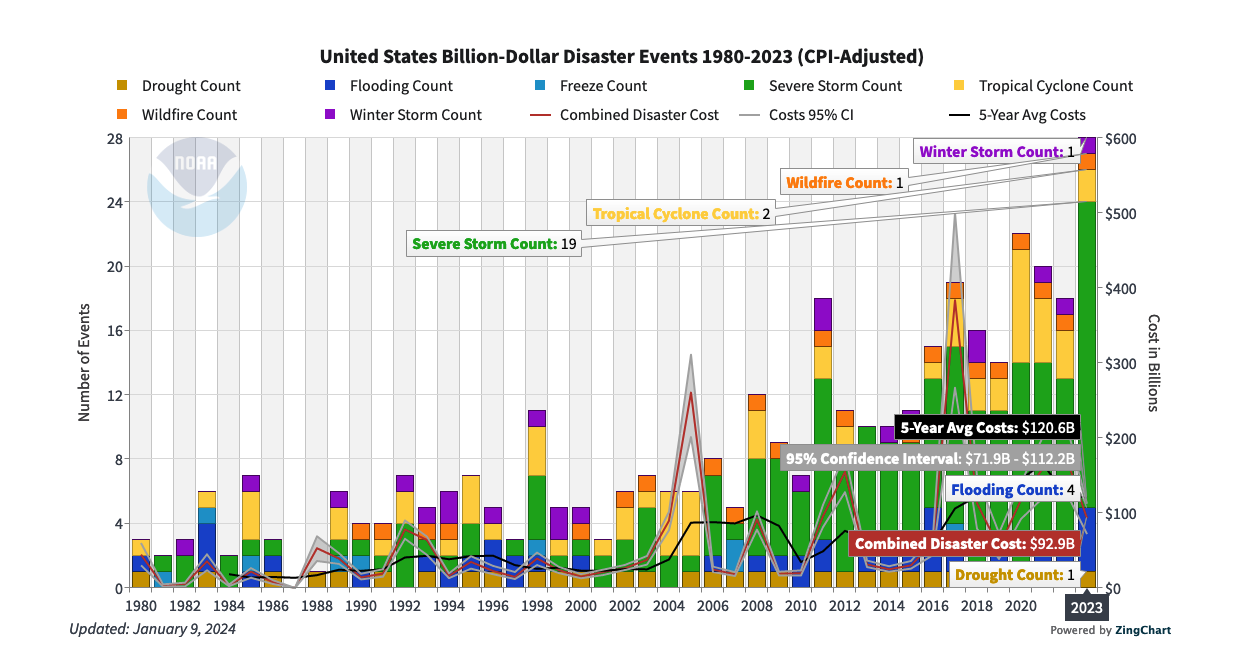
Last year, more than 12,000 people perished around the world in floods, storms, and wildfires, according to the international nonprofit Save the Children. That’s an uptick of 30 percent over the previous year. In the United States, there was a record-shattering $93B in damages caused by weather-driven disasters. Over the last 20 years, billion-dollar climate-related disasters have dramatically expanded, from a handful each year in the 1990s to 10 or more in the 2000’s to last year’s dozens. These mega-disasters have struck even as the scientific community ratcheted up its warnings about the course we are on–and as elected leaders like Abbott worked to slow or stop federal action intended to dampen the devastation.

Discussing root causes presents a dangerous distraction from the only story he wants us discussing, his beef with President Joe Biden. To keep us from debating actual solutions to the surge, he’s willing to go against the U.S. Supreme Court—the most conservative court in nearly 100 years—which still defers to the Constitutional primacy of the federal government in matters of the border and immigration. To do otherwise risks exposing his own contribution to the crisis. 

Abbott’s culpability is encapsulated in his brag a decade ago during his time as Texas Attorney General: “I go into the office, I sue the federal government and I go home.” Many of those lawsuits targeted US EPA efforts to regulate air pollution contributing to the climatic chaos we are experiencing today.

For those who need reminding: 2023 was the hottest year to date not only in Texas but the hottest that planet Earth has experienced in at least 120,000 years. The second hottest year on record was only a few years before that. And the hottest 10 years measured since modern record-keeping began? That’s right: All within the last decade. See a pattern? Moving into 2024, all arrows point to another record-breaker.

The world didn’t need to be like this. But the efforts of Abbott and others to undermine climate action have a supportive audience. Climate conspiracies seep through the pores of the internet in spite of promises of Big Tech tycoons to regulate disinformation. Yet the science behind this global cooking is deceptively simple:

Every year we wrench massive amounts of carbon from the ground in the form of coal, oil, and gas, crushing and incinerating those substances to create energy. We then shunt the wastes—the CO2, methane, and other heat-trapping gasses—into the atmosphere with predictable consequences.

The basic science behind this artificial warming overheating the planet has been understood for more than 100 years, such that policymakers who have worked to undermine action have a lot of explaining to do. 

Most people today know that the weather events they are experiencing are both unprecedented and unnatural. More than 70 percent of those surveyed in Texas last fall said that they both understand global warming is happening and believe that the gasses contributing to it should be regulated as pollutants. Roughly half told the surveyors with the Yale Program on Climate Change Communication that they have personally suffered from global warming’s impacts.

The rejection of climate science intended to score political points on behalf of fossil fuel billionaires, the brand of denialism marking Abbott’s entire political life, is unraveling.

In short: the rejection of climate science intended to score political points on behalf of fossil fuel billionaires, the brand of denialism marking Abbott’s entire political life, is unraveling. Denying the warming of the planet that we are all experiencing smacks today of lunacy. So, to help protect the most heavily subsidized industry on the planet ($13M per minute for fossil fuels, according to the International Monetary Fund), Abbott and company need a new form of denialism.

A recent report by the Center for Countering Digital Hate (CCDH) marks the rise of what it calls “new denial.” Instead of arguing the heat we all feel is not real (as the fossil fuel industry and related trade groups and think tanks have done for decades), today’s deniers are instead trying to convince voters that climate solutions won’t work. If you’ve found yourself logging off social media lately mired in depression feeling as if there is no solution to the fix we are in, likely you have been caught up in one of these new denial claims. 

CCDH researchers reviewed 4,458 hours of YouTube video content posted between 2018 to 2023. They found that “old denial” arguments, including claims that the Earth isn’t getting hotter, have dropped from 65% of all claims to only 30 percent. So-called “new denial” claims that suggest, for instance, that the solution is worse than the problem itself, now make up 70 percent of all detractor arguments. Attacks on climate solutions, in particular, have leapt by more than 21 points. The reality, however, is that there is a world of solutions—many underway, others waiting for us to activate

If this generation and the ones hoping to follow us are to have a chance, we have got to take up this project honestly.

Crafting solutions requires shaking off the paralyzing sludge of industry disinformation campaigns and seeing these challenges with clear eyes. Instead of demonizing climate’s victims, we must demand policy changes that protect all people, wherever they live.

Demands made under the current and previous administration that migrants and refugees remain in Mexico while struggling to secure a court hearing to present their asylum claims have contributed to tent cities with no place to hide from the biting punishments of extreme weather. Unfortunately, with Abbott, the cruelty is the message. His inhumanity roared to the surface recently when he was caught lamenting the failure of his coercive violence against migrants. Talk radio host Dana Loesch asked him on January 5 what was the maximum amount of pressure he could apply to the situation before being running afoul of federal law. Abbot responded that he was doing everything but “shooting” migrants and refugees at the border, because, he said, “of course the Biden Administration would charge us with murder.”

And it’s true. The assault on humanity at the border is profound. To start, Operation Lone Star is intended to keep refugees and migrants from crossing the border to make their asylum claims, which is their right under both 1948’s Universal Declaration of Human Rights and the Refugee Convention of 1951. Then, at Eagle Pass, oversized buoys have been placed in the river with serrated metal plates between and underlain by submerged netting. Beyond that, miles of razor wire. For those who brave all of this, oftentimes with children in tow, there are frequently staged arrests, after agents lead migrants onto private property in order to lock them up on misdemeanor trespassing charges. Now he has demonstrated a willingness to stoke domestic violence by stoking those conspiracy minded who believe, as he insists, this humanitarian crisis is actually an orchestrated invasion.

Undoubtedly, it’s an untenable situation. But to begin to fix it we need to understand what is actually behind it. People just don’t leave their homes and families and communities because the United States left a back door unlocked somewhere. They undertake desperate voyages because their lives at home have become unbearable. After Mexico, most of the families arriving at the border this month (and they are nearly half family units) have been from Guatemala, Honduras, and El Salvador, Central America’s so-called Northern Triangle. It’s an area that has been severely stressed by extreme weather events and rising temperatures linked to global warming. A recent study by researchers at the University of Texas at Austin and the University of Utah found a definite correlation between dry growing seasons in the Northern Triangle and emigration to the United States of more than 70 percent even after controlling for factors like criminal violence and poverty. In other words, love him or hate him, Mayorkas is right to highlight climate. It gets far too little attention, which does little for developing strategies to ultimately solve the intersecting crises.

“Mounting evidence suggests that Venezuela is experiencing accelerating, chronic climate shocks and stresses, some of which are factored into people’s calculations whether to stay or leave.”

Consider the unraveling of Venezuela—and the stunning 7.7 million refugees and migrants streaming out of the country in recent years. This story is most often reported as a political one, with reporters highlighting state corruption or an economic over-reliance on oil. Rarely factored in is the contribution of years of extreme drought, rising seas, and other devastating climate impacts punishing the Venezuelan people who recently suffered their worst drought in at least 40 years. The USDA’s own assessment of Venezuela’s food security in 2022 didn’t mention drought or climate. Instead it limits blame to “anti-market policies, political turmoil … decline of the country’s oil industry … and hyperinflation.” 

Researchers with Humanitarian Practice Networks, however, wrote around the same time that:

“Mounting evidence suggests that Venezuela is experiencing accelerating, chronic climate shocks and stresses, some of which are factored into people’s calculations whether to stay or leave.”

In Haiti, where lives have also teetered on the brink of anarchy, sending tens of thousands to seek shelter in the United States in recent years, the disequilibrium is not merely political. Global climatic forces and local survival strategies that can compound the impact of storms and floods both contribute to that instability, according to UNICEF.

“It is an incredible injustice to our children to leave behind a world that is worse than the one we inherited, let alone one that threatens to be increasingly uninhabitable by humans,” writes Imran Ahmed, CEO of the Center for Countering Digital Hate.

Another path is still possible. In much the same way that Texas has leapt ahead of most others in wind and solar energy production (and could be a global leader, as Time magazine pointed out recently) there is a huge opportunity here for the state. We could choose to tackle the climate crisis and related opportunities as a partner with the world to our south. Abbott has decided, instead, to declare war on them.

Chicago Bears Q&A: How divided are fans over the QB decision? Will GM Ryan Poles shop for a running back in free agency?

posted in: News | 0

While Chicago Bears coach Matt Eberflus fills out his coaching staff, general manager Ryan Poles and the front office are preparing for the NFL scouting combine ahead of a potentially momentous draft with the Nos. 1 and 9 picks.

As he does every Wednesday, the Tribune’s Brad Biggs tackles reader questions in the Bears mailbag.

Do you recall another time when Bears fans have been this divided over an incumbent QB? I don’t believe even Ryan Poles truly knows what he will decide given he hasn’t seen what teams will offer for the No. 1 pick. Agree? — @rgbears69

I try to avoid the back-and-forth over the topic, to be honest with you. I’m not sure the masses are quite as divided as some believe. I imagine Poles will field phone calls, but barring something extraordinary, I believe he will stick at No. 1 and draft a quarterback. If the Bears arrive at a point in the evaluation process where they have strong conviction on a quarterback at the top of the draft, Poles should say, “No, thanks,” if he receives calls about the pick.

It simply doesn’t make sense to be at the top of the draft for two consecutive years and have an offense that is so consistently deficient throwing the ball and not take a quarterback. The Bears have a better roster in place than many teams that draft a quarterback at No. 1, and that’s in large part because the selection came from the Carolina Panthers. This shapes up to be an exciting, talented quarterback class, and if not now, when? It’s pretty clear to me the Bears will use a first-round pick, and likely the No. 1 selection, on a quarterback.

As I have written a few times, the idea they could trade down and secure the quarterback they want seems far-fetched. When Poles, coach Matt Eberflus and everyone involved reaches a conclusion on the quarterback draft board, eventually they will need to share that information with President/CEO Kevin Warren and ownership. They probably will be asked to summarize what went into their order. They surely will be asked some questions.

How in the world could Poles then explain to Warren and Chairman George McCaskey what went wrong if they came out of the draft without the top quarterback on their board? They have the first pick. Trading out of No. 1 would create an element of risk and they no longer would control the board.

Can you knock down the commentary crediting Ryan Poles with “the most lopsided trade in NFL history”? As things now stand, the Bears certainly have gotten more from last year’s trade of the No. 1 pick than the Panthers (though improvement from Bryce Young could eventually alter that assessment). Credit/blame for the outcome, however, belongs more with the Panthers than with Poles. If the Panthers had taken C.J. Stroud, as a number of wise heads recommended, no NFL GM on the planet (Poles’ press comments to the contrary) would have preferred the Bears’ side of the trade. I suspect that’s true even if you ignore that the Bears wouldn’t have gotten the first pick if Stroud had quarterbacked the Panthers. Elite QB play is priceless and in assessing the wisdom of passing on the opportunity to draft it, consideration should be given not only to the outcome of last year’s trade but to what that outcome could/should have been. — Dennis R.

I haven’t seen a lot of stuff claiming it was the most lopsided trade in league history. Jimmy Johnson might want a word with anyone making that assertion. He swapped running back Herschel Walker to the Minnesota Vikings in a 1989 deal that involved 18 players and draft picks and helped fuel a run of three championships for the Dallas Cowboys.

It was a great trade by Poles. He wound up getting a No. 1 wide receiver in DJ Moore and, with a bit of luck, made a move with a team that went in the tank, earning the Bears the No. 1 pick again this year. I could make a very compelling case that the Bears would be better off right now had they remained at No. 1 and selected Stroud. Some would counter that he would have struggled without the assets the Bears received in the trade (Moore, right tackle Darnell Wright, etc.).

I won’t discount that, but it’s a lot easier to fix a wide receiver issue than a quarterback problem. Stroud joined a Houston Texans roster that was really bad in 2022 and he turned that organization around almost immediately. He was throwing to a group of receivers who were, at the start of the season anyway, just a bunch of guys.

What really matters is what Poles does moving forward, not whether we consider if he swindled the Panthers or the Panthers made a blunderous decision. For the Bears to get where they want to go, they have to nail this draft. They need to get their quarterback situation righted like the Texans did with the second pick a year ago. The Bears would be fortunate to get a quarterback as talented as Stroud, and now they have a decent group of offensive players surrounding the position.

For the Bears’ improvement on defense as the season went on, what percentages do you put on the following changes making the difference: (a) Matt Eberflus taking over the reins; (b) the Tez Effect; and (c) rookie improvement? Or any other reasons you can think of. — @thesnowpup

A lot of factors were in play for a defense that was, in a lot of ways, much better than in 2022. Eberflus taking over made a real difference. In speaking with pro scouts throughout the season who kept a close eye on the Bears, the common theme was it was easy to see a focused, week-to-week strategy that wasn’t necessarily there the year before. The run defense was terrific, really from the start of the season, and that can be credited to a number of factors, including some offseason personnel moves.

Takeaways started to come in bunches after the trade for Montez Sweat, and we saw veteran players improve, too, with cornerback Jaylon Johnson coming to mind. The Bears played with a lot more cohesion in 2023, and part of that was the holdover players being more accustomed to their assignments and part of it was an infusion of new talent, both free agents and rookies. The Bears were also pretty healthy throughout the season and didn’t face a murderer’s row of quarterbacks on their schedule.

The three biggest reasons for improvement were Eberflus running the defense, the arrival of Sweat and the addition of other rookies and veterans — such as linebackers Tremaine Edmunds and T.J. Edwards and nose tackle Andrew Billings. I’d say each of those was about one-third responsible for the gains. Now the Bears have to be better against the pass next season, more consistent rushing the passer and a heck of a lot better on third down after ranking 29th at 44.1%.

What is the next significant Bears news that will come out: Jaylon Johnson extension, Justin Fields trade, other? — @jtbarczak

If I were a betting man, I’d probably wager on Johnson being franchise-tagged as the next big news. If Johnson is set on becoming the highest-paid cornerback in the league — and that’s what he recently said — that leads me to believe negotiations could take some time. The Bears can create time by securing him with the franchise tag. The window for teams to use the tag runs from Feb. 20 through March 5.

What are the chances the Bears go running back shopping this offseason via free agency? If so, what free agents do you think they have a shot at landing? — @twashington1029

I’m generally opposed to sinking big money into a running back. In a passing league, it’s rare to find one who is worth the investment. There are a few, but most years you can count the number of truly special backs on one hand. Some have suggested this isn’t a great draft class for running backs. I would imagine the Bears will do something at the position with Khalil Herbert and Roschon Johnson under contract and D’Onta Foreman a decent bet to leave via free agency.

Some have wondered about Saquon Barkley. He turns 27 next month and has averaged 4.07 yards per carry over the last three seasons. The Giants have been poor on offense, but I wonder if a lot of things around Barkley need to be right for him to be super productive — and how much production are you going to get at this point? Derrick Henry, Josh Jacobs, Tony Pollard and Austin Ekeler are slated for free agency as well. None of them looked fantastic this season.

I’d be a lot more interested in the Bears’ plans at wide receiver. A really productive WR2 is more important, in my opinion, than a running back. The Bears already have a pair of backs they can win with if they improve elsewhere on offense.

What happened with Sanjay Lal? — @mosconml

The former Seattle Seahawks wide receivers coach was a candidate to join the Bears, and his addition would have made sense as he has worked with offensive coordinator Shane Waldron. Lal reportedly removed himself from consideration for the job. What went into that decision, I don’t know. I can tell you that after speaking with a wide variety of coaches around the league, some folks have concern that it might not be the most stable position with Matt Eberflus entering Year 3 and an uncertain quarterback situation. Assistants seeking work might prefer to hitch their wagon to a head coach entering Year 1.

Is Ian Cunningham still interviewing with other teams or is he sticking with the Bears? — @quikwit25

It looks like Cunningham is out of the running for a GM job after the Los Angeles Chargers hired Joe Horitz. Cunningham and Jeff King, the Bears co-director of player personnel, both interviewed for the Chargers GM job. Cunningham was a finalist for the Washington Commanders GM job that went to Adam Peters. So absent something unexpected, Cunningham will remain with the Bears.

Some were interested in seeing him get a GM job elsewhere because it would have brought the Bears two compensatory third-round picks. High-level front-office personnel are worth more than that in the long run, though, so I’m sure Ryan Poles is happy to still have Cunningham as his assistant GM. Yes, he would like to see a friend and co-worker get a promotion, but Poles wants Cunningham to help him too.

If the city was seriously interested in working with the Bears on a new stadium, wouldn’t it make sense to build the Bears stadium at The 78, then tear down Soldier Field and put a baseball stadium there? — @halatekhall

I won’t pretend to have inside insight on the stadium situations for the Bears or White Sox. My opinion is the Bears’ ongoing dialogue with the city has been about gaining leverage in negotiations with Arlington Heights over property taxes for land the team already owns. The city is probably motivated to continue communication with the Bears so it can appear interested in keeping them.

As far as what space is best for what, I don’t know. What I do know is the Bears spent nearly $200 million for land in Arlington Heights, and that space is massive and would allow for a variety of income sources if developed. Good luck finding a 326-acre site like that in the city that’s in a desirable area and a situation in which the Bears would be in control, not the city.

Who’s going to replace Cliff Stein? — @stanleyk934

That’s a good question. Matt Feinstein was hired in 2022 as director of football administration, a role that oversees the salary cap and contract negotiations. He has handled nearly everything in that regard since the beginning of the 2023 season. Stein took the lead on some of that in 2022 and helped Feinstein along. I’m sure Kevin Warren has someone in mind with a legal background to add to the front office. I doubt Warren fired Stein without having a plan ready.

Do you think Baltimore’s offensive play (specifically Lamar Jackson) against the Chiefs will affect how the Bears view Justin Fields for the long term? — @stevenhbaumann

Why would it? The current regime has two full seasons with Fields as the starter and three years (38 starts) in all to evaluate. Fields struggled mightily in Week 3 in Kansas City. Jackson had a rough go of it Sunday in the AFC championship game but was lights out for the vast majority of the season. Fields was up and down all season and more down than anything. I don’t see a connection between the Ravens-Chiefs game and the Bears quarterback situation.

At No. 9 — OL or Brock Bowers? — @bubgallagher

If the Bears stick at No. 9, my guess is a wide receiver would be the most likely selection. There would need to be an early run on quarterbacks and receivers for Notre Dame’s Joe Alt or Penn State’s Olu Fashanu — the top two offensive tackles — to be on the board at No. 9. Bowers is a terrific talent and worthy of consideration, but I could see the Bears going with a wide receiver here and really transforming the position.

()

Yoán Moncada aims for a healthy 2024 after back issues led to 2 IL trips last season for Chicago White Sox 3B

posted in: News | 0

Yoán Moncada pulled a double into the right-field corner during the second inning of an April 2 game against the Houston Astros last season at Minute Maid Park.

The Chicago White Sox third baseman doubled again — this time pulling a grounder that just stayed fair down the first-base line — in the sixth inning. Batting left-handed again, the switch-hitter capped the day by going the other way with a two-run home run to left field in the ninth.

Moncada had a strong start to the season, going 8-for-18 (.444) with two homers and four RBIs in the series against the Astros as he built off his All-Tournament Team performance for Cuba during the World Baseball Classic. Then came the back issues that led to two trips to the injured list.

“During the first half of that season, it was painful, stressful,” Moncada said through an interpreter Thursday at the Boys & Girls Clubs of Chicago in Bridgeport. “I couldn’t do anything. I wanted to do stuff and help the team but I couldn’t. It was a really tough time for me.”

He was out from April 11-May 12 with lower back soreness and again June 14-July 25 with lower back inflammation.

Moncada rebounded after returning from the second IL stint, slashing .280/.323/.430 with two home runs and 12 RBIs in August and .298/.344/.560 with six home runs and 12 RBIs in September.

“Once I started getting better and stronger, I felt much better and I felt good,” Moncada said. “That was why I was able to finish the way that I did and that’s how I feel right now.”

The 28-year-old is aiming to use that late-season bounce back as a springboard for 2024.

“He feels great, the back feels great, he’s motivated,” manager Pedro Grifol said. “He’s going to get to spring training early on the 31st of January or first of February, which is a great sign and he’s going to put himself in a position to have a great year. We need Moncada.

“He’s motivated to having a full season under his belt, which is good for him.”

Moncada slashed .260/.305/.425 with 11 home runs and 40 RBIs in 2023. After appearing in 144 games in 2021, Moncada played 104 games in 2022 and 92 in 2023.

His offseason work has included strengthening his abs, back and legs to “get all that core really strong,” he said.

“The way I’m preparing myself for this coming season is to play 202 games,” Moncada said, when asked about attempting to play as close to 162 games as possible. “That’s an exaggeration, but that’s how I’m preparing myself.

“I want to be healthy. I want to be on the field every day.”

Moncada said he is motivated and excited because he’s healthy.

“That’s the only thing I want — if I’m healthy, I know I can do a lot of good things in the field,” Moncada said. “I’m excited right now to get to spring training and start working.

“I think God has saved something good for me. Hopefully we are going to see that. Hopefully I’ll be able to be healthy and really show and really display all I can do on the field.”

Moncada’s best season was in 2019, when he established career highs in several categories, including OPS (.915), doubles (34), home runs (25) and RBIs (79). He signed a five-year, $70 million extension in March 2020 — a deal in which the Sox hold an option for $25 million in 2025 with a $5 million buyout.

The solid defensive third baseman knows he’ll be fielding questions from reporters about the future.

“I would love to stay with the White Sox if they want me here,” Moncada said. “I’m very thankful for the White Sox for the opportunity they have given me after I was traded from the Red Sox (in December 2016). They’ve been treating me very well. I like the organization, I like the city, I like the fans. I would like to stay here.”

()

Gophers women’s basketball star Mara Braun out indefinitely with foot injury that will require surgery

posted in: News | 0

If the Gophers women’s basketball team is going to go on a run this season, it will have to do so without its best player.

In the aftermath of Minnesota fading late in a 73-68 loss to Illinois on Sunday afternoon, Gophers head coach Dawn Plitzuweit announced Monday that star sophomore guard Mara Braun is out indefinitely with foot injury that will require surgery. The foot injury occurred in Sunday’s game when Braun landed awkwardly following a made three-pointer.

“The development of Mara’s game on both ends of the court this season has been such a joy to watch, and while we know that this setback is incredibly frustrating, we also know that she will continue to be a great teammate and leader in our program,” ” Plitzuweit said in a release. “Mara is an elite player and competitor, and we know that she will attack her rehab with enthusiasm and tenacity, and we cannot wait to get her back on the court as soon as her injury fully heals.”

It’s a significant blow for the Gophers (14-6, 4-5 Big Ten), who must now play perhaps the rest of the conference slate without their leading scorer.

It’s going to take a group effort to replace Braun and her 17.8 points per game. Some of the players who will be asked to step up include sophomore guard Amaya Battle (10.9 points per game), freshman guard Grace Grocholski (10.8) and sophomore forward Mallory Heyer (10.1).

Next up for Minnesota is a tough matchup against Penn State (15-5, 6-3 Big Ten) on Wednesday night at Williams Arena.

Related Articles

College Sports |


Women’s basketball: Gophers fall to Wisconsin in Madison

College Sports |


Women’s basketball: Former Gopher Sara Scalia scores 22 in No. 16 Indiana’s 85-62 win over Gophers

College Sports |


Gophers explore renovations to Williams Arena or new basketball venue

College Sports |


Women’s basketball: Gophers top Michigan with fourth-quarter surge

College Sports |


Clark sets another mark as No. 4 Iowa routs Gophers