Chicago Bears general manager Ryan Poles and coach Matt Eberflus are working on revamping their coaching staff.
After firing five coaches earlier this month, including offensive coordinator Luke Getsy, the Bears began the offseason seeking at least new offensive and defensive coordinators and position coaches for the quarterbacks, wide receivers and running backs.
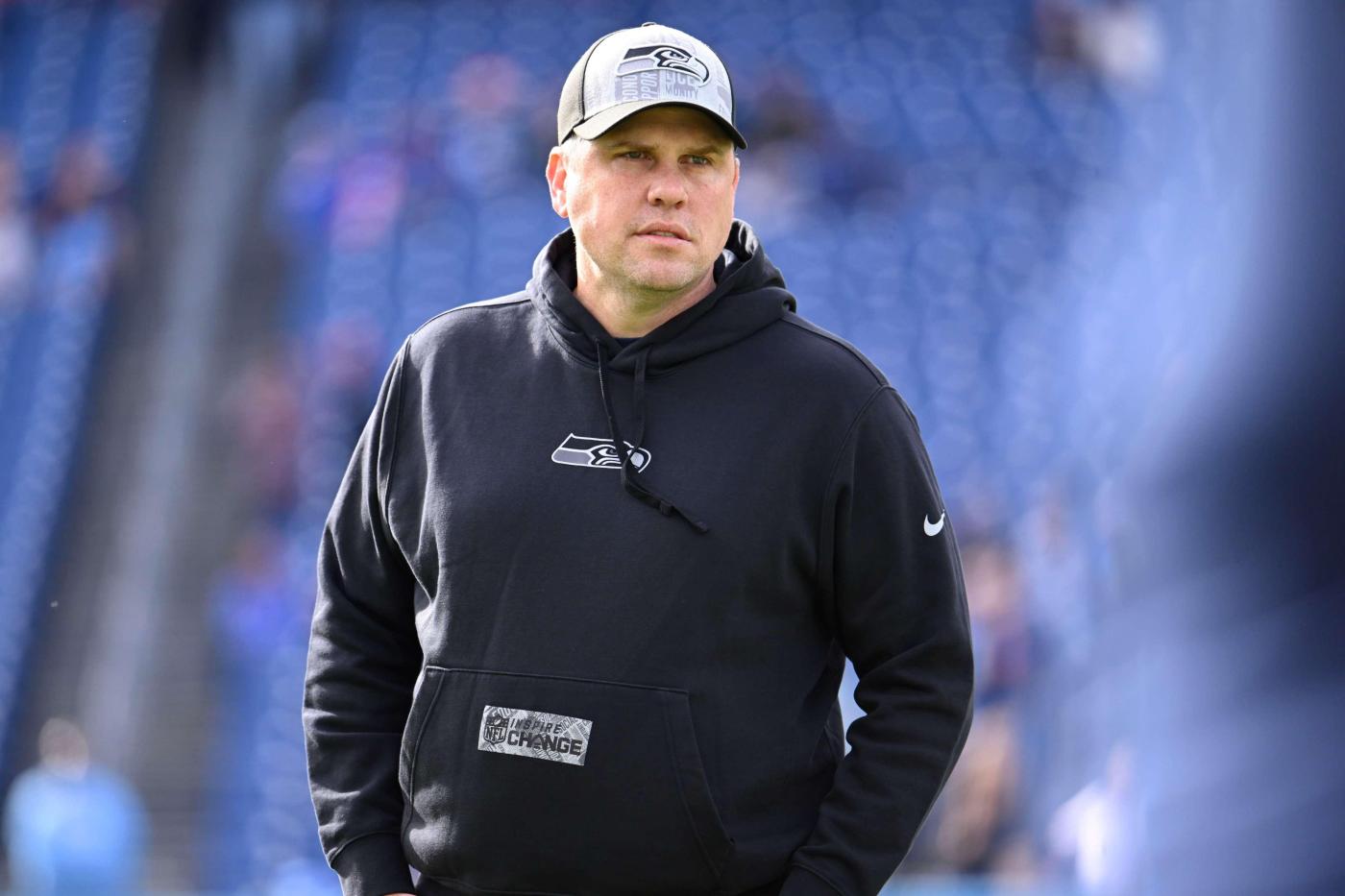
On Tuesday, the Bears officially announced the hiring of former Seattle Seahawks offensive coordinator Shane Waldron as their new offensive coordinator. A deal had been reported Monday to be in the works.
“This was a very exhaustive search, but in the end I’m grateful the journey led us to Shane,” Eberflus said in a statement. “He is a great teacher and communicator with a diverse coaching background among some of the game’s most elite head coaches. I look forward to partnering with him as we build out the rest of the staff and get him started here.”
Waldron said in a statement: “I appreciate this opportunity given to me by Coach Eberflus and Ryan Pole. We can’t wait to get to work at a franchise with such a storied history and passionate fan base.”
Here’s how the offensive coordinator hiring process unfolded.
Jan. 18
The Bears are expected to interview former Arizona Cardinals head coach Kliff Kingsbury, ESPN reported.
The rundown: Kingsbury, 44, spent this past season as a senior offensive analyst and quarterbacks coach at USC, where potential No. 1 draft pick Caleb Williams played. The Bears are getting deeper into their evaluations of Williams as they determine whether to draft a quarterback with the No. 1 pick this spring. Williams threw for 3,633 yards with 30 touchdowns and five interceptions in 12 games in 2023.
In four seasons as the Cardinals coach, Kingsbury was 28-37-1. The Cardinals fired him last January following a 4-13 season after the team made the playoffs a year earlier behind quarterback Kyler Murray. Before that, Kingsbury was the head coach for six seasons at Texas Tech, where he coached quarterback Patrick Mahomes.
He also was offensive coordinator and quarterbacks coach at Texas A&M and Houston. Kingsbury played quarterback at Texas Tech and in the NFL, NFL Europe and CFL.
The Bears are interviewing Los Angeles Rams passing game coordinator and quarterbacks coach Zac Robinson, Sports Illustrated’s Albert Breer reported.
The rundown: Robinson, 37, has been part of Sean McVay’s coaching staff in Los Angeles for the last five seasons and in his current role the last two years. In 2021, Robinson also served as Matthew Stafford’s quarterbacks coach as Stafford matched a career high with 41 touchdown passes and led the Rams to a Super Bowl title.
This season Robinson contributed to a passing offense that ranked in the top 10 in yards and yards per play.
Robinson was a standout quarterback at Oklahoma State and a seventh-round selection by the New England Patriots in 2010. He spent four seasons in the NFL with the Patriots, Seattle Seahawks, Detroit Lions and Cincinnati Bengals.
The Bears have requested an interview with Philadelphia Eagles senior offensive assistant Marcus Brady, ESPN reported.
The rundown: Brady, 44, spent the 2023 season on Nick Sirianni’s Eagles staff after five seasons with the Indianapolis Colts.
He worked on the same Colts coaching staff as Bears coach Matt Eberflus for four years under Frank Reich, though on the opposite side of the ball from Eberflus. With the Colts, Brady rose from assistant quarterbacks coach (2018) to quarterbacks coach (2019-20) and then to offensive coordinator (2021-22) after Sirianni left for the Eagles. The Colts offense was one of the best in the league at running the ball in 2021, but it ranked 27th in total yards per game with 311.6 in 2022.
Brady also spent nine seasons coaching in the Canadian Football League.
Jan. 17
The Bears are interviewing Carolina Panthers offensive coordinator Thomas Brown, The Athletic reported.
The rundown: Brown, 37, completed his first year as the Panthers coordinator after three seasons with the Rams, with whom he won a Super Bowl under McVay.
The Panthers struggled behind rookie quarterback Bryce Young in 2023, averaging a league-worst 265.3 yards per game. With the Rams, Brown coached running backs and then tight ends and had the title of assistant head coach in his last two seasons.
The former Georgia running back was a running backs coach in college for eight seasons, including with Wisconsin, Georgia, South Carolina and Miami, where he also was the offensive coordinator. Brown also is scheduled to interview with the Tennessee Titans for their head coaching position.
Jan. 15
The Bears interviewed former Baltimore Ravens offensive coordinator Greg Roman, NFL Network’s Peter Schrager reported.
The rundown: Roman, 51, is a longtime NFL coach who served as offensive coordinator for the San Francisco 49ers, Buffalo Bills and Ravens. Among his accomplishments is crafting the Ravens offense around dual-threat quarterback Lamar Jackson and helping Jackson to an MVP season in his second year in 2019. The Ravens had the best rushing offense in the league that year.
However, Roman and the Ravens parted after the 2022 season after the offense declined. The Ravens went from averaging 33.2 points in 2019 to 20.6 in 2022.
Jan. 12
The Bears interviewed Seahawks quarterbacks coach Greg Olson, the San Francisco Chronicle reported.
The rundown: Olson, 60, has been a college and NFL quarterbacks coach and offensive coordinator since 1990. He has extensive experience as an NFL offensive coordinator, holding the position with the Lions, Tampa Bay Buccaneers, St. Louis Rams, Oakland and Las Vegas Raiders in separate stints and Jacksonville Jaguars.
He most recently was the Seahawks quarterbacks coach in 2023 and a senior offensive assistant with the Los Angeles Rams in 2022. Olson spent the 2003 season as the Bears quarterbacks coach.
The Bears planned to interview Kentucky offensive coordinator and quarterbacks coach Liam Coen, CBS Sports reported.
The rundown: Coen, 38, has one season of NFL offensive coordinator experience with the Rams in 2022, though McVay called the plays. He was an assistant wide receivers coach and assistant quarterbacks coach with the Rams from 2018-20.
Beyond that, Coen has been a college quarterbacks coach and offensive coordinator since 2010 at Brown, Rhode Island, Massachusetts, Maine and most recently Kentucky in 2021 and 2023.
Jan. 11
The Bears planned to interview 49ers passing game coordinator Klint Kubiak, ESPN reported.
The rundown: Kubiak, 36, is in his first season with the 49ers under Kyle Shanahan. Before that, he was the Denver Broncos passing game coordinator and quarterbacks coach in 2022 for Russell Wilson and their QBs coach from 2016-18.
Kubiak, the son of longtime NFL coach Gary Kubiak, also worked for the Minnesota Vikings as offensive coordinator in 2021 and quarterbacks coach from 2019-20, working with Kirk Cousins.
Jan. 10
The Bears requested an interview with Seahawks offensive coordinator Shane Waldron, NFL Network reported.
The rundown: Waldron, 44, was the Seahawks offensive coordinator the last three seasons, helping quarterback Geno Smith to a comeback season in 2022. Before that, he spent four seasons with the Rams as passing game coordinator, quarterbacks coach and tight ends coach under McVay.
He also served as an offensive assistant with the Patriots (2008-09) and Washington (2016) and worked in operations with the Patriots early in his career. He has coached in college, high school and the UFL.
More Bears news
Bears Q&A: Did GM Ryan Poles miss a chance at a big-name coach? How desirable are the coordinator openings?
Caleb Williams declares for the NFL draft — and the Bears, picking No. 1, ‘can’t be scared of the unknown,’ analyst says
Bears GM Ryan Poles staying ‘open-minded’ as he evaluates whether to keep Justin Fields or draft a QB at No. 1
Column: How can GM Ryan Poles fix the cycle that has plagued the Bears forever? Pick the right quarterback.
Why did Bears GM Ryan Poles decide to retain coach Matt Eberflus? ‘The stability was a big piece of it.’
5 player decisions besides QB facing the Bears, including Jaylon Johnson’s contract and Darnell Mooney’s future
Column: What the Bears can learn about turning a franchise’s fortunes from the Houston Texans
Inside the numbers: Quarterbacks C.J. Stroud and Jordan Love have dazzling NFL playoff debuts
()