Biden sits out Super Bowl interview for a second time

posted in: Politics | 0

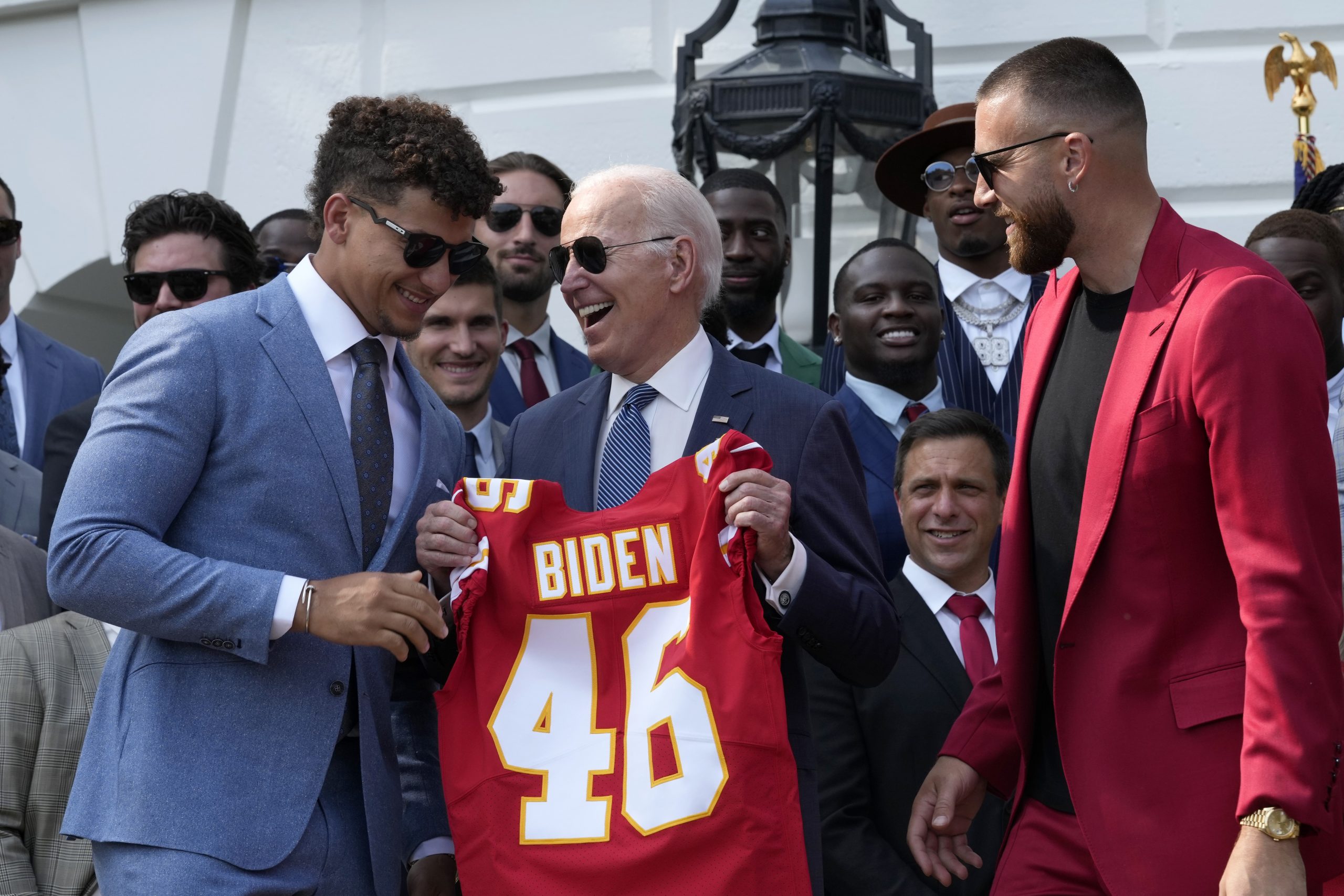
President Joe Biden will again skip a pregame Super Bowl interview embraced by recent presidents as an annual tradition.

Presidents have traditionally sought to leverage the marquee football event’s broad viewership, making Biden’s decision particularly notable in an election year.

Biden participated when NBC and CBS aired the game but sat out last year, when the Super Bowl was aired by Fox. CBS will broadcast the game this year Feb. 11. Variety first reported the news that Biden wouldn’t participate.

“We hope viewers enjoy watching what they tuned in for — the game,” White House spokesperson Ben LaBolt told the entertainment outlet. The White House did not respond to a request for further comment.

Former President Donald Trump skipped an interview with NBC during his presidency in 2018, after heavily criticizing both the network’s reporting and the NFL over player protests during the national anthem.

Former President Barack Obama began the tradition of sitting for a formal pregame broadcast interview.

The Super Bowl typically draws tens of millions of viewers, a far larger audience than the president can expect to attract in most media appearances. In 2023, the game set a new record of some 115 million viewers.

In the lead-up to this year’s Super Bowl, a conspiracy theory surrounding pop star Taylor Swift — who endorsed Biden in 2020 — gained traction on the right. Prominent conservative figures, including former GOP presidential candidate Vivek Ramaswamy, have suggested that the game is fixed in favor of Swift’s beau, Kansas City Chiefs tight end Travis Kelce, to give Swift a prime platform to deliver an endorsement.

Can a youth baseball and softball group revive neighborhood ball for St. Paul?

posted in: News | 0

Ian Zangs and Cory Klinge are on a mission to bring baseball back.

Zangs, a special-education teacher and head coach for St. Paul’s Como Park Senior High School baseball team, watched with dismay as St. Paul Midway Baseball gradually unraveled. After 33 years of drawing 8-year-old Joe DiMaggios and 13-year-old Hank Aarons to St. Paul’s storied Dunning Park, the association put down its bats and officially called it quits in early 2023.

A pandemic canceled the 2020 season. And in its final years, declining enrollments forced the organization, run by the Dunning Boosters, away from operating its own independent, in-house youth leagues at Dunning’s Jim Kelly and Billy Peterson fields.

The lush grass fields that in their childhoods had drawn the likes of future Major League Baseball Hall of Famers Joe Mauer, Dave Winfield and Paul Molitor were suddenly quieter.

The Dunning Boosters have since directed baseball and softball fans to register directly with St. Paul Parks and Recreation for its less structured Jr. RBI league or consider private, for-profit youth baseball clubs, which have gained popularity in the suburbs but can cost families thousands of dollars.

Zangs, who coached at St. Paul’s Johnson High School for several years before joining the Como Park Cougars, sees a development void in the Midway that will clearly impact the city’s high school teams like his own down the line.

“There is a widening gap between the level of club-level play, which is really elite but incredibly expensive and often times not accessible for a lot of the people due to the cost … and then there’s rec centers, which are really inconsistent from place to place,” Zangs said. “There’s nothing in between.”

The new Como Ball Youth Baseball and Softball Association

That’s not good enough for Zangs and Klinge, who together with their eight-member board have begun locking down corporate sponsorships for the new Como Ball Youth Baseball and Softball Association. This summer, teams wearing jerseys sporting sponsor titles like “Affinity Plus Credit Union” or “Mudslingers Coffee” will face off against each other at Como High’s regulation baseball and softball fields, as well as backup fields at the North Dale and Northwest Como recreation centers.

The duo say they’re determined to offer affordable baseball and softball options to kids ages 6 to 15 in the North End, Frogtown, Hamline-Midway, Como and St. Anthony Park. A youth team played under the “Como Ball” flag in the Minnesota Youth Athletic Services’ Gopher State Baseball program this past fall.

“We’re being really focused in our first year on keeping it small,” said Klinge, the board president, whose day job involves serving as director of information technology for Richfield Public Schools. “We’ve already secured at least six corporate sponsors. Our board has three officers but eight people. That allows us to spread the labor. Some people have been gung-ho about fundraising. Ian and I have been able to focus on just the baseball part of it.”

Como Ball, which began accepting summer registrations in late January, advertises $100 for a two-month season that will consist of two games and up to two practices per week. The fee includes a shirt and a cap. For most, the season will run from early June through the end of July.

Related Articles

Local News |


St. Paul Port Authority greenlights approximately $20 million of riverfront construction

Local News |


Public hearing on St. Paul Bike Plan draws more enthused cyclists than critics

Local News |


Woodbury man located safe after eight days missing in Florida

Local News |


Photos: Minnesota’s ‘Red Bulls’ get send-off before Middle East deployment

Local News |


Winter Carnival event will celebrate Bernese Mountain Dogs — and remember a royal one

The focus is largely on younger kids for now, but players ages 13 to 15 would be charged $300 for traveling games, league fees and tournaments, though scholarships are available. Klinge and Zangs noted that they plan to work closely with existing leagues, which could send them (or absorb) some players to create teams when there aren’t sufficient sign-ups.

For instance, the St. Paul North Area Rookies is the only softball association in the North End and Maplewood area, and their numbers have dwindled in the younger age groups. At Como, Zangs works alongside softball coach Callie McDermott, a former coach for the Rookies, and he’s confident that with her help, they can boost softball registrations as well.

The goal is to create a more formalized program than the typical Parks and Rec setup, with standardized drills that replicate what’s done at the high school level, to prepare kids for competitive play into their teen years. The board of Como Ball Youth Baseball has already recruited what Klinge called a “small army” of parent volunteers and high school students to help out. That includes paid summer gigs for teen umpires.

Shaun McClary, a Hamline-Midway father, found himself a bit adrift placing his son, Ronan, in different programs as Midway Baseball began to unravel. At some sites, “the practices weren’t heavily organized,” said McClary, who also sits on the Como Ball board. “For kids who really wanted to build their skills, it was harder. I think this will definitely be more structured.”

Competition from private clubs, video games

Why did enrollment run aground for Midway Baseball, and how will Como Ball avoid the same fate?

Klinge and Zangs say that while interest in baseball has lost some ground to soccer, basketball, video games and other pastimes in rapidly diversifying and immigrant-rich urban areas, at least an equal hurdle for community ball is competition from pricier private clubs, many of them run as for-profit businesses in the suburbs.

As with exclusive hockey, soccer and volleyball programs, access to tonier facilities and year-round play tends to lure the most competitive athletes, if they can afford it. That’s put a damper on American Legion programs and other types of widely affordable community ball at neighborhood sandlots.

Even before Midway collapsed, some families gravitated to the nonprofit Roseville Area Youth Baseball or Highland Ball. “One thing that has really hurt sports in St. Paul is we’re losing kids to Roseville, we’re losing kids to private schools, we’re losing kids to charter schools, and to Highland Park and elsewhere,” Klinge said.

Still, “Midway was an affordable option for a lot of families,” said Klinge, who coached high school baseball in River Falls, Wis., for nearly a decade. “And then there was this severe interruption during the pandemic. Families tried Parks and Rec, and some had a very good experience, and for others it was abysmal. Teams would cancel and forfeit.”

Feeder system

As the middle ground between T-ball or other municipal Parks and Rec offerings and exclusive club play has eroded, there’s been less of a feeder system for urban high school baseball programs, said Zangs, who grew up on the East Side playing with Parks and Rec teams, back when there were more of them.

Over the years, he watched his younger brother Brendan Zangs graduate from Parkway Little League to the East Twins Babe Ruth League in Maplewood and then play for Gustavus Adolphus College in St. Peter, Minn. Brendan, who is now the head baseball coach for Johnson High School — the Zangs’ alma mater — sometimes meets his older brother head-on when their high school teams face off.

“Last year, we actually scheduled an extra game as a rubber match,” said Ian, with a laugh. “Como won. That’s been interesting.”

Summer registrations for Como Ball opened Jan. 28 and run through mid-March. More information is available at ComoBall.com, through the Como Ball Youth Baseball and Softball Association Facebook page or by emailing comoball23@gmail.com.

Related Articles

Local News |


Minneapolis man, 19, gets 10 years in federal prison for armed carjacking spree across Twin Cities

Local News |


Joe Soucheray: Taylor Swift and Travis Kelce and Kanye West and on and on and BLEEP

Local News |


Letters: Experimenting with ways to use less road salt in Minnesota

Local News |


Pedestrian fatally struck by vehicle on Greater East Side, St. Paul police say

Local News |


Photos: St. Paul Bouncing Team holds tryouts as hopefuls ‘conquer fears’
Minneapolis man, 19, gets 10 years in federal prison for armed carjacking spree across Twin Cities

posted in: News | 0

A young Minneapolis man who authorities said embarked on an armed carjacking spree and high-speed pursuit through residential neighborhoods last March has been sentenced to a decade in federal prison.

Javon Thomas Wilson-Branch, 19, was sentenced to 10 years in prison, three years of supervised release and ordered to pay $1,100 in restitution to the victims of three violent carjackings committed within a 12-hour period, U.S. Attorney Andrew M. Luger announced Thursday.

“This individual put several lives at risk by going on an armed carjacking spree and evading law enforcement by driving 120 miles per hour through a residential neighborhood,” Luger said in a statement. “This case offers a snapshot of a disturbing trend of violent and reckless behavior. Wilson-Branch’s spree is one of the reasons our office has focused our resources on prosecuting violent carjacking cases.”

According to court documents, on March 16, 2023, at approximately 8 p.m.,Wilson-Branch and another man pulled up beside two people unloading groceries from a Mercedes-Benz SUV in Minneapolis and robbed them by pointing an assault-style rifle at them. He demanded the victims turn over their belongings and the keys to the SUV before he and his co-conspirator drove away.

Eight hours later, at around 4 a.m., he and another man, pulled the Mercedes SUV up to a Toyota Highlander in Minneapolis, pointed a gun at the driver and demanded the vehicle’s keys. After robbing the occupants, Wilson-Branch then got into the Toyota and drove it away.

An AirTag online tracking device inside the Toyota located it in St. Paul, where it was abandoned about a half-hour later at 4:30 a.m. and recovered by police.

Another 30 minutes later, at approximately 5 a.m., Wilson-Branch and the other man held up the driver of an Audi A6 with a 9mm semiautomatic handgun and the assault rifle. Both men robbed the driver of his keys, wallet and phone and forced the driver to unlock his cellphone. Later they used the unlocked phone to transfer money from the victim’s bank account into Wilson-Branch’s account and other accounts. Wilson-Branch drove away in the Audi.

About 30 minutes later, St. Paul police officers spotted both the carjacked Mercedes and Audi near Maryland and Western avenues. When officers attempted to stop the vehicles, both drivers fled, leading officers on a high-speed pursuit through neighborhoods and then onto freeways.

Two days later, officers from the Woodbury Police Department spotted the Audi in a mall parking lot and arrested Wilson-Branch after a brief foot chase. Two of the guns used in the carjacking, both fully loaded with high-capacity magazines and a stolen box of ammunition, were found inside the car along with the keys to the Toyota.

Wilson-Branch, who had an extensive criminal record as a juvenile, pleaded guilty on Aug. 4 to two counts of aiding and abetting carjacking, and admitted to aiding and abetting a third carjacking. He was sentenced in St. Paul by U.S. District Judge David S. Doty.

Related Articles

Crime & Public Safety |


Vadnais Heights lawmaker Brion Curran sentenced for driving while impaired

Crime & Public Safety |


It was Jan. 31, but the Twin Cities felt like April 10 after reaching a record high of 55

Crime & Public Safety |


Dodge Nature Center cancels Winter Fun Fest due to lack of snow and ice

Crime & Public Safety |


Dakota leaders urge more education after Treasure Hunt medallion hidden at sacred site

Crime & Public Safety |


Normal offseason has Twins’ Carlos Correa feeling confident, prepared


Your Money: Is being a saver or spender wrecking your marriage?

posted in: News | 0

Bruce Helmer and Peg Webb

More than a third (36%) of adults who are married or in a serious relationship report that money is the single biggest source of stress in their relationship, according to a 2018 Harris Poll/Ally Bank survey.

Often, friction can occur when one partner is a “saver” and the other a “spender.” In part, this is because saving and spending decisions arise from both nurture (how your views were shaped in childhood or during a specific personal crisis) and nature (personal comfort level about spending or saving, your career choice, or whether you have dependents).

More broadly speaking, in our experience, financial missteps in relationships typically arise from poor communication, keeping secrets (what some call financial infidelity), control issues, blending budgets, and emotional assumptions about a partner’s motivations.

Spender or a saver?

Before you can address relationship issues that arise from ingrained financial behaviors, you must recognize whether you are a spender or a saver. Spenders frequently buy things they don’t end up using or later forget about. They also cringe when they hear the word “budget,” don’t have much money set aside in savings and, in some cases, live paycheck to paycheck.

Savers often are mirror images. They don’t especially enjoy spending money and would rather see their bank balance grow each month rather than shop for items they don’t need. Savers pay themselves first each month, either by contributing to an emergency fund, retirement account, home improvement project, or specific goal such as travel. They are perfectly comfortable delaying purchases and sticking to a budget.

Being a spender or a saver isn’t inherently good or bad. The trick is to find a comfortable balance between both ends of the spectrum.

Five common financial missteps in a relationship

Avoiding talking about money: Many couples focus more time and energy on marital milestones (i.e., planning the wedding, buying a house, or starting a family) rather than how they will handle money together. This is a mistake. Major storms could surface if one partner is a spendthrift and the other is a miser. Open and honest communication about financial goals, priorities, and, yes, anxieties, is critical to a healthy partnership — as is relaying any concerns you have about jointly handling your income.

Concealing financial infidelity: One sure way to shatter trust is to keep financial secrets from your partner. Close to half of couples (43%) who have combined their finances in a relationship admit to hiding purchases, bank accounts, financial statements, bills, or cash from their spouse or partner, according to a 2021 study from the National Endowment for Financial Education (NEFE). The survey found that when such deceptions occur, 85% of couples said it affects the relationship, “leading to arguments, a breakdown of trust, and, in some cases, separation or even divorce.”

Resolving control issues: If one partner solely controls the household’s purse strings, resentment can fester. And few things build resentment faster than one partner being made to feel inferior as a result of bank account imbalances. If you’re the person in the relationship who has more cash, you need to be especially sensitive about how you discuss spending decisions.

On the other hand, if you’re the one with less income, you need to be able to handle the related stress that can be inevitable in such cases — even if your marriage is on otherwise solid ground. We’ve seen situations in which a couple shares responsibilities for paying the bills equally and takes turns managing the household finances. Others may put one partner in charge of savings and investments, and the other pays the day-to-day bills. Another popular approach is the  “you, me, we” approach: Both partners contribute to an account that pays for joint non-discretionary living expenses (such as the mortgage, health insurance, and groceries), but each maintains a separate account for their spending. Whatever system you decide on should be decided on together, and it should be fair to each partner.

Blending the family budget: Combining finances when partners are coming off a second or third marriage can get a lot more complicated. For example, there may be real estate on both sides, multiple savings and retirement accounts, life insurance policies with different owners and beneficiaries, and, of course, kids from prior relationships. In these “blended budget” situations, you need to be transparent and leave nothing to chance. Ideally, before you walk down the aisle, sit down with your new partner to make clear what you each own in terms of assets, liabilities, and financial goals. Are one or both of you supporting a child? How will you handle joint expenses, such as health insurance, property taxes, or the mortgage? Who will pay for college?

It’s critically important to document the big-money decisions. For example, will both parties agree to a prenup or postnup if something goes wrong? In situations where there has been a divorce, the affected party needs to update beneficiaries in their will, life insurance policies, and retirement accounts to properly reflect their new marital status and wishes. In addition, estate plans need to properly reflect how you intend to distribute your assets after death. A variety of trusts can be set up to accomplish these complicated goals, but you should consult a financial professional or estate planning attorney for guidance.

Getting past emotional assumptions: Couples can often misread the motivation for their partner’s financial decisions, and this can sometimes lead to conflict. Remember that each of us brings our emotional relationship with money to a marriage or relationship — what it is, its value, and how it should be used. A policy of honest, full disclosure — and listening to truly understand what your partner is saying about your joint money — will go a long way to fending off bad feelings or mending fences when one partner may sometimes cross the line into making a bad money decision.

Don’t let finances be the reason to end a relationship

Money can sometimes derail an otherwise solid relationship and is often cited as the reason a relationship ends. It doesn’t have to be this way. Here are some ways to facilitate a conversation and develop a better understanding with your significant other about money matters:

• Create a budget

• Try to agree on what you both value

• Set reasonable goals

• Plan for the unexpected

• Envision your future happiness together

Ultimately, the money message that most couples need to aspire to can be simple: “We value spending money on what we need, but we carefully evaluate our spending on what we want.”

Related Articles

Business |


Your Money: Unpacking your retirement account options

Business |


Your Money: The Money Matrix approach for sustaining retirement income

Business |


Your Money: Five smart ways to maximize an inheritance

Business |


Your Money: Two last-minute tax moves for your stock portfolio

Business |


Your Money: Making impactful year-end (and year-round) charitable giving

The opinions voiced in this material are for general information only and are not intended to provide specific advice or recommendations for any individual. 

Bruce Helmer and Peg Webb are financial advisers at Wealth Enhancement Group and co-hosts of “Your Money” on WCCO 830 AM on Sunday mornings. Email Bruce and Peg at yourmoney@wealthenhancement.com. Securities offered through LPL Financial, member FINRA/SIPC. Advisory services offered through Wealth Enhancement Advisory Services, LLC, a registered investment advisor. Wealth Enhancement Group and Wealth Enhancement Advisory Services are separate entities from LPL Financial.