NYSE working on a new platform for trading digital tokens around the clock

posted in: All news | 0

The New York Stock Exchange is working on a digital platform that would enable investors to trade digital tokens around the clock.

Related Articles


Hours after ABC News ran a story about Mischief Toy Store, ICE agents arrived at their door


How to conduct your own portfolio makeover


Inequality and unease are rising as elite Davos event opens with pro-business Trump set to attend


What to know about the annual World Economic Forum meeting in Davos


What’s open and closed on Martin Luther King Jr. Day

The platform would be separate from the NYSE itself, which operates only on weekdays, and allow for instant settlement of transactions, orders sized in dollar amounts and stablecoin-based funding, NYSE owner Intercontinental Exchange said Monday.

Tokenization uses blockchain technology that powers cryptocurrencies to create digital tokens as stand-ins for things like stocks, bonds, real estate or even fractional ownership of a piece of art that can be traded like crypto by virtually anyone, anywhere at any time. Stablecoins, which are a type of cryptocurrency typically bought and sold for $1, have helped fuel the appetite to tokenize other financial assets.

Assuming it meets regulatory scrutiny, the platform would power a new NYSE venue that would support trading of tokenized versions of company shares, the exchange said.

The development of the platform is part of Intercontinental Exchange’s bid to broaden its transaction clearing capabilities to handle 24/7 trading of tokenized securities and, potentially, the integration of tokenized collateral.

Intercontinental Exchange said it’s working with Citigroup, Bank of New York Mellon and other lenders to support tokenized deposits across the company’s six clearinghouses around the globe.

Charges: UMN equine hospital vet tech took morphine from vials, which she then diluted with saline

posted in: All news | 0

A veterinary technician at the University of Minnesota’s equine hospital stole morphine from vials, diluted the painkiller with saline and sealed them back up, charges allege.

As a result, horses treated at the Falcon Heights hospital during a two-week span last summer likely did not receive the pain relief they needed and “therefore, likely experienced unnecessary physical pain,” according to a criminal complaint charging the technician with three felonies.

The 28-year-old, from Circle Pines, was charged Friday in Ramsey County District Court by summons with theft, theft by swindle and procuring a fifth-degree controlled substance. She was placed on administrative leave from her job on Aug. 5 and later fired, the complaint says. She declined a formal interview with law enforcement.

An attorney is not listed in court case file and she was not reached Monday to respond to the allegations.

According to the complaint, hospital staff contacted law enforcement on July 31 after a vet tech and surgeon discovered that a vial of morphine from the hospital’s secure medication dispensing system was empty, even though it appeared unopened. Security caps on other morphine vials appeared to have a glue-like substance on them.

A review of the system’s user transaction reports showed that the Circle Pines woman accessed the morphine drawer 35 times between July 6 and July 21, a number that was significantly higher compared to her peers. No one else accessed the drawer during that time, besides pharmacy staff during three inventory checks, the complaint says.

Meanwhile, hospital records showed she was not assigned to treat patients with morphine during the 15-day timeframe “and therefore, had no reason to be accessing morphine,” the complaint says.

In all but one instance, the records showed, the veterinary technician generically coded her access to the morphine as “Surgery” instead of to a specific patient, which is the common practice. She then later coded them as “Cancelled,” according to the complaint.

The remaining transaction was tied to an equine patient named “Reggie,” who was never prescribed morphine and did not receive it, despite a bill that said otherwise, the complaint continued.

Related Articles


Another immigrant died in a sprawling Texas detention facility. ICE says Minnesotan died by suicide


Ex-husband indicted by grand jury in slaying of couple found in their Ohio home


Members of Zizians group attend hearing ahead of Maryland trespassing trial


ICE says a Cuban immigrant died in a suicide attempt. A witness says guards pinned and choked him


The Education Department is opening fewer sexual violence investigations as Trump dismantles it

When the investigation began, the dispensing system contained 29 vials of morphine. Last month, the FDA’s Forensic Chemistry Center reported that testing on all of them showed evidence of tampering — punctures and glue on stopper tops — and that the morphine was diluted by approximately 87% to 97%.

During an Aug. 5 interview with hospital administration, the woman denied making the 35 morphine transactions and said someone must have used her unique personal identification number without her knowledge to access the system. Records, however, showed she used her fingerprint to access the system for each of them, the complaint says.

According to the complaint, staff told investigators the woman has a history of painful medical issues that required narcotic pain medications for treatment.

How abortion coverage threatens to prevent a congressional deal on health care subsidies

posted in: All news | 0

By MARY CLARE JALONICK

WASHINGTON (AP) — There is broad bipartisan support in the House and Senate for reviving federal health care subsidies that expired at the beginning of the year. But long-standing disagreements over abortion coverage are threatening to block any compromise and leave millions of Americans with higher premiums.

Despite significant progress, bipartisan Senate negotiations on the subsidies seemed to be near collapse at the end of the week as the abortion dispute appears intractable.

“Once we get past this issue, there’s decent agreement on everything else,” Sen. Bernie Moreno, R-Ohio, who has led the talks, told reporters.

Sen. Bernie Moreno, R-Ohio, center, talks with reporters as he walks through the Ohio Clock Corridor at the Capitol, Tuesday, Jan. 13, 2026, in Washington. (AP Photo/Rod Lamkey, Jr.)

But movement was hard to find.

Republicans were seeking stronger curbs on abortion coverage for those who purchase insurance off the marketplaces created by the Affordable Care Act. Democrats strongly opposed any such changes, especially in the wake of the Supreme Court overturning Roe vs. Wade in 2022. And advocacy groups on both sides were pushing against any compromise that they believe would weaken their positions.

The impasse was a familiar obstacle for lawmakers who have been arguing over the health law, known widely as “Obamacare,” since it was passed 16 years ago.

“The two sides are passionate about (abortion) so I think if they can find a way to bring it up, they probably will,” said Ivette Gomez, a senior policy analyst on women’s health policy for KFF, the health care research nonprofit.

A fight with a long history

The abortion dispute dates back to the weeks and months before President Barack Obama signed the health overhaul into law in 2010, when Democrats who controlled Congress added provisions ensuring that federal dollars subsidizing the health plans would not pay for elective abortions. The compromise came after negotiations with members of their own party whose opposition to abortion rights threatened to sink the legislation.

FILE – Pages from the U.S. Affordable Care Act health insurance website healthcare.gov are seen on a computer screen in New York, Aug. 19, 2025. (AP Photo/Patrick Sison, File)

The final language allowed states to offer plans under the ACA that cover elective abortions, but said that federal money could not pay for them. States are now required to segregate funding for those procedures.

Since then, 25 states have passed laws prohibiting abortion coverage in ACA plans, 12 have passed laws requiring abortion coverage in the plans and 13 states and the District of Columbia have no coverage limitations or requirements, according to KFF. Some Republicans and anti-abortion groups now want to make it harder for the states that require or allow the coverage, arguing that the segregated funds are nothing more than a gimmick that allows taxpayer dollars to pay for abortions.

Senators involved in the negotiations said a potential compromise was to investigate some of those states to ensure that they are segregating the money correctly.

Sen. Susan Collins, R-Maine, chair of the Senate Appropriations Committee, is met by reporters outside the Senate chamber, at the Capitol in Washington, Tuesday, Jan. 6, 2026. (AP Photo/J. Scott Applewhite)

Sen. Susan Collins, R-Maine, who has led the negotiations with Moreno, said “the answer is to audit” those states and enforce the law if they are not properly segregating their funds.

But that plan was unlikely to win unanimity from Republicans, and Democrats have not signed on.

Trump weighs in

Negotiators were more optimistic last week, after President Donald Trump told House Republicans at a meeting that “you have to be a little flexible” on rules that federal dollars cannot be used for abortions.

Those words from the president, who has said little about whether he wants Congress to extend the subsidies, came just before a House vote on Democratic legislation that would extend the ACA tax credits for three years. After his comments, 17 Republicans voted with Democrats on the extension over the objections of GOP leadership and the House passed the bill with no new abortion restrictions.

Anti-abortion groups reacted swiftly.

Kelsey Pritchard, a spokeswoman for Susan B. Anthony Pro-Life America, said the group would not be supporting the 17 Republicans who voted for the extension. Trump’s comments were “a complete change in position for him” that brought “a lot of backlash and outcry” from the anti-abortion movement and voters opposed to abortion rights, she said.

Those who did not support changes to the ACA to reduce abortion coverage “are going to pay the price in the midterms” this year, Pritchard said. “We’re communicating to them that this isn’t acceptable.”

Related Articles


RFK Jr.’s MAHA movement has picked up steam in statehouses. Here’s what to expect in 2026


Vance and Rubio set to attend Winter Olympics opening ceremony in Italy. Trump isn’t on the list


US Catholic cardinals urge Trump administration to embrace a moral compass in foreign policy


Hawaii’s strict gun law faces Supreme Court scrutiny in landmark case


AP Source: Fed Chair Powell to attend Supreme Court argument on Cook case

‘Zero appetite’ for changes

Democrats say the Republican effort to amend the law and increase restrictions on abortion is a distraction. They have been focused on extending the COVID-era subsidies that expired on Jan. 1 and had kept costs down for millions of people in the United States. The average subsidized enrollee is facing more than double the monthly premium costs for 2026, also according to KFF.

The two sides have been haggling since the fall, when Democrats voted to shut down the government for 43 days as they demanded negotiations on extending the subsidies. Republicans refused to negotiate until a small group of moderate Democrats agreed to vote with them and end the shutdown.

After the shutdown ended, Republicans made clear that they would not budge on the subsidies without changes on abortion, and the Senate voted on and rejected a three-year extension of the tax credits.

Maine Sen. Angus King, an independent who caucuses with Democrats, said at the time that making it harder to cover abortion was a “red line” for Democrats.

Republicans are going to “own these increases” in premiums, King said then.

The bipartisan group that has met in recent weeks has closed in on parts of an agreement, including a two-year deal that would extend the enhanced subsidy while adding new limits and also creating the option, in the second year, of a health savings account that Trump and Republicans prefer. The ACA open enrollment period would be extended to March 1 of this year, to allow people more time to figure out their coverage plans after the interruption of the enhanced subsidy.

But the abortion issue continues to stand in the way of a deal as Democrats seek to protect the carefully crafted compromise that helped pass the ACA 16 years ago.

“I have zero appetite to make it harder for people to access abortions,” said Sen. Chris Murphy, D-Conn.

Associated Press writers Ali Swenson in New York and Joey Cappelletti and Lisa Mascaro contributed to this report.

Christian leaders urge protecting worshippers’ rights after protesters interrupt service

posted in: All news | 0

By GIOVANNA DELL’ORTO

Several faith leaders called urgently for protecting the rights of worshippers while also expressing compassion for migrants after anti-immigration enforcement protesters disrupted a service at a Southern Baptist church in Minnesota.

Related Articles


RFK Jr.’s MAHA movement has picked up steam in statehouses. Here’s what to expect in 2026


Vance and Rubio set to attend Winter Olympics opening ceremony in Italy. Trump isn’t on the list


US Catholic cardinals urge Trump administration to embrace a moral compass in foreign policy


Hawaii’s strict gun law faces Supreme Court scrutiny in landmark case


AP Source: Fed Chair Powell to attend Supreme Court argument on Cook case

About three dozen protesters entered the Cities Church in St. Paul during Sunday service, some walking right up to the pulpit, others loudly chanting “ICE out” and “Renee Good,” referring to a woman who was fatally shot on Jan. 7 by an Immigration and Customs Enforcement officer in Minneapolis.

One of the church’s pastors, David Easterwood, leads the local ICE field office, and one of the leaders of the protest and prominent local activist Nekima Levy Armstrong said she’s also an ordained pastor.

The Minnesota-Wisconsin Baptist Convention called what happened “an unacceptable trauma,” saying the service was ”forced to end prematurely” as protesters shouted “insults and accusations at youth, children, and families.”

“I believe we must be resolute in two areas: encouraging our churches to provide compassionate pastoral care to these (migrant) families and standing firm for the sanctity of our houses of worship,” Trey Turner, who leads the convention, told The Associated Press on Monday. Cities Church belongs to the convention.

The U.S. Department of Justice said it has opened a civil rights investigation.

The recent surge in operations in Minnesota has pitted more than 2,000 federal immigration officers against community activists and protesters. The Trump administration and Minnesota officials have traded blame for the heightened tensions.

“No cause — political or otherwise — justifies the desecration of a sacred space or the intimidation and trauma inflicted on families gathered peacefully in the house of God,” Kevin Ezell, president of the North American Mission Board, said in a statement. “What occurred was not protest; it was lawless harassment.”

Jonathan Parnell, the pastor who led the disrupted service, is a missionary with Ezell’s group and serves dozens of Southern Baptist churches in the area. Cities Church, housed in a Gothic-style, century-old stone building next to a college campus on one of the Twin Cities’ landmark boulevards, has not returned AP requests for comment.

Christians disagree on immigration enforcement

Christians in the United States are divided on the moral and legal dilemmas raised by immigration, including the presence of an estimated 11 million people who are in the country illegally and the spike in illegal border crossings and asylum requests during the Biden administration.

People ride in a car during a caravan protest, Monday, Jan. 19, 2026 in St. Paul, Minn. (AP Photo/Angelina Katsanis)

Opinions differ between and within denominations on whether Christians must prioritize care for strangers and neighbors or the immigration enforcement push in the name of security. White evangelicals tend to support strong enforcement, while Catholic leaders have spoken in favor of migrant rights.

The Southern Baptist Convention is the largest Protestant denomination in the U.S. and has a conservative evangelical theology.

Miles Mullin, the vice-president of the Ethics and Religious Liberty Commission of the Southern Baptist Convention, said faith leaders can and often have led protests on social issues, but those should never prevent others from worshipping.

“This is something that just shouldn’t happen in America,” Mullin said. “For Baptists, our worship services are sacred.”

On Facebook, Levy Armstrong wrote about Sunday’s protest in religious terms: “It’s time for judgment to begin and it will begin in the House of God!!!”

But Albert Mohler, the president of The Southern Baptist Theological Seminary, called the protesters’ tactics unjustifiable.

“For Christians, the precedent of invading a congregation at worship should be unthinkable,” Mohler said in an interview. “I think the political left is crossing a threshold.”

Federal protections for houses of worship

Many faith leaders were dismayed when the government announced last January that federal immigration agencies can make arrests in churches, schools and hospitals, ending the protection of people in sensitive spaces.

No immigration raids during church services have been reported, but some churches have posted notices on their doors saying no federal immigration officers are allowed inside. Others have reported a drop in attendance, particularly during enforcement surges.

Following the protest in Cities Church, Harmeet Dhillon, the assistant attorney general for civil rights at the U.S. Department of Justice, posted on X that there was “zero tolerance for this kind of illegal behavior & we will not stand for it.”

Dhillon said her office is investigating “potential violations of the federal FACE Act,” calling the protest “un-American and outrageous.”

The 1994 Freedom of Access to Clinic Entrances Act prohibits interference or intimidation of “any person by force, threat of force, or physical obstruction exercising or seeking to exercise the First Amendment right of religious freedom at a place of religious worship.”

White House press secretary Karoline Leavitt warned in a social media post that “President Trump will not tolerate the intimidation and harassment of Christians in their sacred places of worship.”

Several pastors called for better security in churches.

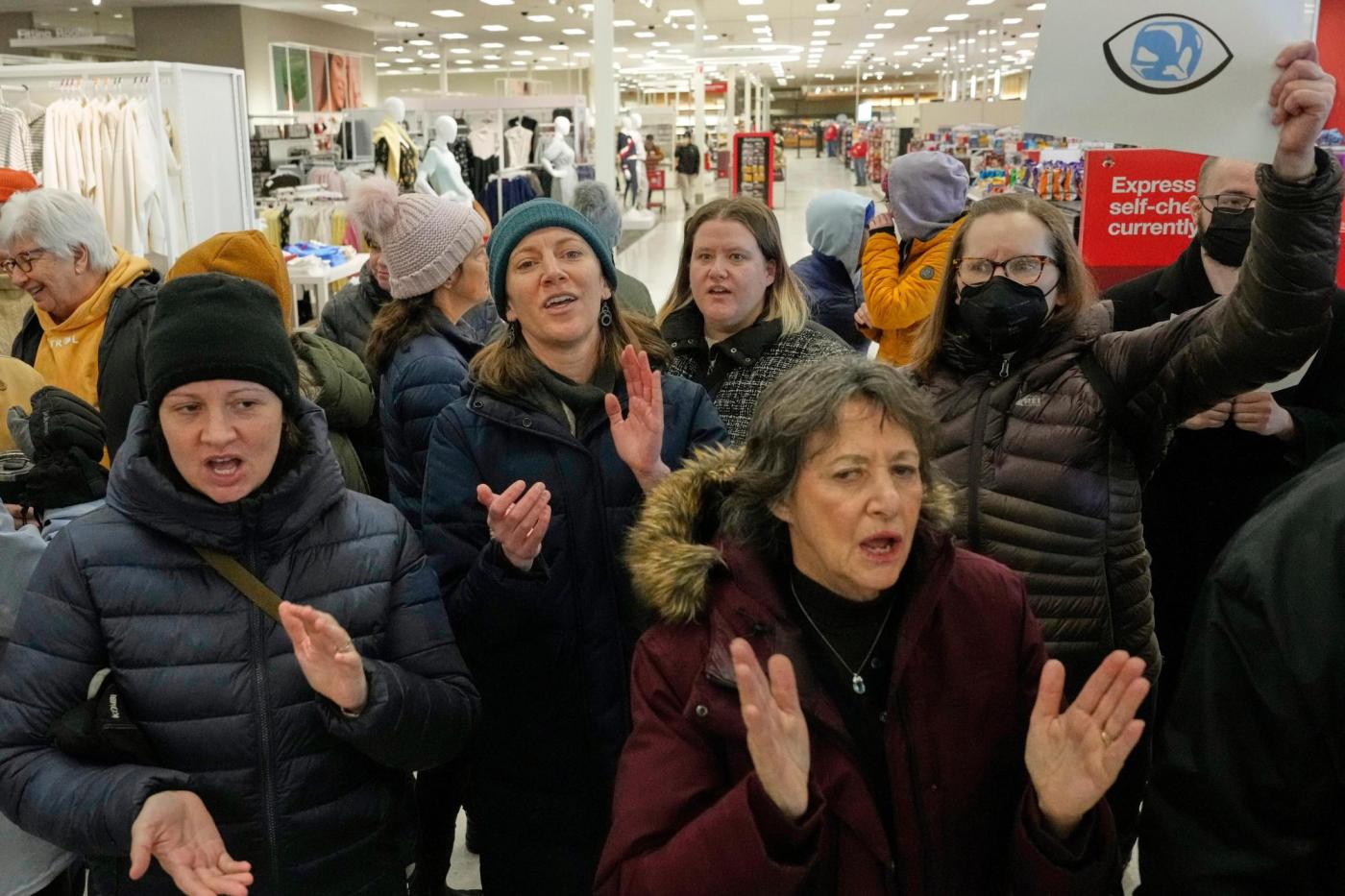
Community members and neighbors of people detained by ICE sing during a protest at a Target store, Monday, Jan. 19, 2026, in St. Paul, Minn. (AP Photo/Yuki Iwamura)

The Rev. Joe Rigney, one of the founding pastors at Cities Church in 2015 who served there until 2023, said safety would have been his first concern had a group disrupted service, especially since the fatal shooting at a Minneapolis Catholic school Mass last summer.

In a statement to the AP, Minnesota Gov. Tim Walz’s spokesperson said, “While people have a right to speak out, he in no way supports interrupting a place of worship.”

Legal developments and protests in the Twin Cities

Also Monday, the Department of Justice notified a federal appeals court that it will appeal a ruling that federal officers in the Minneapolis area cannot detain or tear gas peaceful protesters who aren’t obstructing authorities. The case was filed in December on behalf of six Minnesota activists who are among thousands of people observing the activities of federal immigration officers in the area.

Yet more protesters braved temperatures that dipped below zero (-18 Celsius) Monday to honor Martin Luther King, Jr. Day in St. Paul. Some waved signs from vehicles bearing messages including, “What did you do while your neighbors were being kidnapped?” and “We love our Somali neighbors.”

Dozens of protesters also staged a brief sit-in at a Target store in St. Paul demanding that the retailer bar entry to federal agents. Target, headquartered in Minneapolis, has been criticized by activists after a video showed federal agents, detain two employees at a store in Richfield, Minnesota.

Associated Press journalists Holly Meyer in Nashville, Tennessee, Steve Karnowski in Minneapolis and Jack Brook in St. Paul, Minnesota, contributed.

Associated Press religion coverage receives support through the AP’s collaboration with The Conversation US, with funding from Lilly Endowment Inc. The AP is solely responsible for this content.