White powder sent to judge in Donald Trump’s civil fraud case, adding to wave of security scares

posted in: Society | 0

By MICHAEL R. SISAK (Associated Press)

NEW YORK (AP) — White powder was found Wednesday in an envelope addressed to the New York judge who ordered Donald Trump to pay a $454 million civil fraud judgment. It’s the latest security scare involving people in key roles in the former president’s legal cases.

A court officer screening mail at Judge Arthur Engoron’s Manhattan courthouse opened the envelope around 9:30 a.m. Some of the powder fell out of the envelope and landed on the officer’s pants, police said. Preliminary tests were negative for hazardous substances, court spokesperson Al Baker said.

The courthouse operations office where the mail was opened was briefly closed, but the courthouse remained open. The officer and other workers who may have been exposed to the powder were temporarily isolated, Baker said. No injuries were reported.

Engoron had no exposure to the letter or the powdery substance, Baker said.

Wednesday’s scare came less than two weeks after Engoron issued his verdict penalizing Trump, his company and executives, including his two sons Eric and Donald Trump Jr., for scheming to dupe banks, insurers and others by inflating his wealth on financial statements used to secure loans and make deals.

Along with staggering financial penalties, the judge’s ruling forced a shakeup at the top of Trump’s company, putting the Trump Organization under court supervision and imposing strict restrictions on how it does business.

In January, hours before closing arguments in the case, authorities had responded to a bomb threat at Engoron’s Long Island home. Engoron’s chambers have reported hundreds of harassing and threatening calls, emails, letters and packages.

Separately, on Christmas Day, Justice Department Special Counsel Jack Smith was the subject of a fake emergency call that reported a shooting at his home.

Smith, who is leading Trump’s federal prosecutions in Washington, D.C., and Florida, has been the subject of numerous threats and intimidating messages since he was appointed and Trump began posting messages about him, prosecutors have said.

U.S. District Judge Tanya Chutkan, who is overseeing Trump’s Washington D.C. case, was targeted with a similar fake emergency call a few days later. Trump is charged in Washington with scheming to overturn his 2020 election loss and in Florida with hoarding classified documents after he left the White House.

On Monday, police in hazmat suits responded to Donald Trump Jr.’s Florida home after the former president’s eldest son opened a letter that contained an unidentified white powder and a death threat. White powder was also found in a letter to Trump Jr. in 2018 and in mail sent to Eric Trump and Trump Tower in 2016.

Hoax attacks using white powder play on fears that date to 2001, when letters containing deadly anthrax were mailed to news organizations and the offices of two U.S. senators. Those letters killed five people.

__

David French: What is Christian nationalism, exactly?

posted in: News | 0

If you’re alarmed by the rise of Christian nationalism, the single worst thing you can do is define it too broadly. If you define it too broadly, then you’re telling millions of ordinary churchgoing citizens that the importation of their religious values into the public square somehow places them in the same camp or on the same side as actual Christian supremacists, the illiberal authoritarians who want to remake America in their own fundamentalist image.

Enter the new feature-length documentary “God and Country,” which examines the role of Christian nationalism in American politics. Even before I knew that Rob Reiner (the director of “A Few Good Men”) was involved in the project, I agreed to be interviewed by the filmmakers for two key reasons:

First, I wanted to make sure that I could offer a sensible definition of Christian nationalism, one that didn’t cast aspersions on Christians simply for bringing their values into the public square.

And second, I wanted to outline exactly why actual Christian nationalism presents a real danger to our Constitution.

What it’s not

To understand what Christian nationalism is, it’s important to understand what it is not.

It is not Christian nationalism if a person’s political values are shaped by the individual’s Christian faith. In fact, many of America’s most important social movements have been infused with Christian theology and Christian activism. Many of our nation’s abolitionists thundered their condemnations of slavery from Northern pulpits. The Civil Rights Movement wasn’t exclusively Christian by any means, but it was pervasively Christian — Martin Luther King Jr. was, of course, a Baptist minister.

Anyone may disagree with Christian arguments around civil rights, immigration, abortion, religious liberty or any other point of political conflict. Christians disagree with one another on these topics all the time, but it is no more illegitimate or dangerous for a believer to bring her worldview into a public debate than it is for a secular person to bring his own secular moral reasoning into politics. In fact, I have learned from faiths other than my own, and our public square would be impoverished without access to the thoughts and ideas of Americans of faith.

Primacy is the problem

The problem with Christian nationalism isn’t with Christian participation in politics but rather the belief that there should be Christian primacy in politics and law. It can manifest itself through ideology, identity and emotion. And if it were to take hold, it would both upend our Constitution and fracture our society.

Sociologists Samuel Perry and Andrew Whitehead define Christian nationalism as a “cultural framework that blurs distinctions between Christian identity and American identity, viewing the two as closely related and seeking to enhance and preserve their union.” Author and pastor Matthew McCullough defines Christian nationalism as “an understanding of American identity and significance held by Christians wherein the nation is a central actor in the world-historical purposes of the Christian God.” Both definitions are excellent, but what does ideological Christian nationalism look like in practice?

In 2022, a coalition of right-wing writers and leaders published a document called “National Conservatism: A Statement of Principles.” Its section on God and public religion states: “Where a Christian majority exists, public life should be rooted in Christianity and its moral vision, which should be honored by the state and other institutions both public and private.” That’s an extraordinary — and ominous — ideological statement, one that would immediately relegate non-Christians to second-class status. It’s utterly contrary to the First Amendment and would impose a form of compelled deference to Christianity on both religious minorities and the nonreligious.

Not just ideology, but also identity

But Christian nationalism isn’t just rooted in ideology; it’s also deeply rooted in identity, the belief that Christians should rule. This is the heart of the Seven Mountain Mandate, a dominionist movement emerging from American Pentecostalism that is, put bluntly, Christian identity politics on steroids. Paula White, Donald Trump’s closest spiritual adviser, is an adherent, and so is the chief justice of the Alabama Supreme Court, Tom Parker, who wrote a concurring opinion in the court’s recent IVF decision. The movement holds that Christians are called to rule seven key societal institutions: the family, the church, education, the media, the arts, business and the government.

One doesn’t have to go all the way into Seven Mountain theology, though, to find examples of Christian identity politics. The use of Christianity as an unofficial but necessary qualification for office is a routine part of politics in the most churchgoing parts of America. Moreover, one of the common red-America arguments for Trump is that he might not be devout himself, but he’ll place lots of Christians in government.

But what is Christian identity politics but another form of Christian supremacy? How does Christian identity alone make any person a better candidate for office? After all, many of the worst actors in American politics are professed believers. Scandal and corruption are so pervasive in the church that when a person says, “I’m a Christian,” it tells me almost nothing about their wisdom or virtue.

Feelings over reason

Finally, we can’t forget the intense emotion of Christian nationalism. Most believers don’t follow ideological and theological arguments particularly closely. In the words of historian Thomas Kidd, “Actual Christian nationalism is more a visceral reaction than a rationally chosen stance.” It is tied, in other words, to a visceral sense that the fate of the church is closely tied to the outcome of any given political race.

That fervor can make believers gullible and potentially even dangerous. Its good-versus-evil dynamic can make Christians believe that their political opponents are capable of anything, including stealing an election. It artificially raises the stakes of elections to the point where a loss becomes an unthinkable catastrophe, with the fates of both church AND state hanging in the balance. As we saw on Jan. 6, 2021, this belief invites violent action.

Committed Christian nationalists represent only 10% of the population, according to a 2023 PRRI/Brookings Christian Nationalism Survey. But even members of a minority that small can gain outsize power when they fold themselves into the larger Christian electorate, casting themselves as “just like you.” That’s why we cannot conflate Christian activism with Christian nationalism. One can welcome Christian participation in the public square while resisting domination, from any faith or creed.

David French joined The New York Times as an Opinion columnist last year. Before that, he was a senior editor at The Dispatch, which he helped start, and a contributing writer at The Atlantic. He spent most of his career as a practicing lawyer, working in commercial and constitutional litigation. In his late 30s, he joined the United States Army Reserve as a judge advocate general. David deployed to Iraq in 2007 and served in Diyala Province, where he was awarded a Bronze Star. He is a former president of the Foundation for Individual Rights and Expression. His most recent book is “Divided We Fall: America’s Secession Threat and How to Restore Our Nation.” He lives in Franklin, Tenn.



Republicans block Senate bill to protect nationwide access to IVF treatments

posted in: Politics | 0

By MARY CLARE JALONICK and STEPHEN GROVES (Associated Press)

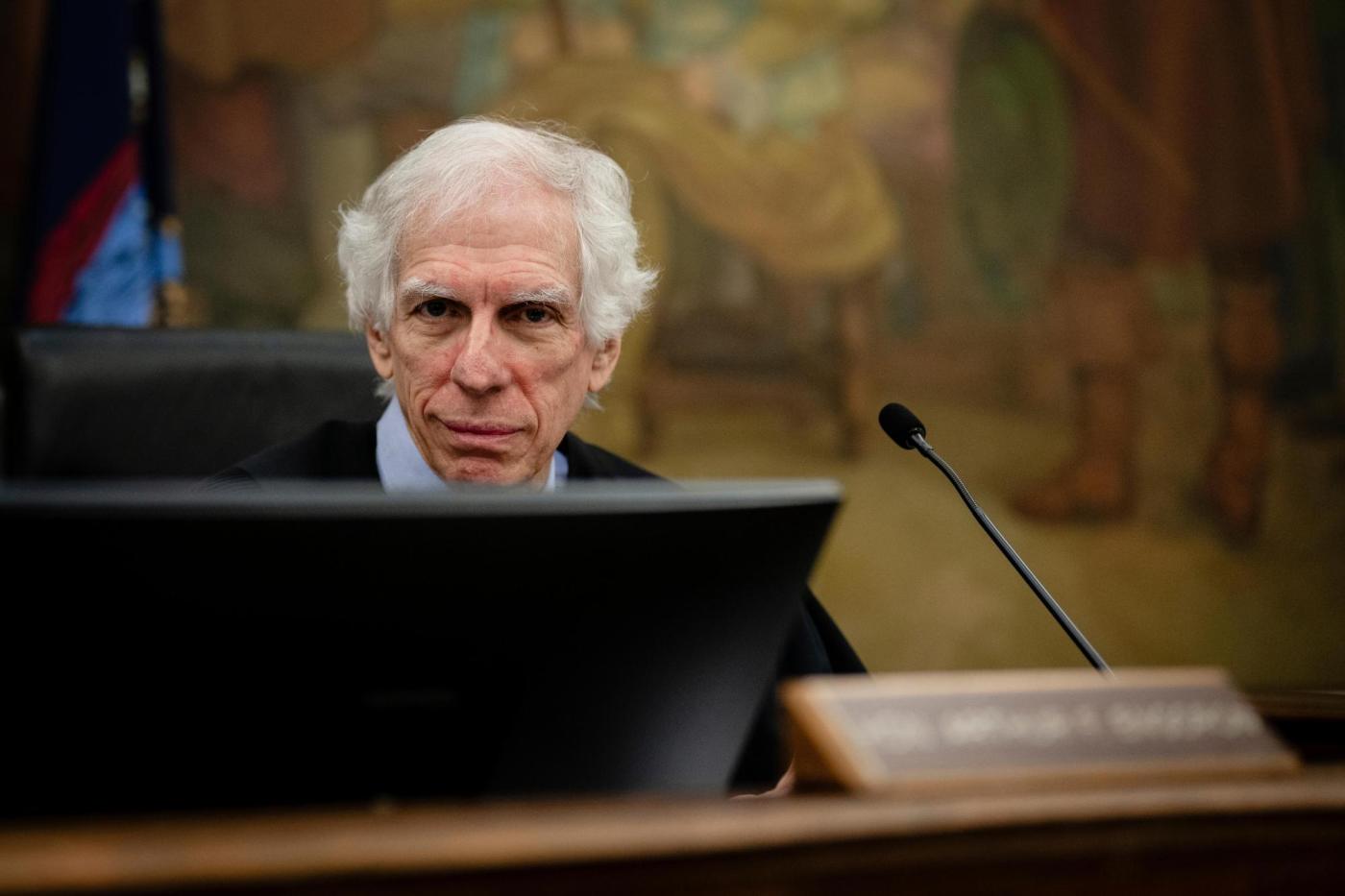
WASHINGTON (AP) — Senate Republicans have blocked legislation that would protect access to in vitro fertilization, objecting to a vote on the issue Wednesday even after widespread backlash to a recent ruling by the Alabama Supreme Court that threatens the practice.

Sen. Cindy Hyde-Smith, a Mississippi Republican, objected to a request for a vote by Sen. Tammy Duckworth, D-Ill., who used IVF treatments to have her two children after struggling with years of infertility. Duckworth’s bill would establish a federal right to the treatments as the Alabama ruling has upended fertility care in the state and families who had already started the process face heartbreak and uncertainty.

Several clinics in the state announced they were pausing IVF services as they sort out last week’s ruling, which said that frozen embryos can be considered children under state law. The court said that three Alabama couples who lost frozen embryos during an accident at a storage facility could sue the fertility clinic and hospital for the wrongful death of a minor child.

Democrats have immediately seized on the election-year ruling, warning that other states could follow Alabama’s lead and that other rights could be threatened as well in the wake of the U.S. Supreme Court’s decision to overturn Roe vs. Wade and the federal right to an abortion in 2022. Congress passed similar legislation in 2022 that would protect the federal right to same-sex and interracial marriages.

“Mark my words, if we don’t act now, it will only get worse,” Duckworth said.

Abortion opponents have pushed laws in at least 15 states based on the idea that a fetus should have the same rights as a person.

Hyde-Smith defended the Alabama Supreme Court decision that found frozen embryos can be considered children under state law. She pointed out that it originated with a pair of wrongful death cases brought by three couples who had frozen embryos destroyed in an accident at a fertility clinic.

“I support the ability for mothers and fathers to have total access to IVF and bringing new life into the world. I also believe human life should be protected,” Hyde-Smith said.

At the same time, three providers in Alabama have paused the often-used fertility treatments while they sort out the legal implications. Alabama lawmakers are scrambling to find ways to protect the treatments. And former President Donald Trump, the front-runner for the GOP presidential nomination, said he would “strongly support the availability of IVF.” Trump called on lawmakers in Alabama to preserve access to the treatment.

Many GOP lawmakers also reinforced their support for IVF services.

Soon after the decision, Alabama Sen. Katie Britt made calls to fellow Republicans, including Trump, to argue for the importance of supporting the treatments, emphasizing that they are pro-life and pro-family, according to a person familiar with the calls.

In a statement after the ruling, Britt said that “defending life and ensuring continued access to IVF services for loving parents are not mutually exclusive.”

Other Republicans agreed. Texas Sen. Ted Cruz, one of the more vocal opponents of abortion in the Senate, said he supports IVF and believes it is “entirely life affirming.” Kansas Sen. Roger Marshall, a former obstetrician, said he’d referred patients for IVF treatments for 25 years in his practice. “We are the pro-family party, and there’s nothing more pro-family than helping couples have a baby,” Marshall said.

Still, this is the second time Republicans have blocked Duckworth’s bill. By Bringing it up again, Democrats said they are challenging GOP senators to display real support for IVF access after many this week issued statements criticizing the Alabama ruling. Democrats held the Senate floor for 45 minutes Wednesday with a series of speeches deriding the overturn of Roe v. Wade.

Senate Majority Leader Chuck Schumer said on Tuesday that Republicans who have denounced the Alabama ruling “are like the arsonist who set a house on fire and say, why is it burning?”

For Duckworth, the bill holds deep personal significance. After she was seriously injured while piloting a Black Hawk helicopter in Iraq, she became an amputee and was only able to have her own children, ages 5 and 9, through IVF.

“After a decade struggling with infertility after my service in Iraq, I was only able to get pregnant through the miracle of IVF,” Duckworth said on the Senate floor. “IVF is the reason I get to experience the chaos and the beauty, the stress and the joy, that is motherhood.”

She called her infertility “one of the most heartbreaking struggles of my life. My miscarriage more painful than any wound I ever earned on the battlefield.”

___

Associated Press writer Kim Chandler contributed from Montgomery, Ala.

Stephen Mihm: What Biden could learn from Ike’s leadership during the Suez Crisis

posted in: News | 0

As Israel’s Gaza offensive has grown ever more deadly and destructive, President Joe Biden has equivocated: condemning the civilian death toll while simultaneously sending more arms to Israel. This position, though perhaps politically expedient at the outset of the conflict, has become untenable.

Now, as the war threatens to destabilize the entire region, Biden should take a more forceful stance, much as one of his predecessors did. In 1956, President Dwight “Ike” Eisenhower successfully defused the Suez Crisis, forcing Israel and its allies — as well as the president’s own political rivals — to back down. Eisenhower’s willingness to confront Israel offers a model, however imperfect, for today.

At the beginning of 1956, the Suez Canal remained in the hands of British and French interests, much as it had been for nearly a century. That summer, though, Egypt’s president, Gamal Abdel Nasser, seized control of this critical conduit, effectively cutting off the flow of Middle Eastern oil to Europe. The move also hit Israel, denying its ships passage through the canal.

Nasser’s act, the culmination of rising tensions between Egypt and European powers, set off a major crisis. Britain and France, eager to reclaim some of their former influence in the region, forged an alliance with Israel, which had already clashed with Egypt in 1948. Together the three nations crafted a plan dubbed “Operation Musketeer”: Israel would invade Egypt’s Sinai Peninsula, as well as Gaza, which was then under Egyptian control. Britain and France would then land troops in the canal zone in a bid to overthrow Nasser.

News of the plan left Eisenhower aghast. Though the president counted all three countries as allies, he had cultivated relations with the newly independent Arab nations as well, in part to check Soviet influence in the region. Eisenhower, who had previously warned Britain against using force in the region, resolved to curb his Cold War allies if they proceeded with the plan.

This was not without risk: a direct confrontation with Britain, France, and Israel could backfire not just internally, but also closer to home. With the presidential election set to take place a week later, Eisenhower could ill afford to alienate pro-Israel voters in key states, particularly because his opponent, Adlai Stevenson, had tried to make Eisenhower’s foreign policy a campaign issue.

Israel and its allies undoubtedly expected that these considerations would sideline Eisenhower and proceeded with their plan. Israel moved first, invading Egypt on October 29. When Eisenhower pushed for a United Nations resolution calling for Israel to withdraw, Britain and France vetoed the measure — again, expecting that this would settle the issue.

It did not. Instead, Eisenhower delivered a national address on October 31 declaring that the U.S. would not countenance the invasion. “In all the recent troubles in the Middle East, there have indeed been injustices suffered by all nations involved,” Eisenhower said. “But I do not believe that another instrument of injustice — war — is the remedy for these wrongs.”

Eisenhower understood that eloquence alone wouldn’t force a withdrawal, particularly as Britain and France made it clear they would proceed with the plan. Ike now played hardball, informing the Brits through back channels that the U.S. would no longer help prop up the value of the pound sterling, which was already in freefall. The gambit worked: in the face of potential economic crisis, Britain had no choice but to back down and soon withdrew its troops. France followed suit, furious but unable to proceed without Britain by its side.

Israel, though, refused to withdraw. Eisenhower was not pleased. He turned again to diplomatic back channels, this time to threatening to support a UN resolution that would ban all public and private aid to Israel, including the tens of millions of dollars the nation received from the U.S. each year. At first, Israel refused to budge. But Eisenhower was unwavering — even as Democrats in Congress, led by future president Lyndon Baines Johnson, threatened to revolt.

As the year came to a close, Eisenhower combined the stick with a carrot: reassurances that the U.S. recognized Israel’s right to defend itself should Nasser take any measures to threaten the nation. By March of 1957, Israel bowed to reality and withdrew its forces, ceding control of the territory it had captured. Egypt reopened the canal the following month, and while tensions over free passage of cargo persisted, the Suez Crisis had come to an end.

What can Biden learn from this episode? While it’s tempting to suggest that he should simply emulate Eisenhower, the reality is more complicated. Egypt’s seizure of the Suez Canal wasn’t anywhere near as deadly or abhorrent as the attacks launched by Hamas. Moreover, Israel today is a far more powerful and established country than it was in 1956, and quite mindful of the fact that the U.S. failed to honor Eisenhower’s commitment a decade later, a betrayal that helped set the stage for the Six-Day War.

Still, Eisenhower’s bedrock belief — that the U.S. should put stabilizing the Middle East ahead of propping up its allies — remains relevant today. If Israel proceeds with an invasion of Rafah, it will unleash a refugee crisis that could rupture the tenuous peace Egypt and Israel currently enjoy. Eisenhower would not have let such a thing happen. Neither should Biden.

Biden may wish to reread what Eisenhower wrote in his diary at the height of the Suez Crisis, as the words are eerily prescient. The U.S., Ike concluded, “must be friends with both (Arab and Israeli) contestants in that region in order that we can bring them closer together. To take sides could do nothing but to destroy our influence in leading toward a peaceful settlement of one of the most explosive situations in the world today.”

Stephen Mihm, a professor of history at the University of Georgia, is coauthor of “Crisis Economics: A Crash Course in the Future of Finance.”