Minnesota House passes bill aimed at clarifying police force use in schools

posted in: News | 0

After weeks of committee hearings and compromises, the Minnesota House on Monday passed a bill aimed at clarifying the kinds of force police officers can use on students in schools.

Lawmakers have been working since the beginning of the legislative session on Feb. 12 to address law enforcement concerns about a 2023 state law that put new restrictions on officers’ use of prone restraints on students in schools by including them in the list of school employees prohibited from using that kind of hold.

At the beginning of the school year, more than 40 law enforcement agencies withdrew school resource officers in response to the law.

While Attorney General Keith Ellison in September issued guidance that addressed the concerns of most law enforcement agencies, Republicans pushed on majority Democratic-Farmer-Labor lawmakers to tweak the law to clear up any potential confusion.

‘Model policy’

The result is a bill that allows the use of prone restraints on students, but only in situations where there is a risk of death or serious harm. The state’s Peace Officer Standards and Training Board will have to develop a new “model policy” for school resource officers by the end of the year, with input from schools and community organizations.

Rep. Cedrick Frazier, DFL-New Hope. (Courtesy of MN House)

“We need to focus on our kids and worry about making sure they are OK. That is what this bill is about,” said Rep. Cedrick Frazier, a DFLer from New Hope who sponsored the bill in the House. “It creates a framework for the entire state now. There’ll be transparency. There’ll be accountability, if necessary.”

The bill passed 124-8, with Democrats making up all the no votes. Its next stop is the Senate, and then the desk of DFL Gov. Tim Walz, who said he supports the bill.

The bill’s passage in the House comes after DFL lawmakers accepted their GOP colleagues’ suggestions for the bill, which were aimed at pleasing law enforcement groups. That included new language to preserve peace officers’ discretion in using force if the “model policy” contradicts their duty to protect the public as a whole.

Bipartisan talks

Those bipartisan talks started happening after it became apparent some progressive members of the House DFL Caucus might not back the bill. DFLers have 70 seats in the House and Republicans currently have 63. With no GOP support it might not have passed.

Republicans on Monday said the change should have come sooner, but thanked Democrats for coming to the table to reach a bipartisan agreement on school resource officers.

“I think on both sides we want to make sure our schools, our kids, and our teachers are safe,” said Rep. Jeff Witte, a Lakeville Republican who once worked as a school resource officer.

Law enforcement groups including the Minnesota Chiefs of Police Association, Minnesota Sheriffs’ Association and the Minnesota Peace and Police Officers Association said they were on board with the version of the bill that passed on Monday.

Activist groups like the Solutions Not Suspensions Coalition remain opposed, as they don’t want a rollback of restrictions on face-down restraints.

St. Paul Public Schools moved to end its school resource officer program in 2020 following the murder of George Floyd by Minneapolis police officer Derek Chauvin. Floyd died after being held in a face-down restraint which impeded his breathing. Opponents of prone restraints in schools have cited Floyd’s death as an example of the risks posed by that type of force.

Related Articles

Politics |


Linda Marie Thayer: I was an ICU nurse for 35 years. Let people have a legal choice in how they leave this world

Politics |


Letters: To deter carjackers and assault? Issue personal bodycams at a low price

Politics |


Minnesota’s presidential primary is on Tuesday. Here’s what to know.

Politics |


Minnesota revenue forecast shows $3.7B surplus, but shortfall still projected for 2026-2027

Politics |


DFL senator calls lack of hearing for ‘Prove It First’ mining bill ‘legislative malpractice’

John Marboe: A musical soul, Ron Evaniuk

posted in: All news | 0

“No one can do what Ron does on cello,” Tom Kehoe told me. But let me back up in time.

Tom and his wife, Mira, are marvelous jazz musicians who came to our small community church in the Midway of St. Paul seven years ago. I told them at the time, “We can’t afford you.” They said, “You will be surprised. And we have friends. Some of the best musicians in town.”

Ron Evaniuk (courtesy of John Marboe)

“We believe in community,” they told me, “and we want to support the grace that a genuine community can provide. Music is a spiritual gift.”

I was stunned. I had just heard their band, Xibaba, play at a venue in downtown St. Paul. I did not believe they would be interested in playing at a small church that could offer them only $100 per week. They were interested. They said, “You get two for one. Both of us.” We started as an experiment, and the creative community collaboration has not stopped.

Ah, and their amazing musical friends. Many have graced our sanctuary over the years, but none who became more dear to me — to us — than Ron Evaniuk.

Ron was a great musician who was handed a cello at his grade school in Pittsburgh (he wanted to play trombone) by his teacher, a member of the Pittsburgh Philharmonic who taught public-school orchestra to make ends meet. Ron remembered needing to carry the cello home with his sister’s help in fifth grade. Later his family moved to Allen Park, Michigan. He kept up the cello and played with the Detroit Junior Symphony. Later he studied at the Cleveland Institute of Music, where Yo-Yo Ma also studied.

Ron went places. He was the cellist in Harry Chapin’s band. He toured and made several studio recordings. He played with Eric Kamau Gravatt and Source Code. He played with Paul Metsa, and with the Peter Vircks Quartet. He played at major theater venues in Minneapolis/St. Paul. He played upright bass and electric bass, as well as cello.

Ron Evaniuk (courtesy of John Marboe)

When I met Ron through Tom and Mira, he was working for an hourly wage at a model-train store. His gigs had mostly dried up. His concert cello had been stolen. He was facing serious health issues.

We invited him to play at the church. We found a student cello for him to play. That Sunday, a friend of mine was visiting who plays cello professionally. She was amazed at what she heard when she learned Ron was playing such a modest instrument, and that he had not played in years. The community later rallied to buy a cello worthy of his gifts — and, of course, as a gift to ourselves.

The church community (Zion Lutheran) embraced Ron and loved his music. He was energized to play again. It was a joy to see and hear him flourish.

He was never far from a laugh and a joke. As I would walk to the front to begin a Sunday service, he would play the theme from the Tonight Show with Johnny Carson — da da da da da … Which inspired me to pretend swinging a golf club. We developed a rapport.  Musical back and forth during the service, along with Tom at piano.

When I told him how grateful I was for him, his presence, and his gift, he replied, “I am grateful to be here, and to be part of this community.”

Ron Evaniuk (courtesy of John Marboe)

Last Saturday, I got a phone call from Tom. “Ron passed away,” he said. “We don’t know anything more.” I jumped in my car and met our musicians, Tom, Mira, Ray and Dennis, at Ron’s apartment. He had been found dead in his recliner, we were told. The police and medical examiner had come and taken his body. He had been dead for a day or two, or more. He lived alone, in an apartment with his hand-built model train city filling both rooms. He died alone.

But not entirely. In these last years, friends nurtured him back into playing, remembering, exploring his gift and genius for music. He gained and blessed a small community that appreciated and loved him.

In his apartment, I felt him present. I heard him laugh. I heard him play. Tom was right. No one can do what Ron could do — for us.

Rest well, dear friend.

The Rev. John Marboe of St. Paul is a pastor in the Evangelical Lutheran Church in America. His e-mail address is johncharles2@gmail.com

The memorial service for Ron Evaniuk will be at Zion Lutheran Church 1697 Lafond Ave., St. Paul, on Saturday, March 23. Visitation at 10 a.m., service at 11, luncheon to follow. Storytelling in the service most welcome.


Minnesota native who fixed foot pain with amputation shares journey on TikTok

posted in: News | 0

KASSON, Minn. — Sierra Diller has experienced chronic pain for more than half of her life. It began when she was a student at Kasson-Mantorville Elementary School, when constant pain in her right foot caused her to limp.

“A teacher saw me limping and told my mom,” Diller, now 28, said. “We saw so many doctors from Mayo to Olmsted (Medical Center) to private practices all over the Rochester area, really trying to find some sort of answer.”

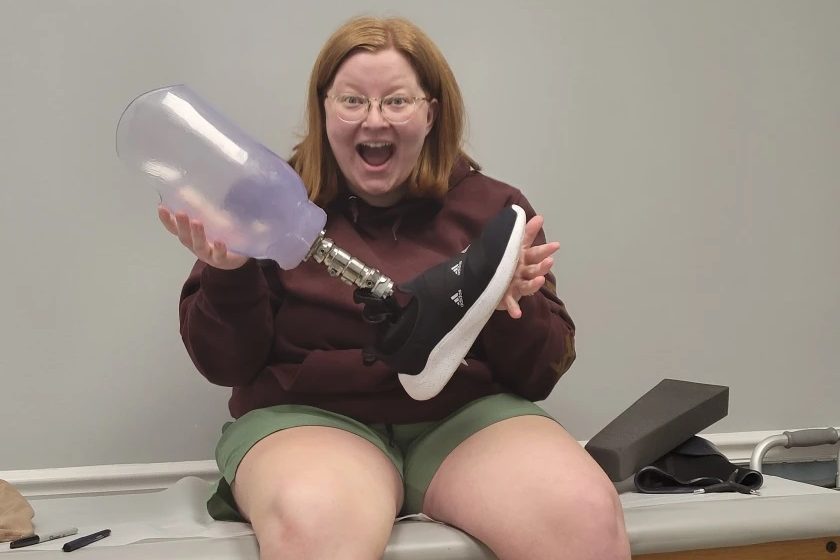
Sierra Diller, formerly of Kasson, Minn., shows off her temporary prosthetic after having her foot amputated in December 2023. (Courtesy of Sierra Diller)

Ultimately, Diller and her family learned that she had a hemangioma, a non-cancerous tumor, sandwiched between the bones and the tendons in her right foot.

“I ended up having surgery to try and remove the tumor,” Diller said. “Unfortunately, it was unsuccessful because the tumor is too intertwined with the rest of the things in my foot — the tendons, the veins, the nerves, everything. The only way to get it out was to basically resect the entire arch of my foot, which would leave me with no functionality at all.”

As the 7-inch incision on the sole of her foot healed, Diller had to relearn how to walk. A few years later, Diller’s providers tried sclerotherapy injections to try to dissolve the blood vessels in the tumor, but the treatment didn’t work.

“We didn’t really have any other options,” Diller said. “I kind of just went on with life, just expecting that foot pain was going to be my future.”

And Diller did live with that pain for several years. To accommodate the tumor, her foot bones had to shift, like how a person’s fingers arch around a computer mouse. This caused a cascade of chronic pain up her right leg, affecting her ankle, hip and lower back.

“I did grow up on a (dairy) farm in Kasson … and my foot did become a challenge,” Diller said. “At the end of the day, on a farm, the job is to get the job done. It doesn’t matter what you got to do to get there, it just has to get done. So, it was challenging growing up with the pain but, you know, we made it work.”

Saying goodbye

But the pain worsened. After attending Winona State University for her undergraduate degree, Diller moved to Florida for graduate school. During her first year there, Diller’s commute between her apartment, the bus stop and campus “caught up with my foot super fast.” One day, she reached a breaking point.

“I was walking back home from class and I couldn’t take the pain,” she said. “I actually remember I was sobbing it hurt so bad. I sat down on a bench. I was using my socks as tissues because I didn’t have anything, and I was sobbing on the phone to my now-wife and was like, ‘Hey, can you come get me? I just can’t do this anymore.’”

That’s when she pursued a different treatment option: saying goodbye to her foot completely.

Related Articles

Health |


Health care workers push for their own confidential mental health treatment

Health |


Post-pandemic vaccine hesitancy fueling latest measles outbreak

Health |


Measles Q&A: Do I need a booster? And other answers

Health |


France becomes the only country to explicitly guarantee abortion as a constitutional right

Health |


Trader Joe’s chicken soup dumplings recalled for possibly containing permanent marker plastic

“It’s hard for people to grasp elective amputation, as I can imagine,” she said. “Because some people think it’s very extreme, which comes from a place of not understanding what constant pain is, or (what) chronic pain feels like.”

It took a few years to get there — Diller had a hard time finding a doctor in Florida or in Indianapolis, where she lives now, who took her request for elective amputation seriously.

“It was so dismissed because it wasn’t cancerous. I wasn’t going to die imminently from whatever was in my foot,” Diller said. “The doctor I’m with now was very willing to listen and he said, ‘We’ll put that as a last resort, but I want to try some things, too.’”

After two rounds of sclerotherapy injections and another surgery failed, amputation was on the table.

Inspired to share

That’s when Diller decided to share her journey with others, taking inspiration from Jo Beckwith, known as “Footless Jo,” a YouTuber who posts videos about her elective amputation and how she navigates life with a prosthetic foot.

“She kind of encouraged me to be able to keep pushing myself, just keep trying,” Diller said. “Because of her and the encouragement she gave me, even though she didn’t know I existed, she made me want to share my story, too.”

Starting last year, Diller has been documenting her amputation journey on the social media platform TikTok, with her videos gathering thousands of views and comments. After having her right foot amputated in December 2023, she posted a TikTok from before the surgery showing her right foot covered with farewell messages written in marker and a “cut here” line around her ankle:

@hopalong.sierra

And just like that. It’s gone!!! Amputee Day 1! Handling recover like a champ! #fypシ #fyp #foot #footbreakup #pain #endchronicpain #amputee #amputation #preamputation

♬ Cut It (feat. Young Dolph) [Challenge Version] – O.T. Genasis

It went viral, reaching more than 5 million users.

“Those videos kind of blew up, with my very positive reaction to not having a foot,” Diller said. “Which, I woke up and I was just elated, so excited, and so I think that positivity went very far.”

‘Hopalong Sierra’

Sierra Diller, a Kasson, Minn., native who now lives in Indianapolis, poses for a photo with her wife, Alli Diller, after Sierra’s foot amputation. Sierra has gotten millions of views on her TikTok videos about her December 2023 foot amputation. (Courtesy of Sierra Diller)

In the weeks following her surgery, Diller (who goes by Hopalong Sierra on TikTok) has posted videos about getting her prosthetic leg, using the adaptive foot pedal that lets her drive a car with her left foot and experiencing phantom pain — real pain that feels as if it’s coming from a missing limb. “Why did you choose amputation?” is the most common question Diller gets from viewers.

“I’ve also had people reach out privately that are going through maybe not the same situation, but they may be facing the idea of elective amputation and they just don’t know how to talk to their families about it,” Diller said. “I try and give them my best support and how I handled my situation.”

Now that her right foot — and the tumor within it — is gone, Diller said she’s now able to go about her life without being constantly aware of her foot.

“Don’t get me wrong, I still have to consider how I’m going to get from point A to point B without a foot,” said Diller, who’s been using crutches as she recovers. “But there’s no more foot pain, and if I would have told that to sixth-grade me, when I was going through so much pain all the time, that there is going to be a day where you won’t have any more pain, I wouldn’t have believed you.”

Related Articles

Health |


Cloquet Super 8 shooting suspect did not know victims, police say

Health |


Minnesota’s dry weather leading to an increase in wildfires

Health |


Linda Marie Thayer: I was an ICU nurse for 35 years. Let people have a legal choice in how they leave this world

Health |


MacKenzie Scott’s Minnesota gifts are ‘transforming lives.’ Local nonprofits have been remade, as well.

Health |


State wrestling: Simley adds three first-time state champions

U.S. women’s national soccer team coming back to Allianz Field in June

posted in: News | 0

The U.S. women’s national soccer team will come to Allianz Field for an international friendly against South Korea on June 4, a source confirmed to the Pioneer Press on Monday.

The USWNT has made two previous visits to St. Paul for exhibition games: a 3-0 win over Portugal in 2019 and a 6-0 victory over South Korea in 2021. The 2021 match was legendary forward Carli Lloyd’s 316th and final time playing for the U.S.

New coach Emma Hayes is taking over the U.S. team this spring and will be on the sideline for the first time during this international window.

Fox 9 reporter Pierre Noujaim first reported the upcoming USWNT trip on Monday. The news is expected to soon become official.