Any performance review of Ryan Poles’ first two years as Chicago Bears general manager has to be stamped with a big, red “Incomplete.”
As Poles said at the Bears end-of-season news conference earlier this month, his rebuild of the Bears, who finished 7-10 last season, is “just not there yet.” Some of the team’s young players still are developing. Poles still has some roster holes to fill and depth to build. And he has major decisions ahead that will affect the trajectory of the franchise.
The most crucial decision, of course, is whether Poles will select a quarterback with the No. 1 pick in the 2024 NFLdraft, stick with three-year starter Justin Fields at the position — or do both.
As Poles works to make such choices in a critical third offseason, here’s a look at 10 of the biggest decisions he has made since the Bears hired him exactly two years ago Thursday.
1. Trading the 2023 No. 1 draft pick.
When Poles traded the No. 1 draft pick to the Carolina Panthers last March, he described himself as “over the moon” to add not only first-round picks in 2023 and 2024 and second-round picks in 2023 and 2025 but also wide receiver DJ Moore.
Poles has to be somewhere well beyond the moon now given the way the trade has played out, perhaps most notably getting the No. 1 pick this year courtesy of the Panthers’ 2-15 finish.
Moore’s 1,364 receiving yards on 96 catches in 2023 ranked fourth all time among Bears single-season leaders. And rookie right tackle Darnell Wright and cornerback Tyrique Stevenson, the players acquired from the 2023 draft picks, turned in promising rookie seasons. (The Bears drafted Stevenson with the help of a second trade.)
One potential criticism of the trade, however, is that Poles decided to give Fields at least one more year as the Bears starter rather than taking a quarterback prospect such as C.J. Stroud, who was selected at No. 2.
Given Stroud’s success in helping the Houston Texans to the divisional round of the playoffs as a rookie, Poles was asked this month if he felt like his team made a misevaluation.
“You have to take in what’s best for your team,” Poles said. “So when you look at that situation and how it ended up playing out, to have DJ, to have Darnell, to have Stevenson, to have the first overall (pick) and to have the second(-round pick) next year, I feel like that’s the best for our organization.”
Now Poles has the opportunity to build up the return of the trade even more depending on what he does with the 2024 No. 1 pick — setting up what could be a pivotal moment in team history on April 25.
2. Hiring Matt Eberflus — and retaining him.
Two days after the Bears hired Poles as GM on Jan. 25, 2022, Poles landed on Eberflus as his head coach from a group of finalists that included Dan Quinn and Jim Caldwell.
Poles said at the introductory news conference that he was so confident in Eberflus, a longtime defensive coach and coordinator but first-time head coach, that “the moment he walked through the room I knew he was the guy, especially when he started going through his plan.”
Poles has continued to offer support for Eberflus despite the coach’s 10-24 record — including 2-10 in the NFC North — over two seasons. And Poles did so again this month when he affirmed that Eberflus would return for a third season. He cited Eberflus’ leadership and stability through a turbulent season that included a 2-7 start, defensive coordinator Alan Williams’ abrupt exit and frequent quarterback speculation as reasons he wanted to retain the coach in 2024.
“When you go through hard times and he can keep everyone together, to me that’s like the critical piece,” Poles said. “In a big market like this, you have to be strong. … So the stability was a big piece of it. The detail that he coaches with. Taking some of the mistakes from the game, bringing them to practice and making sure that we’re doing things the right way, I saw a lot of progress in that. There’s a reason why we went from three to seven wins. … If it’s not for him, I really don’t think that’s the case. I think it starts to crumble, everyone starts to do their own thing.”
Poles and Eberflus have shown a willingness to move on from other coaches. The Bears fired running backs coach David Walker midseason for what Poles said was not meeting team standards of conduct. And they fired offensive coordinator Luke Getsy and four other assistants this month.
But Poles tethered the Bears’ future success to Eberflus, whose defense at least made visible strides by the end of the season.
Taking that track of consistency eliminated the possibility of Poles hiring certain top offensive coaching candidates whose eyes are on becoming a head coach instead of an OC, but Poles seemed convicted in the decision. Eberflus hired new offensive coordinator Shane Waldron, the former Seattle Seahawks OC and play caller, to guide whichever quarterback helms the Bears next year.
3. Trading for defensive end Montez Sweat.
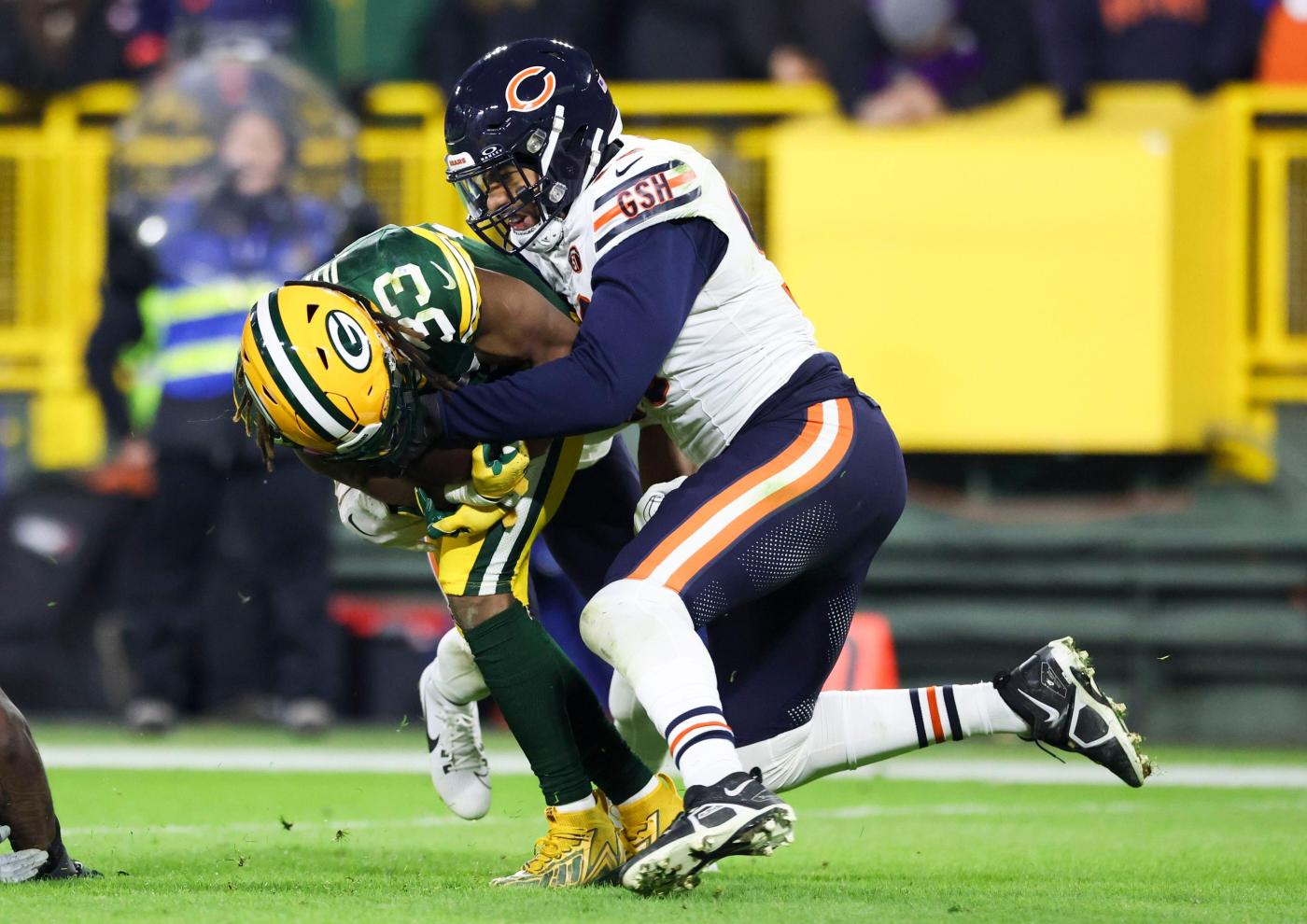
On locker clean-out day at Halas Hall, Sweat called it a “cool stat” to be the first player in NFL history to lead two teams in sacks in one season. He had 6 1/2 sacks with the Washington Commanders and then six with the Bears after Poles acquired him for a 2024 second-round draft pick.
“But really when I look at that, I feel like I left a lot of meat on the bone,” Sweat said. “So I’m going to analyze that over the offseason and come back ready to go.”
Sweat already got off to a pretty good start with the Bears as one of the driving forces in the late-season defensive turnaround. He had 14 quarterback hits and 21 pressures, according to Pro Football Reference, and became what Poles called “a multiplier.”
“He helped that entire defense,” Poles said. “When you add players like that, all of a sudden you could see everyone had a little more swagger to them. I think it affected the back end. You saw interceptions go up. You saw us win more games. The “Tez Effect” there. Really proud of that one. Great human being too.”
Poles took a risk in trading for Sweat before having an agreement on a contract extension. But the Bears signed Sweat to a four-year, $98 million contract four days after the trade, and the early returns are good — though Sweat still has a long way to go to make the contract worth it.
4. Trading away edge rusher Khalil Mack.
Poles certainly started his Bears career with a bold move — trading the team’s best player.
Poles’ trade of Mack to the Los Angeles Chargers in March 2022 set the tone for a multiyear rebuild. The Bears gained needed draft picks, which they turned into second-round safety Jaquan Brisker, seventh-round safety Elijah Hicks and seventh-round punter Trenton Gill. And they freed up some salary cap space.
“I would understand why some people would be upset,” Poles said after the trade. “It’s not easy for us to do either but again that’s kind of the name of the game. That is my job is to do what I think is best for the organization for now and the future.”
Of course, the Bears still could use a player like Mack, who at age 32 had a career-high 17 sacks, 21 tackles for a loss, five forced fumbles and 10 passes defended. He has been named a Pro Bowler twice in two seasons with the Chargers.
5. Drafting right tackle Darnell Wright over defensive tackle Jalen Carter.
Carter was considered by many analysts to be the most talented defensive player in the 2023 draft, but his buildup to the draft was turbulent.
During the NFL scouting combine, news broke that Carter was involved in a crash that killed a Georgia teammate and staffer. Carter, who was driving a different car than the one that crashed, later pleaded no contest to misdemeanor counts of racing and reckless driving. Amid that turmoil, Carter also struggled to get through his pro day workout in Georgia.
When Carter was available at No. 9 for Poles to select in April, the Bears GM instead traded back one spot, allowing the Philadelphia Eagles to take Carter and earning the Bears a 2024 fourth-round pick. The Bears then nabbed their first-round choice at No. 10: Wright.
Carter and Wright both were named to the Pro Football Writers of America’s all-rookie team this week. Carter had six sacks, nine quarterback hits, eight tackles for a loss, two forced fumbles and a fumble return touchdown for the Eagles. Wright started all 17 games for the Bears at right tackle.
Poles said this month that he feels really good about the move and raved about Wright’s potential.
“Darnell did an outstanding job,” Poles said. “He continues to work on his technique. Once he closes the technique gap and the consistency of using the right techniques versus the right players … There’s a Rolodex that you’ve got to build out in terms of the pass rushers that you go against, because they all have different stuff. So once he starts putting that together, you’re going to see a really good player.
“He’s out there right now as a rookie just using his natural ability. In a lot of games, that was good enough, but there were some games and some reps where it wasn’t good enough, and he’s got to continue to get better. And I know he’s going to put the time in. But he’s made of the right stuff. He’s tough. He’s strong.”
6. Trading linebacker Roquan Smith and defensive end Robert Quinn.
In a season and a half since Poles traded Smith to the Baltimore Ravens for second- and fifth-round draft picks, Smith has twice been named an All-Pro and has helped the Ravens to the AFC championship game this season.
Poles said at the time of the November 2022 trade that he and Smith couldn’t find common ground on a contract extension. The Ravens gave Smith a five-year, $100 million deal.
“The reality of it is that you have to ask yourself a question: Are we ever going to find that middle ground?” Poles said then. “It felt like it was highly unlikely. So then are you able to then take the opportunity to enhance your roster now? Or are you OK with the chance that he walks away and we can’t use some of that to enhance our roster? And that’s what it came down to and I felt like we had to move forward at that time.”
Poles turned the draft picks received in the trade into defensive tackle Gervon Dexter and linebacker Noah Sewell, and Poles spoke highly this month of Dexter’s development in his rookie year. But it’s fair to wonder on the outside why the Bears couldn’t make it work with Smith.
The trade of Quinn to the Eagles hasn’t left as many questions, even though Quinn had 18 1/2 sacks with the Bears in 2021. Quinn didn’t play this season after he was charged with hit-and-run and assault in August in South Carolina, ESPN reported. The Bears used the fourth-round pick on wide receiver Tyler Scott, who had a bit of a bumpy rookie season.
7. Signing linebackers Tremaine Edmunds and T.J. Edwards.
The flip side to the Smith trade is the Bears signed two linebackers in the offseason who found their groove together as the season went on and became key team leaders too.
The Bears signed Edmunds to a four-year, $72 million contract and Edwards to a three-year, $19.5 million contract, which now looks like a steal given his play in 2023.
Both players had the type of ball production the Bears wanted to see from Smith. Edmunds received the Bears Ballhawk Award for 2023 after totaling four interceptions, including a pick-six, a forced fumble and a fumble recovery. Edwards added three interceptions, a forced fumble and two fumble recoveries.
“You can kind of see it from when they got here just how competitive they are,” linebackers coach Dave Borgonzi said last month. “It’s been pretty consistent throughout the whole season, just their love and passion to play the game, and it carries over to Sunday. How they prepare really affects how they play on Sunday, and the way they prepare is unbelievable. It kind of rubs off on the rest of the group, and it’s been such a positive impact not just for the play on the field but the guys around them as well.”
8. Signing tight end Cole Kmet to an extension.
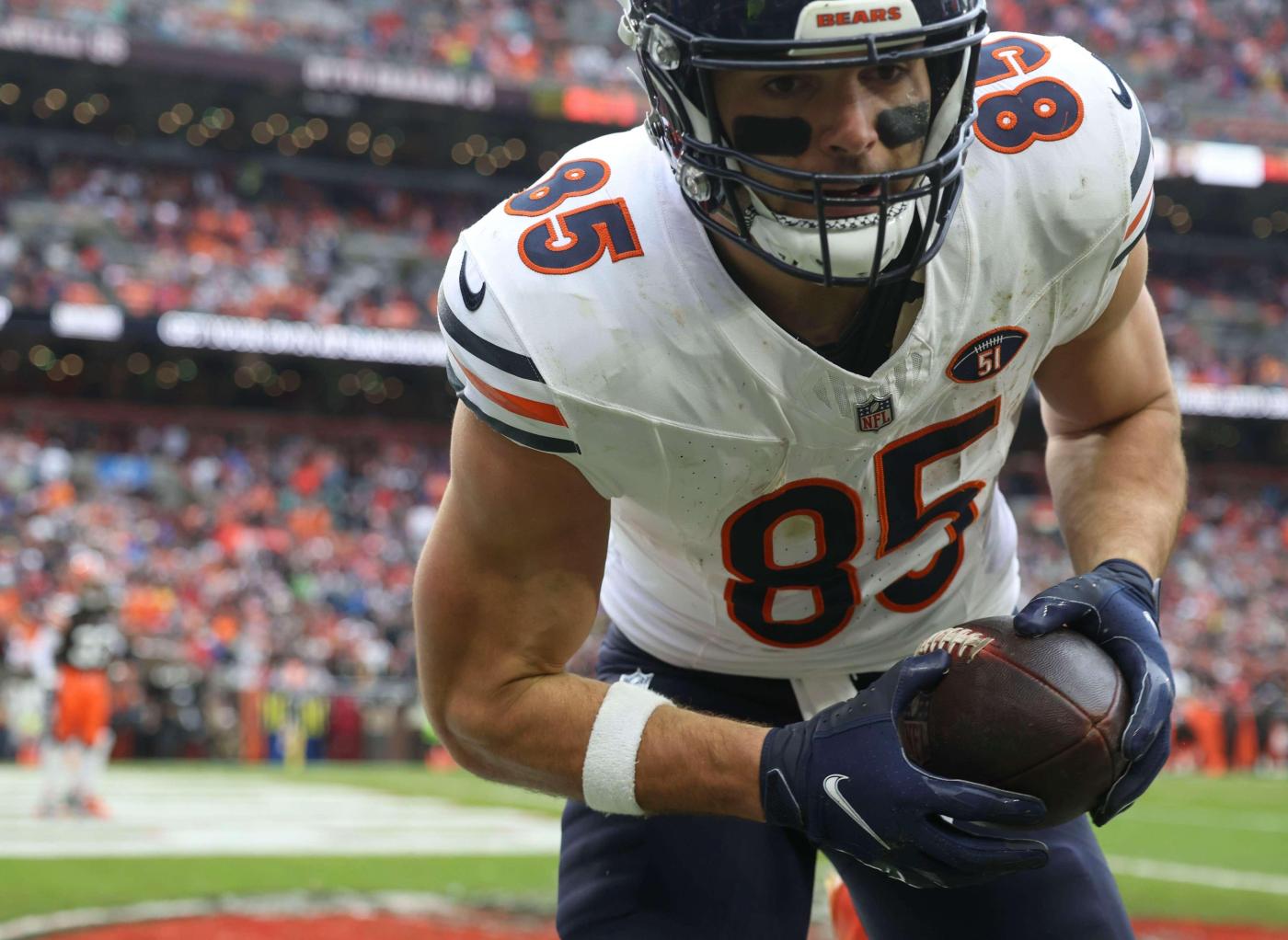
Poles’ first extension for a player the Bears drafted came in July when Kmet signed a four-year, $50 million deal. Kmet said at the time he wanted to prove the Bears right, and then he put together his best season in four years, totaling 73 catches for 719 yards and six touchdowns.
“We’ve seen Cole get better and better ever since we’ve been here,” Poles said after the extension. “We’re excited for him. He embodies everything we look for in a Bear: hard work, dedication, how he handles himself in the locker room. He’s a true professional.”
Kmet’s extension, however, was sandwiched by two the Bears couldn’t get done, the aforementioned Smith negotiations and talks with cornerback Jaylon Johnson. The Johnson talks broke down at the 2023 trade deadline, resulting in Johnson requesting a trade that didn’t materialize. But Poles said last month that he is confident the Bears can work something out this offseason with the cornerback.
9. Using three second-round picks on the secondary.
Among the major focuses of Poles’ first two offseasons has been rebuilding the Bears secondary.
Poles used second-round picks in 2022 to draft cornerback Kyler Gordon and Brisker, then used another second-round pick to draft Stevenson in 2023. Poles also added fifth-round cornerback Terell Smith last spring.
The result has been a promising young group anchored by more veteran players in Johnson and safety Eddie Jackson, both of whom Poles must make decisions about this offseason.
At nickel, Gordon took a big leap from his rookie year to his second season, and Brisker also continued his development. Stevenson and Smith dealt with growing pains but also flashed enough potential to get the Bears excited about the group under cornerbacks coach Jon Hoke.
If Johnson is back and the players stay healthy, it could be a strength in 2024.
“You’ve got to give all the credit to those guys. The work they put in is incredible,” Poles said on the team’s pregame radio show in December. “I look out my window even after practice, for 20-30 minutes after, and those guys are still working on ball skills to be able to finish and get interceptions to the little footwork, nuances of the position and the different coverages. They put a lot of work in and they’re reaping the benefits.”
Of course, making those moves to build the secondary has come at the expense of depth at other positions, and the Bears notably still need help on the offensive line and at wide receiver.
10. Trading for Chase Claypool — and then trading him away.
Poles offered an interesting nugget of information while thanking the leadership of Chairman George McCaskey and President and CEO Kevin Warren earlier this month.
Poles said he was reflecting on a trade midseason that went poorly, entering it into a decision log where he discusses what he can do better.
“We met on that, and they both supported me in terms of saying, ‘Keep shooting your shot, man. If you put your log together, you’re hitting those boxes that it feels right, and it’s going to help our team, keep shooting your shot,’ ” Poles said. “For a decision-maker to have that type of support is incredible.”
Poles didn’t say whether the trade he was bummed about was the November 2022 acquisition of Claypool, but that was among the biggest errors of Poles’ short tenure thus far. He traded a second-round pick for Claypool, who then managed just 18 catches for 191 yards and a touchdown in 10 games with the Bears. The team benched Claypool in October for poor performance on and off the field and then traded him to the Miami Dolphins for a 2025 sixth-round pick.
Poles, however, continued to shoot his shot. Twenty-five days after parting with Claypool, Poles acquired Sweat, and the Bears defense began its turnaround, which in turn helped make a case for Eberflus to retain his job.
Another web of decisions lies ahead in 2024.
()