The Caitlin Clark Experience: Big Ten women’s basketball tournament storylines

posted in: News | 0

For the first time in the history of the event, the Big Ten Women’s Basketball Tournament has announced a sellout for every session.

That’s the impact of superstar Caitlin Clark.

Nearly 110,000 fans are expected to attend, and while most of them will have their own rooting interests in mind, Clark is undoubtedly at the epicenter of everybody’s experience. She will likely alter the economy in the Twin Cities this week in the same way international pop star Taylor Swift did this summer.

The event itself will take place Wednesday through Sunday at Target Center in Minneapolis. Here are some storylines to watch:

How will Caitlin Clark perform?

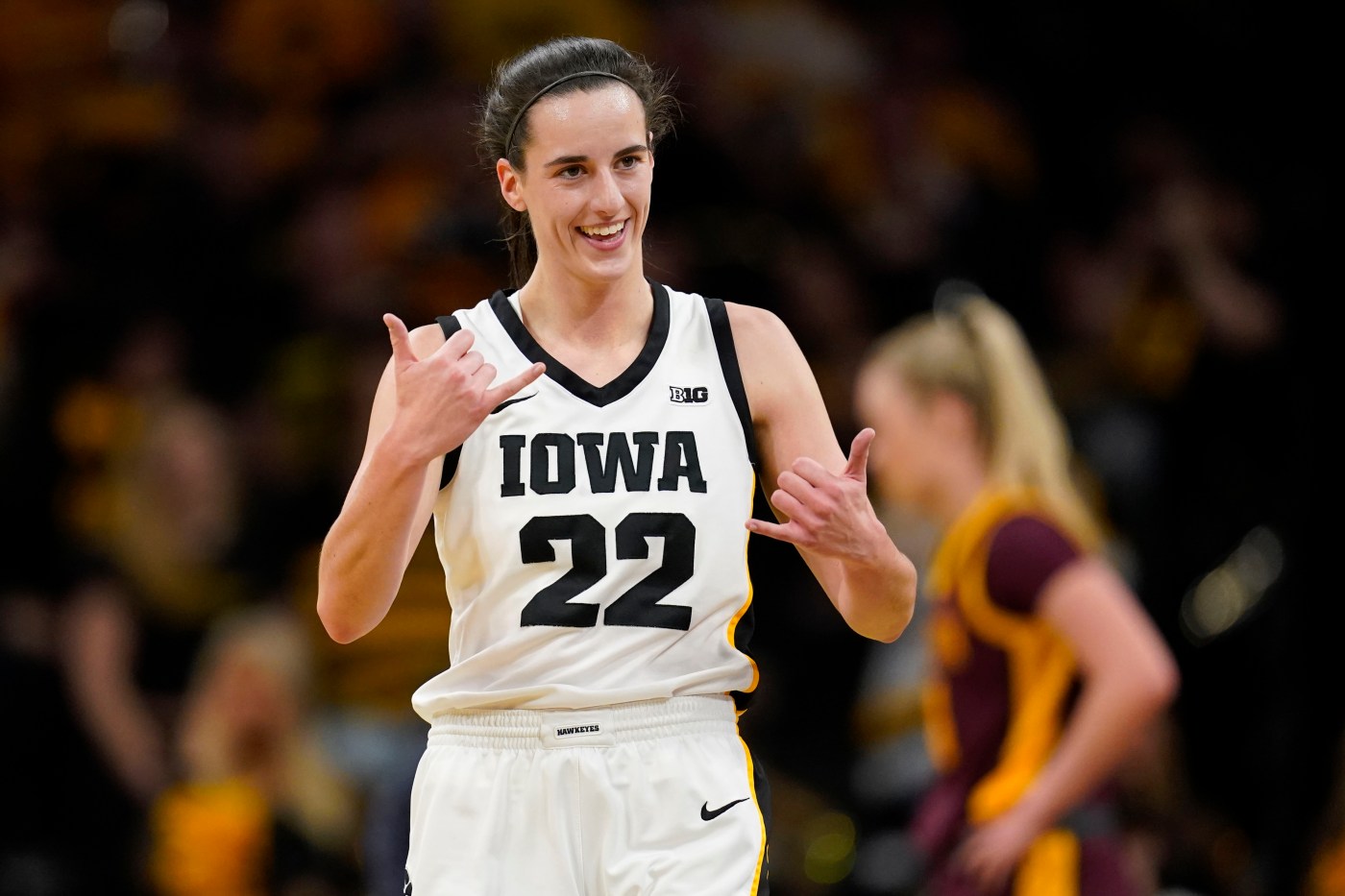
All eyes will be on Clark everywhere she goes this week. She has to perform. Not that there’s any reason to think she won’t. Not only has Clark sold out virtually every building she has played in this season, she has consistently been the best player on the court.

The most recent example of that came last weekend when Clark put up 35 points on national television to become the NCAA’s all-time leading scorer. She passed the legendary Pete Maravich for the crown and now has an astounding 3,685 points for her career. She lives for the big moments.

That sets the stage for this week.

Though it’s likely that Clark will put on a show with her scoring prowess, she would love nothing more than to lead No. 2 seed Iowa (26-4, 15-3 Big Ten) to another Big Ten tournament championship. The first game in that quest will come in a quarterfinal matchup on Friday night against either No. 7 seed Penn State or No. 10 seed Wisconsin.

Stillwater native Sara Scalia returns

This will be a homecoming for Stillwater native Sara Scalia.

Sara Scalia is still wearing No. 14 but the jersey is different. After three seasons at Minnesota, the Stillwater guard returns for a Wednesday game at Williams Arena with an Indiana team that is 20-1 and ranked No. 4 in the country. (AP Photo/Carlos Osorio)

After committing to Minnesota out of high school, Scalia left the hometown program, transferring to Indiana to chase her hoop dreams of playing for a top team in the nation. She came off the bench last season, and after working on her craft, has established herself as a starter this season.

It has been an understatement to call Scalia a sharpshooter. She is averaging 16.3 points this season while shooting a career-high 43.9 percent on 3-point attempts.

As for No. 3 seed Indiana (24-4, 15-3 Big Ten), if the Hoosiers are going to make a run at the Big Ten title, it is going to be with Scalia helping lead the charge alongside teammate Mackenzie Holmes.

Ohio State as top seed

The fan favorite this week will be Iowa. The actual favorite might be Ohio State.

Led by star guard Jacy Sheldon, a balanced attack on offense and a ferocious demeanor on defense, No. 1 seed Ohio State (25-4, 16-2 Big Ten) will be a force to be reckoned with this week. There is no weakness to be found on the roster. There isn’t much to be said other than that.

If Ohio State can find a way to get rolling, there is a good chance they will stop Iowa from winning another Big Ten crown.

Will the Gophers fight back?

There was a time this season that it looked like Minnesota might flirt with a NCAA tournament bid.

Then star guard Mara Braun went down, and everything fell apart.

In fact, since losing Braun to a foot injury a little more than a month ago, Minnesota has won just one game. It has gotten extremely grim with losses in 10 of 11 games, including a recent 90-34 defeat at the hands of Penn State.

The run will end for No. 11 seed Minnesota (15-14, 5-13 Big Ten) on Wednesday night if it can’t beat No. 14 seed Rutgers in the first round.

Related Articles

College Sports |


Women’s basketball: Caitlin Clark knocks out more milestones in Hawkeyes’ 108-60 rout of Gophers

College Sports |


Women’s basketball: Nebraska jumps on Gophers early, rolls to victory

College Sports |


Women’s basketball: Sophomore standout Serah Williams leads Wisconsin past Gophers

College Sports |


Women’s basketball: Grocholski leads Gophers past Northwestern

College Sports |


Women’s basketball: Gophers fall at Rutgers
Amen to New Housing? Faith-Based Development Bill Looks to Secure Legislative Blessing

posted in: Politics | 0

While lawmakers continue to negotiate development incentives and tenant protections in Albany, supporters of the Faith-Based Affordable Housing Act are positioning the bill as one of the state’s best shots at passing meaningful housing legislation this year. “It’s hard to put your guard up when it’s the neighborhood church saying we want to build,” sponsor Andrew Gounardes told City Limits.

State Sen. Andrew Gounardes’ Office

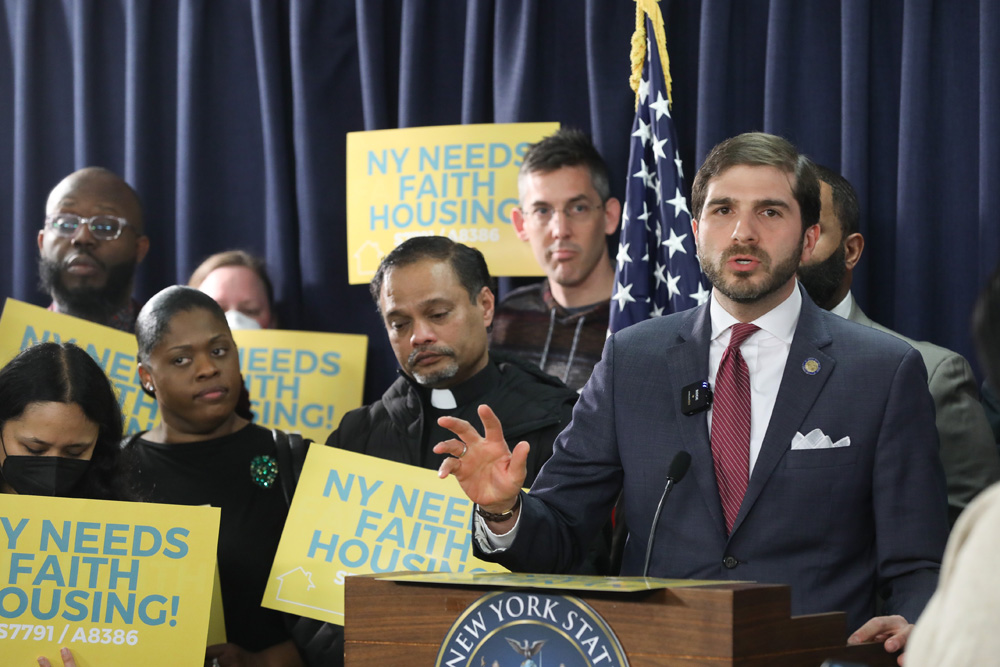
State Sen. Andrew Gounardes and supporters of the Faith-Based Affordable Housing Act at a rally in Albany on March 5, 2024.

While Albany lawmakers continue to debate development incentives and tenant protections in Albany, supporters of the Faith-Based Affordable Housing Act are positioning the bill as one of the state’s best shots at passing meaningful housing legislation this year.

Proposed in December by State Sen. Andrew Gounardes, the legislation would make it easier for religious organizations to build affordable housing on their properties, essentially becoming landlords.

And while not as far-reaching as other housing-related proposals being haggled in Albany—and a year after Gov. Kathy Hochul’s mandated development proposal fizzled out—supporters of the FBAHA hope it will prove a less divisive option to spur new homes across the state.

“I think a lot of people were skittish about the notion of trying to do everything in one big grand slam swing,” Gounardes told City Limits. “So we’ve taken a bit of a different approach. We think that starting with faith based institutions, which are obviously trusted partners and communities, trusted institutions, and allowing them to make it easier to do what they want to do, which is to help create housing for people, was a much lower barrier to entry.”

The concept is not unfamiliar to Gounardes: in fact, a similar faith-based housing initiative was a priority during Mayor Eric Adams’ tenure as Brooklyn borough president, a time when Gounardes served as his counsel.

Largely modeled on the successes of California’s Affordable Housing on Faith Lands Act, which eased the zoning red tape for faith-based organizations and nonprofit universities (excluded from New York’s version), the bill would help create substantial affordable housing on what is typically untaxed land.

If passed, it would allow religious institutions like temples, churches, mosques, and synagogues “to bypass local zoning laws that restrict their ability to develop their land,” as long as that new development includes affordable housing. In areas with fewer than 1 million inhabitants, 20 percent of constructed or converted residences under the law must be allocated for households earning 80 percent of the Area Median Income (AMI).

In cities with 1 million or more residents like New York, residential buildings must adhere to one of three options: allocate 25 percent of floor area for households earning 60 percent of the AMI—equivalent to $84,720 for a four-person household—with at least 5 percent of units affordable to those at 40 percent of the AMI. Alternative options would require 30 percent of floor area for households earning 80 percent of the AMI,  or 20 percent of floor area for households earning 40 percent of AMI, the bill states.

Open New York

A before-and-after rendering of how a religious organization could use the proposed law to develop its property.

So far, the legislation has 18 co-sponsors in the Assembly and 11 in the State Senate, including progressive democrats such as State Sen. Julia Salazar and Assemblymember Emily Gallagher. It’s also earned the support of Queens State Sen. Leroy Comrie, who last year was among those opposed to Gov. Hochul’s housing plan and was a vocal critic of efforts to legalize basement apartments. Both the Senate and Assembly housing chairs, State Sen. Brian Kavanagh and Assemblymember Linda Rosenthal, have signed on as well.

“We’ve just been constantly talking to folks little by little, and building up quiet support, because it’s hard to object if a church says, ‘Hey, we have a parking lot, or we have an unused rectory or an unused school building or some other type of asset that we have no use for anymore. We want to turn it into housing,’” said Gounardes. “It’s hard to put your guard up when it’s the neighborhood church saying we want to build affordable housing.”

According to a recent Pew Research report, 75 percent of New Yorkers support a form of faith-based housing. Reverend Dustin Longmire is one of them.

His congregation, Messiah Lutheran Church near Schenectady, acquired and merged with a neighboring church with lagging membership in late 2021. His congregation began speaking with experts on how to best put the acquisition to good use.

The property is located in a unique zoning overlay district, and the final recommendation was to convert it into a community center as well as affordable housing.

“In my mind, we could use this development opportunity to serve us,” said Longmire. “In a town that doesn’t really have a main street it’d become a kind of a central hub in a lot of ways, and really do some strong place-making, knitting the fabric of community together while also providing housing for some of our neighbors.”

The community center component opened in June 2022, and the church still hopes to develop affordable housing at the site. “We have a pretty conservative town board but really good people who might not be super oriented towards affordable housing, but they’re talking with us,” Longmire said.

According to data provided by NYU Furman Center, 4.6 billion square feet of potential housing could be unlocked across the state via FBAHA’s passage, significantly more than the 76 million square feet that could be provided by converting unused office space, the bill’s supporters wrote in a Daily News oped in December. 

Under the legislation, any congregation that enters into a development agreement will have to undergo a mandated training on housing, “so that they can enter into working with a developer in a responsible way so that they don’t get exploited,” said Rev. Peter Cook, executive director of the New York State Council of Churches, who helped write the bill alongside pro-development organization Open New York. 

“In terms of faith organizations wanting to do this work, this is really common,” said Andrew Fine, Open New York’s policy director.  

“It just really takes too long. A lot of projects take five, 10, 15 years just to cut through the financing and environmental review and rezoning processes and given the [housing] crisis, we just don’t have that time,” Fine said. “So really, this is taking a lot of projects that people love the outcome of, but that get mired in endless processes and trying to shorten it.”

For Longmire, he believes  the bill would help faith-based organizations accomplish what most of them aim to do in their communities: act as forces for public good.

“Supporting this bill will just free up faith communities more to provide the same sort of services that we historically always have,” he said. “The church was always a part of figuring out infrastructure and housing and health care and all these sorts of things, and this is just a 21st century version of that.”

To reach the reporter behind this story, contact Chris@citylimits.org. To reach the editor, contact Jeanmarie@citylimits.org.

Want to republish this story? Find City Limits’ reprint policy here.

The post Amen to New Housing? Faith-Based Development Bill Looks to Secure Legislative Blessing appeared first on City Limits.

Lou’s Last Ride: Lou Nanne set for 60th and final Minnesota boys hockey state tournament broadcast

posted in: News | 0

Lou Nanne found himself on the side of the road with a flat tire and no jacket at almost midnight on a snowy Thursday evening in the metro.

The local hockey legend had yet again called a full day of Class 2A boys hockey state tournament action, and on the way home hit what he believed to be a sinkhole. Nanne, who had never changed a flat tire, proceeded to drive 12 miles home on a flat tire through the snow. In the middle of that treacherous venture, the then-81-year-old thought to himself, “What am I doing here at my age?”

“Maybe,” he thought, “this is a sign.”

Perhaps it was time to call it quits on his illustrious sidegig career calling the state hockey tournament on television. It was then that he decided the next season’s state tournament would be his last.

The time has finally come — the week has arrived. Nanne will call his 60th state tournament this week, serving as Channel 45’s television analyst for all six Class 2A games. And then the 82-year-old will give his vocal chords a well-earned rest. Nanne first announced his decision back in January.

“I just felt it was time. I wanted to give the station an opportunity to get ready to do something that they wanted to do,” Nanne said this week. “It’s the right thing to do at the right time, in my mind.”

The decision likely still hasn’t been accepted by all. It has been brought up to Nanne that perhaps someone else could drive him to the games. Anything to keep him on the air.

He is synonymous with this iconic event. From the beginning, it has been a match made in heaven, Minnesota’s hockey treasure calling Minnesota’s treasured hockey event.

When you turn on the television, you expect to hear Nanne’s voice.

“It’s humbling. It’s really something I’m very proud of, I cherish, and I’m very thankful that they look at me in that vein. I’ve had so many people say, ‘Never quit. I’ve been watching you since I was a little kid,’ ” Nanne said. “You don’t really think about that at all, and then all of a sudden you hear those kinds of comments and then you start thinking, ‘Jeez, this is significant.’ I’m glad I did it. I’m proud to be a part of it.”

He’s had a front-row seat to the tournament’s evolution as it has developed into the must-watch sporting event this time of year that seemingly signals the start of spring while thrusting the State of Hockey firmly into the forefront of everyone’s minds.

Nanne marvels at how the talent has increased year over year. When he first started calling the tournament, he noted teams had maybe one strong line and a couple of good defensemen.

“It just kept progressing and all these guys are so, so talented — big, strong, fast,” Nanne said. “It’s shattering to think of how good these guys are compared to what I saw in the beginning.”

But other things have remained consistent, such as the general enthusiasm. That is Nanne’s favorite part of this week. The sheer joy present on the faces of fans, bands and, really, entire schools and cities serve as the ultimate energizer. It truly matters to everyone in the building, and beyond.

He savors the adrenaline rush that comes with the start of every game and the endless possibilities that come with it.

“The uncertainty of who’s going to win, because in a one-game playoff anything can happen, and I’ve seen anything happen in that time,” Nanne said. “It’s just like going to a mystery movie every year. You never know what’s going to happen and how it’s going to end.”

The thrill of each year has seemingly sped up the passage of time. Six decades is forever. Nanne noted that’s more than the lifetime of many. He has watched as kids became men, and then watched their children and grandchildren do the same. He even called his own grandchildren’s state tournament games. And yet, it all seemed to transpire in the blink of an eye.

“That’s the most amazing part,” he said.

Sixty truly is an amazing number. Nanne surmised he must be Minnesota’s longest-tenured broadcaster. Which is funny, of course, because broadcaster is never the word you would use to describe Nanne.

He was a professional hockey player, then a coach and general manager. Now, he’s a businessman. And somehow, through it all, he has managed to carve out this specific week in his schedule on an annual basis to bring the state tournament to the living rooms of families throughout the state, and, as Prep45.com’s streaming data shows year over year, the world.

He appreciated the cooperation and assistance people gave him throughout the years. It wasn’t unusual that he would work a day or two of the tournament in between games before rejoining his team in another city.

“There was a lot of schedule jumping around to be able to get over there,” Nanne said. “It just worked together. It just worked.”

But it also was work. On quarterfinal Thursday, Nanne is at the rink from 9 a.m. to 11:30 p.m., when things go as scheduled. You never know when the next Duluth East-Apple Valley five-overtime thriller is around the corner. That’s still Nanne’s most memorable game.

“The most amazing thing about that game was, when we went into overtime, both teams seemed to abandon defense. I’ve never seen so many quality chances in my life (with) nobody scoring. I didn’t think it was ever going to end. I’m thinking, ‘How am I going to get out of here? I don’t care if they throw that puck in the net. It’s not going in,’ ” Nanne said. “It was something that I don’t think I’ll ever see again. I’ve never seen a game, at any level, in overtime with those kinds of chances for a longer period of time.”

And when those quarterfinals end, there are still three more games to call. It’s always a long week. This week is even more so, given all of the hoopla surrounding Nanne’s last go-around. His early-week schedule is jam-packed with media interviews. Then he’ll call the tournament. And, on Sunday, he’ll be back at the X, being honored by the Wild before finally returning to Florida on Monday. This week, local clothing company SotaStick put out a limited-edition Nanne 60 shirt, with a portion of the proceeds going to the Lou Nanne Scholarship within the Golden Gopher Fund at the U.

Everyone wants to honor Nanne in some way, shape or form during this sendoff.

“It’s something I’m anxious to get over, but I know I’m going to really enjoy it,” Nanne said. “It’s time to cut the cord, although I know I’m going to miss it a lot.”

Frankly, this week will serve as a good representation of the same love he has always felt throughout his tenure on the call.

“Every year, when I get on the plane on Sunday after the state tournament, (people would) say, ‘Oh, we enjoy it.’ They’ll say, ‘Don’t ever quit. We look forward to this every year,’ stuff like that,” Nanne said. “I think that’s what kept me going, people appreciated it, so I was thankful that they did, and I was happy to do it.”

And he’ll continue to watch the state tournament every year, just from his living room, rather than the television booth. Though he did leave room for one potential exception.

“If any of my great grandkids make it,” he said, “then I’ll come back for a guest appearance.”

Related Articles

High School Sports |


East Metro boys hockey player of the year: White Bear Lake’s Nolan Roed

High School Sports |


Wisconsin boys hockey: New Richmond falls 6-2 to St. Mary’s Springs in Div. 2 title game

High School Sports |


Check out the 2024 Minnesota boys hockey state tournament brackets

High School Sports |


Boys hockey: Stanius’ early goal, Gabriel’s 35 saves power White Bear Lake over Hill-Murray in section final

High School Sports |


Boys hockey: No. 5-seeded Cretin-Derham Hall beats St. Thomas Academy for third straight section title

Washington County, probation officers reach tentative contract agreement over Juneteenth holiday

posted in: News | 0

Washington County and Teamsters Local 320, the union that represents the county’s 48 probation officers, on Tuesday reached a tentative agreement on a contract for 2024 and 2025.

The agreement reflects the same package of paid holidays as most other county employees currently enjoy, including Juneteenth. The agreement “transitions Christmas Eve to a floating holiday, which allows employees to take time off on a day that is important to them,” county officials said in a statement.

Probation officers in January voted to authorize a strike over whether Juneteenth should be a paid holiday for them.

Juneteenth, which commemorates the end of slavery in the United States, became a federal holiday in 2021. Two years later, Minnesota became the 26th state to recognize the holiday, but it is not a paid holiday for all government workers.

“The county is pleased to have reached this agreement with our probation officers that includes a competitive wage and benefit package and brings their paid holidays in line with the rest of the organization,” Washington County Administrator Kevin Corbid said in the statement. “The county values the important contributions our probation officers make to keep our community safe. With this agreement, our staff can move forward with providing the exceptional services the people of Washington County expect, deserve and depend on.”

The agreement includes a memorandum that formalizes staffing on Christmas Eve “to ensure court and public safety needs are met,” according to the statement.

Probation officers last year got 11 paid holidays off: New Year’s Day, Martin Luther King Day, President’s Day, Memorial Day, Independence Day, Labor Day, Veteran’s Day, Thanksgiving, the day after Thanksgiving, Christmas Eve and Christmas.

Under the tentative contract they would get all the same days except Christmas Eve with the addition of Juneteenth and one floating holiday.

Related Articles

Crime & Public Safety |


Anytime Fitness parent company Self Esteem Brands announces global merger with Orangetheory

Crime & Public Safety |


WWII veteran, retired Ramsey County deputy dies weeks after 100th birthday

Crime & Public Safety |


Hudson police investigate St. Croix River accidental drowning death

Crime & Public Safety |


2 men killed in Afton crash of vintage airplane are identified

Crime & Public Safety |


Small plane crash in yard of Afton home kills two onboard