Recipes for 3 hearty vegetarian stews that don’t take hours on the stove

posted in: News | 0

A slowly bubbling pot of stew on a cold winter evening, steam rising and scents wafting, is the epitome of cozy contentment.

There’s a fine line between a stew, a braise and a soup, and it’s quite subjective: Sometimes only a few spoons of broth make the difference. To my mind, a stew needs to be thick enough to eat with a fork but coated with plenty of velvety sauce so there’s a puddle left at the bottom of the bowl, easily mopped up with a piece of crusty bread (or soaked up by rice, noodles or mashed potatoes).

But what’s in the pot? A popular answer would be meat, beef, lamb or pork, simmering gently in an aromatic bath. But many other ingredients benefit from long, slow cooking, and a pot of chickpeas or beets will steam up your kitchen as pleasantly and fill your belly just as heartily as chicken or beef. Since I’ve been eating less meat over the last few years, I’ve often turned to vegetable-based stews to fortify myself and my family against the icy nights.

One benefit of vegetable-only stews is that they generally cook more quickly than meaty ones, which can take hours to soften the tough cuts traditionally called for. Otherwise, vegetable stews are cooked much like their meat-filled cousins. A base of chopped aromatic vegetables or alliums is sautéed, then liquid and more vegetables or beans or grains are added, and the mixture is simmered until tender. Starchy ingredients like potatoes or beans in the pot will help thicken the broth, turning it rich and silky. Broth or wine bump up the flavors.

Each of the three stews here has a distinct character that shows off the range of what’s possible.

Red Lentil Barley Stew

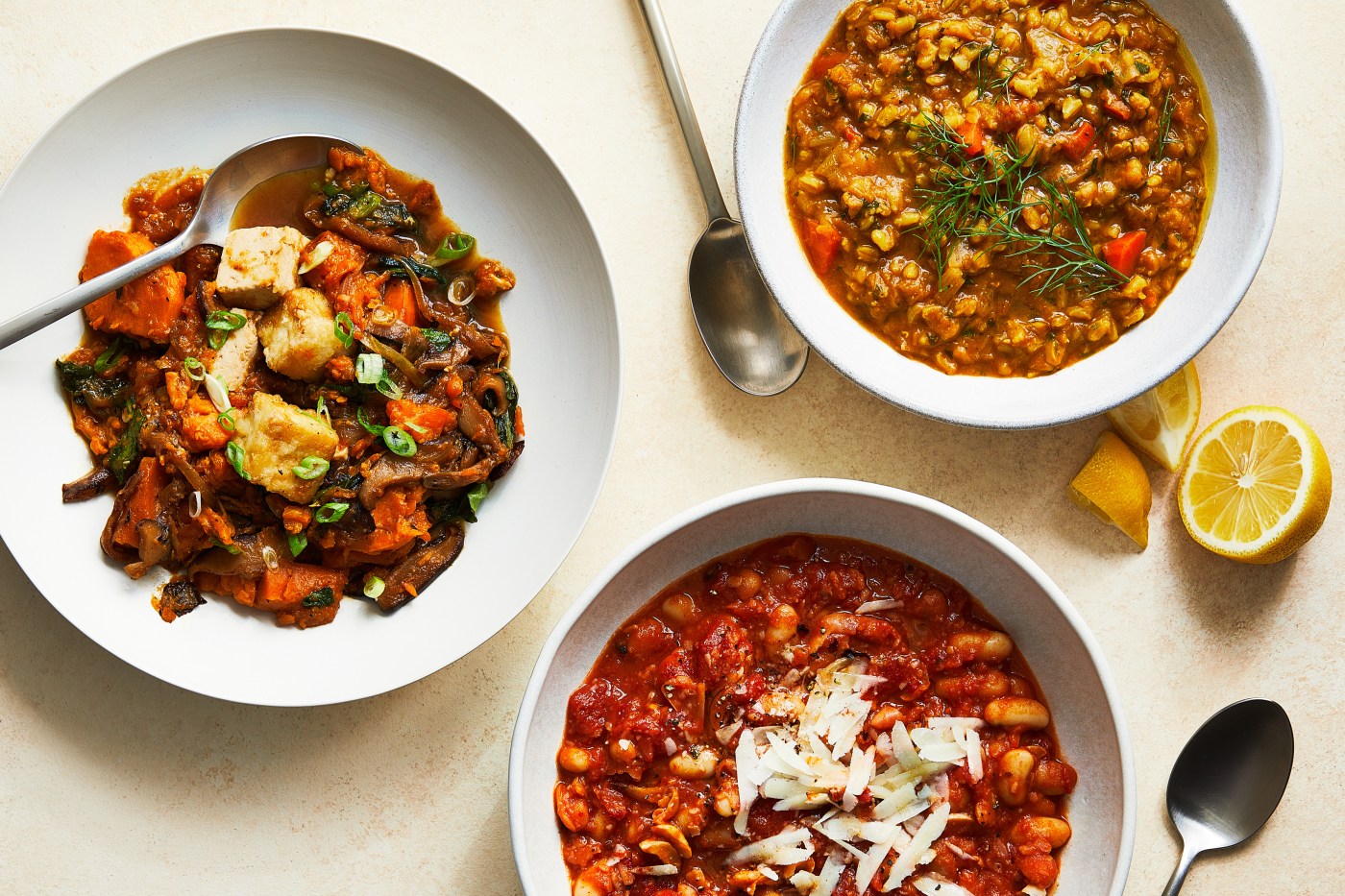
Red lentil-barley stew. Fennel and leeks add a fragrant complexity to this homey lentil-barley stew. Food styled by Cyd Raftus McDowell. (Armando Rafael/The New York Times)

By Melissa Clark

Warm spices, fennel and leeks give this rib-sticking stew a deep, complex character. Feel free to adjust the liquid to taste. Adding a little more makes it brothier and more souplike, suitable for eating with a spoon. Or let it rest a bit. As it sits, the barley will absorb all of the liquid, making it easily forkable. Be sure to serve this with lemon wedges on the side, since the lentils and barley benefit greatly from a bright jolt right at the end.

Yield: 8 servings

Total time: 1 1/2 to 2 hours

INGREDIENTS

3 tablespoons extra-virgin olive oil, more for drizzling
2 leeks, white and light green parts, sliced into half-moons, or 1 cup sliced onion
3 carrots, diced
1 cup chopped fennel, fronds reserved
1 bunch cilantro, leaves and stems mostly separated and chopped (don’t worry too much about leaves and stems mingling)
3 garlic cloves, minced
1 1/2 teaspoons fine sea or table salt, more to taste
2 tablespoons tomato paste
1 tablespoon baharat or garam masala
1/2 teaspoon ground turmeric
1 cinnamon stick
2 quarts vegetable or chicken broth
1 cup pearled barley
1 cup red lentils
1 to 2 tablespoons fresh lemon juice, plus lemon wedges for serving

DIRECTIONS

In a large Dutch oven or soup pot, heat oil over medium-high. Add leeks and cook, stirring often, until tender and beginning to brown, about 10 minutes.
Stir in carrots, fennel, cilantro stems, garlic and salt. Cook until the garlic is fragrant, about 2 minutes. Stir in tomato paste, baharat, turmeric and cinnamon stick, and cook until the tomato paste begins to caramelize, about 2 minutes.
Add the broth, barley and red lentils, and bring to a boil. Lower heat and simmer for 1 hour to 1 1/2 hours, stirring occasionally, until the barley and lentils are tender. (Add some water if the pot starts to look dry; this can be as thick or soupy as you like.)
Stir in a tablespoon of lemon juice and the chopped cilantro leaves. Taste stew and add salt and lemon juice if needed (you might need a lot more salt if you started with unsalted broth). Serve in bowls drizzled with olive oil and garnished with chopped fennel fronds.

Sweet Potato-Tofu Stew

Sweet potato-tofu stew. This dish, whose flavors are based on Japanese nimono, features tofu two ways: stewed and crisped. Food styled by Cyd Raftus McDowell. (Armando Rafael/The New York Times)

By Melissa Clark

In this dish, based on the flavors of Japanese nimono, umami from soy sauce and shiitake mushrooms rounds out the gentle sweet potatoes, which fall apart and thicken the stew as they simmer. The tofu is added in two ways here. Some of it is marinated in the soy sauce and then stirred into the stew for a soft, pillowy texture. Then, the rest is fried until golden and spooned on top as a crisp garnish. You can also leave the tofu out altogether for a speedier but just as satisfying meal.

Yield: 4 to 6 servings

Total time: 1 hour

INGREDIENTS

3 tablespoons toasted sesame oil, plus more to taste
7 to 8 ounces shiitake mushrooms, stems discarded, caps sliced 1/4-inch-thick
1 medium onion, halved and thinly sliced
1 tablespoon grated fresh ginger
3 pounds sweet potatoes, peeled and cut into 2-inch chunks (about 8 cups)
2 cups dashi (instant or homemade), or use vegetable or chicken broth
1 piece dried kombu, about 5 inches square (optional)
6 tablespoons soy sauce, plus more to taste
3 tablespoons mirin
3 tablespoons sake
2 tablespoons raw or turbinado sugar
1 pound firm tofu, cut into 1-inch cubes
Salt, as needed
1 tablespoon cornstarch
2 to 3 cups baby greens, such as kale, spinach or mustard
1 teaspoon rice wine vinegar, plus more to taste
4 scallions, thinly sliced

DIRECTIONS

In a medium pot, heat 2 tablespoons sesame oil over medium-high. Add mushrooms, onion and ginger, and cook, stirring, until golden and tender, 7 to 10 minutes.
Add sweet potatoes, dashi, kombu (if using), 5 tablespoons soy sauce, the mirin, sake and sugar. Bring to a lively simmer. Place a piece of parchment paper or another cover directly on top of the liquid (see Tip) and simmer gently until the sweet potatoes are very tender, 30 to 35 minutes.
While the stew simmers, line a plate or baking sheet with a clean kitchen towel or paper towels, and place tofu cubes on top. Place another layer of paper towels or wrap up the kitchen towel around the tofu and weigh down with a skillet or plate topped by cans. Let sit for at least 15 minutes. Unwrap and place half of the tofu cubes in a small bowl; drizzle with remaining 1 tablespoon soy sauce and a pinch of salt, and set aside to marinate.
In another bowl, toss remaining tofu with cornstarch. Heat a nonstick or well-seasoned cast-iron skillet over medium-high and add the remaining 1 tablespoon sesame oil. Once the oil is hot, add the tofu cubes and fry until crisp, 5 to 7 minutes, turning them on all sides. Transfer cubes to a paper towel-lined plate and season lightly with salt. (Or you can crisp the tofu in the oven or an air fryer; see Tip.)
When the sweet potatoes are tender, uncover the stew. If the sauce seems thin, simmer uncovered for a few more minutes to reduce it.
Stir the greens into the stew to wilt, then stir in the soy sauce-marinated tofu, any extra soy sauce from the bowl, and the rice wine vinegar. The potatoes may start to fall apart from all the stirring, and that is OK: They’ll thicken the sauce. Taste, adding more salt, soy sauce, sesame oil and rice wine vinegar until it’s bright and savory.
Ladle stew into bowls and top with scallions and crispy tofu. Drizzle with more soy sauce if you like, for serving.

Tips: You’ll need to lay something directly on the top of the stew to allow for some evaporation while keeping the vegetables submerged. You can use parchment paper. Either cut a round just large enough to fit inside your pot, or press a larger piece into the pot touching the surface, and letting the edges stand up. Or, if you can, use a silicone steamer lid or a collapsible steamer basket small enough to fit inside the pot. It’s fine if the lid is smaller than the pot by an inch or so, as long as most of the vegetables stay submerged so they cook evenly.

You can crisp tofu cubes in the air fryer or roast them on an oiled baking sheet in a 425-degree oven. (Drizzle the top of the cubes with a little oil as well; bake for 20 to 25 minutes.)

Spicy Tomato White Bean Stew

Spicy tomato white bean stew. This simple stew relies on canned white beans and comes together in just half an hour. Food styled by Cyd Raftus McDowell. (Armando Rafael/The New York Times)

By Melissa Clark

Made in about half an hour from pantry ingredients, this simple, flexible stew has a velvety texture from canned white beans rounded out by plenty of garlic, olive oil and canned plum tomatoes. The optional bacon adds a brawny heft here, but the stew will be just as hardy without it. Or lighten things up by stirring a few handfuls of quick-cooking greens directly into the pot, which also eliminates any need for a salad on the side.

Yield: 3 to 4 servings

Total time: 30 minutes

INGREDIENTS

1/2 cup diced bacon or pancetta (3 strips; optional)
2 to 4 tablespoons extra-virgin olive oil, plus more as needed
7 garlic cloves, thinly sliced
1/2 teaspoon red-pepper flakes
1 (14-ounce) can peeled plum tomatoes
3 (15-ounce) cans white beans, drained
1/2 teaspoon fine sea or table salt, plus more to taste
1 cup vegetable or chicken broth
Grated Pecorino Romano, for serving (optional)
Coarsely ground black pepper or smoked paprika, for serving

DIRECTIONS

In a medium pot over medium-high heat, fry the bacon or pancetta until crisp and browned, 3 to 4 minutes. Use a slotted spoon to transfer to a plate, leaving the fat in the pan. Reserve diced bacon or pancetta for garnish. (Skip this step if not using the bacon.)
Add 2 tablespoons oil to the pot if you used the bacon or 4 tablespoons oil if you didn’t. Heat the oil for a few seconds, then add garlic and red-pepper flakes, and cook, stirring, until garlic is pale golden brown, 1 to 2 minutes.
Dice the canned plum tomatoes. Add tomatoes and their liquid to the pot, along with the beans, salt and broth. Let liquid come to a boil, then lower the heat so the mixture is at a rapid simmer. Mash about a quarter of the beans with a potato masher or wooden spoon against the side of the pot, and simmer until the stew has thickened, 7 to 15 minutes. Taste and add more salt if you like.
Serve warm in bowls topped with reserved bacon and grated cheese if you like, and a drizzle of extra-virgin olive oil and a sprinkling of pepper, smoked paprika or both.

Related Articles

Restaurants, Food and Drink |


Trader Joe’s chicken soup dumplings recalled for possibly containing permanent marker plastic

Restaurants, Food and Drink |


St. Paul barbecue restaurant Hickory Hut marking 30th anniversary with giveaways, raffles

Restaurants, Food and Drink |


Check out Allianz Field’s new food items

Restaurants, Food and Drink |


At North Loop’s new Dario, handmade pasta is the star

Restaurants, Food and Drink |


Is soap safe for cast iron? A former MMA fighter has bet his career on it

Other voices: The liberal Supremes did America a service

posted in: News | 0

CHICAGO — We were not surprised that the U.S. Supreme Court on Monday ruled that individual states can’t unilaterally bar Donald Trump from appearing on ballots on the grounds of Section 3 of the 14th Amendment, the part of the Constitution that bars prior insurrectionists from holding office.

When it comes to federal offices, it’s pretty clear that the framers saw the application, or disabling, of that amendment as the responsibility of Congress. States certainly have the authority to bar their own state officials on those grounds, which is well and good. But having some states allow Trump’s name to stand on a ballot for president of the United States and others bar him on a patchwork basis clearly would have produced a chaotic result, given that what happens in one state would of course impact the other 49. And any reasonable person can see that partisan tit-for-tats would have been the inevitable consequence.

This was always a Hail Mary on the part of those who believe that Trump’s odious actions on that rightly notorious Jan. 6 were those of an insurrectionist and thus disqualifying in his current presidential run. Illinois was among the states that gave it a shot. Most of those who supported this attempt, and we were never among them, likely had convinced themselves that the ends justified their means. Tempting but no cigar.

But we were stirred and pleased that the Supremes acted unanimously in striking down the Colorado Supreme Court ruling, which was the issue on the table here but will extend to other states that have followed suit. The three liberal justices stepped away from their potential partisan corners and also rejected the suggestions of several law professors no doubt of their acquaintance. That puts this issue to bed in the best possible way, and Trump should return the favor by noting that not everything in Washington is some Deep State plot against him.

To his credit, he actually did take some baby steps Monday in that direction. When things go his way, he is capable of marginal magnanimity. It’s when things do not that this big baby’s ruinous side always reveals itself.

In this case, he could learn a thing or two from those liberal justices. They swallowed hard and did their jobs.

Trump for president is a matter for the voters. Such is the price of democracy.

— The Chicago Tribune

Related Articles

Opinion |


Biden beats long-shot challenger Dean Phillips in the congressman’s home state of Minnesota

Opinion |


Noah Feldman: Supreme Court buries the fantasy of keeping Trump off the ballot

Opinion |


Biden and Trump dominate Super Tuesday races and move closer to a November rematch

Opinion |


Supreme Court restores Trump to ballot, rejecting state attempts to ban him over Capitol attack

Opinion |


Nikki Haley wins the District of Columbia’s Republican primary and gets her first 2024 victory

Nikki Haley will suspend her campaign and leave Donald Trump as the last major Republican candidate

posted in: News | 0

By STEVE PEOPLES (AP National Political Writer)

NEW YORK — Nikki Haley will suspend her presidential campaign today after being soundly defeated across the country on Super Tuesday, according to people familiar with her decision, leaving Donald Trump as the last remaining major candidate for the 2024 Republican nomination.

Three people with direct knowledge who spoke on the condition of anonymity because they weren’t authorized to speak publicly confirmed Haley’s decision ahead of an announcement by her scheduled for Wednesday morning.

Haley, a former South Carolina governor and U.N. ambassador, was Trump’s first significant rival when she jumped into the race in February 2023. She spent the final phase of her campaign aggressively warning the GOP against embracing Trump, whom she argued was too consumed by chaos and personal grievance to defeat President Joe Biden in the general election.

Her departure clears Trump to focus solely on his likely rematch in November with Biden. The former president is on track to reach the necessary 1,215 delegates to clinch the Republican nomination later this month.

Haley’s defeat marks a painful, if predictable, blow to those voters, donors and Republican Party officials who opposed Trump and his fiery brand of “Make America Great Again” politics. She was especially popular among moderates and college-educated voters, constituencies that will likely play a pivotal role in the general election. It’s unclear whether Trump, who recently declared that Haley donors would be permanently banned from his movement, can ultimately unify a deeply divided party.

Haley leaves the 2024 presidential contest having made history as the first woman to win a Republican primary. She beat Trump in the District of Columbia on Sunday and Vermont on Tuesday.

She had insisted she would stay in the race through Super Tuesday and crossed the country campaigning in states holding Republican contests. Ultimately, she was unable to knock Trump off his glide path to a third straight nomination.

Haley’s allies note that she exceeded most of the political world’s expectations by making it as far as she did.

She had initially ruled out running against Trump in 2024. But she changed her mind and ended up launching her bid three months after he did, citing among other things the country’s economic troubles and the need for “generational change.” Haley, 52, later called for competency tests for politicians over the age of 75 — a knock on both Trump, who is 77, and President Joe Biden, who is 81.

Her candidacy was slow to attract donors and support, but she ultimately outlasted all of her other GOP rivals, including Florida Gov. Ron DeSantis, former Vice President Mike Pence and Sen. Tim Scott, her fellow South Carolinian whom she appointed to the Senate in 2012. And the money flowed in until the very end. Her campaign said it raised more than $12 million in February alone.

She gained popularity with many Republican donors, independent voters and the so-called “Never Trump” crowd, even though she criticized the criminal cases against him as politically motivated and pledged that, if president, she would pardon him if he were convicted in federal court.

As the field consolidated, she and DeSantis battled it out through the early-voting states for a distant second to Trump. The two went after each other in debates, ads and interviews, often more directly than they went after Trump.

The campaign’s focus on foreign policy following Hamas’ surprise attack on Israel in October tilted the campaign into Haley’s wheelhouse, giving her an opportunity to showcase her experience from the U.N., tying the war to her conservative domestic priorities and arguing that both Israel and the U.S. could be made vulnerable by what she called “distractions.”

Haley was slow to criticize her former boss directly.

As she campaigned across early states, Haley often complimented some of Trump’s foreign policy achievements but gradually inserted more critiques into her campaign speeches. She argued Trump’s hyperfocus on trade with China led him to ignore security threats posed by a major U.S. rival. She warned that weak support for Ukraine would “only encourage” China to invade Taiwan, a viewpoint shared by several of her GOP rivals, even as many Republican voters questioned whether the U.S. should send aid to Ukraine.

In November, Haley — an accountant who had consistently touted her lean campaign — won the backing of the political arm of the powerful Koch network. AFP Action blasted early-state voters with mailers and door-knockers, committing its nationwide coalition of activists and virtually unlimited funds to helping Haley defeat Trump.

With Trump refusing to participate in primary debates, Haley went head-to-head with DeSantis in a single debate, displaying a combative style that seemed to sit poorly with even those committed to support her in the Iowa caucuses. She would finish third.

Haley’s name emerged as a possible running mate for Trump, with the former president reportedly asking allies what they thought of adding her to his possible ticket. As Haley appeared to gain ground, some of Trump’s backers worked to tamp down the notion.

While Haley initially notably declined to rule out the possibility, she said while campaigning in New Hampshire in January that serving as “anybody’s vice president” is “off the table.”

After DeSantis exited the campaign following Trump’s record-setting win in the Iowa caucuses, Haley hoped that New Hampshire voters would feel so strongly about keeping the former president away from the White House that they would turn out to support her in large numbers.

“America does not do coronations,” Haley said at a VFW hall in Franklin on the eve of the New Hampshire primary. “Let’s show all of the media class and the political class that we’ve got a different plan in mind, and let’s show the country what we can do.”

But she would lose New Hampshire and then refused to participate in Nevada’s caucuses, arguing the state’s rules strongly favored Trump. She instead ran in the state’s primary, which didn’t count for any delegates for the nomination. She still finished a distant second to “ none of these candidates,” an option Nevada offers to voters dissatisfied with their choices and used by many Trump supporters to oppose her.

She had long vowed to win South Carolina but backed off of that pledge as the primary drew nearer. She crisscrossed the state that twice elected her governor on a bus tour, holding smaller events than Trump’s less frequent rallies and suggesting she was better equipped to beat Biden than him.

She lost South Carolina by 20 points and Michigan three days later by 40. The Koch brothers’ AFP Action announced after her South Carolina loss that it would stop organizing for her.

But by staying in the campaign, Haley drew enough support from suburbanites and college-educated voters to highlight Trump’s apparent weaknesses with those groups.

Haley has made clear she doesn’t want to serve as Trump’s vice president or run on a third-party ticket arranged by the group No Labels. She leaves the race with an elevated national profile that could help her in a future presidential run.

In recent days, she backed off a pledge to endorse the eventual Republican nominee that was required of anyone participating in party debates.

“I think I’ll make what decision I want to make,” she told NBC’s “Meet the Press.”

Column: As Shane Waldron gets started as Chicago Bears offensive coordinator, finding his ideal fit is the top priority

posted in: News | 0

Maybe it’s best to start here, late in the fourth quarter of Week 15 with the Seattle Seahawks trailing 17-13 and pinned inside their 10-yard line. The two-minute warning had just passed, right after the Philadelphia Eagles downed a punt at the Seahawks 8.

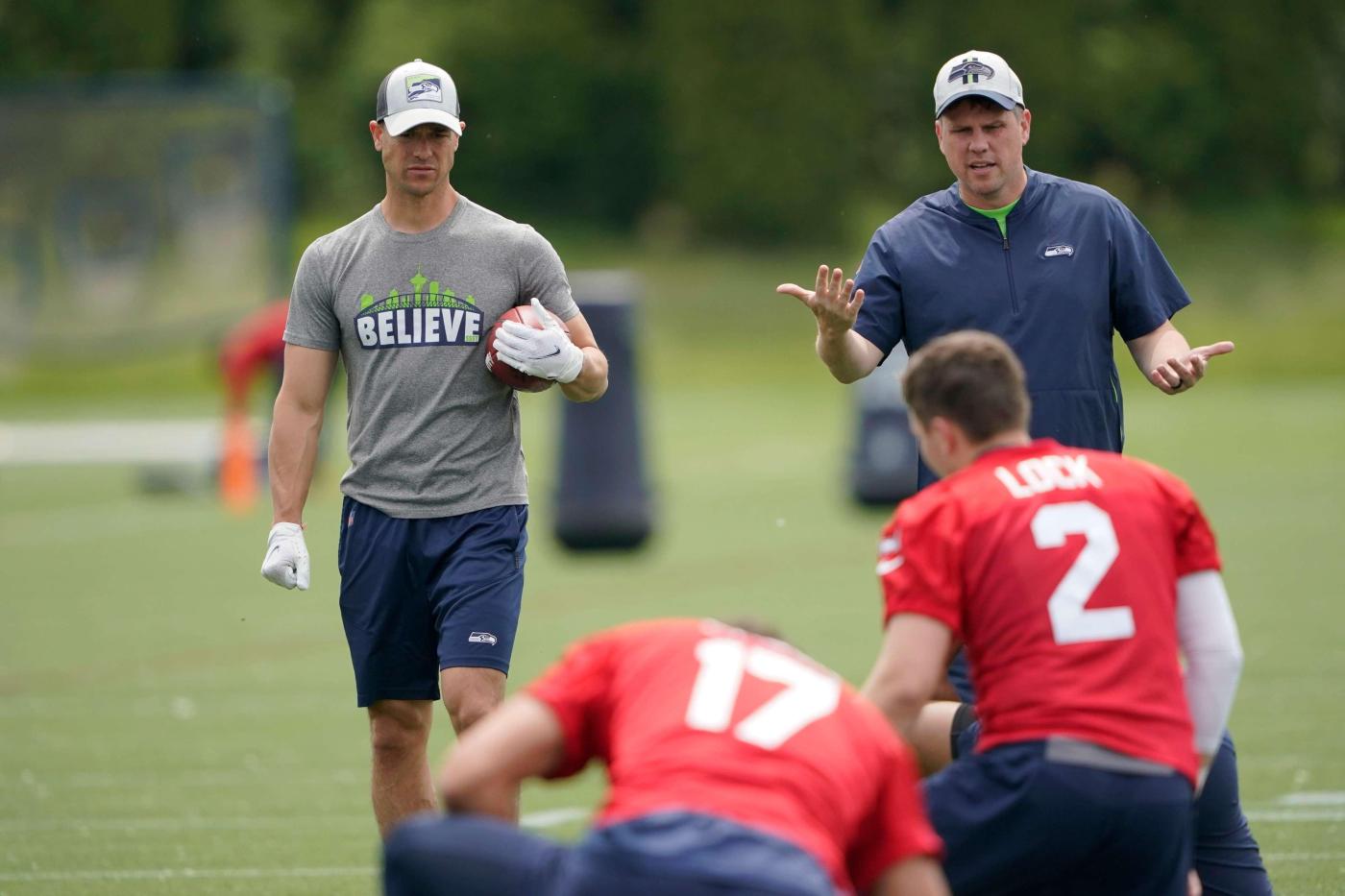
After kicking a field goal two possessions earlier, the Seahawks had life but faced a pressure-packed challenge against a quality opponent in the late stages of a “gotta have it” game. On the sideline at Lumen Field, offensive coordinator Shane Waldron grabbed quarterback Drew Lock — an emergency starter that night due to Geno Smith’s groin injury — and went to work.

It was showtime in Seattle for a 6-7, playoff-contending team in need of a big moment on the “Monday Night Football” stage.

The ensuing drive began with an incompletion — a Lock bullet over the middle that ricocheted off tight end Noah Fant’s hands and almost was intercepted. Over the next nine snaps, there were a few other near-disasters too. But the series also included five Lock completions, including a third-and-10 shot play up the right sideline to DK Metcalf for 34 yards.

Then, in the moment of truth, facing another third-and-long from the Eagles 29, Lock identified rookie Jaxon Smith-Njigba in single coverage, had the ideal play call from Waldron and dropped a game-winning bomb into the end zone with 28 seconds remaining.

Seahawks 20, Eagles 17.

That was a relatively small moment folded into a disappointing season for the Seahawks. But for all involved, it was a game-on-the-line triumph and represented the kind of resilient, poised and fearless football Waldron wants his unit to play.

Six days later, with Smith back at quarterback, Waldron put his fingerprints on another game-winning touchdown drive that ended in the final minute, this time a grinding, 14-play, 75-yard march that finished with Smith’s 5-yard pass to Colby Parkinson in a 20-17 road win over the Tennessee Titans.

That marked the second time in NFL history — and the first since 1999 — a team had two quarterbacks throw game-winning touchdown passes in the final minute of regulation in consecutive weeks. And it provided added evidence of Waldron’s ability to adapt and set up his players for success in the critical stages of games.

The Chicago Bears hope to lean into those skills and many more with Waldron as their new offensive coordinator. That union became official Tuesday. Waldron, 44, will begin the next leg of his football journey at a potentially landmark time in Bears history.

He will be the offensive visionary tasked with fueling the team’s championship pursuit while bringing out the best in whichever quarterback(s) the Bears choose to lead them into 2024 and beyond.

Waldron also will walk into an offensive coordinator’s office at Halas Hall where — with the exception of Adam Gase — the inhabitants almost always leave through a trap door rather than on an up escalator.

The pursuit of consistency

Within league circles, Waldron is regarded as an up-and-coming offensive architect, an intelligent and creative coach with strong teaching skills. His work with Smith in Seattle in 2022 is particularly notable as the once-forgotten quarterback enjoyed a career year (4,282 passing yards, 30 TDs) on the way to earning Pro Bowl honors and the league’s Comeback Player of the Year award.

Waldron has worked under some of the sport’s coaching greats — Bill Belichick with the New England Patriots (2008-09), Sean McVay with the Los Angeles Rams (2017-20) and Pete Carroll for the last three seasons in Seattle.

He was the Rams passing game coordinator for three seasons and Jared Goff’s quarterbacks coach in 2019. He spent one season with Russell Wilson in Seattle before preparing Smith to be a productive starter for a playoff team in 2022.

When it comes time for the Bears to formally introduce Waldron, he likely will detail three key tenets within his offensive philosophy. Ball security is a must. Fundamentals require a daily investment to stay sharp. Buy-in from the entire group will be the blowtorch that ignites everything.

Waldron likely will talk often about being committed to the pursuit of consistency. He strives for balance in his offense, wanting to establish a strong running game while embracing an attacking mentality when explosive-play opportunities present themselves.

And as was the case in those two late comeback victories last month, Waldron surely wants the identity of his offense to include composure, determination and high-level mental toughness.

As a play caller, he will have to connect on a heightened level with his quarterback, striving to consistently bring out the best in whomever that turns out to be.

The presumption is, at the very least, he will be afforded input as his new bosses at Halas Hall work to solve that riddle in the coming weeks and months. That work will include both pre-draft homework and in-house discussions on the developmental progress of Justin Fields.

Fit process

Like with any coaching hire, it’s easy to gravitate first to feelings of hope, to the optimistic visions of the significant improvements that can catalyze a meaningful breakthrough. Waldron’s experience calling plays was a definite plus for the Bears. For general manager Ryan Poles and coach Matt Eberflus, that removes a chunk of the guesswork that comes with trying to forecast how he might handle those duties in Chicago and what kind of productivity they can expect.

Still, Eberflus and Poles are less than two years removed from hiring their last offensive coordinator — the January 2022 union with Luke Getsy that triggered significant excitement at Halas Hall.

Like Waldron, Getsy was hailed as a rising, young offensive coach with high intelligence, proven teaching skills and impressive creativity. He had been with the Green Bay Packers for six of the previous seven seasons, including three working under Matt LaFleur in a Kyle Shanahan/McVay-style offense. Getsy was endorsed by those who knew him best — players and coaches — as a strong communicator, steadying leader and sincere, relatable team builder.

He had been Aaron Rodgers’ quarterbacks coach for MVP seasons in 2020 and 2021 and, while serving as Mike McCarthy’s receivers coach in 2016 and 2017, had been credited by Davante Adams as influential in his breakthrough.

“He’s been on my radar for a while,” Eberflus said after hiring Getsy, later emphasizing his attraction to the timing-based, quick-decision passing attack Getsy was likely to bring.

For the next two seasons, Getsy was regarded as an imaginative football mind with strong collaborative skills and a comprehensive understanding of all the moving parts within an offense. But the Bears, under his guidance, also had significant inconsistency issues, and the desired breakthrough for Fields never reached the level the team hoped.

All the positive traits the Bears identified in Getsy didn’t mean enough when his offense too frequently found itself sputtering.

Fields worked his hardest to master a system that was not ideal for him. Getsy’s troubleshooting efforts sometimes steered Fields away from concepts and plays he was most comfortable with.

It became a frustrating square dance. The quarterback was frequently adjusting to the play caller. The play caller was adjusting to the quarterback. The offense, in turn, was adjusting, readjusting, then adjusting yet again for large chunks of two seasons, impeding the opportunity to build momentum or expand, particularly in the passing game.

It was a fit issue. A significant one. And it’s a lesson Eberflus and Poles must learn as they try to set up Waldron for success.

Waldron’s experience and adaptive qualities should help. But with the Bears potentially at a pivot point at quarterback, striving to marry the offensive vision with the personnel must remain a priority as well.

For whatever it’s worth, Waldron’s Seahawks ranked behind the Bears this season in total offense, first downs, touchdowns, third-down conversion percentage and red-zone efficiency. They also had a bottom-five rushing attack.

Waldron must find ways to make his next offense much more potent. Whatever it takes. He must have solutions and ideas for maximizing his quarterback’s gifts while also playing to the strengths of the supporting cast.

And when the pressure rises? When the Bears reach those critical stages of close games? Waldron will be expected to consistently be at his best, bringing out the best in every player in his offense.

The Bears, naturally, are hopeful for what’s ahead. Ultimately, the results Waldron produces and his ability to help the team’s quarterback(s) shine will define his time in Chicago.

()