By Christine Spolar | KFF Health News (TNS)
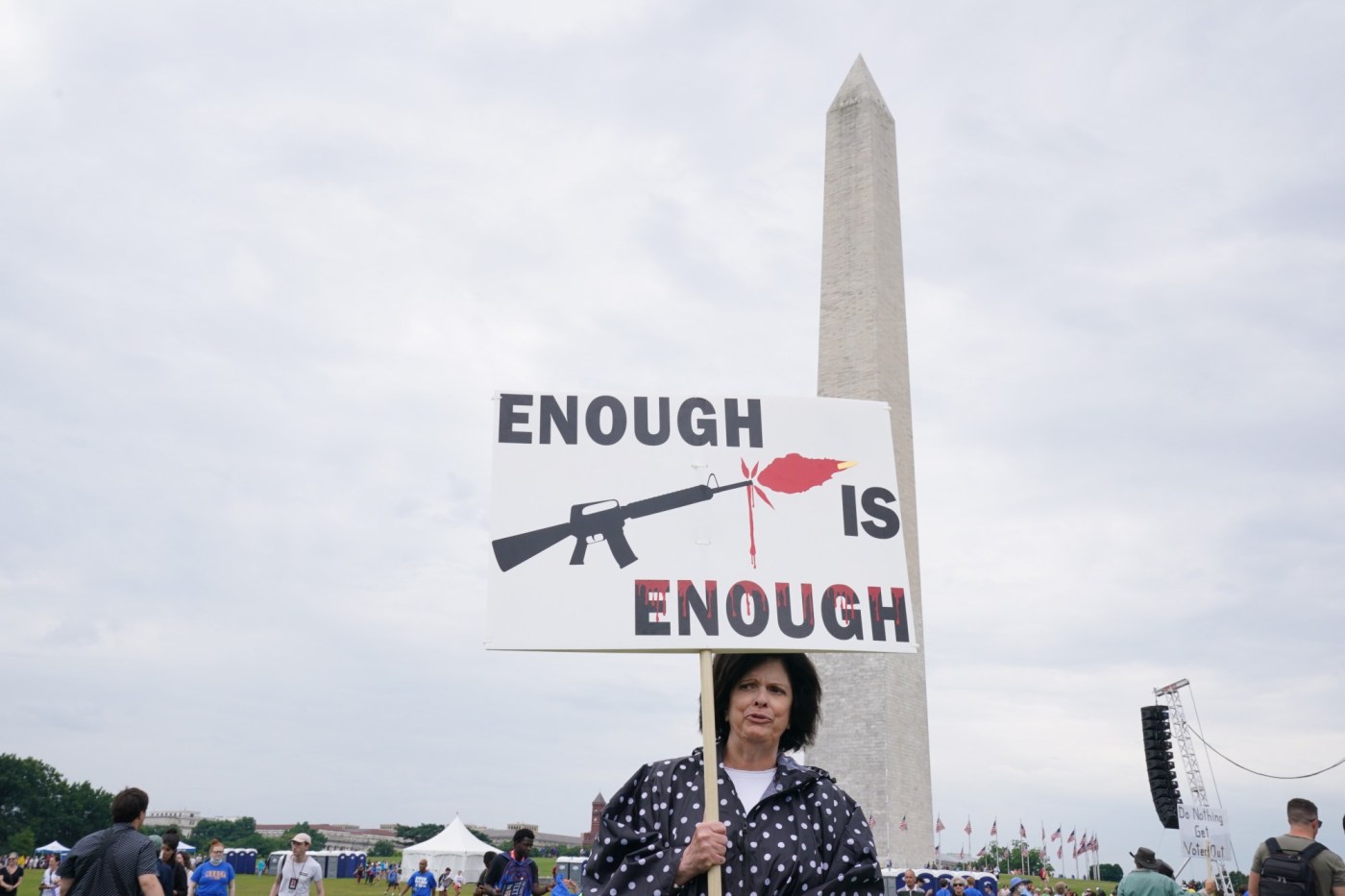
Gun violence has exploded across the U.S. in recent years — from mass shootings at concerts and supermarkets to school fights settled with a bullet after the last bell.
Nearly every day of 2024 so far has brought more violence. On Feb. 14, gunfire broke out at the Super Bowl parade in Kansas City, killing one woman and injuring 22 others. Most events draw little attention — while the injuries and toll pile up.
Gun violence is among America’s most deadly and costly public health crises. But unlike other big killers — diseases like cancer and HIV or dangers like automobile crashes and cigarettes — sparse federal money goes to studying gun violence or preventing it.
That’s because of a one-sentence amendment tucked into the 1996 congressional budget bill: “None of the funds made available for injury prevention and control at the Centers for Disease Control and Prevention may be used to advocate or promote gun control.”
Its author was Jay Dickey, an Arkansas Republican who called himself the “point man” for the National Rifle Association on Capitol Hill. And for nearly 25 years the amendment was perceived as a threat and all but paralyzed the CDC’s support and study of gun violence.
Even so, a small group of academics have toiled to document how gun violence courses through American communities with vast and tragic outcomes. Their research provides some light as officials and communities develop policies mostly in the dark. It has also inspired a fresh generation of researchers to enter the field — people who grew up with mass shootings and are now determined to investigate harm from firearms. There is momentum now, in a time of rising gun injury and death, to know more.
The reality is stark:
Gun sales reached record levels in 2019 and 2020. Shootings soared. In 2021, for the second year, more people died from gun incidents — 48,830 — than in any year on record, according to a Johns Hopkins University analysis of CDC data. Guns became the leading cause of death for children and teens. Suicides accounted for more than half of those deaths, and homicides were linked to 4 in 10.
Black people are nearly 14 times as likely to die from firearm violence as white people — and guns were responsible for half of all deaths of Black teens ages 15 to 19 in 2021, the data showed.
Harvard research published in JAMA in 2022 estimated gun injuries translate into economic losses of $557 billion annually, or 2.6% of the U.S. gross domestic product.
With gun violence touching nearly every corner of the country, surveys show that Americans — whatever their political affiliation or whether they own guns or not — support policies that could reduce violence.
What Could Have Been
It is no secret that many strategies proposed today — from school metal detectors to enhanced policing, to the optimal timing and manner of safely storing guns, to restrictions on gun sales — have limited scientific ballast because of a lack of data.
It could have been otherwise.
U.S. firearm production surged in the late 1980s, flooding communities with more than 200 million weapons. In that era, Mark Rosenberg was the founding director of the CDC’s National Center for Injury Prevention and Control and his agency, over time, was pivotal in helping to fund research on gun violence and public health.
Rosenberg thought then that gun violence could go the way of car crashes. The federal government spent $200 million a year on research to redesign roadways and cars beginning in the 1970s, he said, and had seen death rates plummeted.
“We said, ‘Why can’t we do this with gun violence?’” Rosenberg said. “They figured out how to get rid of car crashes — but not cars. Why can’t we do the same thing when it comes to guns?”
The Dickey Amendment sidelined that dream.
A study published in 1993 concluded that “guns kept in the home are associated with an increase in the risk of homicide,” a finding on risk factors that prompted an uproar in conservative political circles. To newly elected representatives in the midterm “Republican Revolution” of 1994, the research was a swipe at gun rights. The NRA stepped up lobbying, and Congress passed what’s known as the Dickey Amendment in 1996.
Some Democrats, such as the influential John Dingell of Michigan (a onetime NRA board member who received the group’s “legislative achievement award”), would join the cause. Dingell proposed his own bills, detailed last summer by The New York Times.
Under heavy political pressure, the CDC ousted Rosenberg in 1999. Soon after, some CDC administrators began alerting the NRA to research before publication.
“It was clearly related to the work we were doing on gun violence prevention,” Rosenberg, now 78, said of his job loss. “It was a shock.”
Those Who Persevered
The quarter-century spending gap has left a paucity of data about the scope of gun violence’s health effects: Who is shot and why? What motivates the violence? With what guns? What are the injuries? Can suicides, on the rise from gunfire, be reduced or prevented with safeguards? Does drug and alcohol use increase the chances of harm? Could gun safeguards reduce domestic violence? Ultimately, what works and what does not to prevent shootings?
If researchers say they “lost a generation” of knowledge about gun violence, then American families lost even more, with millions of lives cut short and a legacy of trauma passed down through generations.
Imagine if cancer research had been halted in 1996 — many tumors that are now eminently treatable might still be lethal. “It’s like cancer,” said Rebecca Cunningham, vice president for research at the University of Michigan, an academic who has kept the thread of gun research going all these years. “There may be 50 kinds of cancer, and there are preventions for all of them. Firearm violence has many different routes, and it will require different kinds of science and approaches.”
Cunningham is one of a small group of like-minded researchers, from universities across the United States, who refused to let go of investigating a growing public health risk, and they pushed ahead without government funds.
Garen Wintemute has spent about $2.45 million of his money to support seminal research at the University of California-Davis. With state and private funding, he created a violence prevention program in California, a leader in firearm studies. He has documented an unprecedented increase in gun sales since 2020 — about 15 million transactions more than expected based on previous sales data.
Daniel Webster at Johns Hopkins University focused on teenagers and guns — particularly access and suicides — and found that local police who coped with gun risks daily were willing to collaborate. He secured grants, even from the CDC, with carefully phrased proposals that avoided the word “guns,” to study community violence.
At Duke University, Philip J. Cook explored the underground gun market, interviewing people incarcerated in Chicago jails and compiling pivotal social science research on how guns are bought, sold, and traded.
David Hemenway, an economist and public policy professor at Harvard, worked on the national pilot to document violent deaths — knowing most gun deaths would be recorded that way — because, he said, “if you don’t have good data, you don’t have nothin’.”
Hemenway, writing in the journal Nature in 2017, found a 30% rise in gun suicides over the preceding decade and nearly a 20% rise in gun murders from 2014 to 2015. The data was alarming and so was the lack of preventive know-how, he wrote. “The US government, at the behest of the gun lobby, limits the collection of data, prevents researchers from obtaining much of the data that are collected and severely restricts the funds available for research on guns,” he wrote. “Policymakers are essentially flying blind.”
His work helped create the most ambitious database of U.S. gun deaths today — the National Violent Death Reporting System. Funded in 1999 by private foundations, researchers were able to start understanding gun deaths by compiling data on all violent deaths from health department, police, and crime records in several states. The CDC took over the system and eventually rolled in data from all 50 states.
Still, no federal database of nonfatal gun injuries exists. So the government would record one death from the Super Bowl parade shooting, and the 22 people with injuries remain uncounted — along with many thousands of others over decades.
Philanthropy has supported research that Congress would not. The Joyce Foundation in Chicago funded the bulk of the grants, with more than $33 million since the 1990s. Arnold Ventures’ philanthropy and the Robert Wood Johnson Foundation have added millions more, as has Michael Bloomberg, the politician and media company owner. The Rand Corp., which keeps a tab of ongoing research, finds states increasingly are stepping up.
Timothy Daly, a Joyce Foundation program director, said he remembers when the field of gun harm was described by some as a “desert.” “There was no federal funding. There was slim private funding,” he said. “Young people would ask themselves: ‘Why would I go into that?’”
Research published in JAMA in 2017 found gun violence “was the least-researched” among leading causes of death. Looking at mortality rates over a decade, gun violence killed about as many people as sepsis, the data showed. If funded at the same rate, gun violence would have been expected to receive $1.4 billion in research funds. Instead, it received $22 million from across all U.S. government agencies.
There is no way to know what the firearm mortality or injury rate would be today had there been more federal support for strategies to contain it.
A Reckoning
As gun violence escalated to once unthinkable levels, Rep. Dickey came to regret his role in stanching research and became friends with Rosenberg. They wrote a pivotal Washington Post op-ed about the need for gun injury prevention studies. In 2016, they delivered a letter supporting the creation of the California Firearm Violence Research Center.
Both men, they emphasized, were NRA members and agreed on two principles: “One goal must be to protect the Second-Amendment rights of law-abiding gun owners; the other goal, to reduce gun violence.”
Dickey died in 2017, and Rosenberg has only kind words for him. “I did not blame Jay at all for what happened,” he said. The CDC was “under pressure from Congress to get rid of our gun research.”
As alarm over gun fatality statistics from diverse sectors of the nation — scientists, politicians, and law enforcement — has grown, research in the field is finally gaining a foothold.
Even Congress, noting the Dickey Amendment was not an all-out ban, appropriated $25 million for gun research in late 2019, split between the CDC — whose imperative is to research public health issues — and the National Institutes of Health. It’s a drop in the bucket compared with what was spent on car crashes, and it’s not assured. House Republicans this winter have pushed an amendment to once again cut federal funding for CDC gun research.
Still, it’s a start. With growing interest in the field, the torch has passed to the next generation of researchers.
In November, Cunningham helped organize a national conference on the prevention of firearm-related harm. More than 750 academics and professionals in public health, law, and criminal justice met in Chicago for hundreds of presentations. A similar event in 2019, the first in 20 years, drew just a few dozen presentations.
“You can feel momentum,” Cunningham said at the conference, reflecting on the research underway. “There’s a momentum to propel a whole series of evidence-based change — in the same way we have addressed other health problems.”
During a congressional hearing weeks later, Yale University School of Public Health Dean Megan L. Ranney bluntly described the rising number of gun deaths — noting the overwhelming number of suicides — as an alarm for lawmakers. “We are turning into a nation of traumatized survivors,” she said, urging their support for better data and research on risk factors.
Cassandra Crifasi, 41, was a high school sophomore when the Columbine massacre outside Littleton, Colorado, shook the country. She recently succeeded Webster, her mentor and research partner, as co-director of the Johns Hopkins Center for Gun Violence Solutions.
Crifasi has spent much of her career evaluating risk factors in gun use, including collaborative studies with Baltimore police and the city to reduce violence.
Raised in Washington state, Crifasi said she never considered required training in firearms an affront to the Second Amendment. She owns guns. In her family, which hunted, it was a matter of responsibility.
“We all learned to hunt. There are rules to follow. Maybe we should have everybody who wants to have a gun to do that,” she said.
Crifasi pointed to the 2018 shooting at Marjory Stoneman Douglas High in Parkland, Florida — which left 17 dead and 17 injured — as a turning point. Students and their parents took “a page out of Mothers Against Drunk Driving — showing up, testifying, being in the gallery where laws are made,” she said.
“People started to shift and started to think: This is not a third rail in politics. This is not a third rail in research,” Crifasi said.
Shani Buggs worked in corporate management before she arrived at Johns Hopkins to pursue a master’s in public health. It was summer 2012, and a gunman killed 12 moviegoers at a midnight showing of “The Dark Knight Rises” in Aurora, Colorado. The town’s pain led the national news, and “rightfully so,” Buggs said. “But I was in Baltimore, in East Baltimore, where there were shootings happening that weren’t even consistently making the local news.”
Now violence “that once was considered out of bounds, out of balance — it is more and more common,” said Buggs who recently joined the California Firearm Violence Research Center as a lead investigator.
Buggs’ research has examined anxiety and depression among youths who live in neighborhoods with gun violence — and notes that firearm suicide rates too have drastically increased among Black children and adolescents.
There is a trauma from hearing gunshots and seeing gun injuries, and daily life can be a thrum of risk in vulnerable communities, notably those largely populated by Black and Hispanic people, Buggs said. Last year, Buggs organized the Black and Brown Collective with a core group of about two dozen scientists committed to contextualizing studies on gun violence.
“The people most impacted by the gun violence we usually hear about in America look like our families,” she said of the collective.
“They are not resilient. People are just surviving,” Buggs said. “We need way more money to research and to understand and address the complexity of the problem.”
KFF Health News is a national newsroom that produces in-depth journalism about health issues and is one of the core operating programs at KFF—an independent source of health policy research, polling, and journalism. Learn more about KFF.