America worries about health costs — and voters want to hear from Biden and Republicans

posted in: News | 0

Julie Appleby and Phil Galewitz | KFF Health News (TNS)

President Joe Biden is counting on outrage over abortion restrictions to help drive turnout for his reelection. Former President Donald Trump is promising to take another swing at repealing Obamacare.

But around America’s kitchen tables, those are hardly the only health topics voters want to hear about in the 2024 campaigns. A new KFF tracking poll shows that health care tops the list of basic expenses Americans worry about — more than gas, food and rent. Nearly 3 in 4 adults — and majorities of both parties — say they’re concerned about paying for unexpected medical bills and other health costs.

“Absolutely health care is something on my mind,” Rob Werner, 64, of Concord, New Hampshire, said in an interview at a local coffee shop in January. He’s a Biden supporter and said he wants to make sure the Affordable Care Act, also known as Obamacare, is retained and that there’s more of an effort to control health care costs.

The presidential election is likely to turn on the simple question of whether Americans want Trump back in the White House. (Nikki Haley, the former South Carolina governor and U.S. ambassador to the United Nations, remained in the race for the Republican nomination ahead of Super Tuesday, though she had lost the first four primary contests.) And neither major party is basing their campaigns on health care promises.

But in the KFF poll, 80% of adults said they think it’s “very important” to hear presidential candidates talk about what they’d do to address health care costs — a subject congressional and state-level candidates can also expect to address.

“People are most concerned about out-of-pocket expenses for health care, and rightly so,” said Andrea Ducas, vice president of health policy at the Center for American Progress, a Washington, D.C.-based progressive think tank.

Here’s a look at the major health care issues that could help determine who wins in November.

Abortion

Less than two years after the Supreme Court overturned the constitutional right to an abortion, it is shaping up to be the biggest health issue in this election.

That was also the case in the 2022 midterm elections, when many voters rallied behind candidates who supported abortion rights and bolstered Democrats to an unexpectedly strong showing. Since the Supreme Court’s decision, voters in six states— including Kansas, Kentucky, and Ohio, where Republicans control the legislatures — have approved state constitutional amendments protecting abortion access.

Polls show that abortion is a key issue to some voters, said Robert Blendon, a public opinion researcher and professor emeritus at the Harvard T.H. Chan School of Public Health. He said up to 30% across the board see it as a “personal” issue, rather than policy — and most of those support abortion rights.

“That’s a lot of voters, if they show up and vote,” Blendon said.

Proposals to further protect — or restrict — abortion access could drive voter turnout. Advocates are working to put abortion-related measures on the ballot in such states as Arizona, Florida, Missouri, and South Dakota this November. A push in Washington toward a nationwide abortion policy could also draw more voters to the polls, Blendon said.

A surprise ruling by the Alabama Supreme Court in February that frozen embryos are children could also shake up the election. It’s an issue that divides even the anti-abortion community, with some who believe that a fertilized egg is a unique new person deserving of full legal rights and protections, and others believing that discarding unused embryos as part of the in vitro fertilization process is a morally acceptable way for couples to have children.

Pricey Prescriptions

Drug costs regularly rank high among voters’ concerns.

In the latest tracking poll, more than half — 55% — said they were very worried about being able to afford prescription drugs.

Biden has tried to address the price of drugs, though his efforts haven’t registered with many voters. While its name doesn’t suggest landmark health policy, the Inflation Reduction Act, or IRA, which the president signed in August 2022, included a provision allowing Medicare to negotiate prices for some of the most expensive drugs. It also capped total out-of-pocket spending for prescription drugs for all Medicare patients, while capping the price of insulin for those with diabetes at $35 a month — a limit some drugmakers have extended to patients with other kinds of insurance.

Drugmakers are fighting the Medicare price negotiation provision in court. Republicans have promised to repeal the IRA, arguing that forcing drugmakers to negotiate lower prices on drugs for Medicare beneficiaries would amount to price controls and stifle innovation. The party has offered no specific alternative, with the GOP-led House focused primarily on targeting pharmacy benefit managers, the arbitrators who control most Americans’ insurance coverage for medicines.

Costs of Coverage

Health care costs continue to rise for many Americans. The cost of employer-sponsored health plans have hit new highs in the past few months, raising costs for employers and workers alike. Experts have attributed the increase to high demand and expensive prices for certain drugs and treatments, notably weight loss drugs, as well as to medical inflation.

Meanwhile, the ACA is popular. The KFF poll found that more adults want to see the program expanded than scaled back. And a record 21.3 million people signed up for coverage in 2024, about 5 million of them new customers.

Enrollment in Republican-dominated states has grown fastest, with year-over-year increases of 80% in West Virginia, nearly 76% in Louisiana, and 62% in Ohio, according to the Centers for Medicare & Medicaid Services.

Related Articles

Health |


Minnesota native who fixed foot pain with amputation shares journey on TikTok

Health |


Health care workers push for their own confidential mental health treatment

Health |


Post-pandemic vaccine hesitancy fueling latest measles outbreak

Health |


Measles Q&A: Do I need a booster? And other answers

Health |


France becomes the only country to explicitly guarantee abortion as a constitutional right

Public support for Obamacare and record enrollment in its coverage have made it politically perilous for Republicans to pursue the law’s repeal, especially without a robust alternative. That hasn’t stopped Trump from raising that prospect on the campaign trail, though it’s hard to find any other Republican candidate willing to step out on the same limb.

“The more he talks about it, the more other candidates have to start answering for it,” said Jarrett Lewis, a partner at Public Opinion Strategies, a GOP polling firm.

“Will a conversation about repeal-and-replace resonate with suburban women in Maricopa County?” he said, referring to the populous county in Arizona known for being a political bellwether. “I would steer clear of that if I was a candidate.”

Biden and his campaign have pounced on Trump’s talk of repeal. The president has said he wants to make permanent the enhanced premium subsidies he signed into law during the pandemic that are credited with helping to increase enrollment.

Republican advisers generally recommend that their candidates promote “a market-based system that has the consumer much more engaged,” said Lewis, citing short-term insurance plans as an example. “In the minds of Republicans, there is a pool of people that this would benefit. It may not be beneficial for everyone, but attractive to some.”

Biden and his allies have criticized short-term insurance plans — which Trump made more widely available — as “junk insurance” that doesn’t cover care for serious conditions or illnesses.

Entitlements Are Off-Limits

Both Medicaid and Medicare, the government health insurance programs that cover tens of millions of low-income, disabled, and older people, remain broadly popular with voters, said the Democratic pollster Celinda Lake. That makes it unlikely either party would pursue a platform that includes outright cuts to entitlements. But accusing an opponent of wanting to slash Medicare is a common, and often effective, campaign move.

Although Trump has said he wouldn’t cut Medicare spending, Democrats will likely seek to associate him with other Republicans who support constraining the program’s costs. Polls show that most voters oppose reducing any Medicare benefits, including by raising Medicare’s eligibility age from 65. However, raising taxes on people making more than $400,000 a year to shore up Medicare’s finances is one idea that won strong backing in a recent poll by The Associated Press and NORC Center for Public Affairs Research.

Brian Blase, a former Trump health adviser and the president of Paragon Health Institute, said Republicans, if they win more control of the federal government, should seek to lower spending on Medicare Advantage — through which commercial insurers provide benefits — to build on the program’s efficiencies and ensure it costs taxpayers less than the traditional program.

So far, though, Republicans, including Trump, have expressed little interest in such a plan. Some of them are clear-eyed about the perils of running on changing Medicare, which cost $829 billion in 2021 and is projected to consume nearly 18% of the federal budget by 2032.

“It’s difficult to have a frank conversation with voters about the future of the Medicare program,” said Lewis, the GOP pollster. “More often than not, it backfires. That conversation will have to happen right after a major election.”

Addiction Crisis

Many Americans have been touched by the growing opioid epidemic, which killed more than 112,000 people in the United States in 2023 — more than gun deaths and road fatalities combined. Rural residents and white adults are among the hardest hit.

Federal health officials have cited drug overdose deaths as a primary cause of the recent drop in U.S. life expectancy.

Republicans cast addiction as largely a criminal matter, associating it closely with the migration crisis at the U.S. southern border that they blame on Biden. Democrats have sought more funding for treatment and prevention of substance use disorders.

“This affects the family, the neighborhood,” said Blendon, the public opinion researcher.

Billions of dollars have begun to flow to states and local governments from legal settlements with opioid manufacturers and retailers, raising questions about how to best spend that money. But it isn’t clear that the crisis, outside the context of immigration, will emerge as a campaign issue.

(KFF Health News, formerly known as Kaiser Health News (KHN), is a national newsroom that produces in-depth journalism about health issues and is one of the core operating programs of KFF — the independent source for health policy research, polling and journalism.)

©2024 KFF Health News. Distributed by Tribune Content Agency, LLC.

WWII veteran, retired Ramsey County deputy dies weeks after 100th birthday

posted in: News | 0

Herb Gustafson’s family was planning a big celebration for his 100th birthday, but his health rapidly declined after he reached the century milestone. The special menu intended for his party will instead be served at his funeral buffet.

The World War II veteran and retired Ramsey County sheriff’s deputy had been living an active and independent life. Just before his birthday last month, he turned too quickly and fell in his apartment. He died Friday.

After his fall, he underwent surgery for a broken hip. The doctor told the family, “Your dad’s strong, he should do just fine,” said daughter Kristy DuBois. He was determined to get back to living on his own at Applewood Pointe in Woodbury, a senior cooperative where he was a longtime resident.

Up until then, Gustafson woke up at 5 a.m. daily and went to lift weights at Applewood Pointe’s gym.

After surgery for his broken hip, Gustafson was in transitional care. He wasn’t feeling well and wound up back in the hospital, where tests showed cancer.

He’d been diagnosed with lymphoma last fall. He had a tumor removed then and radiation treatment, and the doctor told him the cancer would likely come back in another part of his body. “We didn’t realize it was going to be so soon,” DuBois said.

His family brought him back home to Applewood Pointe in Woodbury last Wednesday on hospice care.

“Once he realized he was home, he started perking up and within half an hour he was telling me to call all these people, they were his card-playing buddies, he said. They just happened to be all the single women in the building,” DuBois said with a chuckle. “So he had a steady stream of women coming through to visit him.”

Gustafson’s family was by his side when he passed away Friday.

Grew up in St. Paul

Gustafson was born Feb. 10, 1924, and grew up in St. Paul. After graduating from Monroe High School, he served in the Army from 1943 to 1946 and was stationed in New Guinea and the Philippines.

He returned to St. Paul, where he worked for the St. Paul school district for 16 years as the storekeeper and buyer for the schools’ trade shops. He was a Ramsey County sheriff’s deputy from 1969 to 1989. And he had a 70-year hobby of photography, winning international awards for his artistic photos.

He and Rose, who Gustafson was married to for 64 years when she died in 2011, raised their four children in St. Paul and later moved to Vadnais Heights.

Gustafson works out in the exercise room at Applewood Pointe on Feb. 6, 2024. (John Autey / Pioneer Press)

“He was very kind and generous, and he just enjoyed life,” DuBois said. “He wanted to stay active. He still had all of his mental faculties, even up until the end. I attribute that to him staying engaged with people and being independent and wanting to have people around him.”

Gustafson’s family had been planning a big birthday party at Applewood Pointe for after his Feb. 10 birthday and, after his Feb. 6 fall, they intended to hold it at a later date.

The menu was to be appetizers from around the world because Rose and Herb Gustafson had traveled extensively.

“Instead of having your typical funeral buffet, I’m going to keep the menu from the party,” DuBois said. “It was something he was looking forward to.”

Funeral arrangements are being finalized. In addition to DuBois, Gustafson is survived by his children, Karen Gustafson, Kathy Bidney and Aric Gustafson, along with his grandchildren and great grandchildren.

Related Articles

Local News |


John Marboe: Remembering a musical soul, Ron Evaniuk

Local News |


Friends and family pay tribute to northwest Minnesota conservation champion

Local News |


Humorously morose comedian Richard Lewis, who recently starred on ‘Curb Your Enthusiasm,’ dies at 76

Local News |


Vietnam vet dies a month after reported assault at Harriet Island Regional Park

Local News |


Obituary: Art Kaemmer, of St. Paul was pediatrician, philanthropist and ‘Alice the Gorilla’

Chicago White Sox manager Pedro Grifol gives an offseason update — including what he recently told starter Dylan Cease

posted in: News | 0

Chicago White Sox players participated in an obstacle course with kids at the Boys & Girls Clubs of Chicago during a surprise visit Thursday in Bridgeport.

The Sox experienced several hurdles last season on the way to 101 losses. They’ll attempt to find the path to improvement with pitchers and catchers scheduled to report to spring training Feb. 14.

Manager Pedro Grifol isn’t thinking about the first game of the season or beyond.

“I’m thinking about the first week of spring training and we’ve got to win that first week,” Grifol said at Thursday’s event. “We’ve got to go into spring training and prepare ourselves to win baseball games. We’ll take it five to seven days at a time and we’ll continue to evaluate the week and correct the things we need to correct and go from there.

“There’s a lot of work to be done before that first game. There’s a lot of conversations between our staff and the players and we’ll be ready to play come day one.”

There have been pitching and hitting summits since the final out of the woeful 2023 season.

“Once that last game was over, the calendar changed for us,” Grifol said. “There’s been really good communication. (General manager) Chris (Getz) installed the pillars he wants the organization to abide by. I’ll have my style of play I want to see on the field and the players will be a part of the process.

“There is a lot of things that are different (this spring compared to last). The energy in spring training I thought last year was OK, but it’s hard to evaluate it because we had so many guys who weren’t there (with the World Baseball Classic taking place). But that’s something we’re going to focus on, the details are something we’re going to focus on.”

Grifol knows it has to be more than just talk.

“When I put myself in the eyes of the fans, we’ve got to prove it on the field,” he said. “I can stand here today and say, ‘We’re going to do this or do that.’ That’s not what this is about. This is about us preparing ourselves to play and prove to our fans — they had a difficult year last year — that we’re going to come out and play a different style of baseball.”

Grifol said he’s most excited about getting to spring training “because the energy we have, that our players are showing, the energy that our front office and coaching staff is showing. We have five new coaches on our staff. And plus what we did last year. We’re motivated, we’re excited to come back and prove to this league that we’re capable of doing some good things. I just feel it, there is a good vibe.”

Grifol likes the moves the team has made this offseason and anticipates a lot of competition at camp.

“Last year we went into spring training probably six or seven starters deep, this year you’re probably looking at 15-16 starters,” he said. “Some of these guys are young, some ended the year in Double A, some in Triple A. Just to look at our depth compared to where we were at this time last year is really encouraging for us.”

One of those experienced starters could be Dylan Cease, who has been mentioned in trade speculation throughout the offseason. Grifol said Cease has been “unfazed” by the chatter.

“I talked to him yesterday, it was a great conversation and we talked about him (pitching) opening day,” Grifol said. “And he’s preparing himself for that and he feels great. He’s throwing pens, he doesn’t have any soreness, he’s excited about this club. He’s excited about the guys we’ve acquired, excited about our catching. Brian Bannister is part of the organization (as senior adviser to pitching), he’s excited to get to work with him and (pitching coach) Ethan (Katz).

“He’s unfazed by all these trade talks and all this stuff. If it happens, he understands the business. But like I told him and he told me, right now he’s our opening-day starter and get ready to do that.”

()

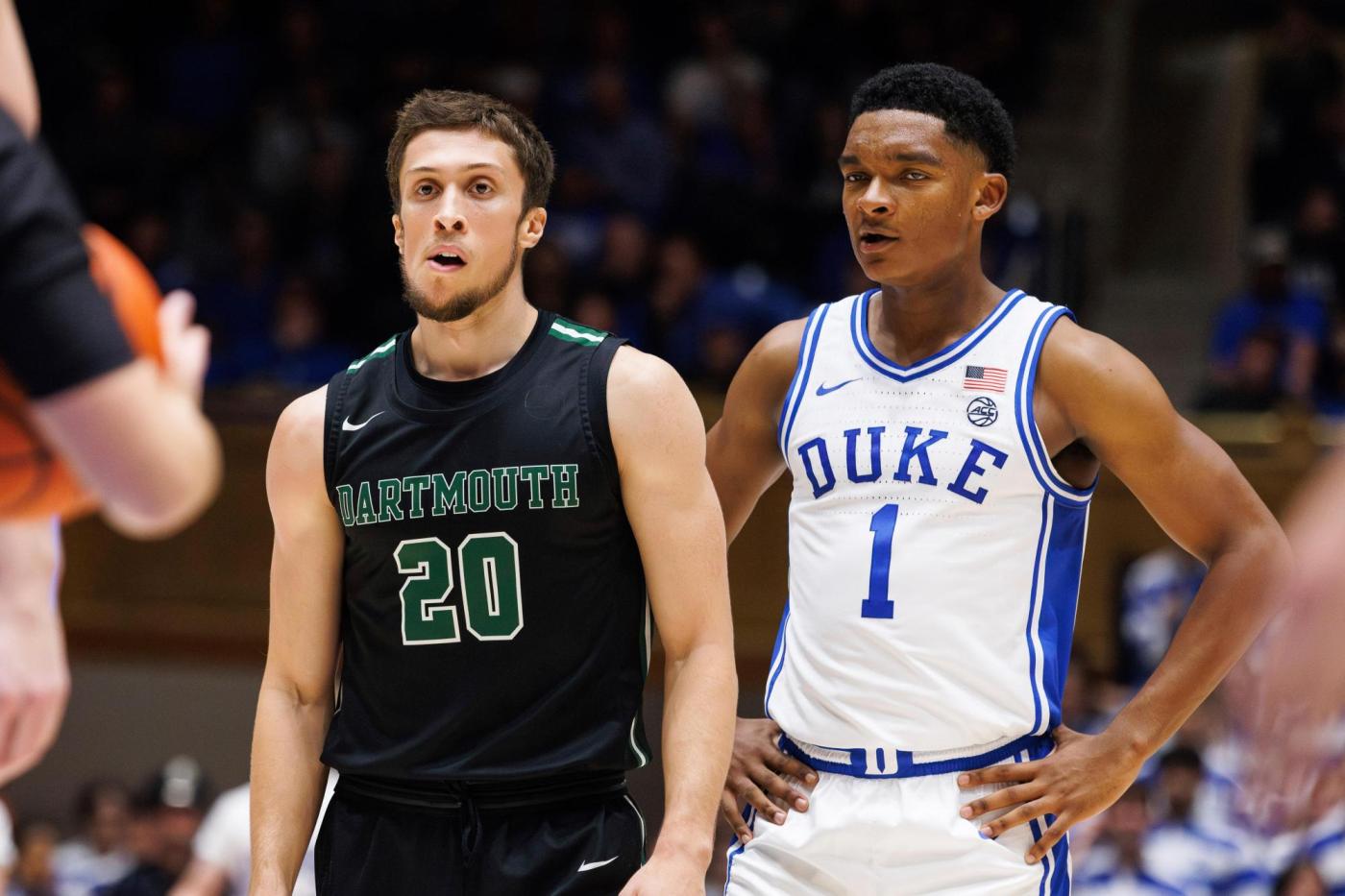
Dartmouth men’s basketball team votes to unionize, though steps remain before forming labor union

posted in: News | 0

By JIMMY GOLEN (AP Sports Writer)

HANOVER, N.H. (AP) — The Dartmouth men’s basketball team voted to unionize Tuesday in an unprecedented step toward forming the first labor union for college athletes and another attack on the NCAA’s deteriorating amateur business model.

In an election supervised by the National Labor Relations Board in the school’s Human Resources offices, the players voted 13-2 to join Service Employees International Union Local 560, which already represents some Dartmouth workers. Every player on the roster participated.

“Today is a big day for our team,” players Cade Haskins and Romeo Myrthil said in a statement. “We stuck together all season and won this election. It is self-evident that we, as students, can also be both campus workers and union members. Dartmouth seems to be stuck in the past. It’s time for the age of amateurism to end.”

The school has five business days to file an objection to the NLRB and could also take the matter to federal court. That could delay negotiations over a collective bargaining agreement until long after the current members of the basketball team have graduated.

Dartmouth pushed back on the decision — again — in a statement, saying it was supportive of the five unions it negotiates with on campus, including SEIU Local 560.

“In this isolated circumstance, however, the students on the men’s basketball team are not in any way employed by Dartmouth,” the school said. “For Ivy League students who are varsity athletes, academics are of primary importance, and athletic pursuit is part of the educational experience. Classifying these students as employees simply because they play basketball is as unprecedented as it is inaccurate. We, therefore, do not believe unionization is appropriate.”

Although the NCAA has long maintained that its players are “student-athletes” who were in school primarily to study, college sports has grown into a multibillion-dollar industry that richly rewards coaches and schools while the players remained unpaid amateurs.

Recent court decisions have chipped away at that framework, with players now allowed to profit off their name, image and likeness and earn a still-limited stipend for living expenses beyond the cost of attendance. Last month’s decision by an NLRB that the Big Green players are employees of the school, with the right to form a union, threatens to upend the amateur model.

“We will continue to talk to other athletes at Dartmouth and throughout the Ivy League about forming unions and working together to advocate for athletes’ rights and well-being,” Haskins and Myrthil said.

A college athletes union would be unprecedented in American sports. A previous attempt to unionize the Northwestern football team failed because the teams Wildcats play in the Big Ten, which includes public schools that aren’t under the jurisdiction of the NLRB.

That’s why one of the NCAA’s biggest threats isn’t coming in one of the big-money football programs like Alabama or Michigan, which are largely indistinguishable from professional sports teams. Instead, it is the academically oriented Ivy League, where players don’t receive athletic scholarships, teams play in sparsely filled gymnasiums and the games are streamed online instead of broadcast on network TV.

Myrthil and Haskins have said they would like to form an Ivy League Players Association that would include athletes from other sports on campus and other schools in the conference. They said they understood that change could come too late to benefit them and their current teammates.

The team includes four seniors, five juniors, three sophomores and three freshman.

“We have teammates here that we all love and support,” Myrthil said after playing at Harvard last month in the Big Green’s first game after the NLRB official’s ruling. “And whoever comes into the Dartmouth family is part of our family. So, we’ll support them as much as we can.”

Mary Kay Henry, the international president of the SEIU, said the players “will go down as one of the greatest basketball teams in all of history.”

“The Ivy League is where the whole scandalous model of nearly free labor in college sports was born and that is where it is going to die,” she said.

___

Jimmy Golen covers sports and the law for The Associated Press.

___

AP college basketball: https://apnews.com/hub/ap-top-25-college-basketball-poll and https://apnews.com/hub/college-basketball