Small Bites review: Hearty food, good prices, late hours make Smorgie’s an ideal across-from-the-X restaurant

posted in: Society | 0

Tater tot hotdish is shown with other dishes at Smorgie’s, a new affordable comfort food restaurant across from the Xcel Energy Center, on Feb. 20, 2024. The restaurant is open till 1 a.m. daily. (Jared Kaufman / Pioneer Press)

Do you still remember the word that knocked you out of your elementary school spelling bee?

I sure do. Curse you, “smorgasbord!”

I love what the word refers to, of course — a full buffet table, or, more generally, a wide variety of something — and, after my onstage embarrassment, I’ll never spell it incorrectly ever again.

But I think I would’ve had more luck back then if I could’ve just spelled Smorgie’s, the name of a new comfort-food restaurant downtown by the Xcel Energy Center.

Unlike its longer namesake, Smorgie’s won’t hurt your 5th-grade ego — nor your present-day wallet.

Every item on the menu, from drinks to apps to entrees, is less than $15. And it rocks.

Beer and wine options average out at about $7 a pop and cocktails run $8–$12, with a great two-for-one deal on rail drinks, house wines and tap beers during daily happy hour. The raspberry island iced tea ($12), a tart twist on the classic long island, is particularly good, quite large and plenty strong.

A variety of dishes including onion rings, tater tot hotdish, chili mac, and a “church basement bar” are shown Feb. 20, 2024, at Smorgie’s. The restaurant, which serves affordable comfort food, recently opened on West 7th Street. (Jared Kaufman / Pioneer Press)

The food menu leans heavily into classic up-north potluck staples, from sloppy joes to Swedish meatballs. I’ll be back to try the double smashburger and fried chicken sandwiches soon, but for my first visit, it only felt fair to start with a classic: Tater tot hotdish ($12).

A layer of broiled cheese on top just tickled me, and the actual hotdish under the tots had the exact ultra-savory cream-of-mushroom-soup quality I was looking for. Not too salty, either. I know some moms who might say Smorgie’s hotdish is skimpy on veggies, but who eats tater tot hotdish for the veggies?

The chili mac ($11), aka a layer of beef and bean chili topped with a layer of macaroni and cheese, wasn’t too bad, either. They used shredded rather than ground beef, which made for a good textural pairing with the noodles.

I probably wouldn’t eat a bowl of the chili alone — it was surprisingly thick and had a slight tinny flavor, which I imagine was due either to an overlong cook time or too much tomato paste, or both — but it was well-spiced and beefy, for sure.

The portion sizes initially struck me as a bit smaller than what other similar restaurants might offer, but the food is heavy, after all. You’ll leave satiated but not weighed down, nor will you have to lug a to-go box of leftovers to the concert or Wild game. (Plus, many restaurants’ portion sizes are too big, anyway!)

Appetizers range from State Fair (pickle fries; mini corn dogs) to, well, a bit less State Fair (smoked salmon dip). The house Smorgie’s sauce, which comes with the onion rings ($8) and the pickle fries and tops the burger, too, is quite tasty. Took me by surprise.

And for $4, you can end the night with a “church basement bar” in caramel apple streusel, raspberry streusel, pecan caramel or peanut butter cup varieties. They’re big, too: I didn’t have a tape measure with me, but I’d estimate my delightful apple pastry was about three tater tots by three tater tots, the long way.

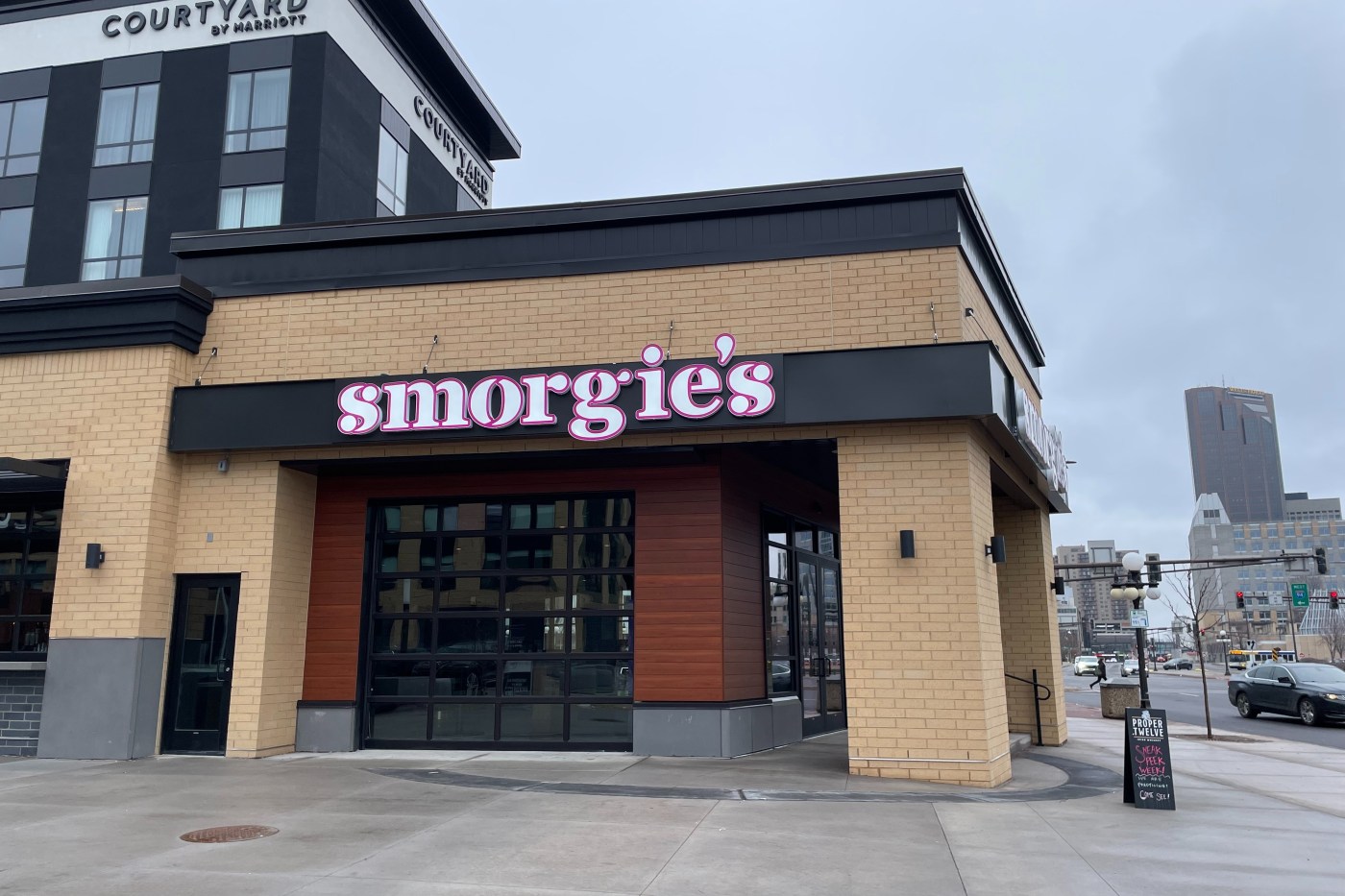
The space itself, on the ground floor of the new Courtyard by Marriott, was initially built for a spring break-themed restaurant from the owner of the nearby Apostle Supper Club. That project didn’t pan out.

Now, as Smorgie’s, the decor is fun and trendy and completely incongruent. A smorgasbord of vibes, I suppose you could say. In one corner: floral wallpaper; tables with rope-swing benches for seats. In another area: soft pink plaid wallpaper; a red vinyl couch; vintage-esque frames and mirrors. Why not? There are regular booths and high tops, too.

Smorgie’s is not revelatory. It’s probably not going to be the best you’ve ever had. Plenty of other spots in St. Paul are taking care of boundary-pushing, and they’re doing so quite creatively.

The exterior of Smorgie’s, in the Courtyard by Marriot across from the Xcel Energy Center in downtown St. Paul. (Jess Fleming / Pioneer Press)

No, Smorgie’s is an ideal across-from-the-X restaurant. They’re here to fill you up with food and beverages that make you happy and don’t cost too much — till 1 a.m. every single day.

On a recent visit, for example, the total bill for drinks, an appetizer, a pair of entrees and dessert: $64.39. (Which, I think, is the cost of one cocktail over at the X.)

Part of how they achieve this, I suspect, is by reducing staff. Diners seat themselves, and ordering is automated via QR code. At about 6:45 p.m. during that weeknight visit, there appeared to be one employee working the floor: bartending, running orders, bussing tables. She looked a bit stressed. I would be, too.

So still tip well, please — lest you have a smorgasbord (part of speech: noun; language of origin: Swedish) of bad karma come your way.

Smorgie’s

Where: 127 W. 7th Street, across from the Xcel Energy Center.

Hours: Open 11 a.m. to 1 a.m. daily.

Contact: smorgiesbar.com

Prices: Appetizers/snacks range from $8–$10; mains (salads, sandwiches, comfort food dishes) run $8–$14, with most costing $10, $11 or $12 apiece. Desserts are $4; drinks range from $6 to $12.

Reservations: Not accepted; walk-ins only.

Good to know: You can submit your own favorite comfort food recipe to the restaurant — and if they like it, they’ll feature it on the menu for a month.

Small Bites are first glances — not intended as definitive reviews — of new or changed restaurants.

Column: New QBs coach Kerry Joseph says ‘it’s about trust’ with the Chicago Bears QB — whoever that ends up being

posted in: News | 0

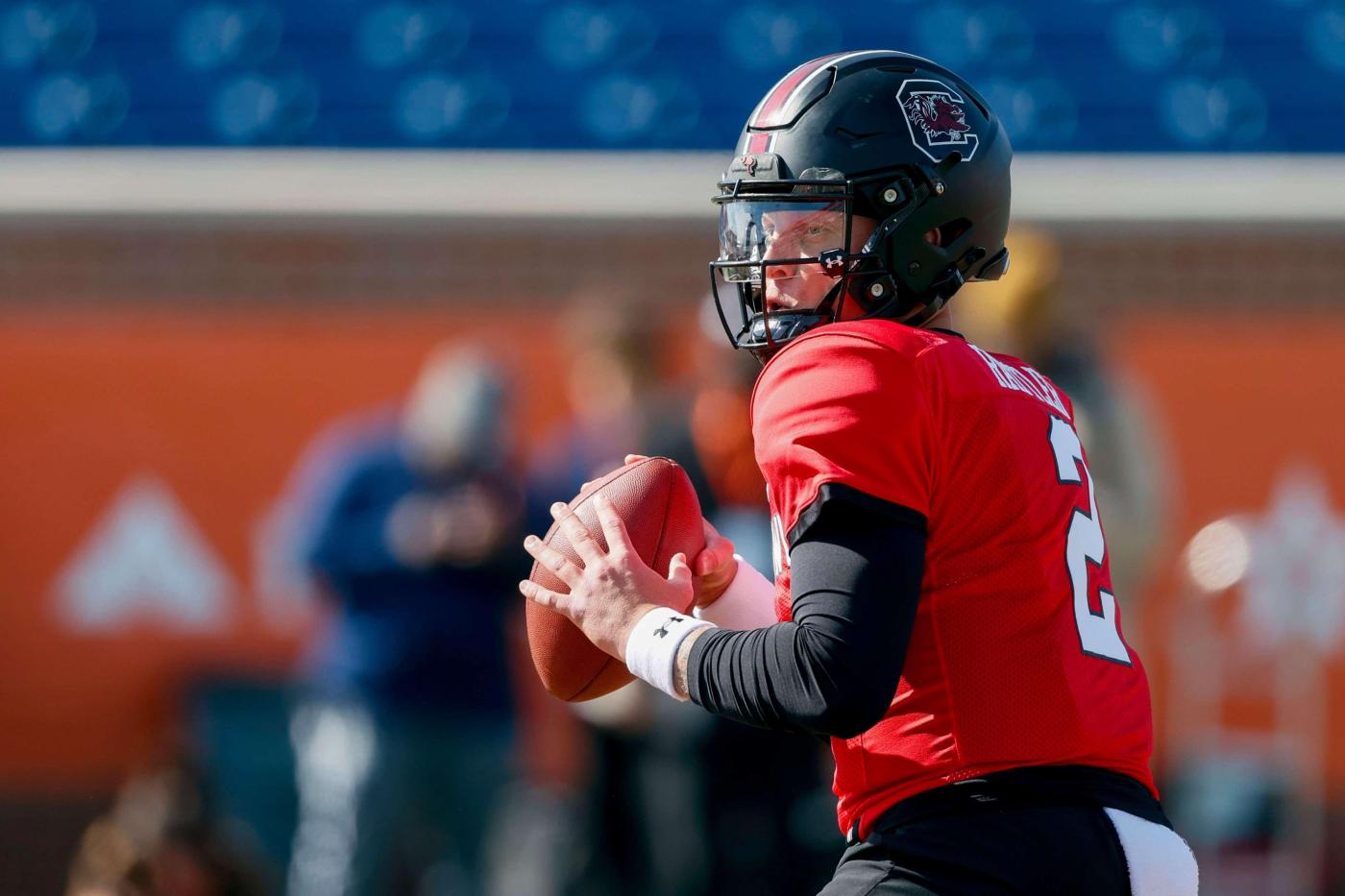
MOBILE, Ala. — Kerry Joseph doesn’t have any thoughts yet on the Chicago Bears’ biggest offseason decision, the one that holds the key to the NFL draft.

The team’s new quarterbacks coach, hired Friday, doesn’t even know where his office is at Halas Hall. He has been on a whirlwind tour since the season ended, free to seek a new job after the Seattle Seahawks forced out coach Pete Carroll.

Joseph, the assistant quarterbacks coach for the Seahawks the last two seasons, spent one day in Lake Forest interviewing for the Bears job. In between, he was scrambling to get to Mobile, where he’s serving as quarterbacks coach of the American team in the Senior Bowl.

Somehow along the way, Joseph got hooked up with Bears gear and was wearing a team-issued navy hat, navy shorts and gray sweatshirt at practice Tuesday at Hancock Whitney Stadium on the South Alabama campus.

He doesn’t have preliminary thoughts on Justin Fields. Joseph was the assistant wide receivers coach in Seattle in 2021, when the Bears drafted Fields. He has yet to dig in on this year’s draft, in which the Bears hold the first and ninth picks and are in position to select a new quarterback.

“I was getting transitioned to coming out here,” the 50-year-old Joseph said.

It’s the first time he has been an NFL position coach — above the assistant position coach level. The connection is easy to make. He worked with new Bears offensive coordinator Shane Waldron, who came from the Seahawks. The Bears also interviewed Seahawks quarterbacks coach Greg Olson for the offensive coordinator job.

The last first-time quarterbacks coach the Bears hired was Shane Day in 2010 based on his experience working with then-offensive coordinator Mike Martz in San Francisco. Since Day, the Bears have rolled through Jeremy Bates, Matt Cavanaugh, Dowell Loggains, Dave Ragone, John DeFilippo and most recently Andrew Janocko.

It would be overly dramatic to say this is the most important offseason for a Bears quarterbacks coach. There has been urgency to get the position right for the longest time. It just so happens they own the No. 1 draft pick as they prepare to thoroughly examine a talented group of passers, including USC’s Caleb Williams, North Carolina’s Drake Maye (who was a spectator at practice Tuesday), LSU’s Jayden Daniels and Michigan’s J.J. McCarthy.

Joseph, who was responsible for red-zone preparation with the Seahawks, had a hand in helping revive Geno Smith’s career in Seattle as Smith threw for 4,282 yards and 30 touchdowns in 2022. Joseph’s knowledge of Waldron’s system will be critical whether the Bears draft a quarterback or not.

“When you think about Shane and what we were able to do with the (Seahawks) offense, I think quarterback play is about having confidence,” Joseph said. “Quarterback play is just about being competitive. It’s about being smart, being dependable, having a good IQ of the game, being passionate.

“When you think about traits, when you talk about quarterback play and when you talk about Shane’s mentality, it’s just about being connected to the play caller, being connected to the offense. There are some things you’ve got to have and you’ve got to bring to it.”

Joseph was a quarterback at McNeese State and had a 42-11 record as a four-year starter, helping the Cowboys to two Southland Conference titles. He spent time with the Cincinnati Bengals in 1996 as an undrafted free agent before playing in NFL Europe. He tried to make the Washington Redskins as a slot back and then played safety for the Seahawks from 1998 to 2001, appearing in 56 games with 14 starts.

He returned to quarterback in the Canadian Football League in 2003, winning a Grey Cup with the Saskatchewan Roughriders in 2007, when he was named the league’s most outstanding player. After retiring following the 2014 season, he got into coaching at the college level with stops at his alma mater and Southeastern Louisiana before joining the Seahawks as an offensive assistant in 2020.

The diverse background — having played defense in the NFL — gives him a different perspective to teach offensive football.

“It helps me tremendously,” Joseph said, “because playing the safety position, playing that dime (position), playing down in the box helped me understand how defenses attack the offense, how guys fit. So now that I’ve gone back to quarterback, I see it from a defensive mentality.

“Being able to help guys to understand the game, not just from the offensive side but from the defensive side, kind of helped (with) where to put their eyes. That’s what it did for me as a player, and I try to teach it that way with a defensive mentality.”

Joseph will learn where his office is soon, and then he can hit the ground running as the Bears prepare for the draft and install a new offense — quite possibly with a new quarterback. As far as his philosophy on developing a young quarterback, he leaned into some basic tenets.

“I use three things: accountability, responsibility, communication,” Joseph said. “It’s about trust, believing and having confidence in each other. A quarterbacks coach and a quarterback, you’ve got to have those three things.

“Then, hey, it’s about the fundamentals. It’s about developing the fundamentals, developing the mentality to be a good leader. To be a winner. Just willing to compete. There are so many things that I have in my philosophy as a person that I take into the coaching world and into the quarterback room to help develop a group of guys.”

()

Chicago Bears zero in on Chris Beatty — DJ Moore’s college position coach — as their wide receivers coach

posted in: News | 0

Chicago Bears wide receiver DJ Moore could reunite with his former college coach.

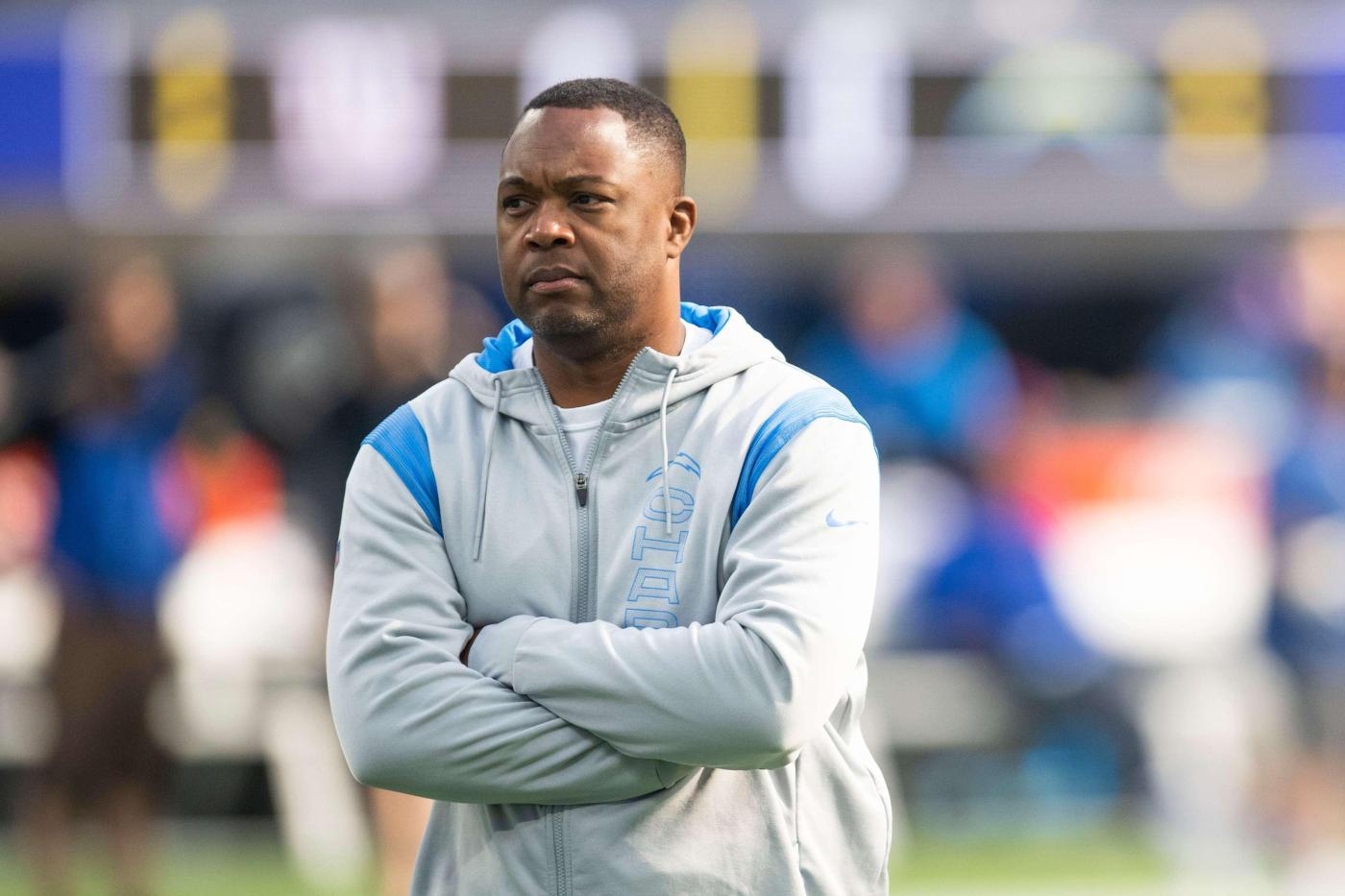
The Bears are working to hire Chris Beatty to be their wide receivers coach, though it was not yet official Tuesday morning, a source confirmed. Beatty was Moore’s position coach for two of his three seasons at Maryland, including 2017, when Moore was the Big Ten wide receiver of the year.

Beatty would join the Bears after three seasons as the Los Angeles Chargers wide receivers coach, his first NFL stint after 15 years coaching in college.

He would replace Tyke Tolbert, whom the Bears fired along with offensive coordinator Luke Getsy and three other offensive staffers earlier this month. ESPN first reported the news of the expected hire.

Along with his time at Maryland, where he was promoted to associate head coach and co-offensive coordinator, Beatty was a position coach at Pittsburgh, Virginia, Wisconsin, Illinois, Vanderbilt, West Virginia, Northern Illinois and Hampton. He was the co-offensive coordinator and quarterbacks coach under Tim Beckman during his lone season with the Illini in 2012.

A former wide receiver at East Tennessee State and in the Canadian Football League, Beatty started his coaching career at the high school level.

He would be tasked with coaching a wide receivers group that Bears general manager Ryan Poles might look to bolster after it lacked production beyond Moore in 2023.

In his first season with the Bears and quarterback Justin Fields, Moore had a career-high 96 catches for 1,364 yards and eight touchdowns.

But Darnell Mooney had his worst season with 31 catches on 61 targets for 414 yards and a touchdown. And rookie Tyler Scott had a bumpy first season, finishing with 17 catches on 32 targets for 168 yards.

Beatty would be the fifth Bears coaching hire this offseason. They previously hired offensive coordinator Shane Waldron, quarterbacks coach Kerry Joseph and defensive coordinator Eric Washington and are hiring Thomas Brown as passing game coordinator. They also need to hire a running backs coach.

()

Thomas Friedman: Inside America’s shadow war with Iran

posted in: News | 0

It’s often been said that the most dangerous hot spot in the world is the waterway between Taiwan and mainland China, where the Chinese navy and air force flex their muscles every day to try to intimidate Taiwan — while the U.S. Navy patrols nearby. I wonder. There is actually a stable balance of deterrence there right now. You could hold a friendly regatta in the Taiwan Straits compared to where I just visited.

I spent two days last week hopscotching in a CH-47 Chinook helicopter among seven U.S. military bases in western Jordan and eastern Syria with America’s senior Middle East Centcom commander, Gen. Michael Kurilla. There is no equilibrium here. What you have, instead, is the other Middle East war that began shortly after the tragic Israel-Hamas war that broke out on Oct. 7.

This other Middle East war pits Iran and its proxies — the Houthis, Hezbollah and Shiite militias in Iraq — against both the small network of U.S. bases in Syria, Jordan and Iraq established after 2014 to destroy the Islamic State group and against the U.S. naval presence in the Red Sea and Gulf of Aden that keeps the vital shipping lanes there secure and open.

These Iranian-armed Shiite militias in Iraq and the Houthi fighters in Yemen may not look or seem like lethal threats, but do not be fooled. They have learned to arm, build, adapt and deploy some of the most sophisticated precision weaponry in the world. That weaponry, provided by Iran, can hit a 3-foot-wide target 500 miles away.

The young U.S. soldiers and sailors arrayed against them cut their teeth on video games, but now find themselves playing the real thing, deploying with software and cursors the world’s most sophisticated countermeasures and interceptors to swat away almost every rocket and drone the Iranian proxies have been throwing at them.

In short, Americans may not know they’re at war with Iran, but Iran’s Revolutionary Guard know for sure they are in a shadow war with America through their proxies.

And if one of these Iranian proxies gets “lucky” and creates a mass casualty event by striking a U.S. warship or the barracks of one of the U.S. bases in Jordan or Syria — something akin to the Marine Corps barracks bombing in Beirut in 1983 — the U.S.-Iran conflict would surely come out of the shadows and become a direct shooting war in the region the world most depends on for its oil.

Just thought I’d let you know.

This other Middle East war kicked into high gear on Oct. 17, 10 days after the attack on Israel by Hamas, Centcom officials explained to me, when Iran clearly took a decision to rev up all its proxies. Under the cover of the Israel-Hamas war and tempted by the anti-American sentiment it has generated, Iran tried to see if it could significantly degrade the U.S. network of facilities in Iraq, eastern Syria and northern Jordan, or perhaps dislodge U.S. forces altogether.

I suspect Tehran also had another goal in mind: to intimidate America’s Arab allies by showing them the damage Iran could inflict on their U.S. protector.

What I know for sure, though, is that this is the most dangerous game of chicken going on anywhere on the planet today, for three reasons.

Sheer volume

The first is the sheer volume of rockets, drones and missiles that Iran’s proxies have deployed — particularly the Houthis in Yemen and the Shiite militias in Iraq. According to Centcom, hundreds of warheads carried by Iranian-supplied land-to-sea rockets, cruise missiles, ballistic missiles, attack drones, suicide speedboats and unmanned underwater vehicles have been fired since Oct. 17 by Iran’s proxies at U.S. bases, warships and commercial vessels in the Red Sea.

Fortunately, despite the volume of attacks, the U.S. has managed to destroy or deflect most of the incoming with interceptors and a growing electronic forest of radars and countermeasures being deployed at the bases and on U.S. warships. This is no easy task; several rockets and drones have gotten through, injuring more than 180 U.S. personnel so far, Centcom said, and I saw the physical damage they did at several bases we visited.

These U.S. bases are not luxury compounds. Many started as ramshackle Islamic State-controlled bases or small towns that the U.S. and its Kurdish allies took over beginning in 2014 after intense firefights with the Islamic State group in a war that threatened the governments of Syria, Iraq and Jordan all at the same time.

Today, they consist of prefab living quarters surrounded and separated by hundreds and hundreds of concrete blast walls imported by the U.S. to limit the damage of any incoming warheads. Spotty wireless enables soldiers to FaceTime with families and follow sports. Spartan kitchens serve corn dogs, chicken nuggets and the like, and at some of the “nicer” facilities, maybe even a daily selection of fresh fruit — though when you’re a 70-year-old visitor carrying around 50 pounds of body armor and a helmet, it’s amazing how good a big fat corn dog from an Army mess in the Syrian desert can taste.

But because these bases were designed and situated to block the Islamic State group from reconstituting its supply lines and critical mass, they were never meant to deter or attack the vast modern rocket arsenals of Iran and its proxies.

Which is why on Jan. 28, a one-way Iranian attack drone with a 20-pound warhead, launched by a coalition of Iranian-backed Shiite militias called the Islamic Resistance in Iraq, hit a U.S. facility, Tower 22, in northeastern Jordan.

I visited Tower 22 with Kurilla’s team last week. The blast killed three U.S. soldiers, who were blown right out of their bunks, and injured 47. Fortunately, the modular living quarters there were separated by blast walls. A soldier in the bunkhouse right next to the one hit told us he was talking to his wife on FaceTime when the drone struck; protected by a thick cement barrier, he emerged shaken but unscathed. Watching live, his wife thought he was dead when he disappeared in smoke but he was able to contact her three hours later and assure her otherwise.

Deterrence and its limits

I was surprised to learn just how aggressive the Iranians have encouraged their proxies to be, which is what leads to the second, extremely dangerous aspect of this war.

It was what Kurilla dryly described to me as a deterrence “conversation” Centcom had with Iran after the Tower 22 attack to make clear to Tehran that it was playing with fire.

On Feb. 2, the U.S. launched airstrikes against the whole Iranian proxy network in Iraq and Syria, and the next day against Houthi sites in Yemen, hitting more than 100 targets overall, with a combination of long-range B-1 bombers out of Texas, and cruise missiles and fighter bombers launched from the Eisenhower carrier group in the Red Sea. Some 40 people were reported to have been killed in the U.S. retaliatory strikes.

The operation was then capped off on Feb. 7 when the U.S. decided to demonstrate to Iran and its proxies what kind of combined intelligence/precision warfare the U.S. can deploy by killing Abu Baqir al-Saadi, the specific commander from Kataib Hezbollah who the U.S. determined was in charge of drone attacks on its bases in Iraq, Jordan and Syria.

Al-Saadi was hit while driving on a Baghdad street by the same kind of drone-fired Hellfire missile that killed senior Revolutionary Guard commander Qassem Soleimani in 2020. It was equipped with six swordlike blades that once it penetrates a vehicle slice and dice anything in their path like a blender, which is why the missile has been nicknamed the “Flying Ginsu.”

This American response clearly got the Iranians’ attention, and Iran’s proxies have been observing an undeclared cease-fire on land ever since, which certainly helped ease my mind as we flew around in helicopters and a C-130 all over the ungoverned spaces of eastern Syria, too close for my comfort one day near the joint Russian-Iranian base on the western side of the Euphrates.

This informal cease-fire, though, has not been embraced by the Houthis, who have declared that they will not stop firing at international ships, the U.S. Navy or Israel, at least until there is a cease-fire in Gaza. Last weekend, the Belize-flagged cargo ship Rubymar, which the Houthis hit with an anti-ship ballistic missile on Feb. 18, became the first vessel to entirely sink in the Bab el-Mandeb Strait, as a result of a Houthi missile attack. It created a huge ecological mess of leaked fuel and the fertilizer it was carrying.

Seconds to decide

And that leads to the third dangerous aspect of this shadow war.

At every base we visited there was a top-secret room journalists could not go into, called the combat integration center. Inside, young American soldiers (and sailors on Navy vessels) stare at screens, try to identify the myriad objects flying toward them and decide by its radar and visual signature whether to engage one, ignore another or let a third go by, figuring it is going to miss and land harmlessly. Discipline is important when you’re firing $200,000 interceptors at $20,000 Iranian drones, a Centcom officer told me.

These operators often have less than 90 seconds to make up their mind whether to engage an incoming drone with a Coyote drone-interceptor that can detect and destroy attack drones at very close range and can be launched from ground vehicles, helicopters or surface vessels.

In other words, every day is pregnant with a low-probability-but-high-consequence event. And the first, and often last, line of defense is usually a 20-something U.S. soldier or sailor squinting at a computer screen, trying to decide with software within seconds what is coming his or her way and engaging the right countermeasures.

Amid all of this, I should add, we also visited Al Hol detention camp in the middle of nowhere in northeastern Syria, where some 43,000 people — mostly Islamic State “brides” and their children — are being held in tents and prefabs under Kurdish guards until they can be deprogrammed and returned to their home countries. It is pretty strange to talk to an American or British woman who got drawn into the Islamic State cult and hear that she has five or six kids by three or four different Islamic State combatants, all of whom were killed by the U.S.-led coalition. Judging from the number of rocks some of the kids threw at our armored convey, the deprogramming process has a way to go.

So why stay?

Given all the risks and open sores out here, it’s worth asking: Why stay?

First let me describe a scene, and then offer an answer.

The scene: Kurilla’s team was visiting the Tanf garrison, a small logistics support base inside Syria, near where Syria, Iraq and Jordan meet. Kurilla took the opportunity to do a battlefield promotion, from second lieutenant to first lieutenant, for a medical platoon leader stationed there. We were standing in an alley and around us were all just different shades of brown — the desert, the buildings, you name it.

Kurilla first asked for someone to get him an American flag and a couple of minutes later two platoon members showed up with a small one and held it up at shoulder level, framing Kurilla and the young officer being promoted.

“Our Army is unique in the world,” Kurilla said to the young man. “We don’t swear an oath to a person or a king, we swear an oath to an idea, embodied in the Constitution and ingrained in our democracy, that all men and women are created equal. We swear an oath to defend that idea.”

Kurilla then administered the oath that every U.S. soldier — this one an enlistee who had worked his way up — repeats as he or she rises in rank. His oath complete, the newly minted first lieutenant slapped on a cap displaying his new rank and then gave a shoutout to each member of his platoon.

There was something about that scene that hit me: the two soldiers holding up their little Stars and Stripes that provided the only color in this vast brown tableau, and the oath of allegiance to an idea, not a king, muffled by the protective blast walls of this far-flung base in a region that has mostly known only the opposite.

During the post-Cold War era, from the early 1990s to the 2010s, I thought it might actually be possible to bring more consensual politics and pluralism to this part of the world — thanks to the Oslo Accords, the Jordanian-Israeli peace treaty, the Arab Spring uprisings and the greater integration that was resulting from globalization.

But it did not happen. Rather than the spread of democracy this region experienced metastasizing disorder and failing states. At the same time, the big divide in the world became no longer between democracy and autocracy, but between order and disorder.

The best case for U.S. forces remaining in eastern Syria, Iraq and the Red Sea is precisely so that the disorder “over there” — from the likes of the Islamic State group, failed states like Syria and the eating away of nation-states by Iranian proxy militias — doesn’t come “over here.”

It is not a pretty or heroic mission — living in body armor all day in a harsh and hostile environment, with all the corn dogs you can eat as one of the few pleasures — but it’s probably worth it. That said, we should have no illusions about the risks because the shadow war playing out there could come screaming out of the shadows at any moment.

Thomas Friedman was born in Minneapolis and raised in St. Louis Park. He writes a column for the New York Times.

Related Articles

Opinion |


Robert Pearl: 3 surprising lessons for U.S. medicine from around the world

Opinion |


David French: The Supreme Court just erased part of the Constitution

Opinion |


Trudy Rubin: 4 ways the US should help Ukraine right now

Opinion |


Noah Feldman: Supreme Court buries the fantasy of keeping Trump off the ballot

Opinion |


David Brooks: The GOP reverts to a bad old mood