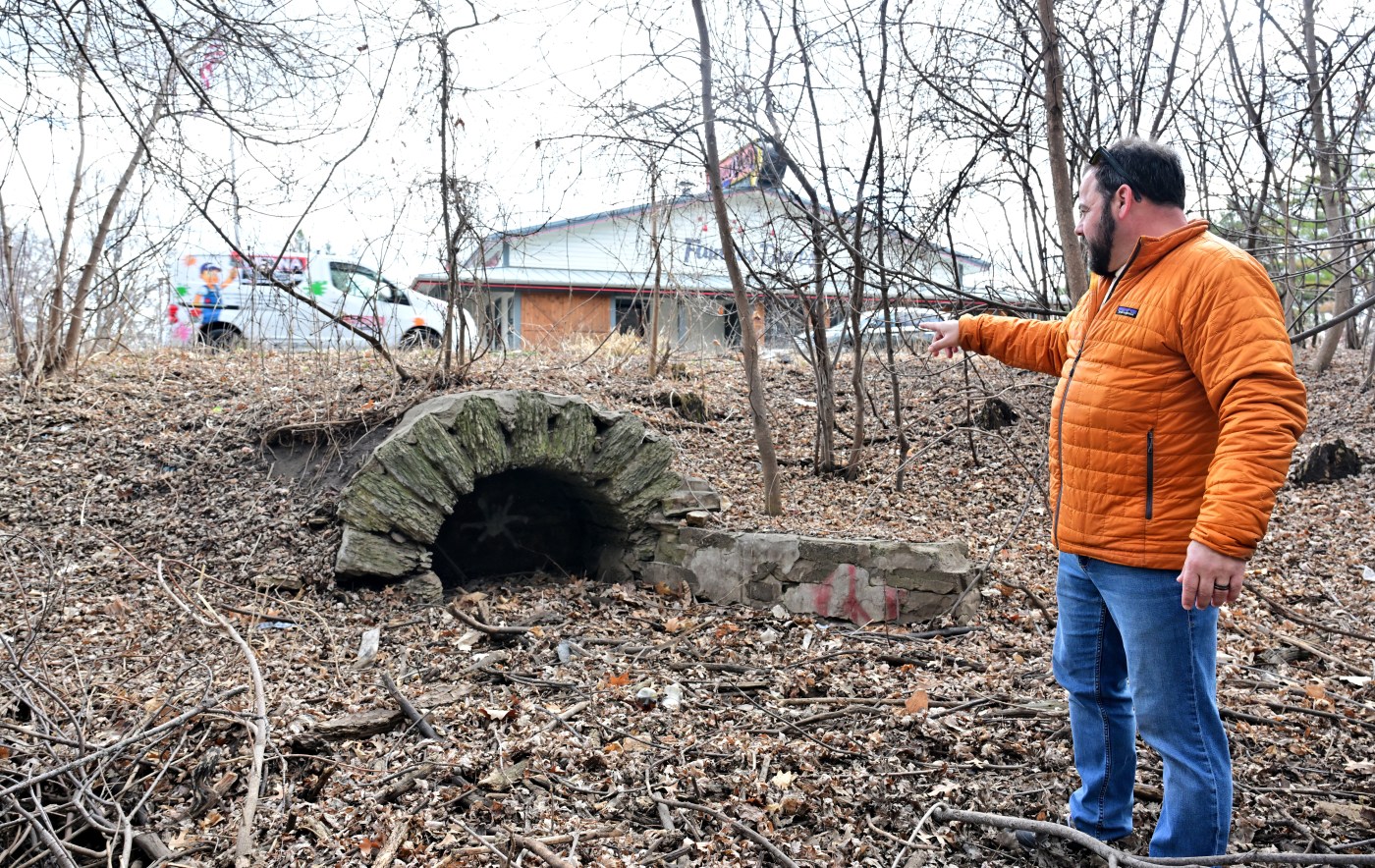
A geologist and a civil engineer found a prehistoric creek in St. Paul. Now they want to restore it.

posted in: News | 0

Charlie Evans stands within the wooded ravine beneath the short bridge that links Edgcumbe Road to Hamline Avenue in St. Paul and excitedly points to limestone remnants of old Works Progress Administration projects from the 1930s.

There sits a staircase, and over there, the outlets and inlets from a century-old municipal swimming hole. A driver on the road above, or a golfer across the street at Highland National Golf Course, would see little more than trees emerging from the recessed earth.

St. Paul civil engineer Charlie Evans. (John Autey / Pioneer Press)

With his training as a civil engineer, Evans spots evidence of what had been a shallow, man-made pool installed around the same time as Montreal Road was extended to West Seventh Street in 1927. On the same natural corridor sat a replacement pool from 1936, running along what is now the muddy trail of an obscure, almost dried-out creek bed to the limestone walls of the boarded-up chlorine building and the long-shuttered Highland Bath House beyond it.

A century ago, St. Paul’s youth splashed in the non-chlorinated groundwater of Highland Lake, a now-defunct municipal pool that ran 100 feet wide and 500 feet long, fed in part by stormwater and a prehistoric creek so small it goes unnamed on historical maps. Evans, a sixth-generation St. Paul resident who can trace his ancestry to the state’s territorial pioneers, has family members who once dipped their toes in those long-gone swimming holes.

“When the WPA did the (1936) pool, at the same time they landscaped the ravine, erecting four foot bridges and 12 waterfalls to help with erosion control,” said Evans, a longtime city employee. “It was a quarter-mile of landscaping in the ravine.”

Highland Creek

Today, you can’t fish from Highland Creek, swim in Highland Creek or even see Highland Creek from a few dozen yards away.

But working with hydrogeologist Greg Brick, Evans is convinced that the creek was once the highest-volume stream in the city, running larger than Phalen Creek or Trout Brook in centuries past. And with less effort than some might suspect, he believes a sizable stretch of the creek could rise again, restored someday by diverted stormwater and the work of like-minded naturalists.

”Highland Creek is now the smallest creek in the city, but it was once the longest,” said Brick, during a recent spelunk through its wooded ravines.

Small ponds and low points on Highland National Golf Course mark the one-time path of Highland Creek in St. Paul on Friday, March 15, 2024. (John Autey / Pioneer Press)

Daylighting a prehistoric creek would be no small undertaking, but why stop there?

Evans sees Highland Creek as just the first phase. The Historic Highland Lake could, in theory, return as a municipal swim pond in the same vein as the swim pond at Lake Elmo.

“If that happened, the city could reopen the Historic Bath House back into an actual bath house again,” he said. “That would be incredible.”

Where it runs

The two men believe the prehistoric creek runs a mile and a half, beginning in a former wetland near the north edge of the Highland National Golf Course. It flowed south through a shallow ravine that is still in evidence as a chain of ponds on the golf course, according to Brick, who believes it crossed under what is now Hamline Avenue around the 18th hole.

That’s where it met the tree-lined ravine at Beechwood Avenue and ran under Edgcumbe Bridge into what had been the Highland Pool. At the pool’s south end, the water found a buried pipe that runs under Circus Juventas, allowing it to emerge in the ravine across West Seventh Street/Fort Road from Mickey’s Diner.

A stone culvert carried the water under the road and into a lower ravine in what’s known on city maps as the Kipps Glen Terrace Addition. Based on Brick’s observations, the 100-foot ravine was likely carved some 10,000 to 12,000 years ago by what Evans describes as a “biblical flood.” Today, the wooded land hosts the last naturally “daylighted” — or above-ground — sections of the creek in Highland Park, though a long-legged adult could likely make it across the sliver of water in one jump.

From there, Highland Creek flowed under the railway trestle of the old Ford spur, the sidetrack that led to the Ford Motor Co.’s auto manufacturing plant in Highland Park. And from there, said Brick, the creek traveled through a sandstone gorge to the Mississippi River bottomlands, where Lake Crosby drained into it.

St. Paul civil engineer Charlie Evans points out Highland Creek on a hydrological map while at Highland National Golf Course St. Paul on Friday, March 15, 2024. (John Autey / Pioneer Press)

Daylighting long-hidden waters

Evans, who has broached the topic with St. Paul Public Works officials, said he’s well aware that St. Paul Parks and Recreation has no money handy for such a project. Still, the Capitol Region Watershed District and similar organizations have put energy into restoring long-lost creeks before, including daylighting long-hidden portions of Lower Phalen Creek.

”This is all within park boundaries,” Evans said. “They don’t have to acquire it. They already own it.”

It took years of advocacy, but the Lower Phalen Creek Project evolved into its own nonprofit, which has led planning and fundraising for the Wakan Tipi Center, an interpretative center that will be located just east of downtown St. Paul.

For now, Evans and Brick are happy to celebrate a slice of St. Paul long forgotten.

The Highland Park Aquatic Center was built south of Montreal Avenue in 1976, turning the old pool into surplus property. It’s unclear when the old pool was removed, but Evans, who played frisbee golf in high school just above the Hamline/Edgcumbe intersection, said it was already gone when he was a student in the 1990s, relegating it to the stuff of city lore.

Related Articles

Local News |


Joe Soucheray: Reckless car thieves, streetlamp wreckers … we’re tired of this

Local News |


St. Paul mother gives emotional statement before sentencing for daughter’s fentanyl death

Local News |


Third suspect charged in weekend shootout outside Cub Foods store on St. Paul’s East Side

Local News |


Central High softball players exceed initial fundraising goal to visit vice president in D.C.

Local News |


St. Paul seeks design, engineering experts to advance River Learning Center in Hidden Falls

‘Palm Royale’ review: Kristen Wiig in a comedy of manners, circa 1969 Palm Beach

posted in: News | 0

Armed with a Southern accent, a tan and the fluffiest blonde wig available, Kristen Wiig plays a socialite wannabe who is equal parts sunny and scheming in the 10-episode comedy of manners “Palm Royale” on Apple TV+.

Set in 1969, she’s a former pageant queen named Maxine Simmons who is staring down middle age and desperate to be embraced by the Florida elite of Palm Beach, so she leverages a tenuous married-in connection: Her himbo airline pilot of a husband (Josh Lucas) is the nephew and sole heir of a Palm Beach grand dame Norma D’ellacourt (Carol Burnett) who is in a coma. With the old lady out of commission, Maxine borrows her last name and worldly possessions and she’s off to the races.

William Thackeray played around with similar themes in his 1848 novel “Vanity Fair” — of a social climber from humble means determined to break into high society — but that’s a tougher idea to hang a story on when the setting is the mid-20th century. Maxine is an outsider who wants in, and the obvious question is why? What does she think will happen if she’s granted entry? When she finally offers a one-line explanation, it’s unpersuasive and nonsensical. Her resolve is admirable, her ambitions hollow.

The rich and insular group of women she gloms onto spend their days drinking by the pool at the country club. At the top of the heap is the caftan-clad patrician snob extraordinaire played by Allison Janney, surrounded by her equally insufferable pals played by Leslie Bibb and Julia Duffy. Everyone is a viper, but Maxine conspires to make herself a useful pawn and she’s not one to back down in the face of threats delivered through the gritted teeth of Palm Beach royalty.

“Ever since my pageant days I’ve maintained a posture of relentless positivity,” she says jauntily. “The other contestants would always underestimate me.” Her delusional and indomitable spirit also involves elder abuse and writing bad checks to the tune of $75,000, and the show can’t decide if it finds these things plucky or horrifying.

Laura Dern plays a wayward rich girl cosplaying as a revolutionary who works at a feminist bookstore called Our Bodies, Our Shelves (I laughed) and she’s swept up into Maxine’s shenanigans. So is a bartender at the country club played by Ricky Martin (his performance of a guy quietly observing everything around him is the most nuanced thing the show has going for it). They are eventually won over by Maxine’s can-do spirit, but their incoherent friendships are less about human connection than narrative expediency. The one Black character in the ensemble, played by Amber Chardae Robinson, exists to roll her eyes at these self-involved Palm Beachers, but is given no interests of her own. Burnett is weirdly underused, but makes the most of her scenes when her character is revealed to be very much Maxine’s equal in the plotting and conniving department.

With “Palm Royale,” Hollywood’s wealthaganda obsession continues unabated. There’s a fizzy delirium to the show that promises more fun than it is. It’s a whirling (swirling?) dervish of meticulously high-end costumes and production design, as Maxine lurches from one lie — and mad scramble to cover it up — to the next. Her signature drink is a grasshopper, which looks delectable every time it arrives on a tray. At least showrunner Abe Sylvia (whose credits include Netflix’s “Dead to Me” and the screenplay for “The Eyes of Tammy Faye”) has an interest in the class peculiarities specific to Palm Beach, unlike Peacock’s recent “Apples Never Fall,” which takes place in the same locale.

You keep waiting for a larger story arc to emerge, but each set piece feels like vamping and filling time until someone can figure out what this show wants to be about, which makes the 10-episode length baffling. Every so often, there’s a glimpse of President Richard Nixon on a TV in the background talking about the war in Vietnam, which suggests the show is building toward some tangy observations about the emptiness of Palm Beach melodrama versus the reality of war. But no. Nothing of the sort transpires. A social satire lacking bite or even a point of view, “Palm Royale” is as substance-free as the froth and foam left by waves on the beach.

‘Palm Royale’

2 stars (out of 4)

Rating: TV-MA

How to watch: Apple TV+

Related Articles

Movies & TV |


‘Apples Never Fall’ review: Annette Bening as a retired mom who goes missing

Movies & TV |


Movie review: A new canine cycles into our hearts in ‘Arthur the King’

Movies & TV |


‘One Life’ a true tale of Holocaust hero

Movies & TV |


What to watch: Kristen Stewart sizzles in wild ‘Love Lies Bleeding’

Movies & TV |


Starry Skies North screening of award-winning documentary

Working Strategies: Nine career management steps for women

posted in: Society | 0

Amy Lindgren

What’s different about career management for women? Nothing and everything, which is why it’s an important concept to visit. Nothing is one answer because the processes are the same, regardless of gender. But everything is also the answer because the results of those processes can vary so widely between men and women.

Some results are measurable: Women earning less than men for the same work (approximately 84%); women being 35% more likely to live in poverty than men; women having vastly fewer financial resources than men post-retirement, including much lower Social Security payments … the statistics are nearly endless, with variations for age, race, education and other factors.

If these numbers were improving, perhaps we could assign the concept to historical bias that’s now shifting. But no, most financial indicators between the genders haven’t changed significantly in decades. Nor are younger women faring much better, with a pay gap of 92% compared to equally employed men in the 25-34 age range.

Enough with the numbers. These are important indicators, but they can’t tell you what to do. Let me do that. Here are nine career management steps that are smart for anyone, but critical for women.

1. Apply anyway: Not qualified for the job? You don’t know that. Sociologists have produced scads of studies demonstrating a difference in how women and men approach a role for which they may not be skilled — men go for it and women hang back. You could argue whether this right, but we do know this: You miss 100% of the balls you don’t swing at.

2. Work above your level: It’s meeting time — who’s going to take the minutes? Ladies, keep your hands down. Unless it’s specifically your job, that’s not your job. Rather than “cleaning up” small things that need doing, focus on the work at or above your current level. Otherwise, you risk being typecast as a low-level contributor.

3. Ask for promotion: Do you deserve a new role? That’s the wrong question. Promotions aren’t given out as a reward, as in, “You’ve worked hard, so you deserve this.” Rather, they’re decided as a matter of potential: “We believe you can handle this.” If you wait to be “rewarded,” you’ll wait forever. Step up and tell your boss you’re ready for the next challenge.

4. Engage in your annual review: Some companies take these seriously, others barely conduct them. In either case, the process lets you identify goals and track progress toward them. If you don’t receive a formal review, conduct one yourself and share the results with your boss, along with your expectations for the next year.

5. Negotiate everything: Pay is one of the few things you can measure to determine your worth to the employer. The gold standard for negotiation is a higher wage, since future pay raises, bonuses and retirement contributions are based on that number.

6. Take the bigger title: If you’re working in a combined role as a something / something, use the higher title. And if you’re working in a peer group where others have a higher title, lobby for an upgrade. Titles matter, or we wouldn’t have them.

7. Limit your loyalty: Whatever role you have, in the end this is just a job and you’re just an employee. When you’re no longer being recognized for your worth, it’s time to move on.

8. Save your money: The more you save, the more freedom you have. Learn to invest and to shelter your funds from taxes. Then, train yourself not to offer money to otherwise able-bodied children. They can get it later from your estate. For now you need to keep building so you’re not poor yourself.

9. Limit your caretaking: Yes, it truly is a privilege to help your parents, and your spouse’s parents, and to help your children with their children, and … Are you sure you’re the only one who can do this? If you cut back or stop out of work, your income might never recover. That’s why it’s not always smartest for one parent to stay home rather than “wash out” the second income by paying for daycare. Even if the net income is zero for those years, working means your career continues to grow, as do your Social Security credits and retirement contributions.

Can you do this? Yes, I know you can. “Business first” isn’t everyone’s natural mode, but sometimes it’s essential to put your career in front. That’s the tool that lets you reach other life goals, so it’s critical to manage it well.

Related Articles

Business |


Working Strategies: A spring reading list for all seasons

Business |


Working Strategies: Leveraging LinkedIn when Changing Careers

Business |


Working Strategies: 11 Reasons to Volunteer between Jobs

Business |


Working Strategies: Exit strategy – following a process for leaving your job

Business |


Working Strategies: Biting the bullet — staying in a job you don’t love

Amy Lindgren owns a career consulting firm in St. Paul. She can be reached at alindgren@prototypecareerservice.com.

Joe Soucheray: Reckless car thieves, streetlamp wreckers … we’re tired of this

posted in: News | 0

We have too many troubled feral youths with a strong affinity for stealing cars and vandalizing streetlamps. They know about tools, and if that is too gracious, they are not afraid to roll up their sleeves and tackle electrical systems that would have most of us calling an electrician.

Joe Soucheray

You’re aiming too low, fellows. You steal cars for no other reason than to run a nefarious errand and then you dump it and steal another one. You’ve got a couple of problems. One, you don’t know how to drive. Every report of a stolen car that comes along contains the inevitable paragraph where we learn the driver crashed into a tree or rolled into a pond.

Any 5-year-old kid raised on a farm can drive better than you urban louts. Aren’t you embarrassed? No, really, you don’t have a clue, making you much more dangerous. You have no concept of speed, braking or turning. You are complete morons and we are tired of it.

The next time you steal somebody’s Hyundai, leave it in one piece. You also have no idea what insurance costs.

And speaking of Hyundais and Kias, too, I suppose, I am not going to blame the manufacturers for your temptations. We have elected a political class that believes that Hyundai and Kia purposely designed cars to be easily stolen in the Twin Cities. They did not. Criminals steal cars. Criminals have tools and they can surf Google. There is not a doubt in my mind that these same drifters could just as easily steal Porsches and Jaguars, but it would take a bit longer so they go after the low-hanging fruit.

You should be ashamed of yourselves, fellas, for the way you have embarrassed the moonshiners, main-street drag racers, low riders and dirt-track racers, all of us for that matter. You don’t know a damn thing about cars.

Don’t know if it’s the same crowd, but it’s the same lazy ideology when it comes to streetlights. All you do is leave behind a pitiable mess. For what? How many “help wanted” signs do you pass on your way to the next $7 score of copper wire?

We have old beautiful streetlamps in St. Paul. They cast a civic twilight glow. The ones still working. They speak to a day of better beggars and thieves. By day, the broken ones offer sprung access panels and strands of wire having been snipped. Now that street is dark and restless.

Any day now, the St. Paul City Council, the least diverse city council in America, all young females with the same liberal world view, will probably get around to blaming the manufacturer of the pole for placing the access panel too near the ground. Why, they should have envisioned the misunderstood youth when they designed those lamps.

For cars, buy a standard transmission vehicle while they still last. The thief wouldn’t get 10 feet if he had to work a clutch.

And even if he could use a clutch, he’d probably crash into a streetlamp, knocking another one out of service.

Joe Soucheray can be reached at jsoucheray@pioneerpress.com. Soucheray’s “Garage Logic” podcast can be heard at garagelogic.com.

Related Articles

Opinion |


Jane Eisner: How should we read the texts of Purim and Passover this year?

Opinion |


Bronson, Rieser: The stories that ‘Oppenheimer’ didn’t tell

Opinion |


Trudy Rubin: At this point, White House policy is more pro-Israel than Netanyahu’s

Opinion |


Lisa Jarvis: This brain cancer breakthrough should excite us

Opinion |


F.D. Flam: Not even Antarctica could stop COVID. It’s a crucial lesson.