F.D. Flam: The U.S. needs a non-partisan 9/11 Commission for COVID

posted in: Society | 0

During the third week of March 2020, with little public debate and less warning, Americans were told to stay in their homes indefinitely as COVID cases climbed. There were only a few days between bland reassurances and lockdown orders — just enough time to go panic shopping for toilet paper.

The first pandemic year represents a crisis distinct from the period after vaccines became widely available. Congress should establish something like the 9/11 Commission — independent and bipartisan — to reexamine why our early response was so disruptive and yet so ineffective. A report issued in time for next year’s anniversary of the start of the pandemic might identify weaknesses in the country’s general ability to deal with the next crisis, whatever that entails.

Some eye-opening analyses covering that first year have recently appeared in “Lessons From the COVID War,” by a panel of scientists and policy experts, and “The Big Fail: What the Pandemic Revealed About Who America Protects and Who It Leaves Behind,” by journalists Joe Nocera and Bethany McLean. But an official bipartisan treatment would have a big impact on our polarized nation.

Such a commission should first address why our elected leaders and expert agencies didn’t warn the public sooner. There was strong evidence by early February 2020 that this disease had already spread far beyond Wuhan, China, that it could travel invisibly through mild cases, and that the oldest people were at highest risk.

Some fair warning could have helped people take voluntary measures to avoid infection and prepare for disruption. But for much of January and February we got false reassurance. Even when Nancy Messonnier of the Centers for Disease Control and Prevention said on Feb. 25 that the virus might cause ” severe” disruption, CDC deputy director Anne Schuchat pushed back, saying “our efforts at containment have worked.” It wasn’t until mid-March that the White House declared COVID a national emergency.

The delays in issuing clear warnings were part of a perverse disregard for the effects of time in a crisis. When protective measures began mattered. So did the timing of lifting or changing those measures. People can better stick with sacrifices that have a specific duration and a realistic goal.

Waiting to issue warnings and directives until after the disease was widespread meant more deaths — and the need for more extreme measures to get the same level of mitigation. And it isn’t hindsight bias to say that extreme measures such as shutting schools, businesses and public events would have been less harmful if done for two or three weeks rather than months.

The scenes of people dying in hospital corridors in Italy made it seem necessary to take drastic measures in the U.S. to “flatten the curve” of infection, but there was no scientific case for trying to eradicate an already widespread virus by keeping extreme measures in place long term.

A COVID commission could also look at what government, employers and communities might have done to prevent deaths among essential workers and their families. While Americans saw limited improvements in paid sick leave policy, the situation called for more. Essential workers who were at risk or lived with people in fragile health should have been able to opt out of work — their jobs taken over temporarily by the many healthy, younger Americans who were unafraid and whose mental health might have improved with the chance to contribute rather than stay cooped up alone.

And a special investigation could also help puncture the thin excuse that U.S. leaders made bad decisions because of a lack of data on a novel virus. Even in those early days of 2020, we had enough information to act more rationally. By early April, there was already growing evidence that the virus was spreading primarily indoors through airborne transmission and there was very little risk outdoors.

Blunt closures of businesses, schools, beaches and parks threw that knowledge out the window — and they didn’t represent scientific consensus. Michael Osterholm, director of the Center for Infectious Disease Research and Policy in Minnesota, co-wrote a Washington Post op-ed published on March 21, 2020, warning that indefinite, sweeping lockdowns were not the best course of action for saving lives:

“The best alternative will probably entail letting those at low risk for serious disease continue to work, keep business and manufacturing operating, and ‘run’ society, while at the same time advising higher-risk individuals to protect themselves through physical distancing and ramping up our health-care capacity as aggressively as possible.”

A targeted strategy could have harnessed what scientists had discerned about who was at the most risk of dying and which kinds of work were riskiest.

Osterholm stood by this view when I spoke to him this month. (And to give credit where it’s due, he was the first to get me thinking about a 9/11 Commission for COVID.) He reminded me that he favored short-duration measures to slow the rate of spread and keep hospitals from being overwhelmed. And he was concerned that long-term lockdowns would increase the death toll among “essential workers,” many of whom had health conditions that put them at elevated risk, or lived in crowded housing with elderly relatives. His worries came true.

Lockdowns caused homes to become more crowded — with college students moving in with families, school-age kids at home and others spending much more time in their houses or apartments. Epidemiologists have confirmed that hours of household exposure caused many more cases than exposures of less than 30 minutes. Again, time matters.

A COVID commission should also measure the lasting impact of these early fumbles. After vaccines were introduced, the U.S. started to see many more deaths than other comparably wealthy countries. We had lower vaccine uptake in part because the public-health community had lost the people’s trust during that first year.

The justification for blunt, long-term restrictions was the assumption that more people would die as a result of more targeted measures. But that needs close examination — it’s also possible that those policies made the situation here much worse and deadlier than it had to be.

Lots of countries made mistakes as COVID spread around the world. The only way to learn from them is to give them a hard, nonpartisan look.

F.D. Flam is a Bloomberg Opinion columnist covering science. She is host of the “Follow the Science” podcast.

Related Articles

Opinion |


Letters: In Cobb case, was deadly force authorized?

Opinion |


Lisa Jarvis: Biden’s $12 billion for women’s health should be just a start

Opinion |


Adam Minter: March Madness as we know it faces extinction

Opinion |


Murphy, Sperling: How a California climate win could end up destroying rainforests — and what to do about it

Opinion |


David French: America’s most overlooked political divide is also its most revealing

Matthew Yglesias: To fix Social Security? Ham-handedness, left or right, isn’t the answer

posted in: News | 0

It’s budget season in Washington, which means the politicians are delivering their annual warnings about the looming Social Security crisis. How big of a crisis — and how close it looms — is largely within their control, and there are basically three proposals to address it: one from House Republicans, one from President Joe Biden, and one from former President Donald Trump.

Trump’s plan is so bad that Republicans decided to attribute it to Biden instead. The budget proposal from the House’s Republican Study Committee, released earlier this month, points out that if no changes are made, the Social Security trust fund will be exhausted by 2032. “Ignoring this fact, as the Biden Administration and Congressional Democrats have, will lead to the largest across-the-board cuts to current Social Security retirement beneficiaries in history,” its report reads.

This is a valid point. But “do nothing and let massive automatic benefit cuts occur” is in fact Trump’s position on Social Security, not Biden’s. The Biden administration released a Social Security plan earlier this month that would restore solvency to the trust fund by raising taxes on people who earn more than $400,000 a year.

As for House Republicans? Their plan calls for raising the retirement age “to account for increases in life expectancy.” They realize this is risky — the Biden administration has already pounced on it — which may explain their attempt to sow confusion by pretending their nominee’s plan is actually the other guy’s.

Painful changes needed, but …

Nonetheless, the plan from the Republican Study Committee, which represents almost 80% of the party’s House membership, is worth taking seriously. And in the universe of possible benefit cuts, the GOP preference for a higher retirement age is one of the worst possible options. It’s essentially a benefit cut that targets people with below-average life expectancy. Social Security needs painful changes, but it’s a strangely regressive choice to make them at such a cost to a group that’s poorer than average.

Progress on life expectancy has been very uneven across U.S. society. Educated Americans are living much longer than we used to, but those without bachelor’s degrees are not. Contemporary Republicans like to cast themselves as champions of the working class, but they haven’t updated their policy playbook on major issues accordingly.

Beyond the specific class skew, meanwhile, there’s just something peculiar and cruel about singling out people in poor health for benefit cuts.

On average, the rich are in better shape than the poor. But there are exceptions. And almost everyone would trade money for better health and longer life if they had the opportunity. Increasing the retirement age essentially singles out the very worse-off class of elderly people — and makes them worse off.

Then there is the already-regressive nature of Social Security: The richer you are, the larger your monthly benefit check. Liberals generally admire Social Security for being a “universal” program rather than a means-tested one, providing a guarantee of dignified retirement to all Americans without a lot of elaborate administrative rigamarole. But most people’s understanding of a universal program is something like a public library or a bus — a service available on equal terms to everyone. Social Security is not like that. It pays larger benefit checks to higher-income people who paid more taxes during their working life.

The theoretical rationale here is that Social Security is supposed to be a kind of mandatory insurance program with a pension-like structure of payments and payouts.

In reality, though, Social Security is redistributive — those who pay higher taxes receive higher benefits, but not in proportion to what they pay. The point of the Democrats’ tax-raising plan is to make the program more redistributive.

But precisely because the existing benefit structure is skewed to the rich, you can achieve the Democratic goal of making the program more redistributive — and the Republican goal of cutting spending — by simply making the program flatter. Take the current 80th percentile of benefits (or 60th or 40th or whatever number you want to compromise on), and make it the maximum benefit. That creates a spending cut that targets not exactly rich people, but at least non-poor people. And because more affluent people live longer, reducing an affluent person’s monthly check does more for the Treasury than cutting spending on the poor.

A tax cut for those who keep working?

All this said, the idea of raising the retirement age is not completely without merit. In fact, the research shows that retirement itself is something of a mixed blessing.

There are clearly people who, due to their physical condition or the nature of their work, benefit from the opportunity to retire earlier rather than later. On average, however, retiring seems to lead to worse physical and mental health due to a reduction in activity and social connectedness.

Beyond the narrow budgetary questions of retirement programs, there is clearly a large economic benefit to having able-bodied people work rather than not, even if they are in their 60s or 70s. Rather than cut benefits for those who want to retire, America might consider cutting taxes on people who choose to continue working past retirement age. At the very least, the government shouldn’t actively discourage the elderly from participating in the labor market.

The main health benefits of continued work seem to accrue with part-time hours — it’s avoiding total inactivity, in other words — and for many people that may be the ideal situation. Part-time work gives the able-bodied elderly a continued connection to coworkers and a role in the national economy, while also generating additional free time to spend with grandchildren or on hobbies. The U.S. should consider creating an active labor market program oriented toward connecting sixty- and seventy-something people with part-time job opportunities.

Smaller tax increases, more careful cuts

It may be boring to say that Republicans want to cut benefits and Democrats want to raise taxes, and that the best solution is some kind of bipartisan compromise that does a mix of the two. But realistically, the optimal policy probably involves tax increases smaller than Biden proposes paired with spending cuts more careful than Republicans suggest.

At least both parties agree — one explicitly, one implicitly — that there is no place in this debate for Trump’s reckless indifference.

Matthew Yglesias is a columnist for Bloomberg Opinion. A co-founder of and former columnist for Vox, he writes the Slow Boring blog and newsletter. He is author of “One Billion Americans.”

Related Articles

Opinion |


Letters: In Cobb case, was deadly force authorized?

Opinion |


Lisa Jarvis: Biden’s $12 billion for women’s health should be just a start

Opinion |


Adam Minter: March Madness as we know it faces extinction

Opinion |


Murphy, Sperling: How a California climate win could end up destroying rainforests — and what to do about it

Opinion |


David French: America’s most overlooked political divide is also its most revealing

‘The Hobby’: A Love Letter to Board Gamers like My Son

posted in: News | 0

My 12-year-old son creates some wacky board games. When he was younger, there was Pillow Fight, where players spin a wheel to collect pillows to smack people, build a fort, or knock down pins. Then there was Chick-fil-A vs. Canes, a game where players collect coins by buying, selling, and promoting menu items from Texas’ favorite fast-food chicken places—but if you get stingy and don’t pay your workers, they’ll go on strike and you’ll find yourself without food. Recently, his creations have turned into more sophisticated battle strategy games, played according to pages and pages of rules. 

For someone who’s always been painfully shy, board gaming is the language my son uses to engage with others. Sit down and play a board game with him, and after a few minutes he will reveal his personality in a way that he typically can’t in a classroom. That’s why I cried when I saw The Hobby. 

Premiering at South by Southwest (SXSW) on March 8, the character-driven documentary The Hobby takes its title from what those in the board gaming world name their larger community and culture. Writer and director Simon Ennis, an avid board gamer who got hooked while working at a video store, follows designers as they reveal their creative process and players as they find community in this world. 

Over the years, my family has collected two dozen games; we have a loose board game group; and we hang out at board game cafes. But The Hobby showed me how much bigger this world is. Toward the beginning of the film, masses of people from all backgrounds and walks of life descend onto the floor of the Gen Con, the largest tabletop game convention in North America, held every year in Indianapolis, Indiana. In this tight-knit subculture, where game designers and reviewers like podcaster Tom Vasel are treated like superstars, Vasel jokingly tells Ennis, “As soon as I leave, no one knows who I am.” 

In the film, Thi Nguyen, philosophy professor at the University of Utah and author of Games: Agency as Art, tells Ennis that “the hobby” embraces “those who don’t fit into this world too well.” Nguyen says in his book: “In ordinary life, we have to desperately fit ourselves to the practical demands of the world.” And in that world, where we are driven by constant demands to be productive, to finish tasks, to achieve—where playing a three-hour game of Settlers of Catan might seem like a waste of time—it’s easy to see why people find a reprieve in “the hobby.” Nguyen theorizes that there is a “motivational inversion” for hobbyists—unlike athletes or others who compete to win or achieve a certain goal, hobbyists see the goal of winning as a means to creative play, to socializing with others for hours on end. When Ennis asks players and designers what the most important aspect of “the hobby” is, they all say, “It’s the people that matter most” or “the shared experience.” 

From the bird’s-eye view of the board gaming world at Gen Con, Ennis dives into the lives of some serious players, including Mik, Starla, and Grant Fitch—an African-American family whose time with each other playing turned into penning reviews on social media and a family Youtube channel called Our Family Plays Board Games. Ennis also features his close friend and fellow member of his board game group Dan Corbett. Together with other friends, they survived the isolation of the pandemic by playing board games in Corbett’s cabin in the woods.

It is this experience that gets the competitive Corbett hooked, and the audience follows him while he prepares for and plays in the World Series of Board Games in Las Vegas. Like the World Series we’re more familiar with, tournaments at this World Series are highly organized events where professional commentators analyze games live on video, and winners receive chunky gold championship rings. Unlike the World Series we’re more familiar with, there’s no trash-talking from fans or sign-stealing from players—just a whole lot of admiration and love from fellow competitors. Corbett comes shy of winning a tournament, but Hanshi Li, a self-deprecating immigrant from Guangzhou, China, who met his wife in “the hobby,” takes the ultimate $25,000 award in the final game of the Viking-themed Blood Rage. Li says for him, “the hobby” is “the purest form of social interaction.” 

It is this unique and shared experience that game designers strive to cultivate when they build a game. The audience learns through the stories of both beginner and expert designers that anyone can create a board game about virtually anything. We journey with newbie designers like musician Candace Harris and soft-spoken John Hague, as they craft, test, and launch their games, which are as varied as the interests of their creators. Harris’ game Stage Left is a music-themed deck-building game and Hague’s The Last Summit a postapocalyptic political diplomacy game. Ennis also shows that the designers’ processes are just as varied: Blood Rage designer Eric Lang starts by playing with game pieces on his bed, while Elizabeth Hargrave built a spreadsheet of her scientific research on the class, genus, habitat, wingspan, nest type, eggs, food, and endangered status of birds to create the game Wingspan.

Simon Ennis, writer and director of The Hobby (Calvin Thomas)

Perhaps the only distracting element of The Hobby was the character that bookends the film: a snooty, wizened curator from the British Museum, who only likes to play board games from antiquity. The board game snob is atypical among hobbyists. Overall, Ennis creates intimate portraits of diverse characters who are so earnest and open about their struggles, desires, and vulnerabilities that you find yourself cheering for them as they all proceed on their individual journeys. Openness, Ennis said later at a SXSW panel, is a hallmark of this community—and that shines through in the film. 

“The hobby,” Nguyen writes in his book, is a break from the indifferent and arbitrary world we seem to face: “In games, we can engineer the world of the game,” its rules, objectives, environment, narrative, and “the agency we will occupy to fit our desires.” 

It’s a kind of creative control that my 12-year-old son lacks in the broader world, as he navigates the increasing demands of homework, tests, and peer pressure, while we adults struggle to keep up with deadlines, bills, and everything else that makes us forget why we do the things we do. Thankfully, Ennis shows us that through “the hobby,” even if it’s just for a few hours, we can forget the incessant demands of the world, enjoy the company of others, and just play.

As the Twin Cities slam poetry scene rebuilds, top local competitors will prove their poetic prowess during BuckSlam’s upcoming Grand Slam Finals

posted in: News | 0

As the Twin Cities’ slam poetry scene rebuilds, BuckSlam — a new organization dedicated to the style of competitive poetry performance — has quickly established itself at the forefront.

Now, as its inaugural season comes to a close, BuckSlam is holding its first Grand Slam Finals, a championship for top local slam poets.

The top prize? $5 — a jackpot compared to the cheeky $1 (a buck! Get it?) awarded to the winner of BuckSlam’s monthly slams.

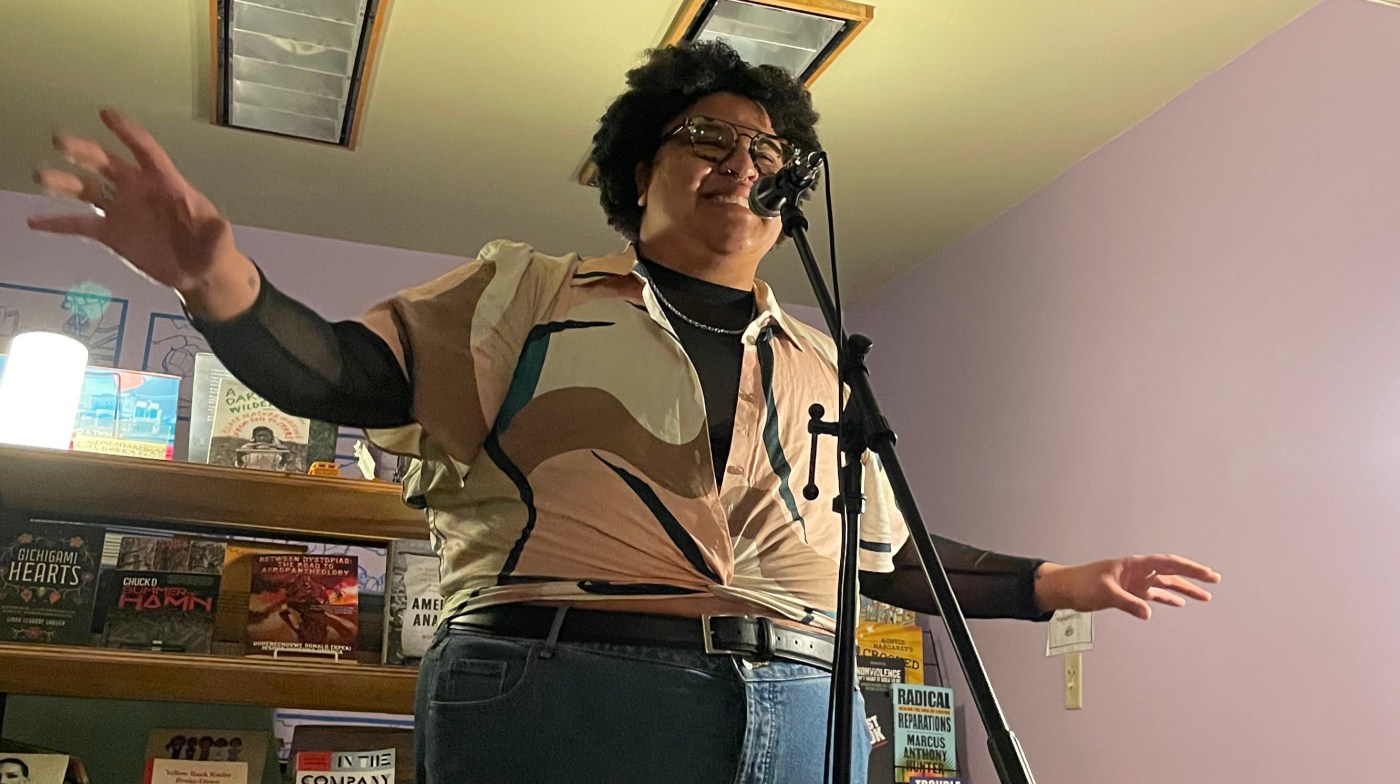
The finals start at 7:30 p.m. Wednesday, April 3, at the Black Hart of Saint Paul, a soccer bar in the Midway. Competitors have qualified for the event by performing well at those monthly events throughout the past year or so.

The four top performers will nab a spot on the 2024 BuckSlam Poetry Team, which means access to slam poetry workshops, coaching sessions with professionals, a writers’ retreat and the ability to compete at regional and possibly national tournaments.

The Twin Cities have long had a significant presence in slam poetry, which itself only started in its modern form in the mid-1980s, said BuckSlam co-organizer Zach Goldberg. Soapboxing, a team from St. Paul, won the National Poetry Slam two years in a row in 2009 and 2010, other St. Paul poets competed on the world stage, and the influential publisher and media company Button Poetry was founded in Minneapolis the next year.

But the national poetry slam scene collapsed somewhat dramatically in 2018 due to a variety of financial and inclusivity concerns, and subsequent efforts to rebuild local slams were vaporized by Covid-19. The National Poetry Slam, Individual World Poetry Slam, College Unions Poetry Slam Invitational and the local Button Poetry Live slam series have all disappeared in recent years.

So now, new regional slam organizations like BuckSlam and the Midwest Poetry Mash-Up are filling the gap. The Mash-Up, now in its second year, is set to take place in late April at the Strike Theater in Minneapolis and will feature competitors from around the country, plus from Canada and the U.K.

And, by the looks of it, both poets and audience members are excited for the slam resurgence. The March BuckSlam event at Boneshaker Books in Minneapolis was standing-room-only, Goldberg said.

For an organization that’s not even a full year old, BuckSlam’s leaders — a five-member collective of poets and slam organizers — have created what appears to be impressively solid infrastructure.

Every month since May 2023, the organization has held slam competitions at Boneshaker. Anyone can sign up, but there are only 10 or so performance slots during each event, so poets are selected at random, Goldberg said. (For fairness’ sake, if a poet’s name isn’t drawn two months in a row, they’re guaranteed a performance slot the subsequent month.)

The scoring process at BuckSlam events, like at many poetry slams, is also infused with spontaneity. Judges are not necessarily professionals nor even poets: They’re audience members, also chosen at random right before the slam begins.

Each member of this impromptu panel awards poets a score from 0.0 to 10.0, and those with the highest scores earn the most points — which in turn determines their standings during the BuckSlam season and their eligibility for events like next month’s Grand Slam Finals.

The point, Goldberg said, is to make poetry accessible and fun for everyone, even those who are not poets. After all, he pointed out, the audience is just as important to the slam atmosphere as those behind the mic.

“If you’re an audience member, it’s so much more participatory and vocal and celebratory than a lot of poetry readings or literary events I’ve been to,” he said. “Not to talk smack about anybody else, because I love those things too. But poetry slam feels like you’re at a sporting event. There’s a lot of cheering and shouting and yelling and clapping, and it’s just a more lively atmosphere.”

Springboard for the Arts, a St. Paul-based nonprofit, has taken BuckSlam under its wing through its incubator program, which helps creative organizations like BuckSlam access grants, donations, and other sponsorship opportunities.

“There’s a lot of interest in exploring what this art form is,” Goldberg said. “It’s a really great method of self-exploration and vocalizing your feelings and speaking truth to power in a room full of supportive people — and not in isolation.”

If you go

What: BuckSlam MN’s Grand Slam Finals, the concluding poetry slam tournament of its inaugural season.

When: 7:30 p.m. Wednesday, April 3.

Where: The Black Hart of Saint Paul; 1415 W. University Ave.

Cost: $5 suggested donation, but no one is turned away for lack of funds.

Age limit: All ages. Yes, the Black Hart is a bar; those under 21 will be allowed to enter the venue specifically to attend BuckSlam’s event but are asked to please check in with the bartenders.

Good to know: BuckSlam enforces a mask policy for audience members.

Related Articles

Arts |


The New Standards, Dan Israel and Rogue Valley set for Lowertown Sounds concert series

Arts |


‘Party for the Parks’ returning to celebrate St. Paul parks in June

Arts |


Skywatch: The wily rabbit of winter

Arts |


Literary calendar for week of March 24: Our Mary Ann Grossmann talks to author Danny Klecko

Arts |


Ooey, gooey, delicious: Six of the best hot cheese dishes on Twin Cities restaurant menus