Expect to see AI ‘weaponized to deceive voters’ in this year’s presidential election

posted in: News | 0

Alfred Lubrano | (TNS) The Philadelphia Inquirer

As the presidential campaign slowly progresses, artificial intelligence continues to accelerate at a breathless pace — capable of creating an infinite number of fraudulent images that are hard to detect and easy to believe.

Experts warn that by November voters will have witnessed counterfeit photos and videos of candidates enacting one scenario after another, with reality wrecked and the truth nearly unknowable.

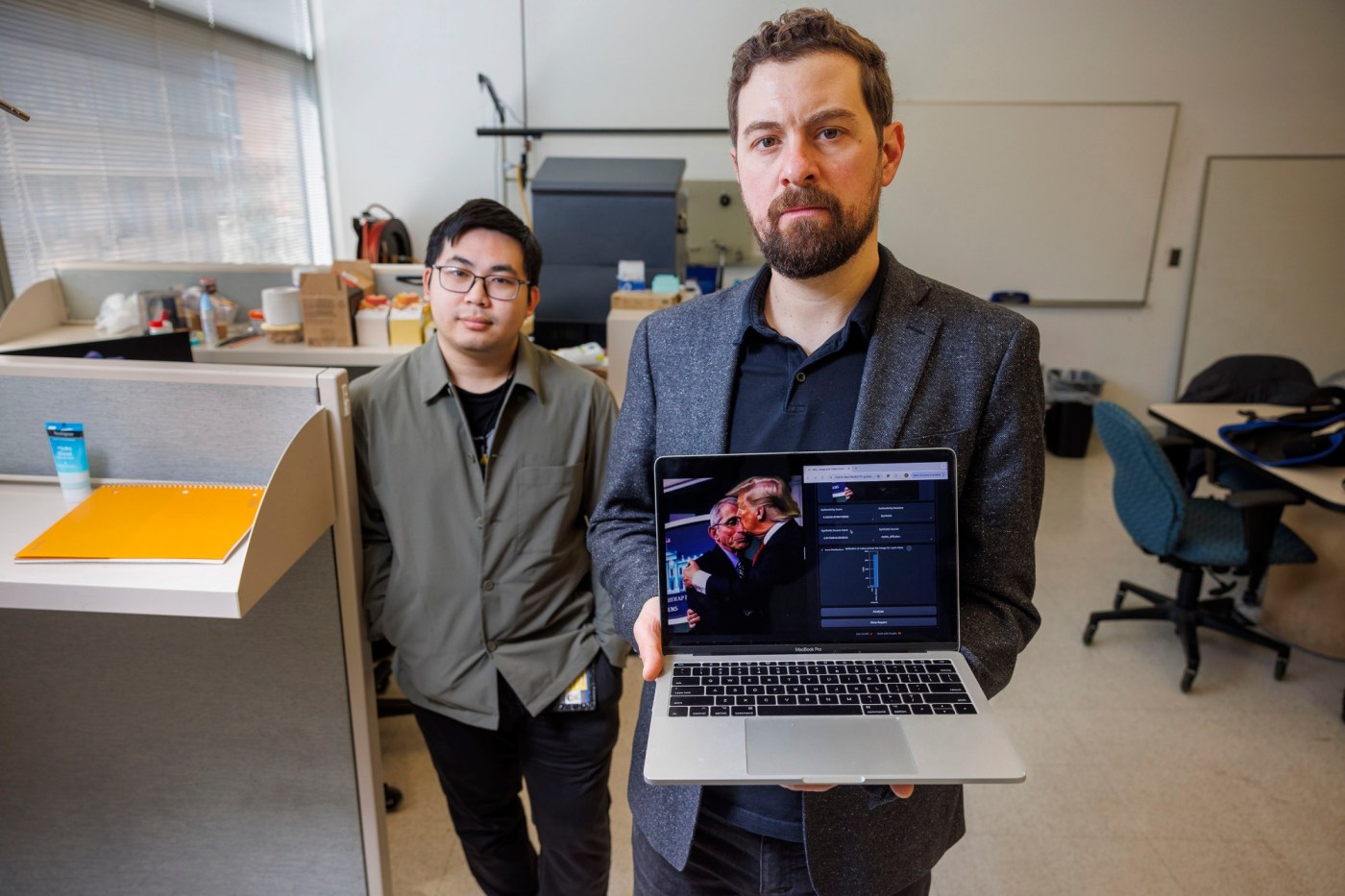
“This is the first presidential campaign of the AI era,” said Matthew Stamm, a Drexel University electrical and computer engineering professor who leads a team that detects false or manipulated political images. “I believe things are only going to get worse.”

Last year, Stamm’s group debunked a political ad for then-presidential candidate Florida Republican Gov. Ron DeSantis ad that appeared on Twitter. It showed former President Donald Trump embracing and kissing Anthony Fauci, long a target of the right for his response to COVID-19.

That spot was a “watershed moment” in U.S. politics, said Stamm, director of his school’s Multimedia and Information Security Lab. “Using AI-created media in a misleading manner had never been seen before in an ad for a major presidential candidate,” he said.

“This showed us how there’s so much potential for AI to create voting misinformation. It could get crazy.”

Election experts speak with dread of AI’s potential to wreak havoc on the election: false “evidence” of candidate misconduct; sham videos of election workers destroying ballots or preventing people from voting; phony emails that direct voters to go to the wrong polling locations; ginned-up texts sending bogus instructions to election officials that create mass confusion.

Pennsylvania Secretary of State Al Schmidt is leading a newly formed Election Threats Task Force, intended in part to combat misinformation about voting. In a brief interview, Schmidt noted that in recent years we’ve seen “how easily misinformation has been spread using far more primitive methods than AI — tweets and Facebook posts with no video or audio.

“So AI presents a far greater challenge if it’s weaponized to deceive voters or harm candidates.”

Sham Biden call

Like the internet itself, AI can be a powerful tool to both advance and hinder society.

And while bad actors have long possessed the ability to generate fraudulent content in the digital age, the contouring of text and imagery to shame or denigrate a political opponent was once “slow and painful,” said computer science professor David Doermann from the University of Buffalo, State University of New York.

“It took work to use Photoshop and video tools,” Doermann said. “You needed experts. But now, your average high school student can generate deepfakes.”

Deepfakes are synthetic media in which a person in a photo or video is swapped with another person’s likeness, or a person appears to be doing or saying something they didn’t do or say.

A recent example occurred before the January New Hampshire primary. An AI-generated robocall simulated President Joe Biden’s voice, urging voters not to participate, and “save” their votes for the November election.

Average voters could have easily believed Biden recorded the message and become disenfranchised as a result, noted the Campaign Legal Center, a nonpartisan government watchdog group in Washington, D.C.

“This is the first year to feature AI’s widespread influence before, during and after voters cast ballots,” said CLC executive director Adav Noti. “AI provides easy access to new tools to harm our democracy more effectively.”

Malicious intent

AI allows people with malicious intent to work with great speed and sophistication at low cost, according to the Cybersecurity & Infrastructure Security Agency, part of the U.S. Department of Homeland Security.

That swiftness was on display in June 2018. Doermann’s University of Buffalo colleague, Siwei Lyu, presented a paper that demonstrated how AI-generated deepfake videos could be detected because no one was blinking their eyes; the faces had been transferred from still photos.

Within three weeks, AI-equipped fraudsters stopped creating deepfakes based on photos and began culling from videos in which people blinked naturally, Doermann said, adding, “Every time we publish a solution for detecting AI, somebody gets around it quickly.”

Six years later, with AI that much more developed, “it’s gained remarkable capacities that improve daily,” said political communications expert Kathleen Hall Jamieson, director of the University of Pennsylvania’s Annenberg Public Policy Center. “Anything we can say now about AI will change in two weeks. Increasingly, that means deepfakes won’t be easily detected.

“We should be suspicious of everything we see.”

‘Democracy can wither’

Misinformation has gushed like a “fire hose of falsehoods,” some of it from Russia, said Matt Jordan, director of the Pennsylvania State University News Literacy Initiative, which helps students and citizens distinguish “reliable journalism” from “the noise that often overwhelms and divides us,” according to its website.

Democracy, Jordan said, “depends on a capacity to share reality,” which misinformation shatters. In such an atmosphere, he warned, “democracy can wither.”

Politicians aren’t the only ones at risk in that atmosphere.

Security specialists recommend election workers keep personal social media accounts private so that pernicious individuals armed with AI have less access to their images and voices. To avoid online intimidation on Election Day, experts also suggest election workers use multistep log-ins, ever-changing pass phrases, and fingerprint scanning.

“In 2020, we encountered a lot of ugliness related to threats, and have had to scramble to make sure our people feel safe,” said Schmidt, Pennsylvania’s top election official.

AI-generated misinformation helps exacerbate already entrenched political polarization throughout America, said Cristina Bicchieri, Penn professor of philosophy and psychology.

“When we see something in social media that aligns with our point of view, even if it’s fake, we tend to want to believe it,” she said.

To battle fabrications, Stamm of Drexel said, the smart consumer could delay reposting emotionally charged material from social media until checking its veracity.

But that’s a lot to ask.

Human overreaction to a false report, he acknowledged, “is harder to resolve than any anti-AI stuff I develop in my lab.

“And that’s another reason why we’re in uncharted waters.”

_____

(c)2024 The Philadelphia Inquirer. Visit The Philadelphia Inquirer at www.inquirer.com. Distributed by Tribune Content Agency, LLC.

Burnsville man charged after neighbor, 17, struck by bullet as she slept

posted in: Society | 0

A Burnsville man was charged Tuesday with reckless discharge of a firearm after a 17-year-old who lived in the apartment below his bedroom was injured by a bullet while she slept.

Officers were dispatched to the Southwind Village Apartments in the 15200 block of Greenhaven Drive off Burnhaven Drive and Crystal Lake Road about 3:55 a.m. Saturday. They saw a hole in the ceiling directly above the teen’s bed.

Police set up a perimeter of the neighboring apartment and called an occupant, who said his 26-year-old son legally owned three firearms but he hadn’t heard a gunshot, according to a criminal complaint.

The 26-year-old called police a few minutes later, saying he owned a shotgun, a rifle and a handgun. He said he hadn’t fired a firearm or heard a shot.

Police arrested the man. Other occupants of the apartment said they heard him playing video games in his room, where his mother said he kept his three firearms.

In the man’s bedroom, police found two magazines for a handgun on a desk. One appeared full and the other was missing a round. Police put a trajectory rod in the hole in the ceiling of the teen’s room and it led to the man’s bedroom, the complaint said.

The 17-year-old reported she was sleeping on her side when she felt a burning sensation in her arm. She knew she was shot because she saw a bullet nearby. She received medical care at a hospital and her injury was classified as a “through and through” wound that caused swelling, the complaint said.

Minnesota court records show no past convictions for the man.

Related Articles

Crime & Public Safety |


Stray bullet strikes St. Paul fire station, causing minor damage to engine and ambulance inside

Crime & Public Safety |


Final three defendants plead guilty in Minnesota murder case taken away from local prosecutor

Crime & Public Safety |


Report of suicide in St. Paul’s Merriam Park turns into homicide investigation as police learn details

Crime & Public Safety |


Pair found fatally shot in car are identified as Blaine residents

Crime & Public Safety |


Indiana felon sentenced to 10 years in prison for Inver Grove Heights bank robbery

Why are Black people more likely to develop glaucoma? Scientists discover new clues

posted in: News | 0

Tom Avril | The Philadelphia Inquirer (TNS)

A team led by University of Pennsylvania scientists has discovered three genetic variants that offer the first strong clues as to why glaucoma disproportionately affects Black people.

The variants are common in people with African ancestry and are associated with a significantly higher risk of developing the sight-robbing disease, the researchers found in their study of more than 11,000 volunteers, including 6,300 from the Philadelphia area.

More research is needed to determine if these variants — each consisting of just a single “letter” among the 3 billion pairs of letters that spell out the human genome — play a direct role in causing glaucoma. But if they stand up to scrutiny, the findings someday could be used to develop better treatments and identify people who could benefit from them, said Shefali Setia Verma, one of the lead study authors and an assistant professor at Penn’s Perelman School of Medicine.

“The idea is that this can help identify individuals who are at higher risk before any symptoms occur,” she said.

Previous studies have found more than 170 other genetic variants that are involved in glaucoma, a condition in which the optic nerve becomes damaged, often as a result of increased pressure inside the eye. But most of those studies were conducted among white or Asian populations — despite the fact that glaucoma is more common in Black people and, when it occurs, is more likely to lead to blindness.

And most of the genetic variants discovered in those previous studies turned out to play little or no role in the disease for Black people, illustrating the need for diversity in study populations, said Penn physician-scientist Joan M. O’Brien.

“It was a hugely unmet need,” she said.

Gaining trust from Black patients

That’s what prompted O’Brien, Verma, and their colleagues to launch the new study, which is among the first — and by far the largest — conducted among Black people.

O’Brien blamed the shortage of studies partly on the justifiable misgivings that many Black people hold about medical research, citing examples of misconduct such as the Tuskegee experiment in which Black men were not treated for syphilis.

Ongoing bias in medicine continues to contribute to mistrust. For instance, Black patients are less likely than white patients to receive pain medication, and less likely to be admitted to the hospital from the emergency room. Until recently, they had to wait longer than white patients for a kidney transplant.

“Clearly there are reasons for individuals of African ancestry to distrust studies and distrust medicine and distrust many things related to science,” she said. “That doesn’t excuse us from trying to involve people of African ancestry.”

Related Articles

Health |


Some Medicaid providers borrow or go into debt amid ‘unwinding’ payment disruptions

Health |


Overdosing on chemo: A common gene test could save hundreds of lives each year

Health |


Few states cover fertility treatment for same-sex couples, but that could be changing

Health |


Telehealth sites promise cure for ‘male menopause’ despite FDA ban on off-label ads

Health |


COVID and Medicare payments spark remote patient monitoring boom

So she and her coauthors then embarked on an unusual campaign to enroll volunteers, spreading the word as they conducted vision screenings at predominantly Black churches, community centers, and health fairs. Eydie Miller-Ellis, a Penn ophthalmologist and study author who is Black, also promoted the study on Black-owned radio station WURD.

They ended up with 11,275 study participants, including the 6,300 that Penn physicians enrolled from the Philly area. The rest came from elsewhere in the United States, as well as Ghana and Nigeria, recruited by collaborators at other institutions.

The scientists started by comparing the genomes of study participants who had glaucoma with the genomes of participants who did not, identifying dozens of genetic variants that differed between the two groups.

Then winnowed down that list to the final three by conducting a series of laboratory studies in human cells. They also validated their findings by checking them against other genetic databases, including Penn Medicine’s own BioBank, a repository of blood and genetic samples of which 17% were contributed by Black people.

Glaucoma risk increase

All three variants were found in noncoding regions of the genome — what used to be erroneously referred to as “junk DNA,” or stretches of DNA that lie outside the genes. But as scientists have found in many other instances, these three variants, despite not being part of any gene, appear to play a role in the activity of nearby genes.

One of the variants was associated with a 75% increase in the risk of glaucoma. The other two each were linked to a 25% increase in risk of the disease.

The three variants appear to play some sort of causal role in the disease, but more work is needed to be sure what that is. O’Brien, director of the Penn Center for Genetics of Complex Disease, hopes that someday the findings could be incorporated into a rapid test, suitable for use in a primary-care office.

Such a test would allow physicians to identify and counsel at-risk patients before they are aware of any symptoms. People with the disease often are unaware they have it, as it typically starts with declining peripheral vision, which patients may not notice at first.

The genetic findings also could guide the development of better drugs, O’Brien said. Currently, physicians treat the disease by trying to lower the pressure inside patients’ eyes, first with medication and later, if needed, surgery.

But those tactics don’t work for everyone in whom the disease is caused by elevated eye pressure, O’Brien said. And in some cases, the disease can occur in people whose eye pressure is normal.

“We know it’s not just the pressure,” she said. “But that’s the only treatment we have to give.”

©2024 The Philadelphia Inquirer, LLC. Visit at inquirer.com. Distributed by Tribune Content Agency, LLC.

Some Medicaid providers borrow or go into debt amid ‘unwinding’ payment disruptions

posted in: News | 0

Katheryn Houghton | KFF Health News (TNS)

Jason George began noticing in September that Medicaid payments had stalled for some of his assisted living facility residents, people who need help with daily living.

Guardian Group Montana, which owns three small facilities in rural Montana, relies on the government health insurance to cover its care of low-income residents. George, who manages the facilities, said residents’ Medicaid delays have lasted from a few weeks to more than six months and that at one point the total amounted to roughly $150,000.

George said the company didn’t have enough money to pay its employees. When he called state health and public assistance officials for help, he said, they told him they were swamped processing a high load of Medicaid cases, and that his residents would have to wait their turn.

“I’ve mentioned to some of them, ‘Well what do we do if we’re not being paid for four or five months? Do we have to evict the resident?’” he asked.

Instead, the company took out bank loans at 8% interest, George said.

Montana officials finished their initial checks of who qualifies for Medicaid in January, less than a year after the federal government lifted a freeze on disenrollments during the height of the covid-19 pandemic. More than 127,200 people in Montana lost Medicaid with tens of thousands of cases still processing, according to the latest state data, from mid-February.

Providers who take Medicaid have said their state payments have been disrupted, leaving them financially struggling amid the unwinding. They’re providing care without pay, and sometimes going into debt. It’s affecting small long-term care facilities, substance use disorder clinics, and federally funded health centers that rely on Medicaid to offer treatment based on need, not what people can pay.

State health officials have defended their Medicaid redetermination process and said they have worked to address public assistance backlogs.

Related Articles

Health |


Overdosing on chemo: A common gene test could save hundreds of lives each year

Health |


Few states cover fertility treatment for same-sex couples, but that could be changing

Health |


Telehealth sites promise cure for ‘male menopause’ despite FDA ban on off-label ads

Health |


COVID and Medicare payments spark remote patient monitoring boom

Health |


Experts say Medicaid rebate change is behind inhaler price cuts

Financial pinches were expected as people who legitimately no longer qualify were removed from coverage. But the businesses have said an overburdened state workforce is creating a different set of problems. In some cases, it has taken months for people to reapply for Medicaid after getting dropped, or to access the coverage for the first time. Part of the problem, providers said, are long waits on hold for the state’s call center and limited in-person help.

The problem is ongoing: George said two Guardian residents were booted from Medicaid in mid-March, with the state citing a lack of information as the cause.

“I have proof we submitted the needed information weeks ago,” he said.

Providers said they’ve also experienced cases of inconsistent Medicaid payments for people who haven’t lost coverage. It can be hard to disentangle why payments suddenly stop. Patients and providers are working within the same overstretched system.

Jon Forte is the head of the Yellowstone County health department in Billings, which runs health centers that provide care regardless of patients’ ability to pay. He said that at one point some of the clinics’ routine Medicaid claims went unpaid for up to six months. Their doctors are struggling to refer patients out for specialty care as some providers scale back on clientele, he said.

“Some have honestly had to stop seeing Medicaid patients so that they can meet their needs and keep the lights on,” Forte said. “It is just adding to the access crisis we have in the state.”

Payment shortfalls especially hurt clinics that base fees on patient income.

David Mark, a doctor and the CEO of One Health, which has rural clinics dotted across eastern Montana and Wyoming, said the company anticipated making about $500,000 in profit through its budget year so far. Instead, it’s $1.5 million in the red.

In Yellowstone County, Forte said, the health department, known as RiverStone Health, is down $2.2 million from its anticipated Medicaid revenue. Forte said that while state officials have nearly caught up on RiverStone Health’s direct Medicaid payments, smaller providers are still seeing delays, which contributes to problems referring patients for care.

Jon Ebelt, a spokesperson for the Montana Department of Public Health and Human Services, said Medicaid can retroactively pay for services for people who have lost coverage but are then found eligible within 90 days. He said the state’s average redetermination processing time is 34 days, the average processing time for applications is 48 days, and, when processing times are longer, it’s often due to ongoing communication with a client.

Ebelt didn’t acknowledge broader Medicaid payment delays, but instead said a provider may be submitting claims for Medicaid enrollees who aren’t eligible. He rejected the idea that individual examples of disruptions amount to a systemic problem.

“We would caution you against using broad brush strokes to paint a picture of our overall eligibility system and processes based on a handful of anecdotal stories,” Ebelt said in an emailed response to a KFF Health News query.

Ebelt didn’t directly answer questions about continued long waits for people seeking help but instead said continued coverage depends on individual beneficiaries submitting information on time.

Federal data shows Montana’s average call center wait time is 30 minutes — putting it among states with the highest average wait times. Mike White, co-owner of Caslen Living Centers, which has six small assisted living facilities across central and southwestern Montana, said some family members allowed the company to manage residents’ Medicaid accounts to help avoid missing deadlines or paperwork. Even so, he said, the company is waiting for about $30,000 in Medicaid payments, and it’s hard to reach the state when problems arise.

When they do get through to the state’s call center, the person on the other end can’t always resolve their issue or will answer questions for only one case at a time.

“You don’t know how long it’s going to take — it could be two months, it could be six months — and there’s nobody to talk to,” White said.

Ebelt said long-term care facilities were provided information on how to prepare for the unwinding process. He said new Medicaid cases for long-term care facilities are complicated and can take time.

Stan Klaumann lives in Ennis and has power of attorney for his 94-year-old mom, who resides in one of Guardian’s assisted living homes. Klaumann said that while she never lost coverage, the state didn’t make Medicaid payments toward her long-term care for more than four months and he still doesn’t know why.

He said that since last fall the state hasn’t consistently mailed him routine paperwork he needs to fill out and return in exchange for Medicaid payments to continue. He tried the state’s call center, he said, but each time he waited on hold for more than two hours. He made four two-hour round trips to his closest office of public assistance to try to get answers.

Sometimes the workers told him that there was a state error, he said, and other times that he was missing paperwork he’d already submitted, such as where money from selling his mom’s car went.

“Each time I went, they gave me a different answer as to why my mother’s bills weren’t being paid,” Klaumann said.

Across the nation, people have reported system errors and outdated contact information that led states to drop people who qualify. At least 28 states paused procedural disenrollments to boost outreach to people who qualify, according to federal data. Montana stuck to its original time frame and has a higher procedural disenrollment rate than most other states, according to KFF.

Stephen Ferguson, executive director of Crosswinds Recovery in Missoula, said the substance use disorder program doesn’t have a full-time person focused on billing and sometimes doesn’t realize clients lost Medicaid coverage until the state rejects thousands of dollars in services that Crosswinds submits for reimbursement. After that, it can take months for clients to either get reenrolled or learn they truly no longer qualify.

Ferguson said he’s writing grant proposals to continue to treat people despite their inability to pay.

“We’re riding by the seat of our pants right now,” he said. “We are unsure what next month or the next quarter looks like.”

(KFF Health News is a national newsroom that produces in-depth journalism about health issues and is one of the core operating programs of KFF — the independent source for health policy research, polling and journalism.)

©2024 KFF Health News. Distributed by Tribune Content Agency, LLC.