Rep. Marjorie Taylor Greene vows to force a vote next week on ousting House Speaker Mike Johnson

posted in: News | 0

By LISA MASCARO and KEVIN FREKING (Associated Press)

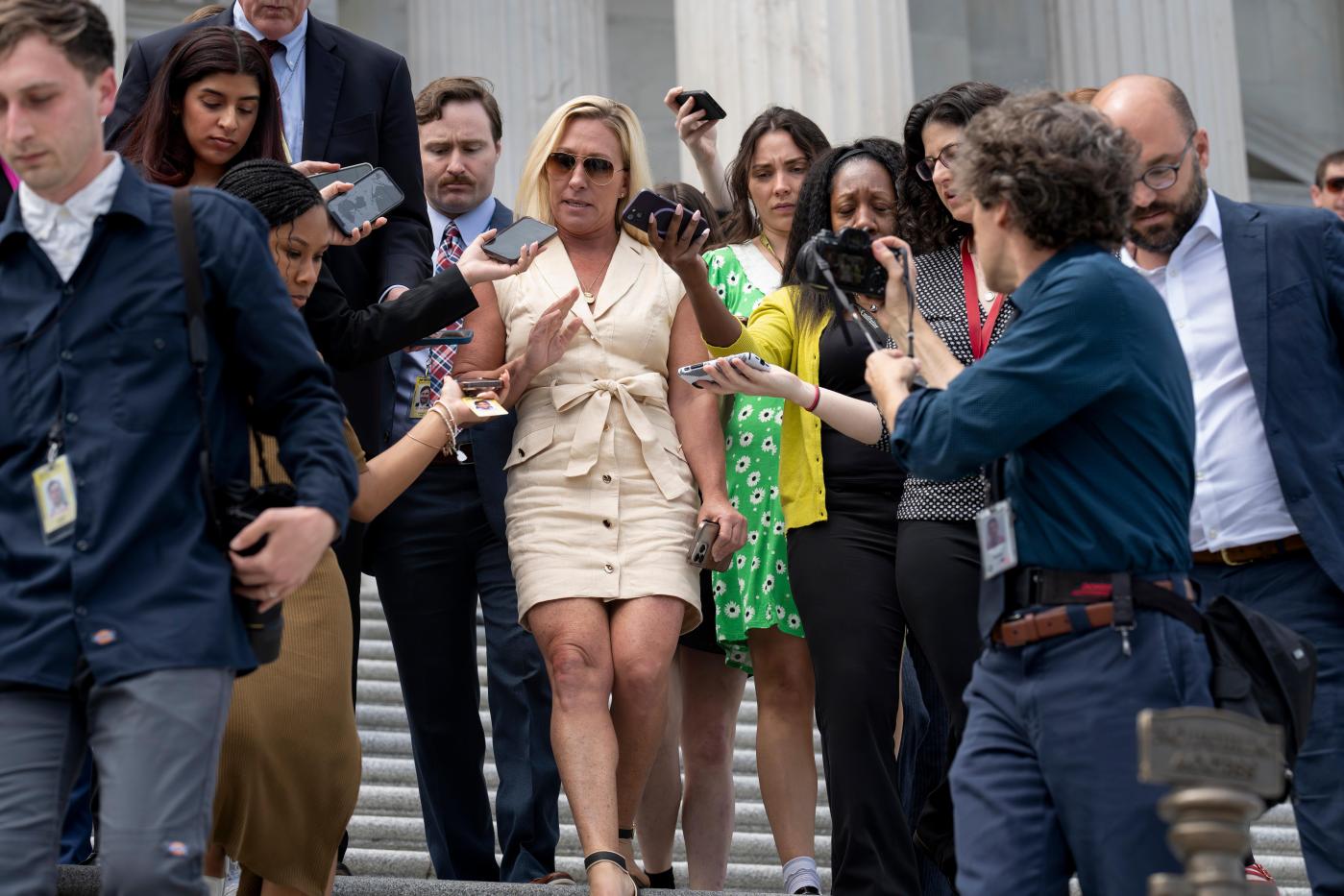
WASHINGTON (AP) — Republican Rep. Marjorie Taylor Greene said Wednesday she would call a vote next week on ousting House Speaker Mike Johnson, forcing her colleagues to choose sides in a difficult showdown after Democratic leaders announced they would provide the votes to save the Republican speaker’s job.

Speaking outside the Capitol, Greene ranted against Republican Party leaders at the highest levels and pushed back against their public entreaties, including from Donald Trump, to avoid another messy political fight so close to the November election. With her was Rep. Thomas Massie, R-Ky., one of the few lawmakers to join her effort.

“We need leaders in the House of Representatives that are going to get this done,” said Greene, R-Ga., holding up a red “MAGA” hat from Trump’s “Make America Great Again” campaign movement.

“Mike Johnson is not capable of that job,” she said.

In pressing ahead next week, she said that “every member of Congress needs to take that vote.”

The standoff with Greene, one of Trump’s most enthusiastic supporters, risks throwing Republican control of the House into a fresh round of chaos as rank-and-file lawmakers will have to choose between ousting Johnson, R-La., as speaker or joining with Democrats to keep him on the job.

Johnson, in his own statement, said Greene’s move was “wrong for the Republican Conference, wrong for the institution, and wrong for the country.”

Democrats see in Johnson a potential partner, a hard-line conservative who nevertheless is willing to lead his Republican Party away from the far-right voices obstructing the routine business of governing, including funding the government and, more recently, supporting Ukraine and other U.S. allies overseas.

The Democratic leader, New York Rep. Hakeem Jeffries, and his team issued a joint statement this week saying it was time to “turn the page” on the GOP chaos, announcing that the Democrats would vote to table Greene’s motion to vacate the speaker’s office, essentially ensuring Johnson is not evicted from office.

Johnson’s public opponents are few, at this point, and less than the eight that it took to oust now-former Rep. Kevin McCarthy, R-Calif., last fall in the first ever removal of sitting speaker from the powerful office that is second in the line of succession to the president. Just one other Republican, Rep. Paul Gosar of Arizona, has joined Greene’s effort.

Greene and Massie said they were giving their colleagues the weekend to weigh their options before calling for the vote on her motion to vacate next week. Or, they said, Johnson could simply resign, pointing to the example of a previous speaker, Republican John Boehner of Ohio, who stepped aside in 2015 when hard-liners threatened to oust him.

“Are you going to embrace Hakeem Jeffries like Mike Johnson has?” said Massie, before a poster-photo of Jeffries handing Johnson the gavel when the Republican first became speaker last fall.

“They’ve got a weekend to think about it, but more importantly, Mike Johnson has a weekend to think about it.”

The turmoil has gripped a House already essentially at a standstill. Johnson has been unable to command his razor-thin majority to work together on party priorities and has been forced him into the arms of Democrats for the votes needed to approve most big bills — and now, to keep his job.

Johnson had been elected by Republicans as a last-ditch consensus candidate after McCarthy’s ouster, but he courted the far-right’s ire when he led passage of the $95 billion foreign aid package for Ukraine and U.S. allies that they oppose.

Trump has given a nod of support to Johnson, who dashed to the former president’s Mar-a-Lago club in Florida last month to shore up backing.

Other Republican leaders, including Trump’s hand-picked head of the Republican National Committee, Michael Whatley, have urged House Republicans to hold off the removal effort before the fall election that will determine which party controls the White House and Congress.

In a private meeting Tuesday, Whatley urged House Republicans to unite around their shared priorities. He delivered the same message later in the day to Greene, telling her that trying to remove Johnson was not helpful, according to a person familiar with the conversations who was not authorized to discuss them publicly and spoke on condition of anonymity.

While the Democratic leaders have said they would provide the votes to table Greene’s motion when it comes forward, essentially shelving it, it is not clear that all Democratic lawmakers would join that effort.

At their own private meeting this week, some Democrats objected to helping Johnson, particularly after he helped lead Trump’s legal challenges to the 2020 presidential election won by Democrat Joe Biden. Party leaders have said their support for sidelining Greene’s resolution is not the same as a vote for Johnson.


Gophers’ turnover at receiver continues with Dallas Sims transferring out

posted in: News | 0

The Gophers football team’ revolving door at wide receiver continued spinning on Tuesday.

Dallas Sims, a true freshman from Clearwater, Fla., said he was entering the NCAA transfer portal after only one semester at the U. Sims was an early enrollee at Minnesota for spring semester and went though spring practices.

Sims is the second receiver to enter the portal this week. Emporia State transfer Jaylen Varner exited on Monday, with Georgia transfer Tyler Williams entering on April 23.

During this portal window, the Gophers have had six players exit and five players enter.

Related Articles

College Sports |


Gophers football: Jaylen Varner reenters NCAA transfer portal before playing for the U

College Sports |


Gophers tight end Brevyn Spann-Ford signs with Dallas Cowboys

College Sports |


Gophers football: Indiana prep defensive lineman Enoch Atewogbola commits to U

College Sports |


Gophers football: Enormous right tackle Aluma Nkele joins from UTEP

College Sports |


Gophers safety Tyler Nubin selected by New York Giants in second round

Bordering on Cowardice

posted in: News | 0

In an otherwise strong State of the Union address this March, President Joe Biden breathed new life into a term the immigrant rights movement has spent years pushing out of the Democratic vocabulary. He was stumbling over a sentence; right-wing Congresswoman Marjorie Taylor Greene was heckling him from the audience about a young woman in Georgia who’d allegedly been killed the month prior by a non-U.S. citizen. Apparently parroting Greene, Biden confirmed that the woman, Laken Riley, had been killed “by an illegal.” 

Backlash was swift from pro-immigrant Congress members and advocates who’ve long fought for the idea that “No human being is illegal.” (For what it’s worth, the alleged killer had reportedly been released into the country through a stopgap parole mechanism.) “The rhetoric President Biden used tonight was dangerously close to language from Donald Trump that puts a target on the backs of Latinos everywhere,” warned San Antonio Congressman Joaquin Castro.

The president went on television two days later to acknowledge he should have used a more respectful word like “undocumented,” describing such rhetorical choices as a “difference between Trump and [him].” Asked point-blank if he regretted his wording, he said yes. But—after Biden’s apparent apology was mocked by Trump and the GOP U.S. House speaker—a White House spokesperson insisted at a press briefing, “The president absolutely did not apologize.”

At best, Biden’s use of a retrograde xenophobic insult could have occasioned a sincere apology and a forceful insistence on the basic fact that undocumented immigrants are less likely to commit crimes than the native-born. But the president’s PR shop felt it more important to (unsuccessfully) avoid looking soft on unauthorized immigration. This decision was but a minor example of Biden’s overall reelection strategy of shifting right on immigration to try to neutralize his opponent’s top issue. 

The real crisis is that we are perilously close to abandoning the dream of bringing our neighbors “out of the shadows.”

It’s all a far cry from 2020, when Democrats had polarized leftward on immigration and then-candidate Biden spoke boldly of restoring “our historic role as a safe haven for refugees and asylum-seekers” and called migrants “an irrefutable source of our strength.” On taking office, Biden paused deportations and submitted to Congress a desperately needed reform proposal including increased visas and a path to legalization for the nation’s 11 million undocumented residents. But, despite campaign pledges, he never threw his weight behind the bill. Eventually, as the pandemic waned worldwide, arrivals at the U.S.-Mexico border increased, GOP fear-mongering accelerated, and polling showed the public somewhat reverting to nativist alarmism. With reelection looming, Democrats began throwing 2020 positions overboard, retreating to more hawkish views common in the party pre-Trump.

Early this year, Biden spied a political opening. He caved to a GOP congressional ploy to pair unrelated foreign aid with a border crackdown, embracing a bipartisan Senate bill over strenuous objections from Latino Democratic senators. The bill would have profoundly undermined asylum law by granting the president a convoluted new power to shut down the border, while generally raising the bar for securing asylum. Unlike previous attempts at “comprehensive immigration reform,” the measure did not even offer citizenship to the so-called Dreamers—immigrants brought as children who’ve often known no other home. “Democrats have really ceded a lot of ground to the Republican position,” one advocate told Al Jazeera in February.

To the seeming delight of Biden world, Republicans ultimately killed the bill, giving the president a talking point he’s since treated like a rented mule: It is the GOP, in fact, who won’t secure the border. As Politico reported in March, “The president’s team believes [it’s been able] to neutralize the political backlash Biden was facing and even reap some benefits in the polls.”

This cynical gambit may or may not work. It will be difficult to steal Trump’s border-crackdown thunder, but Biden probably sees a no-lose situation because pro-immigrant voters have nowhere else to go. If reelected, Trump would likely hand the immigration keys to his top nativist advisor Stephen Miller, who’s been planning what he calls “the most spectacular migration crackdown.” Meanwhile, Dems are letting robust pro-immigrant arguments go to rust and possibly undermining long-term chances for enduring reform.

Take, for example, Dallas Democratic Congressman Colin Allred, now running to unseat GOP Senator Ted Cruz. Allred has vaulted atop the border-hawk bandwagon, signing on to a misleading Republican-led House resolution in January denouncing Biden’s “open-borders policies.” Last fall, he went so far as to praise Biden’s decision to build 20 miles of noncontiguous border wall in South Texas’ Starr County, a move that the president himself described as pointless but out of his hands to stop. 

It’s sad enough for a Texas politician to promote the forced taking of Texans’ private property to build pointless bits of wall, but Allred’s move was also politically hackish. In 2018, he’d called the border wall “racist” and said his generation would “tear it down”—comments the Cruz campaign has predictably used to call out Allred’s “cowardly flip-flopping strategy.” 

Meanwhile, Democratic mayors in the North have made matters worse. Starting in 2022, Texas Governor Greg Abbott began busing migrants to out-of-state blue cities, a gambit to troll so-called sanctuary cities. Fearing local backlash, these panicked mayors have played into Abbott’s hands, with Eric Adams even claiming the arrivals would “destroy New York City.” 

There are, of course, some bright spots within the Democratic Party, including Latino Congress members from Texas’ big cities: San Antonio’s Castro, El Paso’s Veronica Escobar, Greg Casar of Austin, and Sylvia Garcia in Houston. 

But the overall debate has devolved to the point that some Dems could stand to crib a few lines from Texas Republicans of yore. Contradictory policies notwithstanding, George W. Bush described the undocumented in 2006 as “decent people who work hard, support their families, practice their faith, and lead responsible lives,” and Rick Perry said of Dreamers in 2001: “We don’t care where you come from, but where you are going, and we are going to do everything we can to help you get there.” 

Yes, Trump killed that strain of Republican politics. But Trump is also one of history’s small men. The question of human freedom of movement is enormous and will outlast this man who presently warps our nation’s moral compass. 

In 2017, thousands in Dallas joined the “Immigration Reform Mega March,” an homage to a 2006 march that drew out half a million participants. (Gus Bova)

We live in an era of mass migration fueled by war, climate change, and post-pandemic economic crisis, along with ease of international travel and communication. Long past 2024, America’s leaders will face a fundamental dilemma: Deterring migrants from seeking U.S. safety and prosperity requires measures that are cruel, expensive, and possibly illegal under international law. Outsourcing our border enforcement to Mexico, as Biden has begun attempting, may seem to work for a time but is amoral and unsustainable. Moving beyond the model of deterrence is the true challenge, and liberal leaders should be wedded to that cause. 

The federal asylum process—just one small corner of the immigration system—is indeed outdated, but the odds of Congress justly reforming it while today’s Republicans control the House are nil. And to risk gutting it without even legalizing the undocumented is ethical negligence. Our leaders need not always tail our worst instincts but may call us to our best. Any Texan, in particular, can cast propaganda aside and simply look around to see that our state is built, maintained, and improved every day by unauthorized workers. These same laborers send money back home, transforming their families’ lives, in quantities that make a laughingstock of any foreign aid program the United States even contemplates. 

The real crisis is that we are perilously close to abandoning the dream of bringing our neighbors “out of the shadows.” It is that what good steps Biden has taken on immigration—through executive action—can be immediately undone by a reelected Trump. It is that we could be demagogued into losing one of the things that makes this country, born of indelible sin, worth a damn: our fragile yet tenacious understanding that we are a nation of immigrants.

NYC Stabilized Tenants Face Another Round of Rent Hikes

posted in: News | 0

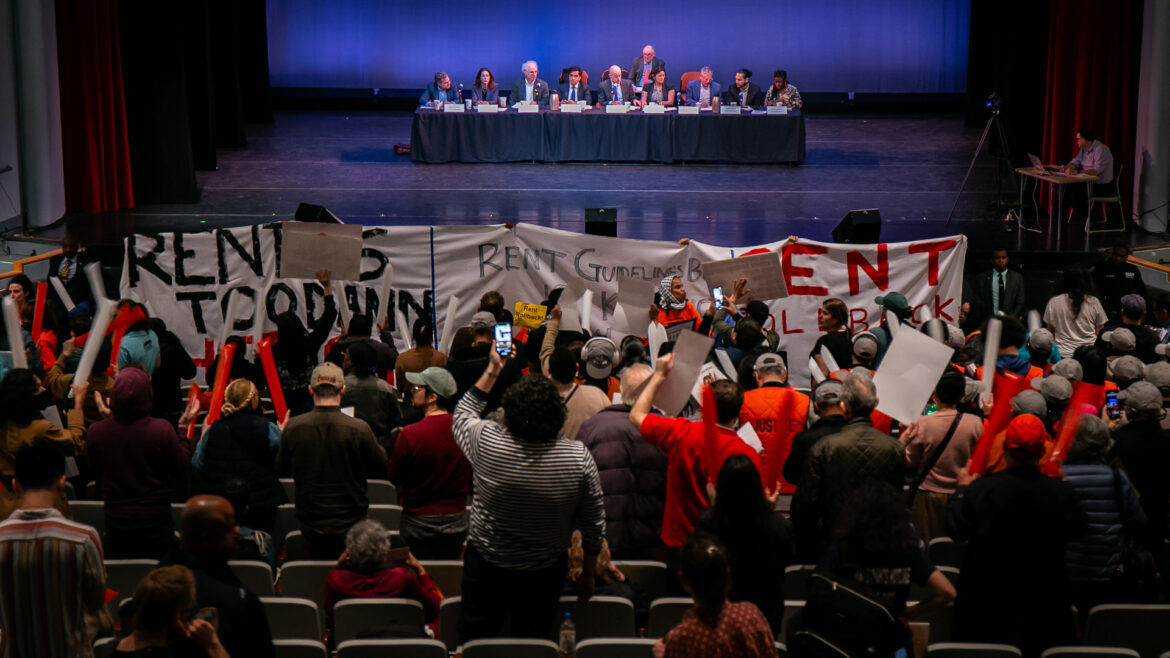
 In a swerve from precedent, the Rent Guidelines Board’s two tenant members dismissed Tuesday’s preliminary vote as a sham, casting a vote of no confidence in both the board and Mayor Eric Adams. 

Adi Talwar

Tuesday night marked the Rent Guidelines Board’s annual preliminary vote, which has historically set the goalposts for rent adjustments for stabilized tenants.

An already eventful year for tenants across New York City’s nearly 1 million rent stabilized apartments just got more raucous.

Tuesday night marked the Rent Guidelines Board’s annual preliminary vote, which has historically set the goalposts for rent adjustments for stabilized tenants, who also benefit from lease renewal rights. Renters and landlords alike will have chances to voice their concerns at public hearings in the coming weeks, ahead of a final vote on June 17. 

Gathered at LaGuardia Performing Arts Center in Long Island City, Queens, seven of the board’s nine mayoral appointees voted 5-2 in favor of rent hikes between 2 and 4.5 percent for a one-year lease and 4 to 6.5 percent for two years. Minutes earlier, its two tenant members had walked out in protest, along with most of the chanting crowd.

Board members Adán Soltren, a tenant lawyer, and Genesis Aquino, executive director of the organization Tenants and Neighbors, dismissed the process as a sham, casting a vote of no confidence in both the board and Mayor Eric Adams.

“Framing the issue as one of degrees of suffering between… owners who have negative consequences from business decisions and tenant suffering is abhorrent,” Soltren said in lengthy remarks before leaving the stage. “They are not, nor will they ever be equal, and the practice of treating the two as though they are is morally indefensible.” 

Above: Board members Adán Soltren, a tenant lawyer (left), and Genesis Aquino, executive director of the organization Tenants and Neighbors (right), walked out of the heating in protest. Photos by Adi Talwar.

Preliminary ranges and final rent increases have been relatively consistent during Adams’ first term, harkening back to the Bloomberg era. Last year saw a 3 percent increase for one year leases signed starting Oct. 1 and an unusual split for two-year leases, equivalent to a 4.4 percent hike.  

Jay Martin, executive director of the Community Housing Improvement Program (CHIP), a landlord trade group, stated Tuesday night that his members need a rent increase “near the highest part” of the range. He also bemoaned how the meeting played out, calling it an “appalling circus.” 

During former Mayor Bill de Blasio’s tenure, the board instituted the only one-year rent freezes in its history, in 2015, 2016 and 2020. Unlike de Blasio, who was explicit in calling for freezes, Adams often urges consideration of small property owners. “Everyone is dismissive of them,” he charged at an April 2 press conference. 

Following Tuesday’s vote, Adams stated that the board must strike a balance between protecting tenants and helping landlords maintain buildings, but that 6.5 percent is “far beyond what is reasonable to ask tenants to take on at this time.” His administration has defendended the board process as independent and data-driven. 

This year’s expected rent increases come on the heels of a tense state budget season, resulting in new eviction defenses for New York City tenants who don’t live in stabilized apartments. But the Good Cause Eviction law has numerous carve outs, and comes with the most significant changes to rent stabilization law since 2019. 

The deal at least doubled the Individual Apartment Improvement (IAI) cap, which limits how much stabilized landlords can increase rents to cover renovations. At a late April Rent Guidelines Board (RGB) meeting, real estate industry representatives dismissed these increases as insufficient to get empty apartments ready for market. 

“Legislators who did their own renovations were joking, ‘Maybe that gets me a new bathroom and a new kitchen.’ Forget about making things lead-safe… [or] electrical code upgrades,” said Reggie Thomas, senior vice president of government affairs at the Real Estate Board of New York, which participated in budget negotiations. 

Adi Talwar

Tenants rallying at the Rent Guidelines Board preliminary vote Tuesday night.

But tenant advocates have urged the board to take these newly-allowed rent hikes into consideration. Esteban Girón, an organizer with the Crown Heights Tenant Union, told City Limits Tuesday that the prospect of larger IAIs for vacant apartments makes it “crucial” to maintain affordable rents for existing tenants. 

Since late March, the RGB has also been reviewing a series of staff reports, aimed at assessing the economic conditions tenants and landlords are facing. 

Some landlord metrics have improved recently. For example, one study calculates their net operating income, or NOI, which is revenue after operating expenses, albeit with a one-year lag. Citywide NOI for buildings with rent stabilized units increased 10.4 percent between 2021 and 2022, after falling nearly as much the year prior. 

Landlord trade groups have dismissed the citywide NOI as misleading, noting that the biggest gains took place in Manhattan south of West 110th and East 96th streets, where NOI increased 42.3 percent following a temporary pandemic dip. In the Bronx, by contrast, NOI dropped 14 percent. Brooklyn and Queens saw modest gains. 

Joseph Condon, general counsel at CHIP, recently urged the board not to be “distracted” by the rosy citywide figure. He drilled down further to NOI data for older buildings, which he argued are in more dire straits than new rent stabilized buildings, which benefit from tax breaks. 

“If you peel out Core Manhattan, and you peel out all of the post-[19]73 regulated buildings, you’re looking at a citywide drop of around 16 percent,” he said at an April 25 board meeting.

But tenant advocates have argued that many real estate portfolios are geographically diverse, suggesting a cushion for landlords’ various pain points. Oksana Mironiva, housing policy analyst at the Community Service Society of New York (a City Limits funder) recently cited analysis from the tenant-aligned nonprofit JustFix. 

Adi Talwar

Tenant groups Marched through Queens on their way to the Rent Guidelines Board preliminary vote.

According to JustFix, 54 percent of rent stabilized buildings in Core Manhattan share owners with rent stabilized buildings in other parts of the city. “Even though Manhattan may be an island, property ownership is not,” Mironova testified on April 25. 

As for tenants’ economic conditions, the RGB found that average inflation-adjusted wages fell 6.1 percent from late 2022 to mid 2023. Residential evictions also increased nearly 200 percent in 2023, hitting 12,139—still lower than 2019, before the COVID-19 pandemic slowed housing court.  

Rent stabilized households have a lower median income than their market rate counterparts, according to the latest Housing Vacancy Survey: $60,000 in 2022, compared to $90,800. 

The survey also found that 20 percent of rent stabilized tenants are food insecure, or unable to afford either full or balanced meals at least part of the time, compared to 12 percent of market rate renters. 

In a historically tight rental market, stabilized apartments are a precious resource, according to Lucy Block, senior research and data associate at the Association for Neighborhood and Housing Development (ANHD), a member group of nonprofit developers and tenant groups. 

Her recent analysis found that over 700,000 New York City renters would need to find apartments renting for less than $1,100 to escape living with rent burden—a federal designation for spending more than 30 percent of one’s income on housing. 

Yet there are only 2,300 such apartments available, according to the HVS. Just over a quarter of the city’s rent stabilized apartments are in this most sought-after rent category, according to Block. 

“If the RGB votes to increase stabilized rents, we will lose even more of the city’s extremely limited low-rent housing stock,” she said in a written statement ahead of Tuesday’s vote. 

Paying the rent is already a challenge for Viola Bibins, a 77-year-old rent stabilized tenant from Crown Heights who attended Tuesday’s vote. “I have to decide: should I pay for my medication or should I pay my rent?” she told City Limits. “I am on a fixed income because I’m retired, and my rent isn’t that high but I still can’t afford it.” 

Adi Talwar

“I have to decide: should I pay for my medication or should I pay my rent?” said Viola Bibins, 77, a rent stabilized tenant from Crown Heights, Brooklyn.

To the extent that there is distress across rent stabilized buildings, it would be neither fair nor effective to compensate landlords with rent increases, tenant advocates have argued. Particularly when renters may not be able to pay the difference. 

In his board testimony this month, Jacob Udell, director of research and data at the University Neighborhood Housing Program, said these issues are better addressed with government subsidies like rental vouchers, and through regulatory interventions like the preservation plan set up following Signature Bank’s collapse last year. 

The RGB has a hammer, he testified earlier this month. But that “does not mean that the host of problems in the rent stabilized market is a nail.”

To reach the reporter behind this story, contact Emma@citylimits.org. To reach the editor, contact Jeanmarie@citylimits.org

Want to republish this story? Find City Limits’ reprint policy here.