‘The Chicano Time Traveler’

posted in: News | 0

Introduction by Lise Olsen

El Paso author Daniel Chacón likes to weave stories and dream up characters in the middle of ordinary episodes of life. The titular character of his new short story collection, The Last Philosopher in Texas: Fictions and Superstitions, came to him as he was walking his dog in Pecos, the windblown West Texas town where his father once lived. “It was really weird because there’s a lot of meth heads and there’s a lot of boarded-up windows,” he told the Texas Observer. He remembers spotting an ad for a manager at a fast food restaurant, one of the town’s best-paying jobs. The story took off when he thought: What would have happened If I had come up here after graduation?

Chacón is originally from Fresno and got a master’s degree in creative writing in Eugene, Oregon, but for decades El Paso and the border has been his home. A longtime professor, Chacón currently serves as chairman of the University of Texas at El Paso’s creative writing program, which bills itself as the nation’s only fully bilingual program, and he hosts a Sunday public radio program on KTEP called “Words on a Wire.”

“Okay, so the Chicano Time Traveler says to that pendejo Columbus, ‘Go home, whitey! We don’t need your ass over here.’”

In his life and work, Chacón, who is something of a philosopher himself, deeply probes limits and connections between the possible and the impossible, the imagination, the dreamworld, and what we call “reality.” For him, the U.S.-Mexico border is a place where those boundaries tend to disappear. Lately, he finds himself feeling like a time traveler in the undergraduate classes he teaches. Every year, he ages, and the cultural and literary references he uses become more unfamiliar to students, whose faces change but who remain forever young. “It’s not just in terms of age. I feel like I came from another time and place,” he said. 

Back in 1985, Chacón founded the Chicano Writers and Artists Association along with Fresno State classmate and friend Andrés Montoya. “I was a little younger when I joined the movement,” he recalled. “As progressive as they thought of themselves, it was all very male-centered and patriarchal and especially anti-gay,” he recalls. In one story in his new book, “The Chicano Time Traveler,” he explores how Chicano culture has evolved by recounting an exchange with an uncle whose ideas clash, sometimes hilariously, with inclusive Chicanx culture. Below is that story, from his 2024 book, reprinted in full with permission of the publisher Arte Publico Press.

The Last Philosopher in Texas: Fictions and Superstitions

“The Chicano Time Traveler”

Tío Rudy told me he had a story idea, and that he would sell it to me for a hundred bucks.

He said I would make lots of money, because it might be the most important story ever told. They might even make a Netflix series out of it, then I’d be rich.

“En serio. You could be successful.”

“I’m okay,” I said.

“Shit! Then how come you ain’t got no ruca?”

“Maybe having a girlfriend’s not my priority,” I said.

“Shi-it!” he said in two long syllables. “Everyone wants a ruca. Unless you’re…”

He looked me up and down.

“Anyway, bro. I’d write it myself, pero, ¿sabes qué? I don’t write too good.”

We were in the backyard of my abuela’s house on Mother’s Day, drinking beer, the sun falling down.

“Pero, my idea, it’s chingón!”

Rudy was an old-school Chicano, a living remnant and stereotype from the barrio. He even dressed old school cholo, and he had tattoos from his gang days, like a little dog paw above his left eye. He was a Fresno Bulldog, East Side. I say he was, because now, pulling the oxygen tank along with him everywhere he went, he didn’t participate in la ganga, but he did say, “Once a gang member, always a gang member.” He was proud to call himself a veterano.

“You’re a writer,” he said. “You could do this, homes.”

He actually used the word “homes,” as if traveling from the past. I hadn’t heard that word in at least two decades, not since the word was replaced by “homie” and “homeboy.”

Rudy was approaching sixty, and he looked it, not like a “forty is the new sixty look,” but like an old man.

His hair was balding, with some stubs standing up like under the power of static electricity, and his cheeks sagged down like a walrus.

“Okay, so check it out. Here’s the idea. It’s called ‘The Chicano Time Traveler,’ ese.”

I wondered, did anyone say “ese” anymore?

“Okay, so the Chicano Time Traveler… Man, this vato is a superhero. He goes through time, man, in and out of any time he wants, and he changes all the fucked-up things the gabacho has done to us, ¿entiendes? ¿Sabes qué? This fucker is mero mero! Like for example, say Christopher Columbus is coming to America, our hero travels in time and is right there on the beach waiting for that maricón.”

Ow, that hurts, I think. I ask him, “Why do you call Columbus a maricón?”

“I don’t mean a gay dude, m’ijo. I just mean, he’s a fuck head, ¿entiendes?”

“But why maricón?” I ask.

“All right, bro. Let’s say, instead of maricón,  pendejo. That better?”

“Less offensive,” I say.

“Okay, so the Chicano Time Traveler says to that pendejo Columbus, ‘Go home, whitey! We don’t need your ass over here.’

“And Columbus would say, ‘Nah, man! I’m here to get me some gold and shit.’

“Pero ¿sabes qué? The Chicano Time Traveler knows how to throw down chingazos, so he fucks up Columbus real good.

“And that gringo turns around and never comes back. And, ¿sabes qué? When the Chicano Time Traveler goes back home to Fresno or East Los or Chuco, or from wherever he lives in Aztlán, things would be different. Brown people would be in charge, man. Chicanos would be mayors and shit. Fucking lawyers and doctors and shit… And people struggling like me wouldn’t have one job. We’d have two jobs! Making la feria, ¿entiendes? All the native peoples would be hooked up, because we’re native, bro. Don’t forget that. I know you’re a little light-skinned, güerito, but it’s true. We’re fucking natives!”

“Okay, let me ask you just one thing,” I said.

“Want another beer?” he asked.

“Yeah!”

So, he grabbed two cans from the cooler and tossed me one. I caught it.

“So, what do you think of my story, bro! Pretty fucking brilliant, no?”

“Well… I have some questions. First of all: Why is he ‘Chicano’?”

“What the fuck you talkin’ about?”

“That’s an antiquated term,” I said. “Rooted in misogyny. Maybe he should be the ‘Chicanx’ or the ‘Latinx’ Time Traveler. That’s what the young activists are saying these days.”

“Fuck that. That’s sellout shit. I’m a Chicano.” And  he started to sing that old Texas Tornados song:

Chicano! Soy Chicano!
And I’m brown and I’m proud
And I’ll make it in my own way.

“Our young people today…” I said, interrupting his song, “…they want to leave out gender, too. It’s no longer fundamental to identity. In fact, why don’t you call it The Chicana Time Traveler?”

“He ain’t no girl,” he said.

“Might be better if she were,” I said. “But even if he is a he, why can’t we say ‘Chicana’? Why can’t that term mean an entire community of men and women and nongendered people? For generations we’ve used the term ‘Chicano’ to mean everybody in the barrio, although it’s clearly a masculine noun. Why can’t we use the feminine term—CHICANA—to indicate everybody? Why stick to patriarchal rules of language?”

“Fuck you!” he said and he walked away, dragging his oxygen tank with him. “Sellout piece of mierda!” he said. “I’ll take my story somewhere else, vendido.”

As I was trying to sleep that night, I had a dream about Rudy.

At least, I think it was a dream. It seemed real, somewhere between memory and a dream. We were in my abuela’s garage drinking beer, listening to some tunes, and everything seemed like virtual reality, like I knew it was all false, but the detail was amazing. I saw the United Farm Workers’ poster, and I could even see the glare of the garage lights on the smooth surface. Underneath the poster, I saw a worktable with some tools scattered about, a crescent wrench, a hammer, screwdrivers and some nails and screws. There was even an old 7-11 Big Gulp cup that must have been sitting there for a long time.

It was the 1990s. I was maybe sixteen years old. I wanted to be a writer back then, so of course I wrote poems and stories. This night in the garage, I read Rudy what I was certain was my best story. I don’t even remember what it was about. After it was over, he slowly shook his head.

“Dude, that was off the fucking wall! You’re going to be a famous writer. I know it in my gut, ese. You got talent!”

Rudy was a hard-core gangster in those days. He did all kinds of crazy shit, but whenever I was with him, he would try to be a good uncle. He would give me beer and smoke weed with me, but he felt an obligation to teach me something. In this memory or dream, Rudy suddenly got serious.

“¿Sabes qué?” he said. “No matter how famous you get, never forget you’re a brown man. They’re going to try to take you down, ese, but you got to fight,” he said. “Don’t forget your people. You got to fight the power.” And I believed him.

I took that with me when I got my bachelor’s degree in English. But since it quickly became clear that I was not likely to make a living as a writer, I went to law school and became a lawyer, an activist. For the last ten years I’d been working at a private law firm, and they were about to make me a partner, the first Latinx person in the firm to have such status. I was making good money, and every time we were allowed to do pro bono work, I always remembered Tío Rudy and tried to help out la gente.

In this dream, we were in my abuela’s garage drinking beer. We were listening to Led Zeppelin. And I said, “You know what, Uncle Rudy? I like your story idea. I think it’s really good, and I’d like to write it.”

“What story, fool?” he asked.

“The Chicano Time Traveler,” I said.

“I have no idea what you’re talking about,” he said.

And I explained the idea he would tell me twenty years or so in the future. He laughed when I told him about Columbus getting his ass kicked by our cholo hero.

“That’s a great story, homes! ¿Sabes qué? I’m gonna remember that shit! You watch! I’m gonna remember that shit. ¡Por vida!”

Top-ranked golfer Scottie Scheffler arrested near fatal crash. Then he tees off at PGA Championship

posted in: News | 0

By DOUG FERGUSON (AP Golf Writer)

LOUISVILLE, Ky. (AP) — Masters champion Scottie Scheffler was arrested Friday morning on his way to the PGA Championship, with stunning images showing him handcuffed as he was taken to jail for not following police orders during a pedestrian fatality investigation.

In a span of four hours, the top-ranked golfer in the world was arrested wearing gym shorts and a tee shirt, dressed in an orange jail shirt for his mug shot, returned to Valhalla Golf Club in golf clothes and made his 10:08 a.m. second-round tee time.

“This morning, I was proceeding as directed by police officers,” he said in a statement released as he was warming up on the range. “It was a very chaotic situation, understandably so considering the tragic accident that had occurred earlier, and there was a big misunderstanding of what I thought I was being asked to do.

“I never intended to disregard any of the instructions,” he said. “I’m hopeful to put this to the side and focus on golf today. Of course, all of us involved in the tournament express our deepest sympathies to the family of the man who passed away in the earlier accident this morning. It truly puts everything in perspective.”

His attorney, Steve Romines in Louisville, also described it as a misunderstanding and told The Associated Press, “We will litigate the case as it goes.”

Traffic was backed up for about a mile in both directions on the only road that leads to Valhalla in the morning darkness with light rain, with dozens of police vehicles flashing red-and-blue lights near the entrance.

Police said a pedestrian had been struck by a bus while crossing the road in a lane that was dedicated to tournament traffic and was pronounced dead at the scene about 5:09 a.m. The PGA of America identified the man as an employee of one of its vendors.

ESPN reporter Jeff Darlington said Scheffler, the No. 1 player in the world who was to start the second round at 8:48 a.m., drove past a police officer a little after 6 a.m. in his SUV with markings on the door indicating it was a PGA Championship vehicle.

The officer screamed at him to stop and then grabbed onto the car until Scheffler stopped about 10 yards later.

Scheffler was booked at 7:28 a.m. — about 2 1/2 hours before his updated tee time after the second round was delayed because of the fatality. Police said he was booked for second-degree assault of a police officer, third-degree criminal mischief, reckless driving and disregarding traffic signals from an officer directing traffic.

“The main thing is he was proceeding exactly as he was directed in a marked vehicle with credentials,” Romines said. “He didn’t do anything intentionally wrong.”

The officer, identified in the arrest report as Det. Gillis, was dragged “to the ground” and suffered “pain, swelling, and abrasions to his left wrist” after the car “accelerated forward,” according to Louisville police.

The officer was dressed in a high visibility reflective jacket when he stopped Scheffler’s car to give instructions, the arrest sheet said. Gillis was taken to the hospital for his injuries.

Darlington watched it unfold. He said police pulled Scheffler out of the car, pushed him up against the car and immediately placed him in handcuffs.

“Scheffler was then walked over to the police car, placed in the back, in handcuffs, very stunned about what was happening, looked toward me as he was in those handcuffs and said, ‘Please help me,’” Darlington said. “He very clearly did not know what was happening in the situation. It moved very quickly, very rapidly, very aggressively.”

Mitchell told Louisville radio station WHAS the man was crossing Shelbyville Road about 5 a.m. and the bus didn’t see him. Mitchell said the man was pronounced dead on the scene.

Scheffler was released by police and returned to the course at 9:12 a.m. He made his way to the practice area around 9:30 a.m. and was welcomed by fans — one shouted “free Scottie!”

Scheffler seemed like his normal, relaxed self, sharing a few laughs on the driving range. Then he went out and made a birdie on his first hole of the day after sticking his approach shot to three feet.

With cars backed up in the morning darkness, other PGA-marked vehicles tried to move slowly toward the entrance. Traffic finally began to move gradually a little before 7 a.m.

It was a surreal start to what already has been a wild week of weather — the Masters champion and top-ranked player in the world, dressed in workout clothes with his hands in cuffs behind his back amid flashing flights.

Darlington said police were not sure who Scheffler was. He said an officer asked him to leave and when he identified himself being with the media, he was told, “There’s nothing you can do. He’s going to jail.”

Darlington said another police officer later approached with a notepad and asked if he knew the name of the person they put in handcuffs.

Scheffler is coming off four victories in his last five tournaments, including his second Masters title. He was home in Dallas the last three weeks waiting on the birth of his first child, a son that was born May 8.

Scheffler opened with a 4-under 67 and was five shots out of the lead as he tries to become only the fifth player since 1960 to win the first two majors of the year.

___

F.D. Flam: It’s officially hotter than anytime since the birth of Jesus

posted in: News | 0

It’s one thing to say the Northern Hemisphere summer of 2023 was the hottest of the 150 years people have been making measurements. This well-documented claim is often dismissed by skeptics of global warming who point out that the Earth has a long history of temperature fluctuations. That’s why it’s important that a new paper shows last summer was actually the hottest in the last 2,000 years — and that our current temperatures are even more of an outlier than we realized.

If all we had were the few decades of temperature readings to understand the past climate, we wouldn’t know whether our current warming was a major shift or a run-of-the-mill blip. Tree rings hold records that can go back thousands of years, giving us the perspective we need to understand what’s happening today.

In a paper published in Nature this week, scientists used tree rings not only to show long-term trends, but to plot Northern Hemisphere summer temperatures year by year for the last two millennia. 2023 was the hottest of them all. The next hottest 25 have all occurred since 1996. The next runner-up was way back in 246 CE.

The world’s understanding of global warming changed dramatically when scientists started to document long-term temperature trends using tree rings, ice cores, sediment layers and other natural temperature monitors. In 1998, scientists published the famous “hockey stick graph” covering the last 600 years. It showed that global temperatures rose and fell like gently rolling hills until the mid-20th century, when they suddenly soared.

That gave people a graphic image of just how unusual things are today. Unable to discredit the results, some people tried to discredit the researchers by hacking into their emails in 2009 and taking statements out of context to imply they’d done something wrong — creating a phony scandal called “climate-gate.”

Since then, there have been dozens of more detailed or further-reaching reconstructions of our climate history. This latest one covers only the part of the globe that has the most trees — the mid-latitude Northern Hemisphere — but it goes back in fine-grained detail 2,000 years and highlights climate change today in the context of centuries of natural variability.

Even seemingly small fluctuations can have a big impact on human life. Take 536 CE, dubbed “the worst year to be alive” by historian Michael McCormick. An Icelandic volcano erupted, spewing particles into the atmosphere and veiling much of Europe and Asia with a strange, dark fog. That caused cold, famines and a wave of plague that coincided with the collapse of the Eastern Roman Empire. The new Nature paper shows the temperature that summer that year was just 1.9 C below the long-term average and 3.9 C colder than then summer of 2023.

Volcanoes have usually been to blame for cooler years. But the cause of past warm spells is not as well understood. The year 246 CE was also unusually warm. More recently, the Medieval warm period, between 800 CE and 1400 CE, allowed orchards and pastures to spread into Northern Europe, Iceland and Greenland — and also triggered megadroughts, famine and collapse of civilizations in the American Southwest.

Tree rings are allowing scientists to decipher the role of climate in that period and others throughout history. The oldest trees — bristlecone pines — can live nearly 5,000 years; scientists can extract a pencil-thin core to study the rings without harming the trees. But researchers don’t have to use such ancient trees to explore the distant past because they can also read information from rings in wood that’s been incorporated into old buildings, ships or preserved in bogs.

Trees growing in cold conditions can reveal temperature history because temperature is the main factor limiting their growth. The new study depended on such trees in nine different sites analyzed by 15 different teams, said the lead author, Jan Esper of Johannes Gutenberg University in Germany.

Esper said he was interested in better understanding what the Earth’s temperature was like in the pre-industrial area, before human-generated emissions started warming the planet. The Intergovernmental Panel on Climate Change defines pre-industrial temperature as the average measured from 1850 to 1900. The Paris Agreement makes it a goal to keep global temperatures within 1.5 C of that pre-industrial period — a threshold we’re close to exceeding.

But measurements before 1900 were sparse, and Esper says the tree rings suggest the actual pre-industrial era was a bit cooler. From 1850 to 1900, temperatures were already about a quarter of a degree warmer than the average over the previous 2,000 years. That means our current temperatures might be more abnormally warm than we realized. Ray Bradley, a climatologist of the University of Massachusetts, Amherst, was an author on the original hockey stick paper. He said the new paper and the initial hockey stick paper use different techniques and are asking different questions, but both show us how our current era fits into the bigger sweep of time.

“You often hear politicians — ignorant politicians — saying climate varies and it’s been warmer in the past so don’t get too excited about all this greenhouse gas we’re putting into the atmosphere,” said Bradley. But the natural records suggest it hasn’t been this warm in 2,000 years, maybe longer, “so that’s a pretty exceptional situation.”

Exceptional but not hopeless — climatologists say it’s not too late to keep global warming within a manageable range. If we listen to what nature is telling us, we can keep 536 CE as the worst year to be alive.

F.D. Flam is a Bloomberg Opinion columnist covering science. She is host of the “Follow the Science” podcast.

Related Articles

Opinion |


Lisa Jarvis: A shocking number of doctors don’t understand menopause

Opinion |


Daniel DePetris: Vladimir Putin has much to celebrate. But the Russian people don’t

Opinion |


Cory Franklin: Was Sweden’s COVID-19 approach superior to that of the U.S.?

Opinion |


Trudy Rubin: The biggest story last week was not Stormy Daniels or campus protests

Opinion |


Thomas Friedman: Biden’s real mistake in pausing military aid to Israel

McDonald’s MVP Alice Kane marks 35 years at Stillwater restaurant

posted in: News | 0

The McDonald’s near the St. Croix Valley Recreation Center in Stillwater gets pretty busy over the lunch hour.

There’s a steady stream of customers placing orders at the drive-thru while others use the kiosk near the front counter.

Alice Kane with Stillwater McDonald’s owner Andy Duval on Thursday. (John Autey / Pioneer Press)

It’s Alice Kane’s job to help make sure everything runs smoothly — from keeping the dining area and lobby clean to taking food orders to preparing food trays to delivering meals to seated guests to keeping the counter area stocked to attending the drive-thru.

She’s been doing it since May 1989, and she plans to keep going for at least another decade.

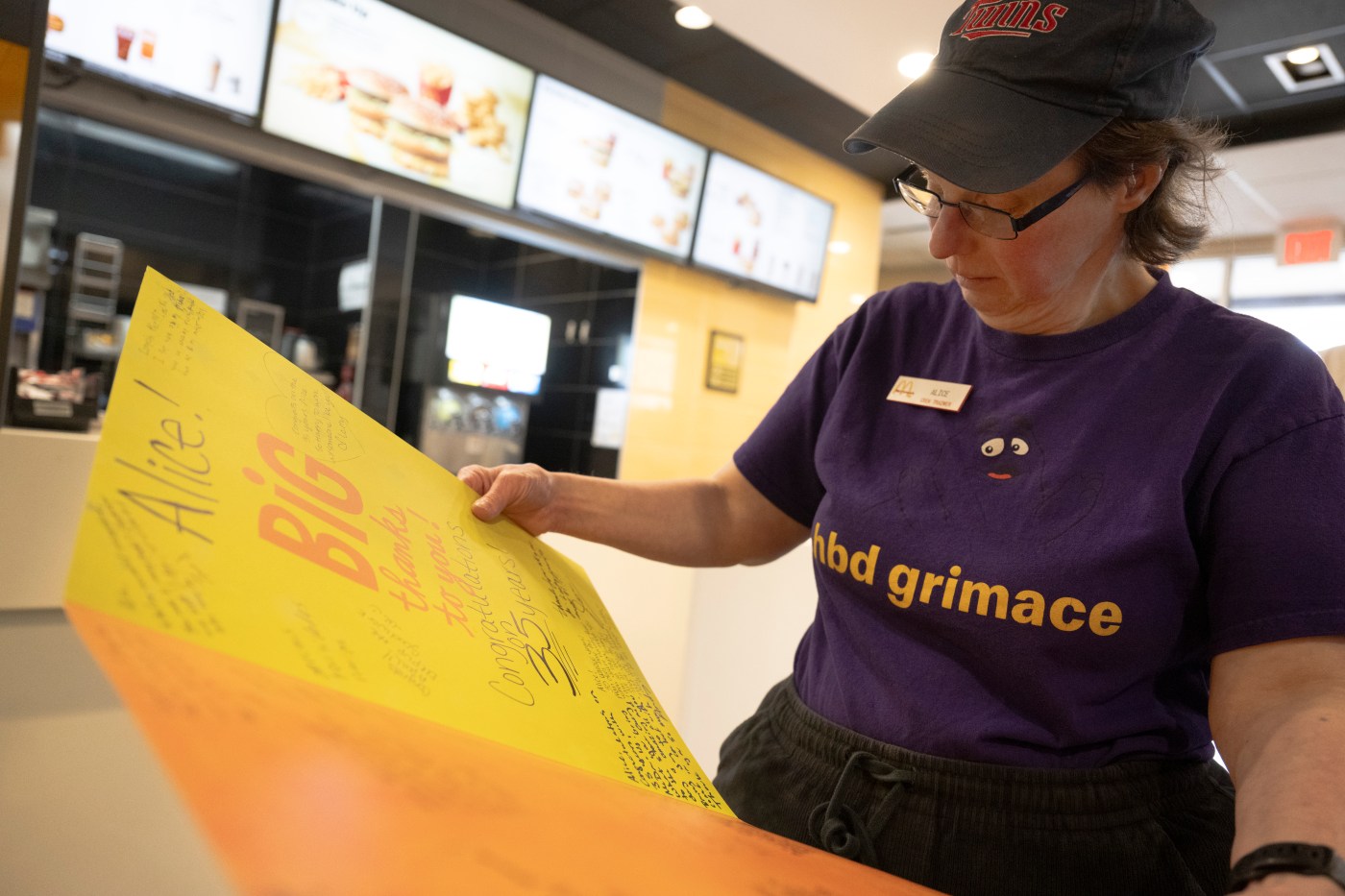
On Thursday, McDonald’s officials marked Kane’s 35th work anniversary with a cake, balloons and a huge card. Her new “Kane” Vikings jersey with “35” on the back — ordered as an anniversary gift by owner Andy Duval — was still en route, he said.

“This is an opportunity for us to thank Alice for 35 amazing years,” Duval said. “Thank God you’re here. How would we run without Alice? We really wouldn’t. We’d close down shop. We admire her consistency, her constant hard work. She’s a joy for all the workers and the customers.”

From cleaner to trainer

Kane, 55, of Lake Elmo, was initially hired as a cleaner at the original Stillwater McDonald’s, actually located in Oak Park Heights, but once her second manager got to know Kane, who has Down syndrome, “she thought I could do much more than clean, so she trained me on all the different jobs,” Kane said.

“I never dreamed I would work here for so many years, but I like it,” Kane said. “I really like the people. I have such friendly customers, and I’ve really gotten to know them over the years.”

Kane’s managers encouraged her to study and take the exam to qualify to be a crew trainer in 2008. Since then, Kane has helped train most of her co-workers on all the jobs required to keep the restaurant running. Some of those employees have gone on to become McDonald’s store managers, she said.

Nick Christianson, director of operations, who started working for McDonald’s in Stillwater in December 2008, is one of them.

“She actually trained me in,” he said. “I was 15 when I first started, and I was really nervous. I wasn’t very good. She was very patient. She has a great attitude and is always on time. She’s one of those people who wants to do things the right way. Everybody loves Alice. Everybody knows her. People come in just to chat with her.”

Alice Kane talks with general manager Jonathan deVries at the start of her shift at the restaurant Thursday. Kane has done most jobs at the restaurant and has trained many of her co-workers. (John Autey / Pioneer Press)

Customers come to the restaurant and ask for Kane by name, said Missy Johnson, second assistant manager.

“They’re like, ‘Oh, where’s Alice?’” she said. “‘Is Alice coming in today?’ She’s absolutely a draw.”

Kane is one of Johnson’s favorite people to work with because she’s punctual and she makes work fun, she said. “We always just have a great time together. She’s super helpful, and she knows what she’s doing. She’s a super hard worker. She knows pretty much every position. If we need her somewhere, she’s right there and willing to step in. She will help even in the kitchen if we need her there.”

Help from Rise

Kane generally works about 18 hours a week, from about 11 a.m. to 4 p.m. Monday, Tuesday, Thursday and Friday. She meets each week with Stacy Egeness, an employment consultant from Rise, a nonprofit organization that supports people with disabilities and other barriers to employment. The two discuss any work-related issues Kane may have and organize her rides to and from work on Metro Mobility.

Related Articles

Local News |


Former President Donald Trump to visit St. Paul Friday. What are the security expenses for the city?

Local News |


Trolling Trump ahead of his fundraising visit, St. Paul mayor invites city to community lunch

Local News |


Hamline University’s protest encampment ends with 10 students facing discipline

Local News |


St. Paul City Council OKs variances for United Village restaurant building by Allianz Field

Local News |


Cambridge couple stranded in Brazil with premature newborn say they are stuck in ‘bureaucratic morass’

“Alice is one of my favorite people to coach, honestly, because she is endlessly positive,” said Egeness, who has worked with Kane for just over a year. “When I first started, I was a little nervous, but she immediately started talking to me, and I’ve been comfortable with her ever since. The first day, she makes people feel welcome. The world would be a better place if there were more people like Alice.”

Egeness, in fact, purposely tries to see Kane on Mondays because “she gets you excited for the week,” she said.

“She always has a great perspective on things, and I think that’s what makes her a good worker, too, because she’s really kind, very sweet, and always wants to help out,” she said.

Afton foster family

Kane grew up in Afton. When she was 3 months old, she was placed with Harold and Dolores Krahn, longtime foster-care providers in Ramsey and Washington counties. The couple, who had seven biological children, took in more than 400 foster-care children over the span of 55 years.

“(Dolores) said she took one in, and it grew on her, so she wanted to do more,” Kane said. “She was always calm and patient.”

Harold Krahn died in 1989. Kane and three other foster children lived with Dolores Krahn until 1998 when her health started to decline; she died a year later.

When Dolores Krahn started to have health issues, Linda Koslowski, who had been with the Krahns since she was 4 days old, became a licensed foster-care provider. “I got my license so we could all stay together,” Koslowski said.

Kane now lives with Koslowski, 68, in a townhouse in Lake Elmo.

“I call her my sister since we grew up in the same house since we were very small, but we’re not biologically related,” Kane said. “I’ve been with Linda since I was 3 months old.”

Koslowski worked for Hooley’s and Cub Foods in Stillwater for 46½ years; Kane’s goal is to beat her sister, she said.

“I’ve got to go another 11½ years,” Kane said. “I’ll be 66. I should be able to do that.”

Koslowski said that Kane actually plans to hit her 47th work anniversary on May 11, 2036. “She’s going for 47,” Koslowski said. “She can’t just stop at 46. She can’t tie Hooley’s and Cub. She’s got to top it. So she’s going to 47 at McDonald’s.”

Likes and dislikes

Alice Kane hands a customer their order on Thursday. Kane started working at McDonald’s in May 1989. (John Autey / Pioneer Press)

Kane’s favorite things to do at work are “doing front-counter register and first drive-thru register person and presenting in the second drive-thru where I double check orders and hand the food and drinks out,” she said.

The worst part of the job? “Dealing with unfriendly customers,” she said.

Kane has worked at the restaurant long enough that she doesn’t have to pay for food. Unfortunately, her favorite items — the grilled-chicken sandwich and the yogurt parfait — are no longer on the menu, she said.

“Now I get the deluxe crispy chicken sandwich, light on the mayo and cheese,” she said. “I don’t eat the fries; I stay away from the fries. If I do order fries, they have to be no salt. I drink water during the week. If I do get a drink, I get a Sprite on the last day of the week.”

Kane supplements her McDonald’s lunch with a yogurt and fresh fruit that she brings from home “to make (her) lunch healthier,” she said. “I like my red grapes, and I like my blueberries and I like strawberries.”

Kane is a fierce fan of the Minnesota Vikings and the Minnesota Twins. Her favorite current Twin is shortstop Carlos Correa. “My all-time favorite is Kirby Puckett. I love Joe Mauer, too,” she said.

Her favorite Viking used to be Kirk Cousins, “but then he left and went to the Atlanta Falcons,” said Kane, who regularly checks her cell phone for sports updates. “I used to like Joshua Dobbs, but he didn’t last long. I’m excited about the new upcoming quarterback J.J. McCarthy. I think he’ll be good. He came from the University of Michigan, where he won 27 games and only lost one, and he won the national championship — that’s what it said in the newspaper.”

She is not a fan of that other team — that one from Wisconsin.

“I despise the Green Bay Packers,” she said. “Silly goose.”

Kane is a self-proclaimed newshound, reading the Pioneer Press cover to cover each day and watching TV news twice a day.

“I watch Fox 9 in the morning and WCCO at night,” she said.

“Fox to get her going and WCCO to get her to bed,” Koslowski said.

Her favorite singers are Reba McEntire and Whitney Houston. Her favorite restaurants are Machine Shed in Lake Elmo and Sgt. Pepper’s in Oakdale. She also likes going to the movies, going for walks and chatting with family and friends on Facebook Messenger.

‘Down syndrome like me’

Kane works out once a week at the Courage Kenny Rehabilitation Institute fitness center and pool in Stillwater. She also is active at Guardian Angels Catholic Church in Oakdale, where she volunteers as an usher and at special events.

Because she has worked at McDonald’s for so long, Kane feels like she knows “pretty much everyone in Stillwater,” she said.

Related Articles

Local News |


Have a great idea for Stillwater? You could win $10,000 to make it happen.

Local News |


Bison return to Afton’s Belwin Conservancy this weekend

Local News |


Stillwater: Celebration planned to mark end of Historic Courthouse’s $4.5M makeover

Local News |


Newport man pleads guilty to fatally shooting cousin at transit center

Local News |


Anderson, Lunneborg, Donaldson: State law needs a tweak this year so Lakeview Hospital project can proceed

Running errands or going places with Kane is like being with a celebrity, said Sue Labno, a longtime friend.

“Wherever you go with Alice, you will find that she has a friend that comes up to her and talks to her,” she said. “I’ll say, ‘You know everybody!’ She really does.”

Kane said she likes to run into people and kids who have Down syndrome. “I just smile and say, ‘Oh, you have Down syndrome like me,’” she said.

Kane said she hopes to one day train another employee at McDonald’s who has an intellectual or developmental disability.

“That way they can be independent and be the best they can be,” she said. “McDonald’s is a good place to work.”