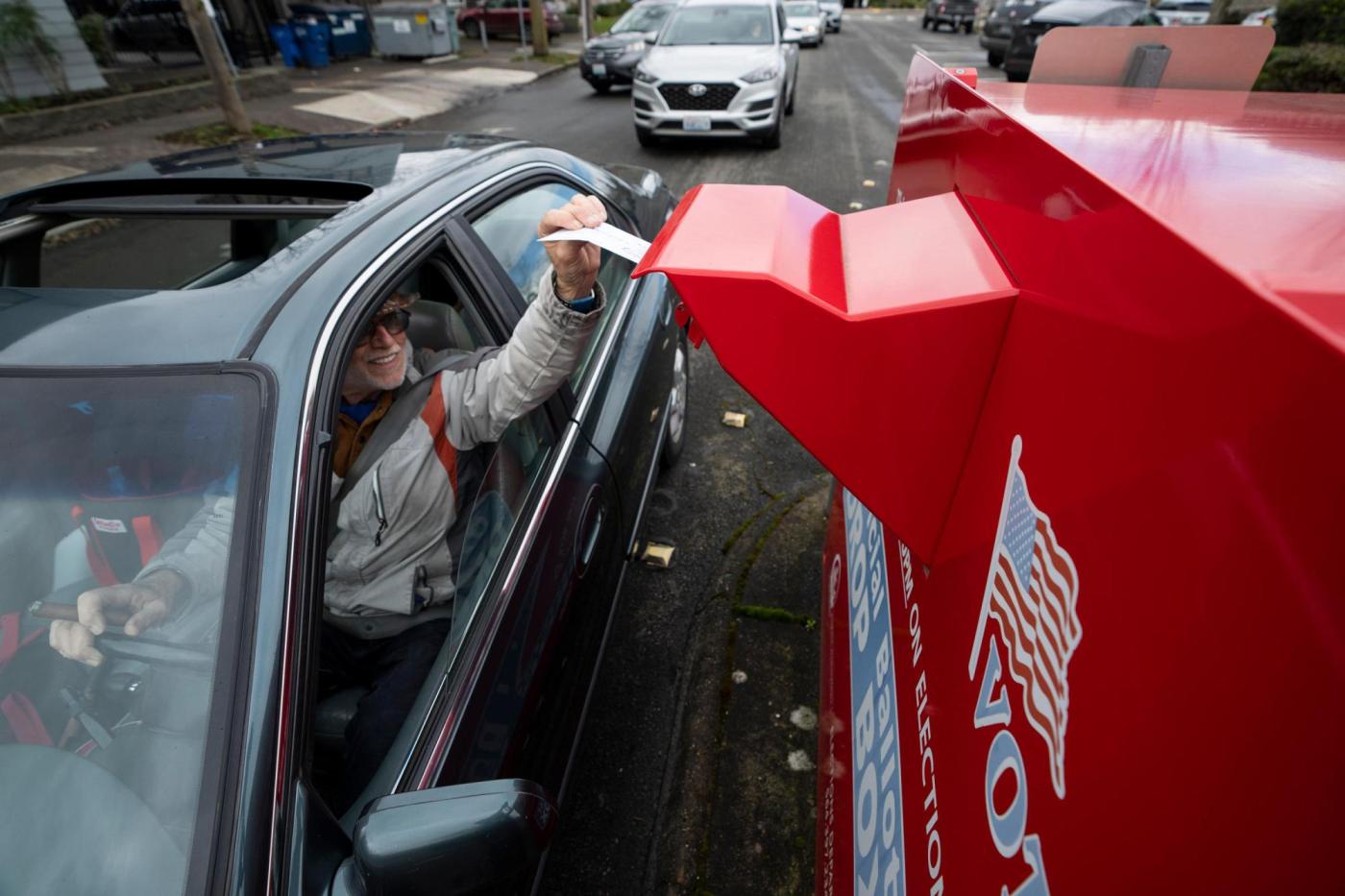
After blaming his 2020 loss on mail balloting, Trump tries to make GOP voters believe it’s OK now

posted in: News | 0

By NICHOLAS RICCARDI and MARGERY BECK (Associated Press)

Marta Moehring voted the way she prefers in Nebraska’s Republican primary Tuesday — in person, at her west Omaha polling place.

She didn’t even consider taking advantage of the state’s no-excuse mail-in ballot process. In fact, she would prefer to do away with mail-in voting altogether. She’s convinced fraudulent mailed ballots cost former President Donald Trump a second term in 2020.

“I don’t trust it in general,” Moehring, 62, said. “I don’t think they’re counted correctly.”

But now Republican officials — even, sometimes, Trump — are encouraging voters such as Moehring to cast their ballots by mail. The GOP has launched an effort to, in the words of one official, “correct the narrative” on mail voting and get those who were turned off to it by Trump to reconsider for this year’s election.

The push is a striking change for a party that amplified dark rumors about mail ballots to explain away Trump’s 2020 loss, but it is also seen as a necessary course correction for an election this year that is likely to be decided by razor-thin margins in a handful of swing states.

“We have to get right on using these mail-in ballots for the people who can’t get there on Election Day,” Rep. Scott Perry, one of Trump’s strongest congressional allies in his push to overturn the 2020 election, said at a conservative gathering in his home state of Pennsylvania.

Republicans once were at least as likely as Democrats to vote by mail, but Trump changed the dynamics in 2020. He preemptively began to argue that mail balloting was bad months before voting began in the presidential race.

That alarmed GOP strategists who saw mail voting as an advantage in campaigns because it lets them “bank” unreliable votes before Election Day and lowers the risk of turnout plummeting because of bad weather or other unpredictable factors at the polls. Trump’s own campaign tried to sell Republicans on casting ballots by mail, but his voters listened to the then-president. In 2020, amid the COVID-19 pandemic, Democrats were vastly more likely to cast ballots by mail than Republicans.

The trend continued in 2022, and its costs were starkly illustrated in Arizona.

Three top-of-the-ticket Republican candidates there who echoed Trump’s lies about the unreliability of mail ballots encouraged their supporters to vote in person on Election Day. An election machine meltdown that day in one-third of the polling places in the state’s most populous county led to huge lines and some would-be voters departing in frustration.

The three top Republicans all lost, including falling 17,000 votes short in the governor’s race and 500 votes short in the one for attorney general.

Related Articles

National Politics |


Biden’s upcoming graduation speech roils Morehouse College, a center of Black politics and culture

National Politics |


The Commission on Presidential Debates faces an uncertain future after Biden and Trump bypassed it

National Politics |


Now armed with AI, America’s adversaries will try to influence election, security officials warn

National Politics |


Stormy Daniels wore bulletproof vest to Trump trial, lawyer says

National Politics |


70 years ago, school integration was a dream many believed could actually happen. It hasn’t

This time, Republicans say they’re not going to risk leaving ballots behind. Trump’s handpicked chair of the Republican National Committee, his daughter-in-law Lara Trump, has vowed to embrace all sorts of legal election methods to boost turnout that Trump falsely blamed for his 2020 loss, including so-called “ballot harvesting” — letting people turn in mail ballots on the behalf of other voters.

“In this election cycle, Republicans will beat Democrats at their own game, by leveraging every legal tactic at our disposal based on the rules of each state,” Lara Trump said in an interview with The Associated Press.

Turning Point Action, a prominent, pro-Trump group, is launching a $100 million campaign to reach infrequent voters in the swing states of Arizona, Michigan and Wisconsin. That will include offering mail voting as one way to make casting a ballot easier, spokesman Andrew Kolvet said.

“We’d love for elections to be run the way they were before,” Kolvet said. “We can spend our time complaining about it or we can get in gear and play by the rules that Democrats, or largely Democrats, used.”

Even Trump himself has started to recommend mail voting, though he frequently bashes it during campaign events and blames it for his 2020 loss. The RNC is also continuing to file lawsuits against various aspects of mail voting around the country.

Nonetheless, Trump recorded a short video telling his supporters that “absentee voting, early voting and Election Day voting are all good options.”

One recent push to publicize mail voting came during last month’s Pennsylvania primary, when the Republican State Legislative Committee teamed up with a committee supporting the party’s Senate candidate and the state GOP. The goal, said RSLC political director Max Docksey, was “to correct the narrative among Republican voters on mail voting.”

The effort was inspired by what the RSLC saw as a successful effort to increase mail voting among Republicans in the battle for control of the Virginia Legislature in 2023, a fight ultimately won by the Democrats.

The group sent mail ballot applications to 1.5 million GOP voters, sent 475,000 text messages encouraging mail voting and touted the benefits of mail voting at party gatherings.

But at the same time, Pennsylvania Republicans have sued to force the state’s mail ballots to be counted at polling places rather than the county election offices, which have the equipment and space to do the job, That’s among many lawsuits targeting mail voting filed by Republicans around the country since 2020.

The conflicting messages could make it challenging to swiftly reverse the drop-off in mail voting among Republicans.

In Pennsylvania, Republican operatives were pleased with their effort, which they said led to them adding nearly twice as many voters to the state’s mail ballot list as Democrats did during the primary. But the overall share of Pennsylvania mail ballots sent by Republicans remained about the same as in 2020, at only one-quarter of overall ballots, according to data from the secretary of state’s office.

Bill Bretz, chairman of the Westmoreland County Republican Party in the western side of the state, said he’s noticed voters in his conservative area slowly but steadily warming up to mail voting.

“People understand the consequences of this election,” he said. “There’s a lot of buy-in to vote by any method available, and the vote-by-mail bogeyman is beginning to fade.”

Riccardi reported from Denver and Beck from Omaha, Nebraska. Associated Press writers Marc Levy in Harrisburg, Pennsylvania, Martha Mendoza in Santa Cruz, California, and Leah Willingham in Charleston, West Virginia, contributed to this report.

Taking presidential debates out of commission’s hands virtually guarantees fewer viewers

posted in: News | 0

By DAVID BAUDER (AP Media Writer)

NEW YORK (AP) — The planned presidential debates between Joe Biden and Donald Trump that were swiftly organized this week are a coup for CNN and ABC News — but a virtual guarantee they’ll be among the least-watched general election contests ever.

The two campaigns skirted the Commission on Presidential Debates, which has organized the events for 36 years with the goal of getting them before as many eyes as possible.

ABC, which has assigned David Muir and Linsey Davis as moderators for a debate scheduled for Sept. 10, has said it will make it available for simulcast on any U.S. television network or streaming service that wants it. CNN had not said by early Friday whether it will do the same for its debate, set for June 27 with Jake Tapper and Dana Bash as questioners.

A debate between Vice President Kamala Harris and whomever former President Trump chooses as his running mate is expected to air this summer on CBS.

Each of the two debates between Biden and Trump in 2020 were carried on at least 16 networks, according to the Nielsen company. The first was seen by 73.1 million viewers, the second by 63 million.

Debates prior to a party’s nominating process, which Trump skipped this year, are usually organized and broadcast by individual media organizations. The tradition has been different for those organized by the commission during general election campaigns, said Kathleen Hall Jamieson, director of the Annenberg Public Policy Center at the University of Pennsylvania, and member of a group of experts Annenberg organized a decade ago that explored ways to increase viewership.

“It’s the public’s debate,” Jamieson said.

For CNN leaders, there’s a great temptation to keep it for themselves. It would likely be the most-watched event ever on a network that is struggling in ratings. CNN’s chief executive, Mark Thompson, made a point in tying the debate to the brand on Wednesday when he announced the agreement to hold it during a sales presentation to advertisers in New York.

“When people have something important to say,” Thompson said, “they say it on CNN.”

CNN said Wednesday the debate would also air live on its international and Spanish-speaking networks, and stream on CNN Max and CNN.com.

The pool of people available to watch on CNN’s main television network is dwindling due to cord-cutting of cable and satellite services. CNN was available in 71% of American homes with television in May 2020; this month it’s just under 54%, Nielsen said.

Keeping the debate on CNN alone would run up against stout criticism that it’s not the public-spirited thing to do, something ABC moved quickly to avoid.

Political polarization that has spread to the media would also likely cut into viewership if the event was not shared, Jamieson said. Would Fox News viewers, after years of hearing CNN criticized by some of their favorite politicians and media figures, turn to CNN for a debate or skip it entirely?

It’s still not certain how many other networks will carry the debates even with the opportunity. Only PBS has said that it would; other networks have yet to give a public commitment.

Related Articles

National Politics |


Biden’s upcoming graduation speech roils Morehouse College, a center of Black politics and culture

National Politics |


The Commission on Presidential Debates faces an uncertain future after Biden and Trump bypassed it

National Politics |


Now armed with AI, America’s adversaries will try to influence election, security officials warn

National Politics |


Stormy Daniels wore bulletproof vest to Trump trial, lawyer says

National Politics |


70 years ago, school integration was a dream many believed could actually happen. It hasn’t

Some of those executives would have to swallow hard to carry another network’s personalities on their air, with the risk some of their regular viewers might like them and switch allegiances. Pressure to carry the debates for public service reasons would be intense, though.

Despite worries about how many people will watch, Jamieson said there’s some irony in that there’s a lot to like about the proposed ground rules for the event. So far, the plans are to hold them in television studios without an audience.

That’s something the Annenberg group had proposed a decade ago, saying an audience that reacts to what the candidates are saying is often a distraction, and that audience is usually packed with partisans on both sides.

If the two campaigns agree to rules where one candidate’s microphone would be shut off while his opponent answers a question, it would go a long way to solving what has been a more frequent problem recently with politicians interrupting and talking over an opponent, she said.

“If someone had told me that there was going to be some good news about political discourse this year, I would have told them they were delusional,” she said.

A college puts the ‘cat’ into ‘education’ by giving Max an honorary ‘doctor of litter-ature’ degree

posted in: News | 0

CASTLETON, Vt. (AP) — A Vermont university has bestowed the honorary degree of “doctor of litter-ature” on Max the cat, a beloved member of its community, ahead of students’ graduation on Saturday.

Vermont State University’s Castleton campus is honoring the feline not for his mousing or napping, but for his friendliness.

“Max the Cat has been an affectionate member of the Castleton family for years,” the school said in a Facebook post.

The popular tabby lives in a house with his human family on the street that leads to the main entrance to campus.

“So he decided that he would go up on campus, and he just started hanging out with the college students, and they love him,” owner Ashley Dow said Thursday.

He’s been socializing on campus for about four years, and students get excited when they see him. They pick him up and take selfies with him, and he even likes to go on tours with prospective students that meet at a building across from the family’s house, she said.

“I don’t even know how he knows to go, but he does,” Dow said. “And then he’ll follow them on their tour.”

The students refer to Dow as Max’s mom, and graduates who return to town sometimes ask her how Max is doing.

Max won’t be participating in the graduation, though. His degree will be delivered to Dow later.

Israeli military finds bodies of 3 hostages in Gaza, including Shani Louk, killed at music festival

posted in: News | 0

JERUSALEM (AP) — The Israeli military said Friday its troops in Gaza found the bodies of three Israeli hostages taken by Hamas during its Oct. 7 attack, including German-Israeli Shani Louk.

A photo of 22-year-old Shani’s twisted body in the back of a pickup truck ricocheted around the world and brought to light the scale of the attack on communities in southern Israel. The military identified the other two bodies as those of a 28-year-old woman, Amit Buskila, and a 56-year-old man, Itzhak Gelerenter.

All three were killed by Hamas at the Nova music festival, an outdoor dance party near the Gaza border, military spokesman Rear Adm. Daniel Hagari said at a news conference. Hamas has been designated as a terrorist organization by the United States, Canada and the European Union.

Israeli Prime Minister Benjamin Netanyahu called the deaths “heartbreaking,” saying, “We will return all of our hostages, both the living and the dead.”

The military said the bodies were found overnight, without elaborating, and did not give immediate details on where they were located. Israel has been operating in the Gaza Strip’s southern city of Rafah, where it says it has intelligence that hostages are being held.

Related Articles


Trucks are rolling across a new US pier into Gaza. But challenges remain to getting enough aid in


Hamline University’s protest encampment ends with 10 students facing discipline


South Africa urges UN’s top court to order cease-fire in Gaza to shield citizens in Rafah


Biden administration is moving ahead on new $1 billion arms sale to Israel, congressional aides say


Palestinians mark 76 years of dispossession as a potentially even larger catastrophe unfolds in Gaza

Hamas-led terrorists killed around 1,200 people, mainly civilians, and abducted around 250 others in the Oct. 7 attack. Around half of those hostages have since been freed, most in swaps for Palestinian prisoners held by Israel during a weeklong cease-fire in November.

Israel says around 100 hostages are still captive in Gaza, along with the bodies of around 30 more. Israel’s war in Gaza since the attack has killed more than 35,000 Palestinians, according to Gaza health officials.

Netanyahu has vowed to both eliminate Hamas and bring all the hostages back, but he’s made little progress. He faces pressure to resign, and the U.S. has threatened to scale back its support over the humanitarian situation in Gaza.

Israelis are divided into two main camps: those who want the government to put the war on hold and free the hostages, and others who think the hostages are an unfortunate price to pay for eradicating Hamas. On-and-off negotiations mediated by Qatar, the United States and Egypt have yielded little.