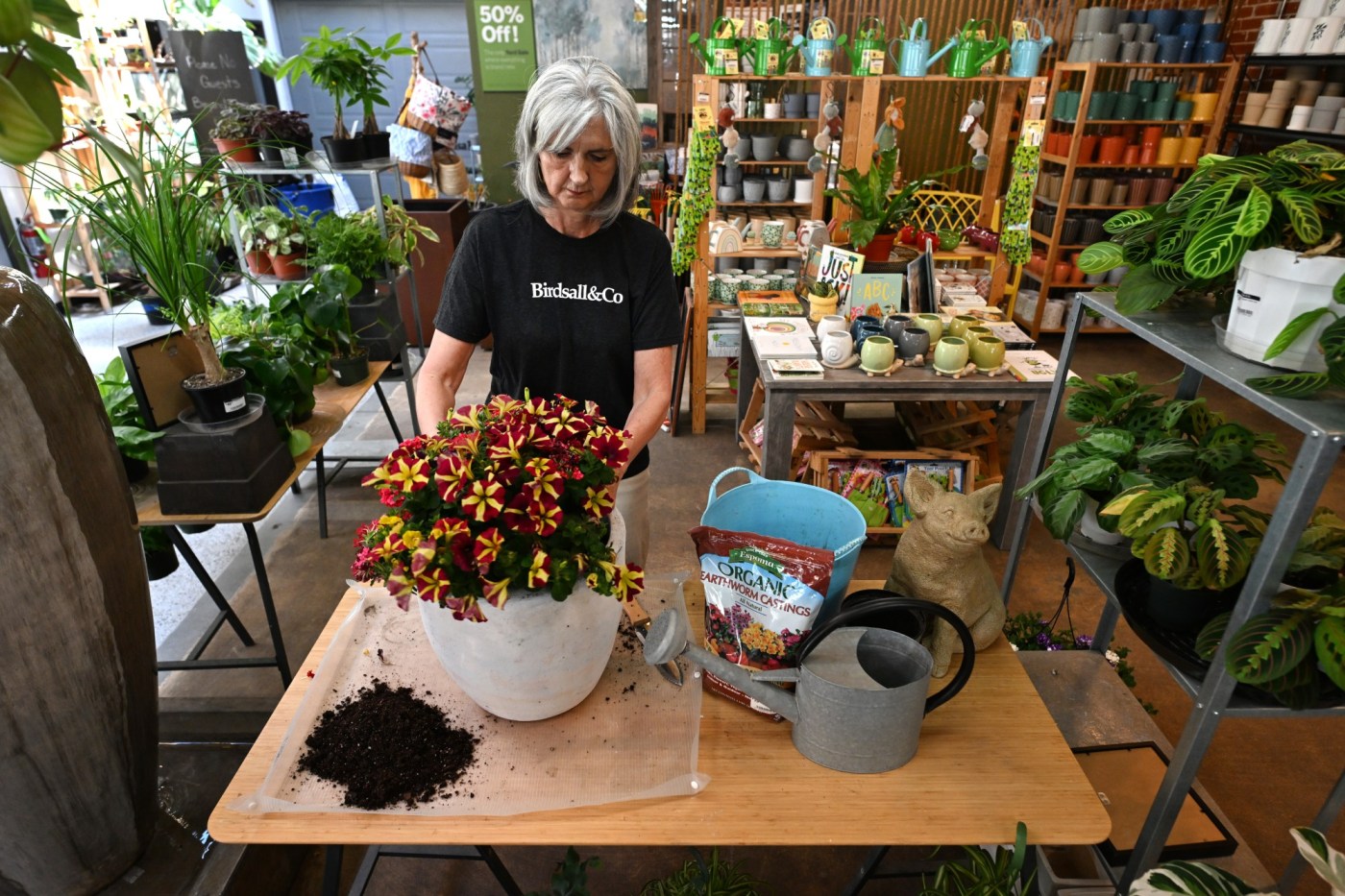
Garden variety: Containers are the perfect way to add color to your porch, patio and lawn

posted in: News | 0

Container gardens offer instant gratification to those who want to enjoy flowers and plants all summer long. Fill a pot with soil, pick your plants and voila! The payoff comes in having a beautiful garden to enjoy.

Gardens in a pot are perfect for those who crave variety. “You can change things every year and through the seasons,” says Annie Huston, co-owner of Denver boutique Birdsall & Co. and a longtime garden designer. A mixture of eye-popping annual flowers might suit you one spring, while a mix of tropical plants and succulents might be to your liking the next. And when summer turns to fall, you can replace plants with new ones to transition into the cooler months.

With so many choices, where do you begin? We asked Huston to break down the process.

Annie Huston, owner of Birdsall & Co., right, shows a collection of flowering plants that make for good container gardens at Birdsall & Co in Englewood, Colorado on April 24, 2024. In the photo Huston is holding from left to right clockwise a Super Moon red zonal geranium, left, a Main Street Oxford Street coleus, and a Star Dust Super Flash grassleaf spurge, right. (Photo by Helen H. Richardson/The Denver Post)

Sun or shade

One of the first things to determine is whether the pot will be mostly in sun or shade, because some plants will wither and die if exposed to too much sun, and others won’t thrive without it.

Huston says that if your container will get western exposure or strong southern sun for most of the day, pick plants that will do best in sun. Containers receiving eastern or northern sun, very filtered sun, or those located under a roof or trees will do best with shade-loving plants. A sun-loving annual will not die in shade or part shade, but it will not produce the expected color or bloom.

Pick your pot

Bigger is better when you are making a container garden as smaller pots dry out quickly. “A collection of smaller containers makes the plantings less interesting and more difficult to maintain,” Huston says. “The idea when choosing containers is to imagine them in the winter months when they are empty of lush colors. They should make a statement on their own, although no pot should ever be empty.”

The size of the container is dictated by the space and scale of the location. While bigger pots make more of a statement, they can be heavy and hard to move when filled with soil and plant material. Huston’s trick for filling them is to invert plastic pots with drain holes and place them inside the larger pot so you’ll need to use less soil overall.

The material of the container -– stone, terra cotta, glazed ceramic, synthetic materials -– doesn’t make a big difference as long as the right soil is used and the plants get enough water, Huston says.

Cast stone containers tend to be more formal and best used for a home’s front entrance or on a large pool deck. “Because of their weight, they need to be placed in a permanent location and become part of the architecture of the house,” she says.

Annie Huston, owner of Birdsall & Co., shows some of the hundreds of pots available at her store that make for good container gardens at Birdsall & Co in Englewood, Colorado on April 24, 2024. (Photo by Helen H. Richardson/The Denver Post)

Huston is a fan of terra cotta and glazed containers because they are available in a variety of styles, textures, colors and shapes to enhance and complement the architectural style of the home and garden.

Lightweight containers are popular for rooftop terraces or balconies and allow for very large sizes without the cumbersome weight. Using plant caddies with wheels can make pots easy to move around depending on weather and light requirements.

Whatever type of pot you use, make sure it has a drainage hole in the bottom.

Select the right soil, plants

Garden centers offer a variety of types of soil mixes for containers. Huston likes Espoma organic potting mix, which includes earthworm castings, alfalfa meal, kelp meal, feather meal and a proprietary blend of mycorrhizae (fungi that have a symbiotic relationship with plant roots).

A ficus tineke, or rubber fig, the larger plant in the arrangement, helps make for an interesting arrangement with other plants in a large container that would be suitable to grow in shady location at Birdsall & Co in Englewood, Colorado on April 24, 2024. (Photo by Helen H. Richardson/The Denver Post)

There are scores of plant options for full-sun containers, so select colors, colors, textures and growth patterns that appeal to your eye, Huston says. The plant tags are an easy way to determine which plants will do well in the sun.

“You cannot go wrong with grasses, verbenas, lantanas and the old-fashioned but reliable geraniums,” she says, adding, “Canna lilies come in different sizes and are perfect for a centerpiece.”

For shade containers, “nothing beats impatiens for a splash of color,” Huston says. Coleus, begonias and upright fuchsias are other choices.

Design considerations

Those just starting out with container gardening can make things easy by choosing two to three varieties of plants with the same growth pattern and let them intertwine for a natural look. “Simple and healthy is better than a mixture of random plants picked at the garden center because they looked lovely that day,” Huston says.

Have patience as some plants will not look their best until they are given room to grow. Examples include euphorbia, sweet alyssum, verbena, creeping Jenny and calibrachoa.

While mixtures of plants are enticing, there’s also nothing wrong with using a single plant type, she says. “The maintenance is simplified and the results striking.”

Keep in mind that instead of relying on colorful flowers to provide the container’s eye appeal, a plant’s leaves can make the statement. “Foliage interest in all its variations and hues looks gorgeous when paired with a dash of contrasting bloom appearing between the leaves,”  Huston says.

Consider mixing indoor plants with annuals. “It’s not only surprising and sophisticated, it is also recycling when you bring them inside after the season,” she says. “Succulents make for wonderful full-sun containers when accompanied with blooming annuals.”

The appeal of succulents is their “enormous personality, their drought-resistant nature and sculptural forms.” Her favorite is the red yucca “shining by itself in a full sun container, and when it flowers, it attracts hummingbirds.” Others she likes outdoors in the summer and indoors in winter are large agaves, Mexican grass tree, and “the beautiful aloe for its structure, soft green and sunburn relief.”

A variegated dwarf smooth agave plant, the larger plant in the arrangement, helps make for an interesting arrangement with other plants in a large container at Birdsall & Co in Englewood, Colorado on April 24, 2024. (Photo by Helen H. Richardson/The Denver Post)

Containers can be made with edible plants as well as ornamental ones. “Some vegetables have the most luscious leaves and give a tropical feel to the design. Kale, artichoke, and broccoli are just a few of them,” she says.

Herbs should be used in full sun to “enchant us with their fragrance,” the garden designer says. Use basil, sage and lavender as centerpieces in a container, and plant strawberries and nasturtium on the edges where they can trail.

You can also incorporate perennials into containers. For sunny spots, add gaura, a long-blooming perennial that adds feathery lightness, and coral bells for foliage interest. For shade containers, hostas and Japanese forest grasses are great choices. When summer ends, you can plant the perennials in your outdoor landscape.

Water and fertilize

Once you’ve invested the time and resources to select and plant your containers, keep them healthy by fertilizing and watering.  Huston recommends applying a liquid fertilizer that contains fish and seaweed every couple of weeks.

For watering, if there is an irrigation system in the landscape near your containers, spaghetti tubing is easy to insert through the drainage hole.

Hand water early in the morning or evening when temperatures aren’t too high. In the hottest part of the summer, most containers need water daily. Watering the edges of the containers, under the grown leaves, is an important detail since these plants are more prone to drying out.

The French-born Huston calls her approach “watering with Champagne,” finding it relaxing to hold a watering wand in one hand and a beverage of choice in the other while taking a daily stroll among the plants to be watered.

Suzanne S. Brown is a freelance writer and the former features editor at The Denver Post.

More plants to try

ZZ Raven zamiaculca zamiafolla, in front, is a plant that is good for container gardens at Birdsall & Co in Englewood, Colorado on April 24, 2024. (Photo by Helen H. Richardson/The Denver Post)

Shade: ZZ plant (Zamioculcas zamifolia); snake plant (Sansevieria laurentii); begonia escargot; mistral orange begonia; spider plant (Chlorophytum comosum); wandering Jew (Tradescandia zebrina); creeping Jenny (Lysimachia nummularia)

Sun: red geranium; white lantana; rosemary; verbena lanai white or deep purple; calibrachoa cabrio yellow; petunia sanguna yellow

A how-to class

Birdsall is hosting a container planting party on May 19, from 10 a.m. to 3 p.m. Bring an empty 15- to 18-inch diameter (measured at the top) container from home, or purchase a new one at the store for 20% off the day of the workshop. Birdsall will provide the soil, plants, instruction, design advice, and help loading your container. The shade container workshop is 10 a.m. to noon; the sun container session is 1 to 3 p.m. Tickets are $65 per seminar at birdsallgarden.com. Birdsall The Garden Boutique, 2870 S. Broadway, Englewood; 303-722-2535.


Their first baby came with medical debt. These parents won’t have another

posted in: News | 0

Noam N. Levey | (TNS) KFF Health News

Heather Crivilare was a month from her due date when she was rushed to an operating room for an emergency cesarean section.

The first-time mother, a high school teacher in rural Illinois, had developed high blood pressure, a sometimes life-threatening condition in pregnancy that prompted doctors to hospitalize her. Then Crivilare’s blood pressure spiked, and the baby’s heart rate dropped. “It was terrifying,” Crivilare said.

She gave birth to a healthy daughter. What followed, though, was another ordeal: thousands of dollars in medical debt that sent Crivilare and her husband scrambling for nearly a year to keep collectors at bay.

The Crivilares would eventually get on nine payment plans as they juggled close to $5,000 in bills.

“It really felt like a full-time job some days,” Crivilare recalled. “Getting the baby down to sleep and then getting on the phone. I’d set up one payment plan, and then a new bill would come that afternoon. And I’d have to set up another one.”

Crivilare’s pregnancy may have been more dramatic than most. But for millions of new parents, medical debt is now as much a hallmark of having children as long nights and dirty diapers.

About 12% of the 100 million U.S. adults with health care debt attribute at least some of it to pregnancy or childbirth, according to a KFF poll.

These people are more likely to report they’ve had to take on extra work, change their living situation, or make other sacrifices.

Overall, women between 18 and 35 who have had a baby in the past year and a half are twice as likely to have medical debt as women of the same age who haven’t given birth recently, other KFF research conducted for this project found.

“You feel bad for the patient because you know that they want the best for their pregnancy,” said Eilean Attwood, a Rhode Island OB-GYN who said she routinely sees pregnant women anxious about going into debt.

“So often, they may be coming to the office or the hospital with preexisting debt from school, from other financial pressures of starting adult life,” Attwood said. “They are having to make real choices, and what those real choices may entail can include the choice to not get certain services or medications or what may be needed for the care of themselves or their fetus.”

Best-laid plans

Crivilare and her husband, Andrew, also a teacher, anticipated some of the costs.

The young couple settled in Jacksonville, in part because the farming community less than two hours north of St. Louis was the kind of place two public school teachers could afford a house. They saved aggressively. They bought life insurance.

And before Crivilare got pregnant in 2021, they enrolled in the most robust health insurance plan they could, paying higher premiums to minimize their deductible and out-of-pocket costs.

Then, two months before their baby was due, Crivilare learned she had developed preeclampsia. Her pregnancy would no longer be routine. Crivilare was put on blood pressure medication, and doctors at the local hospital recommended bed rest at a larger medical center in Springfield, about 35 miles away.

“I remember thinking when they insisted that I ride an ambulance from Jacksonville to Springfield … ‘I’m never going to financially recover from this,’” she said. “‘But I want my baby to be OK.’”

For weeks, Crivilare remained in the hospital alone as COVID protocols limited visitors. Meanwhile, doctors steadily upped her medications while monitoring the fetus. It was, she said, “the scariest month of my life.”

Fear turned to relief after her daughter, Rita, was born. The baby was small and had to spend nearly two weeks in the neonatal intensive care unit. But there were no complications. “We were incredibly lucky,” Crivilare said.

When she and Rita finally came home, a stack of medical bills awaited. One was already past due.

Crivilare rushed to set up payment plans with the hospitals in Jacksonville and Springfield, as well as the anesthesiologist, the surgeon, and the labs. Some providers demanded hundreds of dollars a month. Some settled for monthly payments of $20 or $25. Some pushed Crivilare to apply for new credit cards to pay the bills.

“It was a blur of just being on the phone constantly with all the different people collecting money,” she recalled. “That was a nightmare.”

Big bills, Big consequences

The Crivilares’ bills weren’t unusual. Parents with private health coverage now face on average more than $3,000 in medical bills related to a pregnancy and childbirth that aren’t covered by insurance, researchers at the University of Michigan found.

Out-of-pocket costs are even higher for families with a newborn who needs to stay in a neonatal ICU, averaging $5,000. And for 1 in 11 of these families, medical bills related to pregnancy and childbirth exceed $10,000, the researchers found.

“This forces very difficult trade-offs for families,” said Michelle Moniz, a University of Michigan OB-GYN who worked on the study. “Even though they have insurance, they still have these very high bills.”

Nationwide polls suggest millions of these families end up in debt, with sometimes devastating consequences.

About three-quarters of U.S. adults with debt related to pregnancy or childbirth have cut spending on food, clothing, or other essentials, KFF polling found.

About half have put off buying a home or delayed their own or their children’s education.

These burdens have spurred calls to limit what families must pay out-of-pocket for medical care related to pregnancy and childbirth.

In Massachusetts, state Sen. Cindy Friedman has proposed legislation to exempt all these bills from copays, deductibles, and other cost sharing. This would parallel federal rules that require health plans to cover recommended preventive services like annual physicals without cost sharing for patients. “We want … healthy children, and that starts with healthy mothers,” Friedman said. Massachusetts health insurers have warned the proposal will raise costs, but an independent state analysis estimated the bill would add only $1.24 to monthly insurance premiums.

Tough lessons

For her part, Crivilare said she wishes new parents could catch their breath before paying down medical debt.

“No one is in the right frame of mind to deal with that when they have a new baby,” she said, noting that college graduates get such a break. “When I graduated with my college degree, it was like: ‘Hey, new adult, it’s going to take you six months to kind of figure out your life, so we’ll give you this six-month grace period before your student loans kick in and you can get a job.’”

Andrew Crivilare, Heather Crivilare, and their 2-year-old daughter, Rita, sit at the dinner table at their home in Jacksonville, Illinois, on April 30, 2024. For millions of new parents, medical debt is now as much a hallmark of having children as long nights and dirty diapers. (Neeta Satam for KFF Health News/TNS)

Rita is now 2. The family scraped by on their payment plans, retiring the medical debt within a year, with help from Crivilare’s side job selling resources for teachers online.

But they are now back in debt, after Rita’s recurrent ear infections required surgery last year, leaving the family with thousands of dollars in new medical bills.

Crivilare said the stress has made her think twice about seeing a doctor, even for Rita. And, she added, she and her husband have decided their family is complete.

“It’s not for us to have another child,” she said. “I just hope that we can put some of these big bills behind us and give [Rita] the life that we want to give her.”

About this project

“Diagnosis: Debt” is a reporting partnership between KFF Health News and NPR exploring the scale, impact, and causes of medical debt in America.

The series draws on original polling by KFF, court records, federal data on hospital finances, contracts obtained through public records requests, data on international health systems, and a yearlong investigation into the financial assistance and collection policies of more than 500 hospitals across the country.

Additional research was conducted by the Urban Institute, which analyzed credit bureau and other demographic data on poverty, race, and health status for KFF Health News to explore where medical debt is concentrated in the U.S. and what factors are associated with high debt levels.

The JPMorgan Chase Institute analyzed records from a sampling of Chase credit card holders to look at how customers’ balances may be affected by major medical expenses. And the CED Project, a Denver nonprofit, worked with KFF Health News on a survey of its clients to explore links between medical debt and housing instability.

KFF Health News journalists worked with KFF public opinion researchers to design and analyze the “KFF Health Care Debt Survey.” The survey was conducted Feb. 25 through March 20, 2022, online and via telephone, in English and Spanish, among a nationally representative sample of 2,375 U.S. adults, including 1,292 adults with current health care debt and 382 adults who had health care debt in the past five years. The margin of sampling error is plus or minus 3 percentage points for the full sample and 3 percentage points for those with current debt. For results based on subgroups, the margin of sampling error may be higher.

Reporters from KFF Health News and NPR also conducted hundreds of interviews with patients across the country; spoke with physicians, health industry leaders, consumer advocates, debt lawyers, and researchers; and reviewed scores of studies and surveys about medical debt.

___

(KFF Health News is a national newsroom that produces in-depth journalism about health issues and is one of the core operating programs of KFF — the independent source for health policy research, polling and journalism.)

©2024 Kaiser Health News. Visit khn.org. Distributed by Tribune Content Agency, LLC.

Dane Mizutani: This version of the Timberwolves is different.

posted in: News | 0

You could hear it from the Twin Cities to the Iron Range as tipoff of Game 6 neared on Thursday at Target Center, that fatalistic voice of the Minnesota Sports Fan screaming that the Timberwolves couldn’t do it.

There was no chance they were going to extend the series against the defending NBA champion Denver Nuggets in an elimination game. Those things don’t happen around here.

That mindset has been drilled into the Minnesota Sports Fan for generations. Your grandma and grandpa watched the Vikings go 0 for 4 in the Super Bowl. Your mom and dad watched the North Stars leave town. You watched the Twins lose 18 straight playoff games in a span that stretched nearly 20 years.

Not many places in the country have experienced heartbreak to the same degree. It’s become a way of life for the Minnesota Sports Fan. You’re always waiting for the other shoe to drop.

Now, as the Timberwolves prepare for a decisive Game 7 against the Nuggets on Sunday at Ball Arena, there might be an urge to prepare for the worst. Let’s agree not to do that, OK?

It’s time for Minnesota Sports Fan to let go of the past. This version of the Timberwolves is different.

This group of players has stared down the ineptitude that preceded it and never once blinked. They have risen to occasion time and time again. That has helped to completely change the narrative of the franchise in short order.

The evidence is woven into the fabric of this season, in particular.

Initially, when the Timberwolves started out on fire, the Minnesota Sports Fan assumed it was only a matter of time before a big bucket of water doused the flames. That wasn’t the case as the Timberwolves remained in contention for the No. 1 seed in the Western Conference until the very end.

Then, when the Timberwolves hooked the Phoenix Suns in the first round, the Minnesota Sports Fan went through the mental gymnastics of convincing themselves that it was the worst possible matchup. That clearly wasn’t the case; the Timberwolves imposed their will on the Suns on their way to a stunning sweep.

Finally, when the Timberwolves got punked by the Nuggets while squandering a series lead, the Minnesota Sports Fans concluded that a funeral procession was in order. That wasn’t the case as the Timberwolves rose from the dead with a 45-point blowout win.

No longer are the Timberwolves the butt of the joke. They are a legitimate contender to win the NBA championship largely because this version of the Timberwolves is unlike any team that has come before it. There’s a toughness built into this group of players by head coach Chris Finch that allows them to push through adversity and keep going.

It starts and stops with Anthony Edwards, the future face of the league, who has endeared himself to the masses throughout the playoffs with his killer instinct on the court. He’s aided by a perfectly constructed starting lineup that includes Karl-Anthony Towns serving as a secondary scorer, Rudy Gobert controlling the paint, Jaden McDaniels holding it down on the perimeter, and Mike Conley making sure everything runs smoothly. There’s also a bench unit led by fan favorites Naz Reid and Nickeil Alexander-Walker.

The vibes have been immaculate, and even when they have taken a dip, like they did last week, the Timberwolves haven’t let things spiral out of control like they may have once upon a time.

This team has proved it’s OK to believe. It has shown the Minnesota Sports Fan that it is up for the challenge regardless of circumstance.

Why can’t that continue in Game 7?

Related Articles

Minnesota Timberwolves |


Dane Mizutani: When the Timberwolves needed him most, Mike Conley showed up for Minnesota

Minnesota Timberwolves |


Timberwolves trounce Denver to force decisive Game 7

Minnesota Timberwolves |


Timberwolves’ Kyle Anderson hasn’t thought about free agency yet

Minnesota Timberwolves |


Nuggets selling out to stop Anthony Edwards. And Timberwolves guard isn’t getting much help.

Minnesota Timberwolves |


Life without Mike Conley is awfully difficult for Timberwolves, who may have to save their season without their point guard

Minnesota United vs. Portland Timbers: Keys to the match, projected starting XI and a prediction

posted in: News | 0

Minnesota United vs. Portland Timbers

When: 7:30 p.m. Saturday
Where: Allianz Field
Stream: Apple TV Season Pass
Radio: KSTP-AM 1500 ESPN
Weather: 76 degrees, sunny, 10 mph east wind
Betting line: MNUFC plus-135; draw plus-300; Portland plus-295

Form: MNUFC (6-2-3, 21 points) ran its unbeaten stretch to four straight with a 2-2 draw with Galaxy on Wednesday. Portland (3-6-4, 13 points) ended a nine-match unbeaten skid with a 4-2 win over San Jose on Wednesday. Timbers scored three goals after Earthquakes’ Bruno Wilson received a red card in the 71st minute.

Quote: “I don’t want to be in any way lulled into complacency against them because obviously they are not on a good run at all,” Loons manager Eric Ramsay said Friday. “… I want to try to look behind the table (Timbers are 11th in West) … and encourage the players to do so. They’ve got some very good players.”

Absences: Emanuel Reynoso (return-to-play protocol), Hugo Bacharach (knee) are out. Jordan Adebayo-Smith (ankle) and Moses Nyeman (tight) are presumed out. Kervin Arriaga (hamstring) did not train Friday and is questionable. Hassani Dotson (hamstring) trained Friday, but after missing three matches, it’s likely too soon for the midfielder to be involved Saturday.

Connection: Loons goalkeeper Dayne St. Clair hung out with Portland Timbers Kamal Miller and Eryk Williamson on Thursday night. St. Clair grew up and played at a youth level with Miller in Canada; St. Clair played with Williamson at the University of Maryland.

Rumor: Reynoso has been linked in a move to Mexican club Juarez this week. The Loons is exploring a potential offloading of its Designated Player to Liga MX or elsewhere this summer.

Projected XI: In a 5-2-3 formation, LW Sang Bin Jeong, CF Tani Oluwaseyi, RW Bongi Hlongewane; CM Robin Lod, CM Wil Trapp; LB Joseph Ropsales, CB Devin Padelford, CB Micky Tapias, CB Michael Boxall, CB DJ Taylor; GK Dayne St. Clair.

Player to watch: Evander. The one-named Brazilian has five goals and four primary assists this season, including a penalty kick goal, an assist and six shot-creating actions on Wednesday.

Context: Ramsay said he would look at “micro” details that went into Loons losing control of the Galaxy draw. On Friday, he was asked for an example and pointed to how MNUFC defended the goal kick that led to Riqui Puig being able to go on a long 60-yard run to set up the go-ahead goal in the 68th minute. It appeared, for one element that Robin Lod was caught on the left half-space, opening up the middle for Puig to sprint foward.

Tidbit: A large contingent of MNUFC players and staff were at Target Center for Wolves’ Game 6 win over Denver. Boxall, Lod, Oluwaseyi, Tapias and more. Ramsay was there, too. The Welshman said he has watched YouTube videos to learn some basics of the sport and was intrigued to know what coaches said during the first-quarter timeout before the Wolves’ huge run.

Prediction: The Timbers have allowed 27 goals this season — second-worst in MLS — and MNUFC will add a pair to that total. Here’s to Teemu Pukki ending his 420-minute scoring drought since early March. Minnesota wins 2-1.