St. Paul’s Sean Sweeney is the defensive mastermind behind Dallas Mavericks’ Game 1 win over Timberwolves

posted in: News | 0

The Timberwolves were rather putrid offensively in the second half of Game 1 of the NBA Western Conference Finals on Wednesday night.

Minnesota scored just 43 points over the final two quarters, including a 3.5-minute scoreless drought at the end of the game that ultimately lost the game.

Over the final two quarters, the Wolves shot 36 percent from the field and 29 percent on three-point attempts. Take away second-chance opportunities, and Minnesota’s shooting percentage declined to 31 percent over the final 24 minutes.

Not good.

Welcome to the club, Timberwolves.

This is what Dallas is doing to folks this postseason.

Since May 8, from Dallas’ Game 2 victory over Oklahoma City in the Western Conference semifinals onward, the Mavericks’ sport the top defensive rating in the playoffs, allowing just 109.9 points per 100 possessions.

Dallas played two of the top four regular-season offenses in the NBA over their first two playoff series.

The Clippers’ offensive rating dipped from 117.9 in the regular season to 109.5 in their first-round loss to Dallas. The number plummeted to 107.9 following Los Angeles’ Game 1 victory.

The Thunder sported the No. 3 offense in the NBA during the regular season, scoring 118.3 points per 100 possessions. Their offensive rating was 111.8 in their conference semifinal loss to Dallas, and it was 109.7 in Games 2 through 6.

Dallas currently touts a defense that has proving itself capable of significantly slowing any offense in the NBA. The defense has been what has carried the Mavericks to this point — three wins away from the NBA Finals.

And the brain behind it hails from St. Paul.

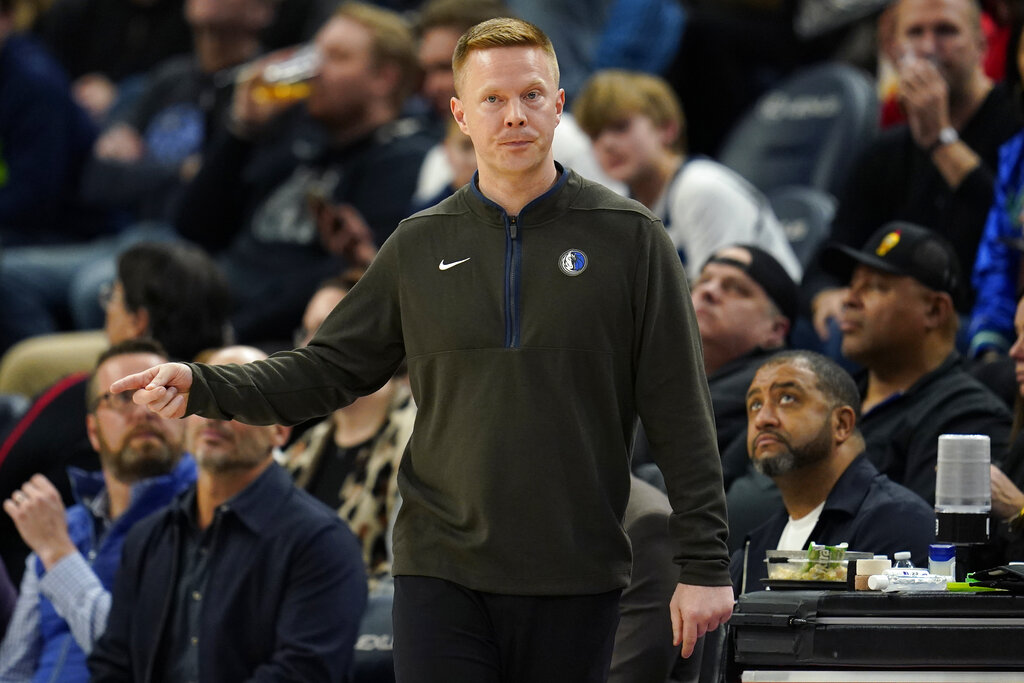
Mavericks assistant coach Sean Sweeney is the team’s defensive coordinator, and year after year cements himself as one of the NBA’s elite defensive minds.

“He does all the schemes. He does the scouting for defense. … He talks to us,” Mavericks star Luka Doncic said. “Since the day he came here, he’s been a great addition to this team. So I’m really happy that he’s on our team, and he helps us a lot.”

The Cretin-Derham Hall and University of St. Thomas graduate has especially had the Mavericks on a string since the trade deadline, when Dallas acquired shot-blocking big man Daniel Gafford and versatile wing P.J. Washington, both of whom have been inserted into the starting lineup. Whenever the Mavericks make such a move, Sweeney starts with head coach Jason Kidd’s plan for how he wants to play defense and looks for the ways in which the new acquisitions can aid in that effort.

“PJ is a very versatile, athletic defender. Good intelligence, good instincts. Daniel is obviously excellent at protecting the rim, does a good job in the pick and rolls, and has a presence to him that allows you to use the strengths of the guys on the team,” Sweeney said. “And they fit in really, really well. I think both are intelligent players, so that helps when you change teams, being able to pick up schemes quickly. And they both have a commitment to working and studying, so that helps speed up the process. You can’t skip steps, but the more time you put in, the quicker you can take them. So those guys have done a great job with that.”

After that deal, Dallas touted the No. 8 defense in the NBA. That’s a level likely thought not possible to reach by many considering the Mavericks’ two best players — Kyrie Irving and Doncic — are far from defensive stalwarts. But everyone, Sweeney noted, has strengths. And Doncic and Irving have a competitiveness that they weaponize on the defensive end, on top of their high basketball intellect.

“Those two guys have showed — both over the course of the season and in the playoffs — what some of those strengths are,” Sweeney said. “Both are good steals guys, both are good communicators, and they have a high level of awareness. And as they have picked up their level of intensity and awareness, I think you’ve seen that on the floor.”

The collective buy-in of players new and old has led not only to a successful season, but one Sweeney has thoroughly enjoyed from start to finish.

“As it pertains to after the (trade) deadline, after the all-star break, to see the way these guys have played and how they’ve done things together, sacrificing when they’ve had to and being willing to do things for one another when it may not necessarily benefit you is really enjoyable as a coach to see guys perform that way,” Sweeney said. “It’s been a fun group to teach, compete with and also learn from.”

This series hits a new level of enjoyment for Sweeney, because it started in his home state. He loves returning to Minnesota — and, specifically, the Twin Cities — whenever possible. Getting to coaching in the West Finals for the second time in three years, and this time against the team he grew up watching, is an experience he is savoring.

But, yes, it’s also a challenge. Timberwolves guard Anthony Edwards has been the rockstar of the NBA playoffs. Karl-Anthony Towns was wonderful against Denver. Mike Conley and Rudy Gobert are two of the highest IQ players you’ll find. Minnesota is no easy scout. That, Sweeney noted, is the fun part.

“The great part about the NBA is you get to coach and compete against the best players and the best coaches. Regardless of what your role is, this is the best time of the year. This is the highest level of competition, when the pressure is the greatest,” he said. “It just makes the preparation piece that much more enjoyable. Getting ready for great players, coaches who have great schemes and the ability to adjust and get ahead. So it makes it a lot of fun.”

Of course, it’s all the more fun when you’re having the type of success the Mavericks are at the moment. They have a chance to take a commanding 2-0 series lead in Game 2 on Friday in Minneapolis. Claiming another road win would likely require another dominant defensive performance. Dallas is turning those out with regularity this postseason.

The playoffs are all about adjustments, schematics and drilling into the finer details of gameplans. Perhaps no one does that more than Sweeney, which could explain why the Mavericks have taken yet another defensive leap in these playoffs to date.

“Sean’s work ethic is like no other. He’s always in the gym, he’s always there to help,” Kidd said. “To have Sean as an assistant coach, his future is extremely bright. He’ll be a head coach in this league some day.”

For now, though, Sweeney is locked in on spending every waking hour trying to help the Mavericks win a title. And, at the moment, there are a lot of waking hours.

Just how much sleep is the coach getting at the moment, anyway?

“Ha. Uhh, the requisite amount,” Sweeney said.

Which is what?

“Enough to prepare,” Sweeney said.

Alright, honest answer time.

“Man, none,” Sweeney admitted. “Nah, this is what makes it fun is there’s so much you can study and prepare for. So now it’s time to put the plan in place and get ready to go.”

Related Articles

Minnesota Timberwolves |


Dane Mizutani: Anthony Edwards is the best player on the Timberwolves. They need him to play like it.

Minnesota Timberwolves |


Luka Doncic carries Dallas past the Wolves late to steal Game 1 in Minnesota

Minnesota Timberwolves |


Anthony Edwards gets big contract value boost with second-team All-NBA recognition

Minnesota Timberwolves |


Minnesota goes all-in on Anthony Edwards’ ‘Bring ya a**’ slogan

Minnesota Timberwolves |


Don’t have tickets to Game 2 of the Western Conference Finals? Timberwolves hosting a block party outside the arena

‘The Blue Angels’ review: Doc soars with aerial photography, not drama

posted in: News | 0

Watching “The Blue Angels” in your living room, you can’t help but be envious of those making the effort to catch the documentary in IMAX.

Playing May 17 through 23 in theaters with IMAX auditoriums, “The Blue Angels” jets onto Prime Video on May 23.

Depending on your home setup, “The Blue Angels” — billed as offering unprecedented access to the staple of air shows across the country that is the United States Navy Blue Angels program — still may look and sound pretty darned fierce, but no home theater can compare with the stage an IMAX setup can offer the exhilarating aerial footage that is by far this movie’s greatest selling point.

That’s the way you’d love to experience the roaring engines and the trails of smoke.

However, even the largest of IMAX screens can’t plaster over the fact that this Paul Crowder-directed film does not soar when it comes to human drama. As it covers the program from its winter training period through its transition late in the year to those who will fly the Boeing F/A-18 Super Hornets in 2023. Yes, viewers are introduced to the men piloting in the shows throughout 2022 — and the myriad men and women supporting them in other roles on the team — but we barely get to know them.

We do go home, briefly, with Capt. Brian Kesselring — who, as commanding officer and flight leader, is bestowed with the nickname “Boss” — and meet his Marine officer wife, Ashley, and their two little children. Really, though, this feels like a bit of box-checking more than anything else.

Even while showing a playful streak within the program, “The Blue Angels” is every bit as squeaky-clean as its G rating would suggest. If there WERE any real drama behind the scenes, you wouldn’t know it from the film.

Counting among its producers filmmaker J.J. Abrams (“Star Wars: The Force Awakens”), actor Glen Powell (“Top Gun: Maverick”) and retired pilot Greg Wooldridge, the only three-time “Boss” of the Blue Angels, it too often feels like a really expensive recruitment video. The honor of being chosen to be a part of the team and the responsibility to perform to its high standards and to be safe while sometimes flying as close as a few inches from other pilots comes through loud and clear.

That isn’t to say it’s not enjoyable to follow the progress of the team, even as the members go through the monotonous grind of winter training — waking up and going to bed in darkness, flying two to three times in between and sitting through video-aided debriefs in which they get to relive their mistakes.

Members of the United States Navy Blue Angels program review video footage of a training session in a scene from “The Blue Angels.” (Courtesy of Amazon Content Services)

You learn about the different components of their show routine, four planes frequently flying in “Diamond” formation and complemented by solo maneuvers, before the team conducts the six-plane “Delta” formation.

The Blue Angels fly in the familiar “Diamond” formation in a scene from “The Blue Angels.” (Courtesy of Amazon Content Services)

They are supported on the ground by crew men and women — each plane is checked thoroughly before each flight and Monica Borza, the flight surgeon who monitors them closely.

“I know where they should be at all times, their attitudes, their flight speeds,” Borza says.

Related Articles


National Memorial Day Concert to mark 35 years of honoring those who died in service to country


Review: ‘Gasoline Rainbow’ is a memorable teenage road trip along an improvised Oregon trail


The bugs are coming! If a cicada invasion sounds familiar, thank Hollywood


Trump campaign calls ‘The Apprentice’ ‘blatantly false,’ director offers to screen it for him


10 movies for summer 2024: Sequels and reboots, but fingers crossed for a surprise

The team has three new pilots this year, with two others flying in different aerial positions, adding to the stress of Borza and others.

Later in the film, we see other pilots vying to join the team, including Amanda Lee, who hopes to be the first female chosen to fly, and watch as those selected take their first steps toward the 2023 season in the form of some unpleasant-seeming training to prepare them for the gravitational forces with which they will be confronted when they are performing the sky-high wizardry.

“The Blue Angels” also offers a history lesson — about the team’s formation in 1946 by Adm. Chester Nimitz, then the chief of Naval operations, who wanted to create a flight exhibition team to raise the public’s interest in naval aviation and boost Navy morale — complete with some archival footage.

That grainy footage helps remind us that state-of-the-art equipment and techniques was used to capture the footage of this film with the help of a helicopter outfitted with IMAX-certified cameras that became the first civilian aircraft permitted to fly within the performance space, called “the box,” according to the film’s production notes. (The aerial camera unit from the aforementioned “Top Gun: Maverick,” led by aerial coordinator Kevin LaRosa II, was brought on board for this project, and it’s easy to wonder if a documentary about the making of this documentary would be a bit more compelling from a narrative perspective than the storyline of “The Blue Angels.”)

“The Blue Angels” isn’t the first time the planes have been captured in moving pictures, with previous showcases including the mid-1990s documentary “Blue Angels: Around the World at the Speed of “Sound and the memorable music video for the 1986 Van Halen hit “Dreams.”

Nonetheless, it’s safe to say you’ve never seen them quite like this before.

‘The Blue Angels’

Where: Prime Video.

When: May 23.

Rated: G.

Runtime: 1 hour, 33 minutes.

Stars (of four): 2.5.

Blue Angels in Cleveland

Cleveland will host the U.S. Navy Blue Angels as headliners of the 2024 Cleveland National Air Show, Aug. 31 through Sept. 2 at Burke Lakefront Airport. The team will present an hourlong choreographed presentation, with Cleveland being one of 30 cities hosting the Blue Angels in 2024, according to press information. Get information and tickets at clevelandairshow.com or call 216-781-0747.

Biden has slight edge in N.H., UML poll shows

posted in: Politics | 0

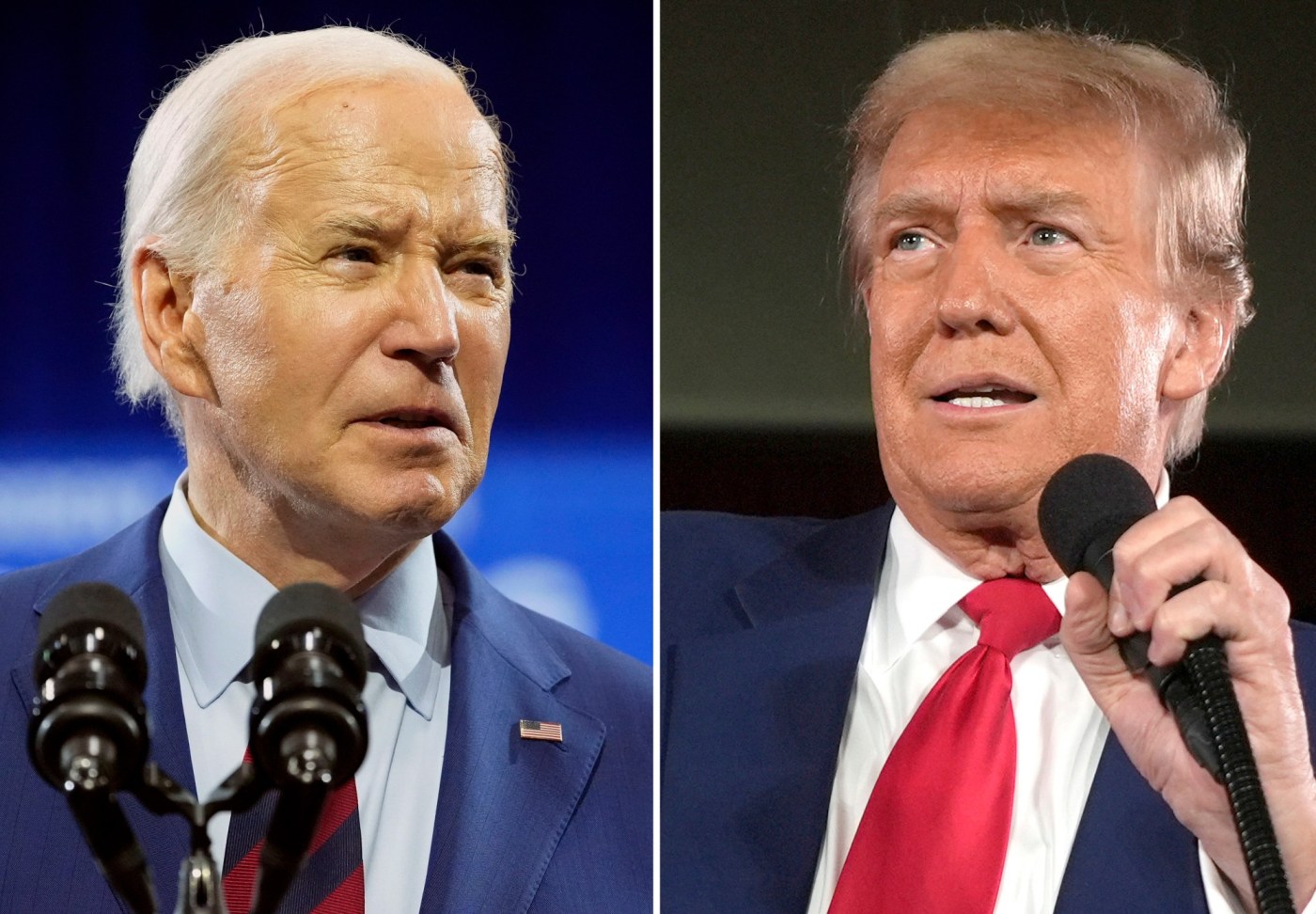
Despite dodging the state’s first-in-the-nation primary election, a recent poll shows President Joe Biden holds a slight edge over former President Donald Trump in New Hampshire.

A poll of 600 likely New Hampshire voters conducted UMass Lowell’s Center for Public Opinion and YouGov from May 6 to May 14 shows that the 45th President would lose the Granite State for a third time running if the general election were held today, despite the fact the Biden chose not to participate in the state’s primary in favor of allowing South Carolina to vote first.

“Biden leads Trump 42% to 36%, with less than six months until Election Day, Tuesday, Nov. 5. Eleven percent of respondents support independent candidate Robert F. Kennedy Jr., while 9% are undecided and 2% say they will vote for another candidate,” pollsters wrote.

Most of those polled expressed their dissatisfaction with the 2020 election sequel presented in 2024. More than half of those polled — 58% — said they were very or somewhat unhappy with the Biden vs. Trump dichotomy do-over. Among independent voters, that number jumps to 71%.

According to Rodrigo Castro Cornejo, the Center for Public Opinion’s associate director and a UMass Lowell assistant professor of political science, “most New Hampshire voters polled are unhappy with the presidential ballot.”

Since that’s a sentiment shared by voters in states across the country, Cornejo says both candidates will need to court the undecided.

“In a polarized America, split along partisan lines, both Biden and Trump will first try to activate their base, and, as November approaches, they will try to appeal to undecided voters. Even though undecided voters are a small portion of the electorate, persuading them will be particularly important in what we can expect to be a highly competitive presidential election,” he said.

The poll also examined the effect of former U.S. Sen. Kelly Ayotte’s anti-Massachusetts stance in her campaign for governor of New Hampshire. The former senator has centered much of her run around the assertion that the Granite State is but “one election away from becoming Massachusetts.”

According to UMass Lowell Professor Joshua Dyck, the polling center’s director and chair of the political science department, New Hampshire voters don’t seem to be buying that message.

“In an increasingly nationalized political environment, it’s unclear whether Kelly Ayotte’s choice to run against Massachusetts liberals is the right strategy to put her into the governor’s mansion. We won’t have a better idea of where this race stands until New Hampshire voters get to know her potential opponents for the fall election. In the meantime, one thing she does have on her side is name recognition in a sea of relatively unknown candidates,” he said.

The poll found 30% of voters think the state is “at great risk” of becoming “too much like Massachusetts.” A little more than a third of those polled said there is some risk, and 36% said there was no risk of the Granite State turning into the Bay State.

Could current COVID vaccines protect against future outbreaks? New study offers hope

posted in: News | 0

Irene Wright | The Charlotte Observer (TNS)

Before March 2020, it was hard to imagine a global pandemic in the modern age.

Now, it’s hard to imagine our lives without one.

As COVID-19 has become less of an active part of our days and more a quick thought when we have a runny nose or cough, it’s time to think about what comes next — and how to stop another pandemic.

A group of researchers had the future in mind when they asked if current COVID-19 vaccines and boosters could also protect your body against future outbreaks in a study published in the journal Nature on May 15.

Here’s what you need to know:

What is immune imprinting?

Researchers from Washington University’s School of Medicine in St. Louis evaluated the ability of the COVID-19 shots to build up memory in the immune system through a process called immune imprinting.

“Immune imprinting is a phenomenon in which prior antigenic experiences influence responses to subsequent infection or vaccination,” according to the study.

This means that when the human body is exposed to an infection, whether by becoming infected or receiving a vaccination, the immune system can build up defenses against it, and those defenses stay in the body even when the infection has left.

“Imprinting is the natural result of how immunological memory works. A first vaccination triggers the development of memory immune cells,” researchers said in a May 17 news release from Washington University. “When people receive a second vaccination quite similar to the first, it reactivates memory cells elicited by the first vaccine. These memory cells dominate and shape the immune response to the subsequent vaccine.”

Related Articles

Health |


Nursing homes wield pandemic immunity laws to duck wrongful death suits

Health |


Cory Franklin: Was Sweden’s COVID-19 approach superior to that of the U.S.?

Health |


Mistrust, fights and blood sport: How COVID-19 trauma is shaping the 2024 election

Health |


There’s a new highly transmissible COVID-19 variant. Could FLiRT lead to a summer uptick?

Health |


New COVID ‘FLiRT’ variants are spreading nationwide. Health experts urge up to date vaccination

But since your body holds onto some “immunity,” it can make it difficult to create a vaccination for the following year that complements an already established immune response and doesn’t interfere.

Doctors already have to deal with this problem.

The annual flu vaccine is updated and adapted each year before the fall rollout to best target the strains of influenza that are particularly strong or infectious.

“In the case of the flu vaccine, imprinting has negative effects,” according to the release, and the cells that are supposed to produce antibodies to fight the virus instead crowd other antibody-producing cells, making the vaccine less effective.

The worry is that if people receive annual COVID-19 boosters, like health officials recommend for influenza, immune imprinting could make the population vulnerable when a new coronavirus, or even another similar virus, starts to spread again, the researchers said.

Their results tell a different story.

‘Gradually build up a stock’

Researchers measured antibodies in people who had all of the updated COVID-19 shots to see if their neutralizing antibodies came from the original variant from the first shots, an omicron variant from updated shots, or both.

They found that most people had antibodies that weren’t unique to the original variant or omicron, meaning the antibodies could also protect against similar strains that haven’t been identified, according to the release.

“The study … shows that people who were repeatedly vaccinated for COVID-19 — initially receiving shots aimed at the original variant, followed by boosters and updated vaccines targeting variants — generated antibodies capable of neutralizing a wide range of SARS-CoV-2 (the virus that causes COVID-19) variants and even some distantly related coronaviruses,” researchers said in the release.

The “cross-reacted” response also extended to far-reaching relatives of COVID-19, like the Middle Eastern Respiratory Syndrome (MERS), a coronavirus that was first reported in 2012.

Instead of getting in the way of the body’s natural ability to identify and respond to new variants, periodic re-vaccination against COVID-19 may “instead cause people to gradually build up a stock of broadly neutralizing antibodies that protect them from emerging SARS-CoV-2 variants and some other coronavirus species as well, even ones that have not yet emerged to infect humans,” according to the release.

This assumes, however, that a person maintains the shot regimen recommended by health officials.

Current COVID-19 vaccination guidelines

As of May 14, the Centers for Disease Control and Prevention recommends everyone over the age of 5 to receive one dose of the updated COVID-19 vaccine, whether they receive initial doses or not.

This includes the Pfizer-BioNTech, Moderna and Novavax shots.

Children between the ages of 6 months and 4 years old may need more than one dose to be up to date, including the newest 2023-2024 shots.

People with immune concerns or who are older than 65 should receive one dose of the new shot, as well as an additional spring shot with at least 4 months in between the two, the CDC says.

It is safe for people who are pregnant or who plan to become pregnant to receive updated doses.

If you are experiencing symptoms of COVID-19 — including but not limited to cough, fever, chills, nausea, vomiting, diarrhea, fatigue and muscle aches — remain isolated until you have gone at least 24 hours without a fever without taking any fever-reducing medications and your symptoms are improving overall, the CDC says.

©2024 The Charlotte Observer. Visit charlotteobserver.com. Distributed by Tribune Content Agency, LLC.