Opinion: New York’s Legislature Must Act to Address Utility Outages in NYCHA

posted in: News | 0

“The warranty of habitability is implied in all New York residential leases, which means that all landlords—including NYCHA—are responsible for making sure apartments are livable and safe, and prolonged gas, heat, and electricity outages run counter to that duty.”

Adi Talwar

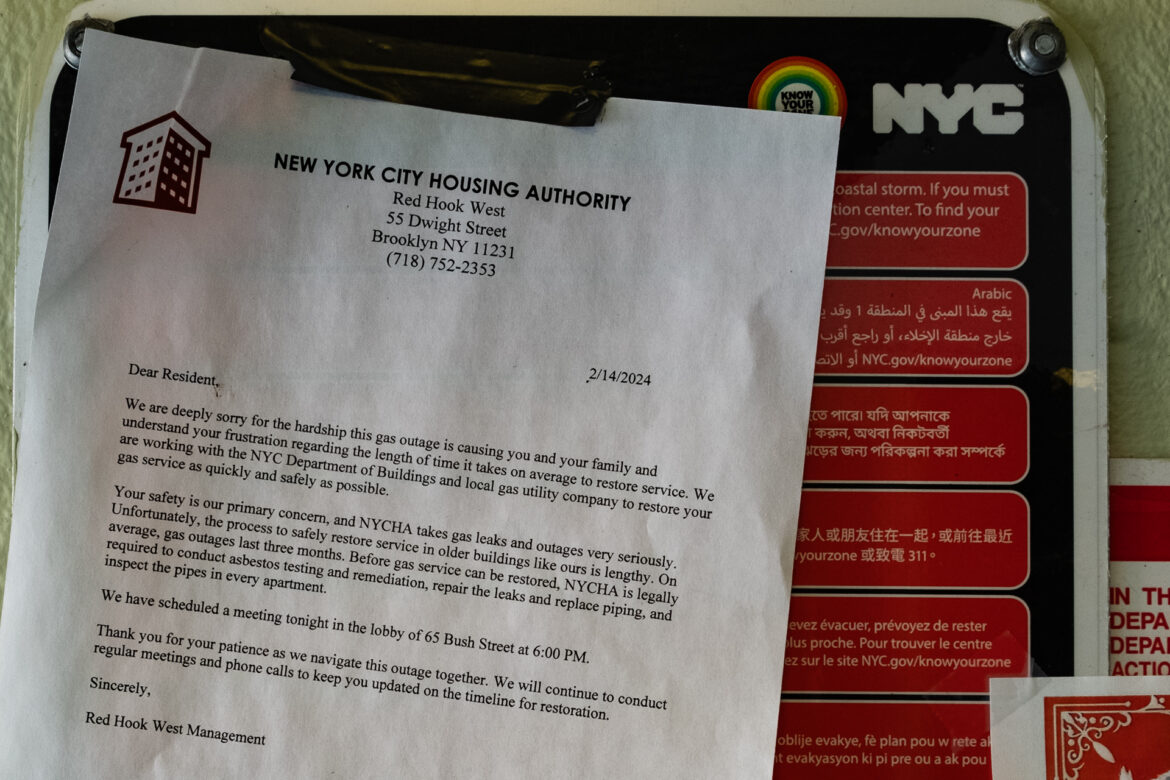
A letter about the gas outage in a NYCHA Red Hook West building, where some tenants have been without cooking gas since Jan. 24.

CityViews are readers’ opinions, not those of City Limits. Add your voice today!

A large cement truck drove through Red Hook West Houses the morning of Jan. 24. Moments later, emergency vehicles descended on the NYCHA development. “One of the construction workers hit something,” Red Hood resident Andrea Mcknight reported. That “something” turned out to be a gas line. To this day, gas service hasn’t been restored.

For the 113 Red Hook West households who depended on that gas line, fresh home cooked meals haven’t been an option since that January morning. Instead, residents trek to the deli, weather the surge in food expenses, and complain to an unresponsive management office. But this is not new. For NYCHA residents across the city, adjusting to utility disruptions has long been par for the course. 

Now, we have the numbers. As law students—in collaboration with Red Hook Community Justice Center (RHCJC)—we’ve spent the last year investigating whether New York law protects public and private tenants equally. Our analysis of the implied warranty of habitability—a particular part of the law—shows that public tenants aren’t as protected as they should be. We also requested data from NYCHA to zoom in on one piece of this puzzle: gas outages. Two data points illustrate the severity of the issue.

Between October 2017 and March 2024, there were 1,323 gas outages in NYCHA buildings (excluding currently pending outages), affecting 32,874 apartments. In 2023, 182 outages affected 5,239 apartments, which was slightly down from the year before, when 212 outages affected 5,887 apartments. The situation is particularly dire in NYCHA developments in Brooklyn and the Bronx, which together account for about 20,000 of the total affected apartments in the last six years.

Janhavi Nemawarkar and Stephen Kpundeh

Moreover, these outages too often take months to be resolved. Of the 1,323 outages captured in this data, 448 lasted for over 100 days. The longest was at the Wagner Houses in East Harlem, where tenants were left with a single hot plate for nearly two years from June 18, 2022 until March 1, 2024, when repairs were completed.

Janhavi Nemawarkar, Stephen Kpundeh

On average, these gas outages last 89 days, often with little to no communication from NYCHA property management about the gas line repair progress. NYCHA routinely refuses to provide tenants with notices or posted updates about utility service restoration even though a City Council law, Local Law 47 of 2015, requires all landlords, including public housing, to do so.

Every day without heat, cooking gas, or electricity is another day when devoted children, parents, and caretakers are forced to pay out of pocket to provide the bare essentials for their loved ones. 

Janhavi Nemawarkar, Stephen Kpundeh

State officials can provide crucial help to NYCHA tenants by amending New York State’s Public Housing Law. The NYCHA Utility Accountability Act (A2573/S546), which is currently pending in the New York Assembly Housing Committee, would reduce the rent tenants have to pay during outages.

The act would require that NYCHA credit tenants with either 10 percent of their rent, or $75 per month—whichever is higher—on a prorated basis for each day of a utility outage. This means, instead of paying for an apartment without utilities, residents can buy food for their families when their stove doesn’t work. Private landlords negotiate with tenants on rent during building utility outages, and this bill would cut through NYCHA’s bureaucracy to permit similar relief.

NYCHA has a responsibility for making sure tenants have essential utilities. The warranty of habitability is implied in all New York residential leases, which means that all landlords—including NYCHA—are responsible for making sure apartments are livable and safe, and prolonged gas, heat, and electricity outages run counter to that duty.

Outages in NYCHA developments across the city are unacceptable, and the thousands of tenants living in these houses without utilities deserve better. The New York State legislature has the opportunity to ease the burden on these residents: pass the NYCHA Utility Accountability Act.

Stephen Kpundeh and Janhavi Nemawarkar are students in the Community Advocacy Lab at Columbia Law School.

Want to republish this story? Find City Limits’ reprint policy here.
Trump could still vote for himself after New York conviction if he’s not in prison on Election Day

posted in: Politics | 0

By NICHOLAS RICCARDI (Associated Press)

DENVER (AP) — Donald Trump may be convicted of a felony and reside in Florida, a state notorious for restricting the voting rights of people with felony convictions. But he can still vote as long as he stays out of prison in New York state.

That’s because Florida defers to other states’ disenfranchisement rules for residents convicted of out-of-state felonies. In Trump’s case, New York law only removes the right to vote for people convicted of felonies when they’re incarcerated. Once they’re out of prison, their rights are automatically restored, even if they’re on parole, per a 2021 law passed by the state’s Democratic legislature.

“If a Floridian’s voting rights are restored in the state of conviction, they are restored under Florida law,” Blair Bowie of the Campaign Legal Center wrote in a post, noting that people without Trump’s legal resources are often confused by Florida’s complex rules.

So as long as Trump isn’t sent to prison, he can vote for himself in Florida in November’s election.

Trump was convicted Thursday of falsifying business records in a scheme to illegally influence the 2016 election through hush money payments to a porn actor who said the two had sex.

A lifelong New Yorker, Trump established residency in Florida in 2019, while he was in the White House.

Even if he is elected president again, Trump will not be able to pardon himself of state charges in New York. The president’s pardon power applies only to federal crimes.

The conviction, and even imprisonment, would not bar Trump from continuing his pursuit of the White House. The Republican National Convention, which will open four days after his July 11 sentencing date in New York, adopted rules last year that didn’t include any specific provisions if its presumptive nominee is convicted of a crime.

Delegates could move to change their rules before formalizing Trump’s nomination, but there’s no evidence that a significant faction of the party would try to replace the former president on the GOP ticket. Trump commands loyalty across the GOP base, and the Republican National Committee is run by his loyalists, including his daughter-in-law Lara Trump as co-chair.

Minnesota United: Emanuel Reynoso transferred to Club Tijuana

posted in: News | 0

The greatest player to put on a Minnesota United jersey has officially left the club.

Club Tijuana announced Thursday the addition of central attacking midfielder Emanuel Reynoso from MNUFC.

The Loons paid a club-record $5 million transfer fee for Reynoso from Boca Juniors in 2020 and will receive what might become a seven-figure return based on Reynoso’s contract incentives and performance qualifiers, a source told the Pioneer Press.

“We would like to thank Emanuel Reynoso for his time and contributions on the field with Minnesota United,” Chief Soccer Officer and Sporting Director Khaled El-Ahmad said in a statement. “The club wishes him the best in the future.”

MNUFC offloads Reynoso, who was insubordinate on multiple occasions, including five months during the 2023 season and for seven weeks this season. Reynoso’s actions this year damaged his relationship with El-Ahmad. When Reynoso returned to Minnesota in early May, he was put on a return-to-play protocol that would require him to be away from the team for the foreseeable future.

The Loons began shopping Reynoso to clubs in other leagues and the Reynoso’s departure opens up Designated Player spot going into summer transfer window. The Loons also free up salary; Reynoso was making $2.2 million in guaranteed compensation in 2024, according to MLS Players Association.

Reynoso was a two-time MLS All-Star who could dazzle with the ball on his left foot. He scored 24 goals and provided 37 assists in 95 MLS games.

Reynoso, 28, also dealt with legal issues. He was accused of pistol whipping a teenager and was just seen in a video holding a bag of cash with an unidentified man, who was holding the likeness of a handgun and more stacks of bills.

Shares in Trump Media slump after former president convicted in hush money trial

posted in: Politics | 0

By MICHELLE CHAPMAN (AP Business Writer)

Shares of Trump Media & Technology Group, the owner of social networking site Truth Social, slumped Thursday after former President Donald Trump was convicted in his hush money trial.

A New York jury found Trump guilty of falsifying business records in a scheme to illegally influence the 2016 election through hush money payments to a porn actor who said the two had sex.

Trump Media’s stock was down about 9% in after-hours trading Thursday as news of the verdict emerged.

The stock, which trades under the ticket symbol “DJT,” has been extraordinarily volatile since its debut in late March, joining the group of meme stocks that are prone to ricochet from highs to lows as small-pocketed investors attempt to catch an upward momentum swing at the right time.

The stock has tripled this year, in the process frequently making double-digit percentage moves either higher or lower on a single day. It peaked at nearly $80 in intraday trading on March 26. For context, the S&P 500 is up almost 10% year to date.

Earlier this month, Trump Media reported that it lost more than $300 million last quarter, according to its first earnings report as a publicly traded company.

For the three-month period that ended March 31, the company posted a loss of $327.6 million, which it said included $311 million in non-cash expenses related to its merger with a company called Digital World Acquisition Corp. DWAC was an example of what’s known as a special purpose acquisition company, or SPAC, which can give young companies quicker and easier routes to getting their shares trading publicly, but with much less scrutiny.

Trump Media & Technology fired an auditor this month that federal regulators recently charged with “massive fraud.” The media company dismissed BF Borgers as its independent public accounting firm on May 3, delaying the filing of its quarterly earnings report.

Trump Media had previously cycled through at least two other auditors — one that resigned in July 2023, and another that was terminated by its board in March, just as it was rehiring BF Borgers.

Trump was charged with 34 counts of falsifying business records at his company in connection with an alleged scheme to hide potentially embarrassing stories about him during his 2016 Republican presidential election campaign.

The charge, a felony, arose from reimbursements paid to then-Trump lawyer Michael Cohen after he made a $130,000 hush money payment to porn actor Stormy Daniels to silence her claims of an extramarital sexual encounter with Trump in 2006. Trump was accused of misrepresenting Cohen’s reimbursements as legal expenses to hide that they were tied to a hush money payment.

Trump’s defense contended that the Cohen payments were for legitimate legal services.