
A draft resister, a judge and the moment that still binds them after 54 years

posted in: News | 0

By Doug Smith, Los Angeles Times

LOS ANGELES — The aging draft resister came early to beat the Memorial Day observance at Los Angeles National Cemetery. He angled through rows of white headstones, treading on immaculately tended grass. He stopped at the grave of the judge who had sentenced him.

He had a message for U.S. District Judge Harry Pregerson that has been in his thoughts since that day in 1970.

As an 22-year-old in 1967, Bob Zaugh had found a purpose in his life more important than school, career or even freedom. It was a recognition of the commonality of all humans that meant he could not support the Vietnam War or the system that sent young men to fight in it.

So on Dec. 4, 1967, the second national draft card turn-in day, he joined other resisters at First Unitarian Church of Los Angeles on West 8th Street in symbolically dropping their cards in a goblet.

At the height of the nation’s struggle of conscience over the Vietnam War, that decision had multiple possible consequences for a young man: ostracism by friends and family, loss of employment opportunities, and lifetime stigma as being unpatriotic or worse — a coward. Not to mention prison time.

When Case 5787, United States of America vs. Robert Paul Zaugh, went on trial on Tuesday, May 26, 1970, Zaugh came prepared to admit to the two charges — refusing to report for a preinduction physical and refusing to report for induction. The maximum sentence was five years in prison and a $10,000 fine.

Pregerson, though remembered as a liberal judge, was also a Marine who was wounded in the Battle of Okinawa in World War II. He didn’t have a track record of leniency, and had already sent three of Zaugh’s roommates — Richard Profumo, Mike Swartz and Jack Whitten — to prison.

After Assistant U.S. Attorney Arnold Regardie introduced Zaugh’s Selective Service file as evidence, the judge turned to Zaugh, who had waived a jury trial and was representing himself.

“You may proceed, Mr. Zaugh.”

“I will start by saying that on May 29th I did refuse to cooperate at a physical, and that on August 27th I did refuse to submit to induction,” he began.

Zaugh, at Pregerson’s grave in November, began his ritual visits after the judge, by then a senior member of the U.S. 9th Circuit Court of Appeals, died in 2017. (Irfan Khan/Los Angeles Times/TNS)

His defense, he said, would be “that there is really no alternative way for me to act when I am confronted by the U.S. Military Code.”

Zaugh would later obtain a transcript of the hearing from the National Archives.

In his opening statement, he quoted at length from a Selective Service System pamphlet called “Manpower Channeling,” and argued that the very concept of the draft infringed on his and other young men’s inalienable rights expressed in the Declaration of Independence and, in his view, reserved to the citizens by the 9th Amendment.

The prosecutor could no longer bear it.

“I will object to any further opening statement along these lines on the grounds that it is irrelevant and really not properly part of an opening statement,” he broke in.

And then came the moment when Pregerson inadvertently created a bond that would live beyond him — and lead Zaugh, year after year, to the judge’s grave.

“What you say is technically true, Mr. Regardie,” Pregerson told the prosecutor. “But I will hear Mr. Zaugh.”

Zaugh would — necessarily — be convicted that day and face possible prison time. But he had unexpectedly won the only victory he hoped for — to be heard.

For anyone who didn’t live through the 1960s, it might be impossible to conceive of the moral fissures wrought in America by the Vietnam War and the life-changing and character-defining decisions faced by every man of military age.

Some would follow their sense of duty, or merely do what they were told, and join a war many found they didn’t understand. Those who didn’t die returned to a home that many found didn’t understand them.

Related Articles


Older men die by suicide at steep rates. Here’s how the VA is trying to change that


The Latest | D-Day’s 80th anniversary brings World War II veterans back to the beaches of Normandy


D-Day anniversary haunted by dwindling number of veterans and shadowed by Europe’s new war


In France, D-Day evokes both the joys of liberation and the pain of Normandy’s 20,000 civilian dead


The last WWII vets converge on Normandy for D-Day and fallen friends and to cement their legacy

Hundreds of thousands would linger in school or marry to obtain deferments, or enlist in the Coast Guard or Air Force to avoid conscription into the Army. Others turned their backs on the U.S. by moving to Canada.

It was later estimated that more than 570,000 sought deferments through deception — the draft dodgers — or openly repudiated the draft — the resisters.

Some declared they wouldn’t fight for reasons of conscience. The standard-bearer of that group was world heavyweight champion Muhammad Ali, who in 1967 was sentenced to prison for refusing induction based on a mix of his Muslim faith and his country’s racial injustice.

“Why should they ask me to put on a uniform and go 10,000 miles from home and drop bombs and bullets on brown people in Vietnam while so-called Negro people in Louisville are treated like dogs?” Ali asked.

The late David Harris, former Stanford student body president and co-founder of a group called the Resistance, emerged as a leader in the growing national civil disobedience movement. He opposed the draft on broad philosophical precepts:

“We are all responsible for what our country does,” Harris wrote. “Under the worst of circumstances, we control our own behavior.”

Zaugh was in graduate school at UCLA when Harris, soon to be tried and sentenced to prison himself, spoke on campus, railing against the draft as an unjust system funneling young men into an unjust war.

The message struck so deeply that Zaugh dropped out of UCLA, joined a commune of fellow draft resisters living in a large house in central L.A., and began volunteering with a ragtag group called the Peace Press that published anti-war literature on a small offset printer.

Among resisters, Zaugh was a special case. Before he took his stand of conscience, he had reported for, and flunked, a preinduction physical due to a congenital condition called rheumatoid spondylitis, a fusing of the spinal vertebrae.

He never would have been sent to Vietnam.

When Zaugh’s day in court arrived, he wanted the Judge to know that he could have taken the easy way out.

“I hope to show that, first of all, I could have cooperated, taken the physical, and I would have flunked and received either a 1-Y or a 4-F,” he said, citing two categories for medical deferment.

But that was not his defense. He brought up his physical condition for only one reason, he said: “I would like you to be convinced of the sincerity of what my defense really is.”

With Pregerson’s license to speak, Zaugh did, for 15 minutes. He read passages from “Channeling Manpower,” which he said “really had a great effect” on him — “so much so that I printed up, myself, about 10,000 copies and distributed them.”

Anyone who read the document, he said, “would clearly see that the young people are dispossessed of their lives in this country, and that as a result we are being deprived of life, liberty, and the pursuit of happiness.

“I maintain that I have the right to choose my own happiness; not to have it imposed upon me from the outside.”

Pregerson cut in.

“Don’t you think all of us live under certain restrictions, Mr. Zaugh? Really, are any of us completely free to do what we want to do and to pursue our own happiness in the way we want to pursue it?”

But without waiting for an answer, he changed his tone.

“What are you doing now? Are you in school?”

“No,” Zaugh replied. “I have been working with blind children for four years, and I do printing on a subsistence wage, and I pack eggs for the father of a friend of mine who was sent to jail for refusing induction.”

“Go ahead,” Pregerson said. “I am glad you are doing that kind of work.”

Zaugh described a recent realization: “All the decisions that I have made relate to various social problems, such as ecology, the draft, racism and war.”

Complying with the induction law “means that I am violating the rights of others, because the result of the Selective Service System is really slavery. I think when you are forced to go in the Army because of fear of five years in prison, you are being enslaved.”

His testimony continued in this vein until Pregerson, in effect, mounted the defense that Zaugh was unwilling to make. The judge pressed Zaugh’s advisory counsel to argue that the government had made procedural errors in his case — a defense that worked for more than 100,000 defendants.

Contrary to Zaugh’s wish not to base his defense on technicalities, Pregerson found him not guilty of refusing induction.

Almost apologetically, he said he had to find Zaugh guilty of refusing his physical. He set sentencing for June 17.

American attitudes toward the Vietnam War were changing in 1970, as images of the dead — Vietnamese and American — on nightly television drummed home the brutality of the war; the enemy’s massive Tet Offensive of 1968 had undermined the U.S. government’s assurances of ultimate victory. Ali, initially condemned as unpatriotic by much of America, became a powerful symbol for the growing anti-war movement. The Supreme Court overturned his conviction in 1971.

That trend was reflected in the justice system. Prosecutions, convictions and prison sentences for draft resisters declined sharply in the late 1960s and early 1970s, President Ford’s postwar clemency board concluded in an exhaustive study of the Vietnam War era.

In “Chance and Circumstance: The Draft, the War and the Vietnam Generation,” Lawrence M. Baskir and William A. Strauss attributed the change to the successful strategy of resistance leaders to overwhelm the court system, and to growing doubts about the war among prosecutors and judges.

In a chart modeled on a family tree, the authors documented the cases of 209,517 men accused of draft violations: 25,279 indictments, 8,750 convictions and only 3,250 prison terms.

Zaugh might have had reason to think Pregerson too was having a change of heart.

Two other members of the commune earlier sentenced by Pregerson — Swartz and Profumo — had obtained early releases and attended Zaugh’s trial to show their support.

Though he has no proof, Zaugh believes Pregerson was responsible for their release. The judge had learned they were in solitary confinement for continuing their civil disobedience in prison. Pregerson went to the prison to see for himself, and then either filed a habeas corpus petition or persuaded a lawyer to do so, Zaugh said.

At sentencing Pregerson gave no inkling of his motivation, but said simply that Zaugh “does not now need confinement.” He sentenced him to two years of probation on the condition that he “perform civilian work of national importance contributing to the maintenance of the national health, safety and interest.”

U.S. District Judge Dean Pregerson, who followed his father to the bench, believes the reasons for his decision were complex.

“I think like so much of the country, my dad had nothing but respect for men and women in uniform, but at the same time he began having doubts about whether this war made sense,” he said.

But he also thought Zaugh’s sincerity had influenced the decision.

“The other thing that is a reflection of my dad’s character is that he appreciated people who were genuine, who lacked guile and were acting on principle,” the son said. “The fact that people like Bob were willing to go to prison rather than do what less principled people would do, which is try to avoid the draft through some other means, is something that spoke to those qualities.”

Zaugh informed the Probation Board that he intended to serve the national interest by continuing to work for the Peace Press.

That could have been a tidy end to the story, but fate was still at play.

Three decades later, the elder Pregerson came back into Zaugh’s life by chance. It happened, of all places, at a UCLA football game where Zaugh, by then a Bruin fan, saw UCLA alum Pregerson honored at halftime.

Zaugh’s sense of destiny was reinforced when he attended a screening of Oscar-winner Terry Sanders’ 1998 documentary “Return with Honor,” about U.S. pilots who’d been prisoners of war. It was a fundraiser for an Inglewood veterans shelter, one of several Pregerson had helped found.

“So, after intending to write you since the 70’s, the signs were clear it was time to do so,” Zaugh said in an undated letter to Pregerson, by then on the U.S. 9th Circuit Court of Appeals.

He reminded the judge of the details of his case and concluded:

“What was crucial for me was that though you probably disagreed with my position, you probably set that aside and allowed me to present my defense.”

He mentioned that he had done his work in the national interest at the Peace Press.

“Though it may seem a stretch as work in the national interest, it was respected by many and studied as a model worker-owned business by the [Small Business Administration] and California.

“My conviction has never been a burden in any way and the fact that you chose not to jail me has probably been a blessing.”

By then Pregerson, who famously testified at his 1979 appeals court confirmation hearing that he would follow his conscience if it conflicted with the law, had established himself as an activist, both on and off the bench, on behalf of homeless people and veterans. He stirred the federal bureaucracy to provide land for the Salvation Army’s shelter in Bell, and his oversight of litigation over the Century Freeway led to the construction of close to 1,000 permanent housing units for veterans at Century Villages at Cabrillo.

On Feb. 16, 1999, Pregerson wrote back:

“It meant a lot to receive your letter. … I remember your case well. I also remember Mike Swartz and another young man whose last name name was Whitten. I’ve often wondered what became of you and the others.

“I am happy to know that my disposition of your case turned out so well for you and for our country.”

Zaugh had long wanted to thank Pregerson in person, but couldn’t get court staff to make an appointment. He finally succeeded in 2016, when he offered to introduce the judge to his friend Gary Tyler. A Black man who had served 40 years in an Alabama prison on a murder charge that was widely discredited as racially motivated, Tyler was released that year in a manslaughter plea deal. Zaugh had supported the campaign to free him and facilitated Tyler’s move to Los Angeles.

The 2½-hour meeting in the judge’s chambers provided a link that bore fruit upon Pregerson’s death on Nov. 25, 2017.

Sanders, the filmmaker, wanted to film the judge’s memorial service at the Shrine Auditorium. Zaugh made the introduction to the family through Pregerson’s staff. That footage became the foundation for “9th Circuit Cowboy,” Sanders’ feature-length documentary on the judge.

Zaugh, Sanders and Dean Pregerson have since appeared at colleges and high schools for showings and discussions of the film.

Today Zaugh, 79, a divorced father of three, lives alone in a guesthouse in south Santa Monica. He spent about two decades at the Peace Press, then another 20 years printing for Matt Groening’s Bongo Comics Group. He used his severance from the company to form a nonprofit, Actions Speak Louder Inc.

His nonprofit produces dramatic readings of the play “Our Town” and speaks with law school students at UCLA and Loyola Marymount about the Resistance. Its history is as relevant as ever today, he thinks, as he sees protesters for the Palestinian cause hiding their identities and shunning the news media instead of openly proclaiming their commitment to the cause.

His current project is preparing a yearlong exhibition of talks and artwork on depression for El Camino College in Torrance.

He also prays out loud every day for some 200 people, living and dead.

“I ask that I am able to represent, carry forth, the best trait of their life in my own life to honor their soul.”

After Pregerson’s death, Zaugh began a ritual that is partly spiritual and partly his continued service to the national interest. On Veterans Day and Memorial Day, he visits L.A.’s National Cemetery for veterans.

It’s a simple observance. He walks to Pregerson’s grave site, sits with him and prays.

His message: “Thank you.”

©2024 Los Angeles Times. Visit at latimes.com. Distributed by Tribune Content Agency, LLC.
As veterinary costs rise, people wrestle with high price of caring for pets

posted in: News | 0

Julie Baxter just faced the most agonizing decision a person with pets can face: whether to euthanize an ailing animal in the face of the overwhelming desire to keep a beloved companion alive.

Baxter’s pain was made all the more acute as she and her partner wrestled with wanting to do all they could for their dog Roscoe, while realizing there was a limit to how much they could spend on tests and hospital stays. The 50-pound mixed breed lived with them for eight years after his rescue off the streets as a puppy.

“My partner and I had a kind of rule that $1,000 is where we’re going to stop on vet bills,” said Baxter, who lives in Broomfield, Colorado. “It was really trying to take that pragmatic approach to how much can we spend. It stinks.”

They ended up paying $2,400 for medications, tests and trips to the emergency room, but decided against further treatment that could have been as much as $8,000. Roscoe, diagnosed with pneumonia, died in early June.

Baxter wonders if she should have bought pet insurance at some point.

“I don’t know that it would have changed the outcome, but it certainly would have saved me at least part of the $2,400 in vet bills,” Baxter said. “It’s something I wish I would’ve looked into because I feel like I wouldn’t have been quite so backed into a corner.”

Rising costs of veterinary care are helping drive an increase in the number of people who are opting for pet insurance, according to the personal finance company NerdWallet. The company reported that more than 5.6 million U.S. dogs and cats were covered by pet insurance in 2023, up 17% from the year before, according to the North American Pet Health Insurance Association.

However, the number of insured animals is just a small fraction of pets nationwide. The 2023-2024 American Pet Products Association National Pet Owners Survey said there are an estimated 65 million households with dogs and nearly 47 million households with cats.

An incentive for buying insurance is increasing pet-care expenses. The cost of veterinarian services rose 7.6% from May 2023 to May 2024, according to the U.S. Bureau of Labor Statistics. A 10% jump in 2022 was the largest dating back two decades, The Associated Press reported.

Higher worker pay and higher costs for medical supplies, lab tests and pharmaceuticals are among the reasons for increases. Some veterinarians also blame the purchase of clinics and hospitals by large corporations for boosting prices.

Nearly half of the respondents to a survey by pet food and supplies online retailer Chewy said the primary reason they have wellness or insurance plans is to be able to take care of their animals if something happens to them. Katy Nelson, senior veterinarian at Chewy, said in an email that the average monthly cost for pet insurance is around $30 for cats and $50 for dogs

“Doing your own research is important. There are many options out there and sometimes selecting the right plan can feel overwhelming,” Nelson said.

A number of online sites provide comparisons of different policies, including NerdWallet and PawLicy Advisor. Pre-existing conditions typically aren’t covered. Some breeds of dogs, such as English and French bulldogs, are more expensive to cover because they are prone to certain health issues.

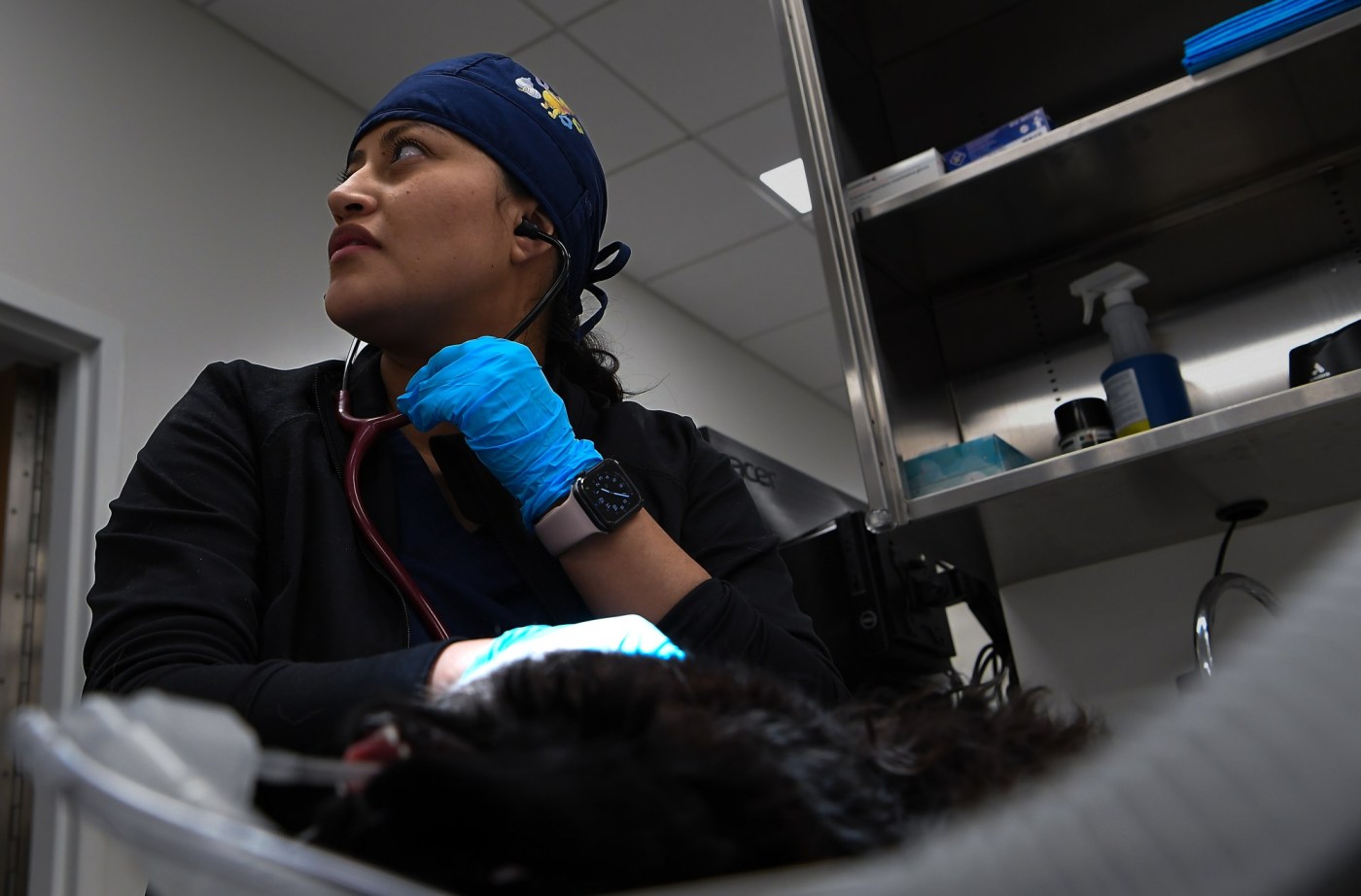
Cynthia Sweet, a vet at the Belcaro Animal Hospital in Denver, has insurance for her dogs. She said pet owners will marvel that things like dental care costs more for their animals than for them.

Veterinarian Dr. Cynthia Sweet, DVM, left, poses for a portrait after doing a senior wellness check on Maddie, a 14 year old boxer, right, at Belcaro Animal Hospital at 5023 Leetsdale Drive in Denver on June 18, 2024. (Photo by Helen H. Richardson/The Denver Post)

“It comes down to insurance. You don’t realize how much medical and dental and medications cost on the human side because the majority of people have insurance. That’s just not the case in the veterinary field,” Sweet said.

Bethany Hsia, a California veterinarian and co-founder of CodaPet, an in-home pet euthanasia service, said the trend of pet insurance has been on the rise in recent years. She recommended that people look at a plan’s exclusions, the premium costs, the percentage of expenses that are reimbursed and an insurer’s reviews and reputation.

Something to keep in mind, Hsia said, is that a majority of pet insurance companies don’t directly contract with vets.

“So the pet parents pay out of pocket at the time of the services to the vet and submit the itemized invoices to the insurer for reimbursement,” Hsia said. “Can I afford to buy groceries next week if I pay for this right now?”

The best time to consider pet insurance is when the animal is young and healthy, Hsia said. In any case, she suggested reviewing different options.

“It’s good to have that peace of mind where you have the ability to do something in an emergency situation and you know that those finances are going to be reimbursed,” Hsia said. “It means the world when you’re sitting there looking into the eyes of your beloved pet.”

What did that highway sign say? States gets creative, but feds warn of confusion

posted in: Society | 0

By Tim Henderson, Stateline.org

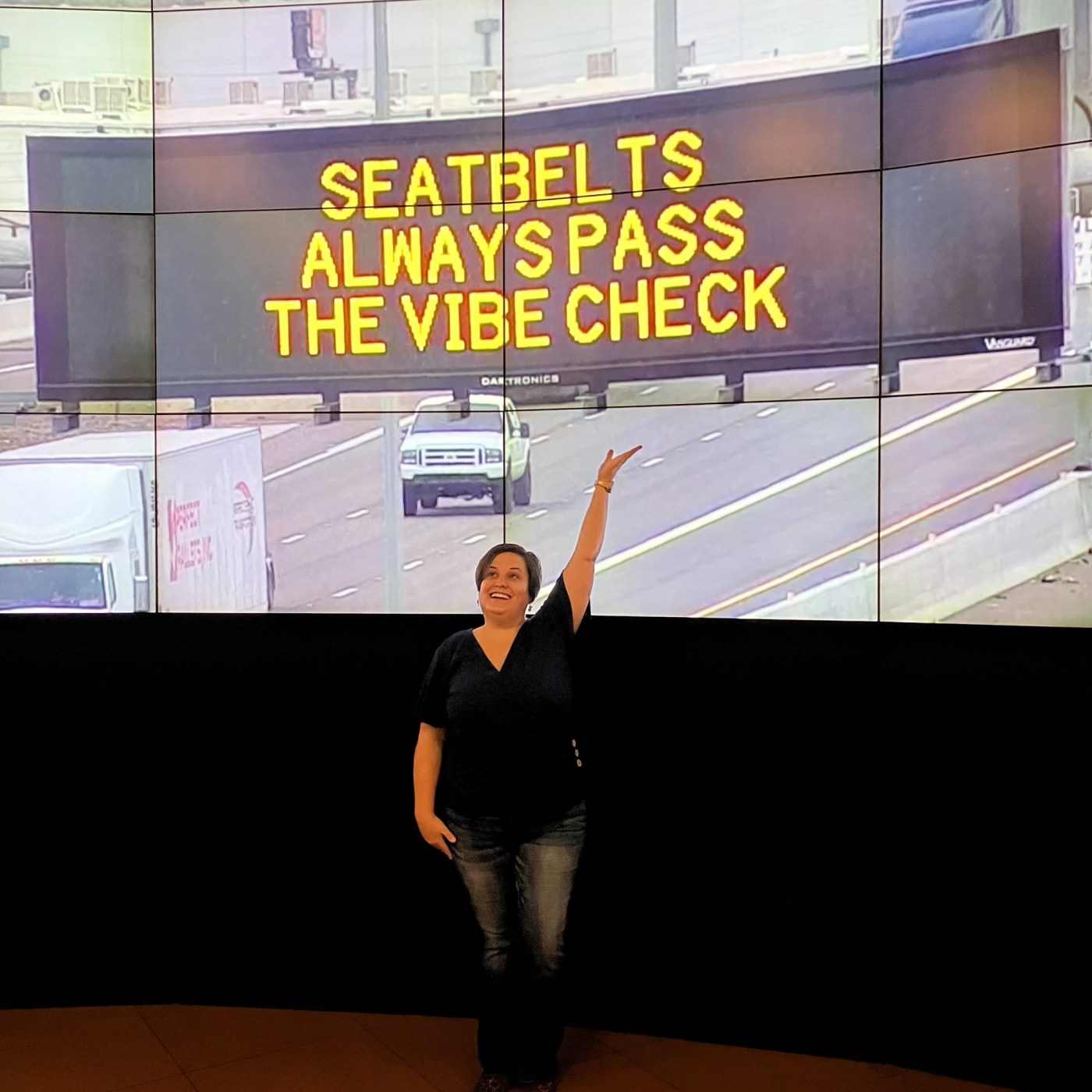
States have had their fun with highway safety messages, posting everything from Taylor Swift lyrics to discourage texting in Mississippi, to a “vibe check” — winking at Gen Z — to encourage seat belt use in Arizona.

Such messages are shown intermittently on thousands of highway signs, known as variable messaging signs, when the billboards aren’t lit up with alerts about accidents, construction or other real-time traffic issues.

As the summer vacation season gets going, millions of America’s interstate drivers can expect to find more puns, silly turns of phrase or cultural references on those massive missives.

But federal safety officials aren’t amused by states’ cheek. In recent years, they’ve begun to discourage what they view as overly creative messages, fearing that in trying to entertain drivers, highway officials are confusing rather than enlightening them. Some states, most recently Arizona and New Jersey, have pushed back. As a result, officials at the Federal Highway Administration clarified this year that they’re not banning road-sign humor outright.

Mississippi, the state with the highest motor vehicle fatality rate in the country last year, has been particularly creative. Recent messages have included “FOUR I’S IN MISSISSIPPI TWO EYES ON THE ROAD,” and a reference to the Taylor Swift song “Anti-Hero”: “TEXTING AND DRIVING? SAY IT: I’M THE PROBLEM IT’S ME.”

“It’s been an effective program for us. We haven’t been contacted by [the] federal highway department and told to cease and desist. We want to be in compliance, but we haven’t stopped our message program,” said Paul Katool, a spokesperson for the Mississippi Department of Transportation.

A new rulebook issued last year “does not prohibit messages from including humor or cultural references,” Federal Highway Administration chief Shailen Bhatt wrote in a recent letter to U.S. Reps. Greg Stanton, an Arizona Democrat, and Thomas Kean Jr., a New Jersey Republican.

The representatives had complained earlier this year that the agency was stifling state creativity, calling the new rules “a blanket discouragement of humorous signs that leaves no room for state-by-state discretion.”

“Both of these states have signs that use slang or popular language, but the messages are clear,” the representatives wrote in their letter to Bhatt.

They cited messages such as two Arizona contest winners, “SEATBELTS ALWAYS PASS THE VIBE CHECK” and “I’M JUST A SIGN ASKING DRIVERS TO USE TURN SIGNALS,” as well as New Jersey’s recent holiday messages: “ DON’T BE A GRINCH, LET THEM MERGE” and “ SANTA’S WATCHING, PUT DOWN THE PHONE.”

Bhatt’s response is an apparent softening of the FHWA’s opposition to the signs, after the agency asked New Jersey to pull down some messages in 2022. Some became so popular on social media that the state Department of Transportation asked drivers not to take photos of the signs while driving, posting a cat meme on its own social media accounts: “IF YOU KEEP TAKING PHOTOS OF THE VMS BOARDS WHILE DRIVING WE WILL TURN THIS CAR AROUND AND GO BACK TO THE OLD MESSAGES.”

Messages shown in 2022 included “GET YOUR HEAD OUT OF YOUR APPS” and “SLOW DOWN. THIS AIN’T THUNDER ROAD,” a reference to a song by favorite son Bruce Springsteen, The Philadelphia Inquirer reported.

The Federal Highway Administration isn’t telling states what to do — states retain control of their message boards — but it doesn’t think humor and cultural references are helpful. Vehicles pass under the signs in the blink of an eye, and the missives could puzzle people who don’t “get it” right away.

“FHWA appreciates the States’ efforts to creatively convey important safety messaging to motorists. Those messages need to be balanced with maintaining driver attention,” Bhatt wrote in his letter to the lawmakers.

An agency spokesperson, Nancy Singer, said in a statement that “states may develop their own traffic safety campaign messages” but they should avoid “messages with obscure meaning, references to popular culture, that are intended to be humorous, or otherwise use non-standard syntax.”

There’s some serious research behind the new guidance: One of the studies cited in Bhatt’s letter shows that overly creative language can have the wrong effect when used on a highway message sign. Driving behavior can get more dangerous, not less so, if you’re trying to process a confusing message.

Related Articles


Seeking an antidote to gun violence, a St. Paul church will help turn firearms into gardening tools


3-year-old girl drowns in residential swimming pool in Cottage Grove


Police, family asking for tips to find 20-year-old missing from St. Paul


Injured boy rescued in BWCA after storms inundate northeastern Minnesota


‘Legendary’ Twin Cities defense attorney Joe Friedberg dies at 87

“Messages involving humor, wit or pop culture references could have adverse consequences on driving behavior for motorists who are unable to correctly interpret those messages,” according to the 2022 study published by the National Academies of Sciences, Engineering and Medicine.

Lead author Gerald Ullman, who was senior research engineer at the Texas A&M Transportation Institute at the time the study was published, said it simulated highway-sign messages seen while driving.

Highway wit can work well but only “for drivers who get the humor used and the traffic safety point of the message,” Ullman said in an email exchange. “However, it does appear to have adverse effects on those drivers who don’t get it.

“Pop culture references that younger drivers get might very easily be confusing for older drivers,” he said. “Conversely, puns or references to older funny movies that older drivers find witty can fly completely over the heads of younger drivers.”

Still in states such as Mississippi, state officials have heard from residents who say creative messages changed their habits, which might not have happened with more direct language, Katool said.

“It’s all good fun, but the point is to save lives,” Katool said. “There’s really only so many times you can just tell somebody to stop texting and driving or tell them to slow down. Eventually they just kind of tune you out. So we feel this is a way to leverage holidays, popular culture, music, that kind of thing.”

New Jersey is still using humor in its messages: A batch that ran in May included “SLOW DOWN BAD DRIVERS AHEAD” AND “CAMP IN THE WOODS NOT THE LEFT LANE.”

But the state is “mindful of the kinds of messages we put up, keeping them safety oriented” and does follow federal guidance, said New Jersey Department of Transportation spokesperson Stephen Schapiro.

The latest messages in June include “THERE’S NO DEBATE DON’T TAILGATE” and “LET THE WAVES DO THE CRASHING STAY ALERT!”

New Jersey has one of the lowest rates of traffic fatalities as of 2023, about 0.78 deaths per 100 million vehicle miles driven. Minnesota is the only state lower, at 0.71, with the highest being Mississippi (1.76) and Arizona (1.69), according to preliminary National Highway Traffic Safety Administration statistics.

In Arizona, messages “sometimes include humor and cultural references, and we work hard to make sure key messages about safety will be easily understood by drivers,” said Doug Pacey, a transportation spokesperson. Over the Memorial Day weekend, the department used a relatively straightforward message: “COOKOUT ESSENTIALS BBQ, MUSIC, WATER, DESIGNATED DRIVERS.”

Like New Jersey and Mississippi, Arizona sometimes gets the public involved in picking safety messages with contests. A contest last fall led to two winning messages: “I’M JUST A SIGN ASKING DRIVERS TO USE TURN SIGNALS” — a reference to a line in the 1990 film “Notting Hill” with actor Julia Roberts, whose character in the film says, “I’m also just a girl, standing in front of a boy, asking him to love her.”

Another contest winner, Elise Riker, won for “SEATBELTS ALWAYS PASS THE VIBE CHECK” which was also displayed last fall. A marketing professor at Arizona State University, Riker told Stateline she crafted it to appeal to Gen Z drivers.

“A vibe check is Gen Z slang for good vibrations, from the 70’s,” Riker said. “Levity definitely helps a safety message get through. ‘You can die in a car accident without your seatbelt’ is more likely to be ignored.

“Nobody likes to think about dying,” she said. “Friendly and funny safety messages are a reminder that there are humans at the heart of it.”

Stateline is part of States Newsroom, a national nonprofit news organization focused on state policy.

©2024 States Newsroom. Visit at stateline.org. Distributed by Tribune Content Agency, LLC.
The hidden cost of helping friends earn more credit card rewards

posted in: News | 0

By Sara Rathner | NerdWallet

Thanks to travel rewards credit cards, you summer like a celebrity for the cost of a staycation, and your friends are starting to notice. There’s no reason to gatekeep your travel secrets — the more friends know about how to earn valuable rewards, the more who will join you on epic and deeply discounted adventures.

Not only do you take the time to answer their credit card questions, but you also send referral links if you carry a card they’re interested in applying for. If they end up getting a card with your referral, they can earn a generous sign-up bonus by meeting the card’s spending requirement, and you get “paid” for your time and expertise by getting a referral bonus.

But there might be a catch. That referral bonus can come with a tax bill.

How the IRS looks at credit card rewards

You may owe taxes on some credit card rewards, depending on how you earn them and the dollar value of what you redeem.

“If you have to spend money for it — for example, you get a bonus after spending $3,000 within a certain time frame — then, it‘s not taxable,” Luis F. Rosa, a certified financial planner and enrolled agent in Las Vegas, said in an email. “However, if no money was spent and it was just an incentive, then, the income is taxable.”

According to the IRS, rewards earned through spending count as rebates, which aren’t taxable. But you don’t have to spend anything to earn a referral bonus, so it’s potentially taxable, especially if you earned at least $600 in value.

Credit card issuers’ fine print spells this out, though some issuers provide more information than others. Citibank’s terms and conditions are quite specific, stating that you may owe taxes on rewards in the year in which you redeemed them, and Citibank determines the value of those rewards. Chase and American Express also include language on taxes in their terms and conditions, but it’s more vague, basically stating that you may earn taxable income and, if so, you’re responsible for the tax liability.

If any of your credit card rewards earnings meet the qualifications to count as taxable, you’ll receive a 1099-MISC form from your card issuer, which will contain information to include on your tax return. Rosa says that even if your earnings from referral bonuses amount to less than $600 and you don’t receive a 1099-MISC, you should still report those earnings to the IRS.

When in doubt, consult a tax professional for guidance on your specific situation.

Should you refer friends for credit card offers?

Any taxes you may have to pay will, of course, be a percentage of the value of the bonus. So it may still be worth it to you to refer friends and deal with the sting of a slight increase to your taxable income later on.

There is another instance, however, where you might want to hold off for the sake of your friendship. Sometimes a card’s welcome offer is larger if you apply through the card’s website or at a bank branch location. In cases where your referral yields a smaller bonus for your friend, the decent thing to do would be to steer them toward the bigger bonus.

Sure, you won’t get that financial incentive, but you’ll win your friend’s respect and avoid potential taxation.

Sara Rathner writes for NerdWallet. Email: srathner@nerdwallet.com. Twitter: @sarakrathner.