In our Morning Report newsletter in August, we featured 19 cats, seven dogs and one rabbit. We also remembered four pets who have passed away.
“Thanks for sharing all of the pet pictures!” a contributor wrote. “They’re my favorite part of the St. Paul Pioneer Press Morning Report.”
If you want to read more, here are the pets we featured in the newsletter in June.
Friday, July 26
“This is sweet Lolly,” Peggy writes. “She’s our neighbor but loves running over to our house and when she stays with us she settles right in to watch for squirrels and hang out on the patio.”
Lolly
Thursday, July 25
“This is our gang: Miss Nilla, Skitbit, and BC (boy cat) — shown here waiting for their supper,” write Kathie and Marc of Linwood, Minn. “All three were found lost/abandoned outside as kittens — provided to us by the Cat Distribution System. Miss Nilla and BC are about 15 and Skitbit is nine.They tolerate each other; sometimes you may catch a couple of them actually sleeping next to each other but they pretty much do their own thing. Over the last 48 years, we have always had at least one cat (usually more) but BC is the first boy cat we ever had; it just happened that way.”
Miss Nilla, Skitbit and BC (Boy Cat).
Wednesday, July 24
“Here is Archie,” Angela writes. “He adopted us 11 years ago. He’s spunky and always instigating a wrestling match with his brother, Link. He is quite a mama’s boy!”
As for Link, who is pictured in the background …
“He lives to show his big belly,” Angela tells us. “He hates exercise but loves to walk in the backyard.”
Archie and Link
Tuesday, July 23
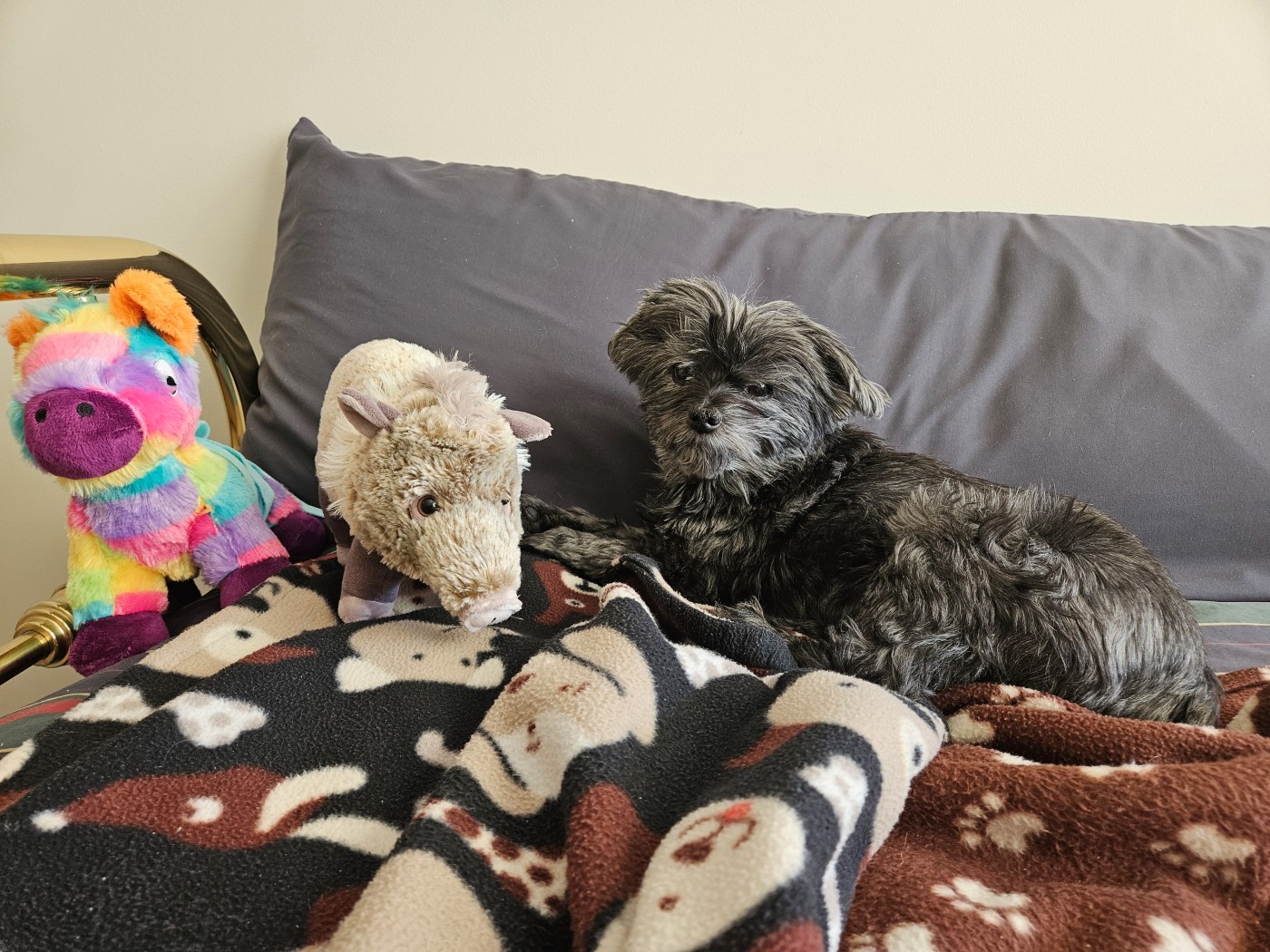
“Meet Oreo, our 12-year-old Yorkie-poo,” writes Stephanie of Minneapolis. “Whenever we go on vacation, we look for a toy for Oreo related to our destination. Usually the toy gets an unimpressed sniff and then it goes into the toy box where it is ignored. On our winter trip to Texas this year, we brought home Juanita the Javelina and finally it seems we brought her a good souvenir. She sleeps behind me while I work and I often find her and Juanita spooning, going head to head and even holding paws. Love seeing the cute dogs and cats in my email each weekday. Thanks!”
Juanita and Oreo.
Monday, July 22 (Memorial)
“Bismarck, our rescue cat, was 16 when he left us this summer,” writes Mary of St. Anthony Park. “He was independent, feisty and demanding. His favorite perch was in the bay window so that he could survey his domain properly. He loved the Man of the House and nobody else. The rest of us were staff. But we all loved him.”
Bismarck
Friday, July 19
“Chloe is all set for the yearly pontoon boat parade,” write Oren and Carol. “She is wearing her favorite party dress and Hawaiian lei. Party on Chloe!!”
Chloe
Thursday, July 18
“Painted in Photoshop,” wrote Jean in an email. “This is years before AI!”
We asked Jean more about her muse.
“Bentley,” a Photoshop “painting” by Jean Moore.
“This sweet cat’s name was Bentley, a rescue cat I adopted about 15 years ago,” she replied. “I took (TOO) many pictures of my cats through the years and decided to ‘paint’ this one.”
Beautiful!
Here are photos of her current cats, a brother and sister who answer mostly to “Kittens”!
Jean calls this photo, “Guarding the Peaches”:
“Guarding the Peaches” by Jean Moore.
This one, our favorite, is “Guarding the Cookbooks”:
“Guarding the Cookbooks” by Jean Moore.
Wednesday, July 17
“A friend of mine referred me to your email/column that you do in the Pioneer Press,” Justin writes. “So, Meet Ajax (AKA Chubbs)! He is a 13-year-old sassy Pug/Pitbull mix who knows that he is too cool for his own good. I mean, look at him! He never misses his dinner time and makes sure his dads never miss it either.
Ajax
“I adopted him when he was two and has been living the life since then. I’ve never met a dog with such personality and character as Ajax, but I wouldn’t have it any other way. He loves to bathe in the sun and take long naps. He is the goodest boy!”
Tuesday, July 16
“My dad says I’m three today and I’m very happy with my life,” wrote Emmy (with a little help from John) in an email to the Morning Report on Wednesday, July 3. “Still, sometimes I look out the window and wonder what it would be like to be a bird.”
Happy Birthday, Emmy!
Monday, July 15 (Memorial)
Oliver
“We said goodbye to our grandcat, Oliver, in June,” wrote Deb of Onalaska, Wis. “He was a 12-year-old Cornish Rex who had some serious health issues before he crossed the Rainbow Bridge. He is missed by his human family, as well as Sparkle the poodle and Lumi the Cornish Rex.”
Friday, July 12
“Good morning,” John writes.”I never thought I would be sending this kind of email to the media. Here are some picks of our recently adopted kittens, James Madison and Abraham Lincoln. We kept the names the rescue organization gave them. They love laying in the sun, snuggling in their kitty bed, exploring the nooks and crannies of their new house, and sleeping in the she-she’s swinging chair. They also love getting the zoomies and incessant playing instead of bedtime. While the aren’t our beloved Dachshund, Winston, they have quickly stolen our hearts. When I proposed to my wife, the one stipulation was that she could get kittens. Well, here we are, and it must be true love because I was not a cat person beforehand.”
James Madison and Abraham Lincoln
Thursday, July 11
“I wanted to share with you a photo of our cat, Sasha,” Allyson writes. “She’s 9 years young and her favorite places to hang out are at home and in the car. Sasha is a curious soul who likes to explore her surroundings providing her two humans are close by — then she’s game for any adventure!”
Sasha
Wednesday, July 10
“Previously, you featured Eurwyn and Freyja, both who have since passed, as well as my ‘grande dame’ Calico, Genbu,” writes Allison of Moorhead, Minn. “While no pet is ever replaced, the Cat Distribution Society of the Universe decided to place these two with me after I lost Eurwyn and Freyja in quick succession.
Isis and Halldor
“Continuing the alphabet of cats*: Halldór, the silver, 4-year-old part-Maine Coon, was acquired in January 2023. He is goofy and extremely dog-like.
Halldór
“Isis, the tiny ginger, is also four and the peacekeeper in the house. A former barn cat found with six (!) fat kittens near Grand Forks, N.D., last October, she joined us in November 2023 once her kittens were weaned and homed.
Isis
“As you can see, these two get along swimmingly (Genbu is thrilled to have Isis distracting Halldór)!”
Halldor and Isis
In her asterisk, Allison explains the alphabet of cats:
“My first cats, once I was on my own after college, were Ångstrom and Bunsen,” she writes. “Then came Clarice, followed by Dumas, then Eurwyn and Freyja. Throughout these first six, I only had two at a time, but somehow ended up with an orphaned 5-week-old kitten, Genbu as a third.”
Tuesday, July 9
“There’s nothing better than cuddling with Raven and Maeve and seeing them calm,” Peggy writes. “But when it’s dinner time the excited jumping begins!”
Maeve
Monday, July 8 (Memorial)
“Our friend’s son’s bunny, named ‘Curdis’ (’cause his coloring looked like a cheese curd!) died suddenly last week,” Joyce wrote on June 21. “How he loved to eat carrots … ”
Curdis
Wednesday, July 3
“This is Nixie, celebrating her Adoption Day on June 11,” Jeanne writes. “I wasn’t able to find a card for that. Nixie seems fine with a birthday card as she nestles in her well-padded box. We got her from Feline Rescue because I wanted a Halloween cat. She’s a BIG fan of looking out of windows, maybe because she was in a cage and couldn’t easily get to a window.
Nixie
“She’s an older cat now and sleeps a lot when she’s not watching squirrels, birds, dogs and people. What a good life.
“She has an interesting way to let me know that she wants to cuddle on my lap: She stands sideways, reaches out with her left leg to snag my shirt and gently plops over. It’s so cute. I wonder how she learned to do that.
“Thanks for sharing all of the pet pictures! They’re my favorite part of the St. Paul Pioneer Press Morning Report.”
Tuesday, July 2
“While ‘Up Nord’ visiting my cousin in February, we got to see her beautiful cat, Chunky,” Joyce writes. “Here he is, just waiting to play some more!”
Chunky
Monday, July 1
“Once again, we are coming up on 7/2, Fritz Mondale’s Gotcha Day, ” Eileen writes. “This will be his third.
“We were a dog short in our family after Ruby passed at 15-1/2 in 2020. We finally found Fritz at Clark County Humane Society in Neillsville, Wis.
Fritz Mondale
“He had been given to two little 8- and 10-year-old Amish boys who had until his first birthday to turn him into a working farm dog. But the poor pup was kicked in the head by a cow, leaving him with a Harry Potter scar over his right eye, and a fear of cows.
“On his first birthday he was taken to the pound, because who needs a working dog terrified of farm animals?”
Fortunately, Eileen and her family live in the suburbs. Not many — any? — cows there, but …
“We live in Roseville, and one morning went out to walk about 5:45 a.m., ” she writes. “Walked out the gate and there, about 15 feet from us, was a deer. Fritz suddenly leaned against me and froze. To him, it was a big, funny-looking cow. He’s also afraid of the grunty pig toy because of the farm animal sounds it makes.
“Don’t worry, Fritz, your doggie and kitty siblings will protect you!”
Fritz Mondale and friend.
Hope you have a great Gotcha Day, Fritz!
Related Articles
Adopting a dog? It helps to do some homework first
Morning Report pets featured in June
Injured Harding the cat is healing thanks to a community of helpers
Rise in feline, animal disease that can infect humans seen in Minnesota
Newport: Updated park for kids now open, next up is one for Fido