SAINT-DENIS, France – In the parlance of the next Summer Olympics host city, Los Angeles’ portion of the Paris Games’ closing ceremony Sunday night was a coming attraction, a global trailer for what International Olympic Committee and local officials hope is the blockbuster hit of the summer of 2028.
“Our chance to give a glimpse to the world of what to expect in 2028,” said sports and entertainment mogul Casey Wasserman, the chairman of LA 28.
So actor Tom Cruise repelled into Stade de France to the theme of “Mission Impossible,” grabbed the Olympic flag, hopped on a motorcycle and rode off through the streets of Paris to an awaiting plane.
“I’m on my way,” Cruise said, talking on a cell phone before boarding the plane in a pre-filmed segment in which he attaches the Olympic rings to the Hollywood sign.
While Cruise’s arrival showed that Los Angeles still knows how to make an entrance it upstaged a moment that was significant in multiple ways.
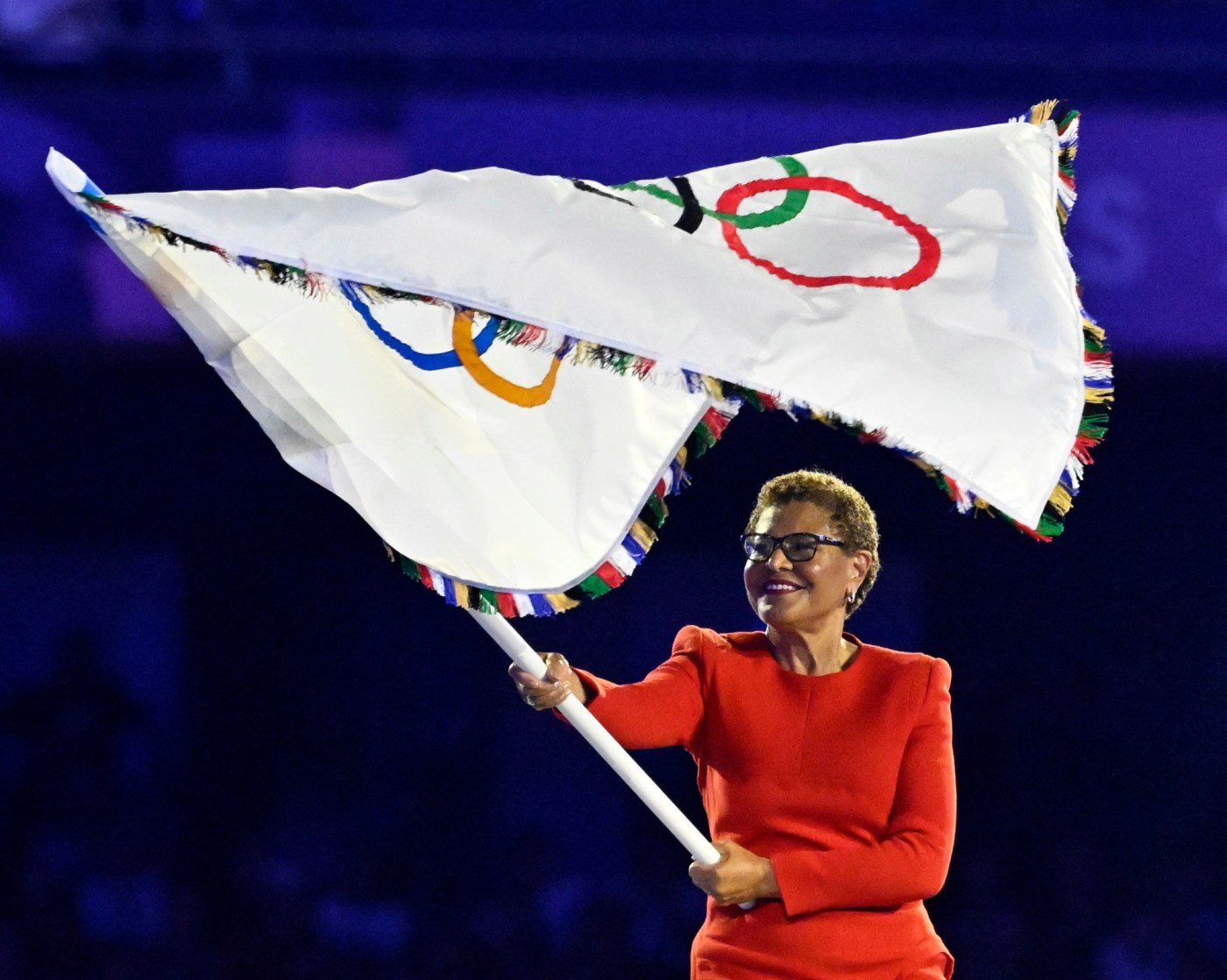
When Paris mayor Anne Hidalgo presented Karen Bass, the mayor of Los Angeles, accompanied gymnast Simone Biles, the Olympic flag, the first ever such handoff between two female mayors, Los Angeles, seven years after being awarded the city’s third Olympic Games, was officially on the clock.
“It’s both symbolic and historic,” Wasserman said. “But for me and the LA 28 organization, it’s the signification that it is our turn. We are no longer on deck. We are in the batter’s box and ready to go.”
Related: Hey, wasn’t that Long Beach in Paris Olympics’ closing ceremony? It sure was
And with all the swagger of Hollywood and emboldened and inspired by the Paris Games, Wasserman and Los Angeles intend to swing for the fences.
“The opportunity to have one of the great sporting cities in the world showcase the greatest sporting event in the world and the place where the world comes to tell their stories,” Wasserman said, “we think is a really powerful opportunity.”
The Paris Olympics have both presented Los Angeles with a tough act to follow and have taken Wasserman and LA 28 off the hook.
“He doesn’t have to save the Olympic movement,” Rick Burton, a Syracuse sports marketing professor and the former chief marketing officer for the U.S. Olympic and Paralympic Committee, said of Wasserman.
Paris took care of that.
The first Games not held in COVID-forced isolation since 2018, Paris rebooted – many would indeed say saved – an Olympic movement undercut by decades of corruption, sexual abuse and doping scandals, widespread criticism that the IOC in doing business with authoritarian regimes in Russia and China has prioritized its bottom line over human rights abuses, and the billions in cost overruns by host cities with a trail of white elephant venues stretching from Sydney to Athens to Sochi that became obsolete almost from the moment the Olympic flame was extinguished.
Parisian venues were sold out from track and field to gymnastics to table tennis. Paris sold an Olympic record 8.6 million tickets, generating $2.83 billion. The opening ceremony drew 28.6 million viewers across the NBC and Peacock platforms, up significantly from the 17.9 million who tuned into Tokyo’s opening night three years earlier. If the 17-day Olympics were an original series they would have been the summer’s second most-watched series, averaging 33 million viewers per day.
“The appeal of these games has been absolutely undeniable in every metric, viewership engagement, tickets,” Wasserman said, “and that provides a great deal of momentum for us as we head to Los Angeles in just four years.”
Those numbers were driven by a galaxy of generational stars. Cruise was far from the biggest superhero to land in Paris. It only seemed like Biles could leap tall buildings in a single bound on her way to winning gold medals in the all-around, vault and team competition and further cementing her as history’s greatest gymnast.
American hurdler Sydney McLaughlin-Levrone raced herself into any conversation about the greatest athletes in the world with her sixth 400-meter hurdles world record in three years.
Hometown hero Leon Marchand gave the French plenty to cheer about, capturing five swimming medals, four of them gold. Marchand won the 200 butterfly and 200 breaststroke in less than two hours, becoming the first Olympic swimmer to win two individual events on the same day since 1976.
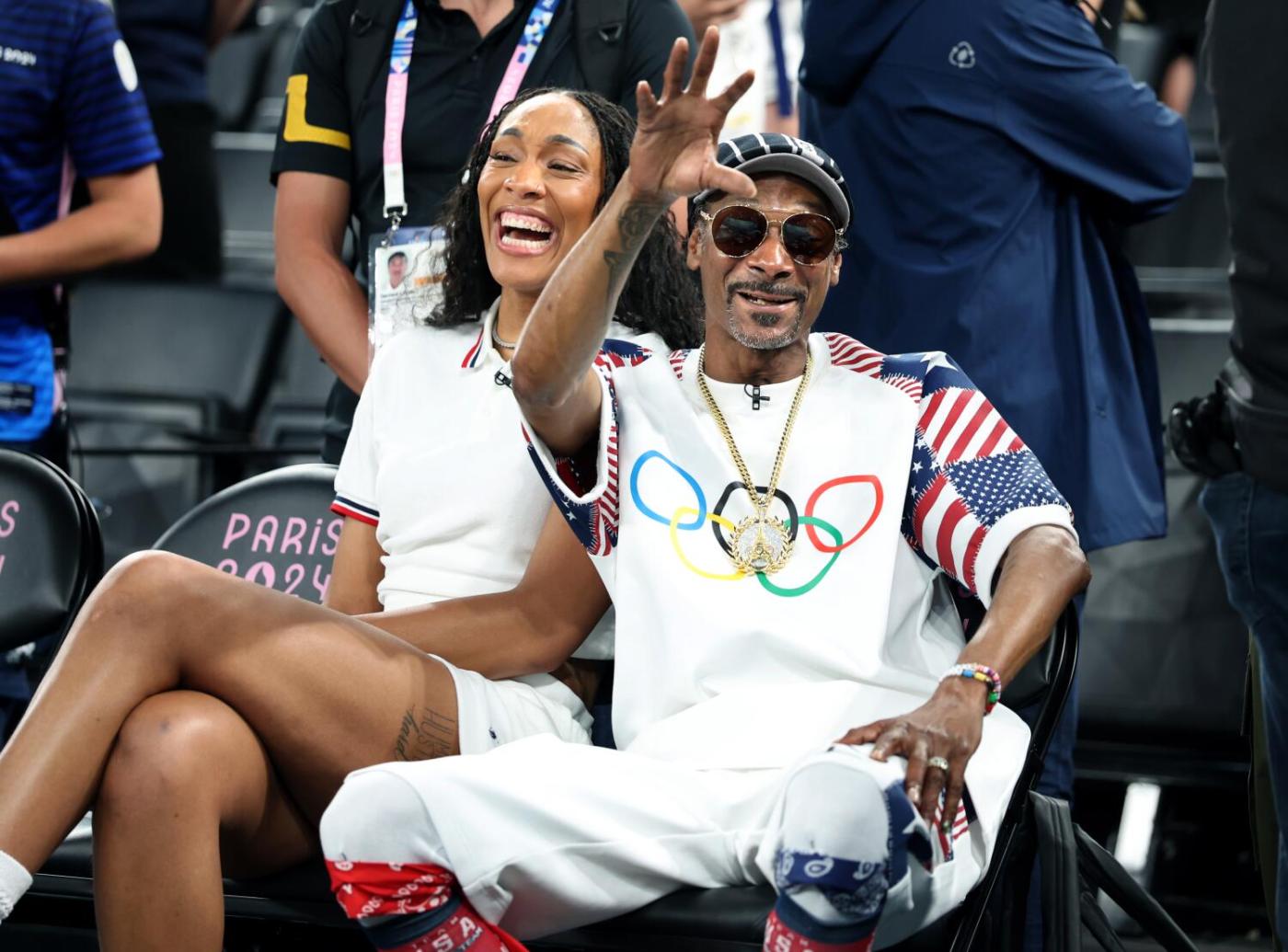
“A full stadium every day, both morning and evening sessions, countries winning their first-ever Olympic gold medals, incredible performances, shock upsets, world and Olympic records, three marriage proposals, a couple of GOATs and a Snoop Dogg,” said Jamie Fox, director of communications for World Athletics, track and field’s global governing body, referring to the rapper ever-present on NBC.
But the real hero of these Games was Paris itself and the most iconic and historic settings and venues in Olympic history, all them anchored by the Eiffel Tower from which the five Olympic rings lit up the city each night.
“The truth north of these Olympic Games, being Games wide open,” Wasserman said, “I think really opened the eyes of the world to how spectacular the Olympics are and how successful they have been, not just in the city of Paris but for the whole world to experience. The appeal of these Games has been absolutely undeniable.”
The lesson of the Paris Olympics, he said, is to not be afraid to take chances.
Dozens of LA 28, Los Angeles city, county and state officials spent the Games shadowing Paris 2024, local and national government and law enforcement officials in preparation for the 2028 Games which open July 14.
“Bastille Day,” Wasserman said laughing.
“What I learned here and I give the French team a great deal of credit for is they were willing to do things differently and take chances and it didn’t mean they were all going to be perfect or work, although most of them did,” Wasserman said. “But they really thought outside the box, obviously starting with the opening ceremonies, which was spectacular, but in every facet of their delivery they took a step back and said how can we do things differently and do things that’s right for our city and our communities and it’s not the way that other Games have done them. They were doing it for them and I give them a lot of credit because the easy thing to do has been to do what has been done before.
“But they have taken chances and those chances have been rewarded. And they have been spectacular and I still think it’s incumbent upon us in an appropriate way for Los Angeles to think about what we can do to do things differently for our communities in our city.”
For Los Angeles that means working within a $6.8 billion budget with a $615.8 million contingency fund in case the Games are postponed or canceled, adding sports like cricket, lacrosse and flag football to Olympics that will be held almost exclusively at existing or previously planned venues and holding to what Bass vowed would be “No Cars Games,” despite the region’s lack of a mass public transportation system comparable to recent Summer Olympic hosts like Paris, Tokyo and London.
“As we’ve seen here in Paris, the Olympics are an opportunity to make transformative change,” Bass said. “It’s our top priority to ensure that the Olympic preparations benefit Angelenos for decades.”
While LA 28 will submit an updated budget to the city later this year, the organizing committee has a projected goal of generating $2.5 billion in domestic sponsorship revenue, and Wasserman has said that the 2028 Games have already attracted more contracted revenue from sponsors such as Coca Cola, Delta and Visa than the Paris Games will have in total revenue.“American sponsors are coming back in and wanting to be part of the movement,” Burton said.
In naming Los Angeles host of the 2028 Games in September 2017 as part of an unprecedented double award in which Paris received the 2024 event, the IOC agreed to pay LA 2028 at least $2 billion, up from $1.7 billion had the city hosted the 2024 Games and the largest payout ever to an Olympic host city.
As part of that agreement, the IOC paid LA 28 $180 million up front in 20 quarterly $9 million payments starting on January 1, 2018.”We feel very good about where we are today,” Wasserman said. “And it’s our job to stay really diligent.”
Longtime Olympic observers and sports economists are optimistic that LA 28 will stay within its budget.
“There’s a potential problem of mission creep, that’s the military version of it, or the upgrades creep,” said Victor Matheson, a Holy Cross economics professor who has written extensively on Olympic finances.
“That’s the concern and we’re hoping that LA stays with its good reputation of having actual competent and rational people running the Games like Ueberroth did back in the old days,” Matheson continued, referring to Peter Ueberroth, chairman of the 1984 Los Angeles Olympic organizing committee. “The initial numbers look pretty good but again, just like in Paris, what remains to be seen is do those good numbers finally hold up when the final books are closed?
“At least they’ve got a shot. You don’t have anybody over there saying, ‘Oh, you know what would be really cool is a permanent 80,000 stadium just for track? Don’t think that would be cool?’ We’re not even getting a hint of that.”
LA 28 has used that money to help fund a $160 million youth sports program in Los Angeles, what Wasserman calls “the single biggest investment in youth sports in the history of America in one city.”
“Your zip code is no longer a barrier to entry to participate in sports,” he said.
The federal government will pick up the cost of security, which is expected to exceed $2 billion. The Games received national special security event designation last January.
LA 28 will borrow a page from the London Games in 2012 and use local sporting events as dry runs to train both law enforcement and the military and educate the public on what to expect security-wise at the Olympics. In London’s case, they used a day at Wimbledon a year earlier for a dry run for security and the public.
“So just to be ready we could take a Dodgers game and enact on a Thursday night in 2027 and tell people what it’s going to be like so that we can practice,” Wasserman said, “They can practice and we can learn.”
The 2028 Games will only be accessible by public transportation. While the region continues to expand its public transportation lines and hubs, Bass acknowledged “that’s not going to be enough. We’re going to need over 3,000 buses.”
A significant portion of those buses – and their drivers – will come from other U.S. cities. Atlanta implemented a similar program for the 1996 Games with mixed results.
Paris, following an approach taken by previous Olympic host cities, removed the homeless from the city during the Games. Bass didn’t directly answer when asked in Paris if Los Angeles would implement a similar program in 2028.
Los Angeles County reported 75,518 homeless persons in 2023, a nine percent year-over-year increase with the City of Los Angeles reporting 46,210 homeless, a 10 percent increase, according to the Los Angeles Homeless Security Authority.
“We are going to get Angelenos housed,” Bass said. “That is what we have been doing and we’re going to continue to do that. We will get people housing, we will get them off the street. We will get them into temporary housing, address the reasons why they are unhoused and get them into permanent housing.”
Related Articles
How the Paris Olympics spun ratings gold for NBC and Peacock
A look at the winners and losers as curtain closes on memorable Olympic Games
Olympics TV schedule for Sunday, Aug. 11
No-car Games: Los Angeles Olympic venues will only be accessible by public transportation
After Paris Olympics shined, Los Angeles in 2028 brings new and returning sports, plus a fresh look
Bass will board a Delta flight Monday for LAX, the Olympic flag now in her care, with the lessons of 17 glorious days in Paris and the knowledge that any issue facing Los Angeles will be played out on a global stage and that the clock is ticking.
“The day after the Olympics and everybody is back in town and they roll up their sleeves it’s going to be about is A) Is there anything to be gleaned from Paris and then B), Let’s go,” said David M. Carter, a sports marketing professor at USC’s Marshall School of business and founder of the Sports Business Group, a sports and entertainment consulting firm. “We need to start hiring. We need to start getting these Games in the right position and I think they’ve got a lot of this at the gate.
“The day afterwards is where they’ve been at for years, it’s just that it’s going to go from a jog to a sprint.”
Wasserman said he is ready.
“So we’ve learned a lot here,” he said Saturday. “We are focused on the road ahead. It’s about 14,135 days to the opening ceremonies. But who’s counting?”
IT’S A BIRD. IT’S A PLANE. IT’S TOM CRUISE! #ParisOlympics | #ClosingCeremony pic.twitter.com/5v4j8pOwBF
— NBC Olympics & Paralympics (@NBCOlympics) August 11, 2024