Takeaways from a Harris-Walz ticket now that the stage is set for a reimagined presidential race

posted in: Politics | 0

WASHINGTON — The stage is set for an election that was unimaginable mere weeks ago when President Joe Biden was atop the Democratic ticket. Now Vice President Kamala Harrishas tapped Minnesota Gov. Tim Walz as her running mate to take on Republican Donald Trump and his No. 2, Ohio Sen. JD Vance.

As different as they are, Walz and Vance both qualify as picks meant to reassure their party’s loyal base voters rather than adding homegrown heft in a critical battleground state.

The two No. 2s will also get a chance to square off in almost real time as Walz is traveling this week with Harris to Pennsylvania, Wisconsin, Michigan, Arizona and Nevada, while Vance will follow an overlapping itinerary to offer his own counterprograming in some places.

Some takeaways on the race now that Harris has settled on Walz:

How Walz might help — or hurt — Harris’ chances

Opting for the Minnesota governor immediately calms the Democratic Party’s left wing, which was worried that another contender, Pennsylvania Gov. Josh Shapiro, might have pushed the party closer to Israel and disheartened Arab American and younger voters. Some in Harris’ inner circle saw Walz as a do-no-harm choice who can keep the party unified heading into the Democratic National Convention opening in Chicago on Aug. 19.

Progressives are already celebrating Walz’s ability to deliver an unapologetically populist message in the style of a Midwestern dad who recalls the social studies teacher and football coach he once was.

Activists who for months have followed Biden around the country to protest his full-throated support for Israel in its war with Hamas in Gaza are hopeful that Walz will help Harris take a more nuanced approach than someone like Shapiro.

But some critics will point to 2016, when the only other woman to be nominated for president, Hillary Clinton, picked a mild-mannered dad with centrist views and a modest national profile: Sen. Tim Kaine of Virginia. That ticket lost to Trump.

Exciting each side’s most loyal supporters

Neither vice presidential pick seems to do much to build out his party’s coalition — a sign that both campaigns view this election as about boosting turnout from their existing bases.

Just as Walz hails from the solidly Democratic state of Minnesota, Vance comes from the safely Republican state of Ohio. There is a bet that each choice can radiate Midwestern appeal to the key “blue wall” states of Michigan, Pennsylvania and Wisconsin simply by dint of geographical proximity.

Harris allies have stressed Walz’s ability to appeal to rural voters, although his 2022 reelection as governor roughly matched the margins of Joe Biden’s 2020 presidential win in Minnesota. Trump won 6 in 10 rural and small town voters nationwide in 2020, according to AP VoteCast.

The Trump campaign was quick to try to connect Walz to its characterizations of Harris as a California liberal, saying his support for gun control and teachers unions make him a “West Coast wannabe.”

Vance, for his part, comes from a state that has twice backed Trump by 8 percentage points. Just like the former president with his book “Trump: The Art of the Deal,” Vance achieved national recognition with his memoir, “Hillbilly Elegy.” Vance has mainly played to cultural and policy issues favored by strict adherents of Trump’s “Make America Great Again” movement such as cutting military support for Ukraine.

Vance offering battleground counterprograming to Walz

Vance is set to follow an overlapping itinerary to Harris and Walz over the next two days, including stops in the battleground states of Pennsylvania, Michigan and Wisconsin. His role is to attack the Biden administration’s policies and tear down Harris’ record on the economy, public safety and immigration.

Vance got out ahead of the Democrats in Philadelphia on Tuesday, holding an event hours before Harris was to formally introduce her new running mate at a rally. He said during his Philadelphia stop that “I absolutely want to debate Tim Walz,” but not until after the Democratic convention.

Harris’ team seemed to be happy to have Vance making the contrast with the Democrats.

“We appreciate JD Vance providing voters in battleground states exactly the split-screen that defines the choice this November,” said Harris campaign spokesman Charles Lutvak.

Plenty of drama still to come

Walz’s selection settled one big question mark among Democrats, but plenty of major challenges remain for the final months of a race already defined by its unexpected twists and turns.

There is the prospect of a wider war in the Middle East, the possibility of a rate cut by the Federal Reserve that might calm global financial markets and questions about whether Trump and Harris will actually square off in a September debate that was set before Biden bowed out of the race.

No matter what happens, the conventional narratives of a presidential campaign have already had seemingly brief shelf lives. Voters over the past few weeks have dealt with Biden’s disastrous performance in the June 27 debate against Trump, a brazen assassination attempt on Trump, Biden’s exit from the race and Harris’ quick ascendance among Democrats.

Now that both tickets are settled, a reckoning will take place over positions, and small differences can matter to voters who on the margin could decide a narrow election. Global events can upend talking points in ways that are hard to predict. The 2008 campaign intensified with that year’s financial crisis, while the persistence of the coronavirus shaped 2020.

If there are any lessons from this year, it’s that election year surprises are no longer reserved for October.

___

Associated Press writer Hannah Fingerhut contributed to this report.

Related Articles

National News |


Here is Gov. Tim Walz’s résumé and background on his political career

National News |


Five things to know about Tim Walz

National News |


Harris introduces new running mate Minnesota Gov. Tim Walz as the ‘vice president America deserves’

National News |


Here’s what happens if Gov. Tim Walz becomes vice president

National News |


Secretaries of state urge Elon Musk to fix AI chatbot spreading election misinformation on X

Weak spots in metal may have led to fatal Osprey crash off Japan, documents obtained by AP reveal

posted in: News | 0

By TARA COPP and AARON KESSLER

WASHINGTON (AP) — A gear crack that led to a fatal crash of a V-22 Osprey last year may have been started by weak spots in a metal used to manufacture that part, according to documents obtained by The Associated Press.

The November crash killed eight Air Force Special Operations Command service members. It was the second time in less than two years that a catastrophic failure of a part of the Osprey’s proprotor gearbox, which serves as its transmission, caused a fatal accident. In June of 2022, five Marines were killed when a different part of the proprotor gearbox system failed.

The crashes have led to an aggressive effort by the V-22 program office and manufacturer Bell Flight to find fixes for the critical system, which has had some components wear down earlier than the military expected. This latest finding might hold some clues.

There’s no other aircraft like the Osprey in the fleet. It can speed to a target like an airplane then rotate its engines to land like a helicopter. Program leaders have pointed out that the Osprey has been vital in special operations and combat missions and has flown hundreds of thousands of hours successfully.

But the aircraft also has a troubled crash history, and the proprotor gearbox has been a persistent problem.

Data gathered by The Associated Press through the Freedom of Information Act shows 609 proprotor gearboxes have been removed for repair in the past 10 years. Over the last five years, the Marine Corps, Navy and Air Force have reported 60 incidents involving the proprotor gearbox.

Last week the Air Force identified cracking in a pinion gear, a part that’s about the size of a large jar lid, as one of two factors that caused the crash off Japan. The Air Force also faulted the pilot and crew, because the Osprey sent six warnings during their flight that the proprotor gearbox was in trouble.

But additional crash report documents obtained by the AP show this is not the first time this metal has failed in Osprey proprotor gearbox components, although it was the first time it failed in this specific gear. There have been seven previous cracking incidents in related gears that were likely caused by the same metal weakness, investigators reported.

It’s not clear if that information had previously been shared with the services, which could have led them to take a much more restrictive approach to how pilots were instructed to respond to any proprotor gearbox warnings.

In a rare move, as part of the accident report released publicly last week, the Air Force faulted the V-22’s program office for not sharing data that could have better informed crews of the severity of the risk.

The pinion gears are located inside the proprotor gearboxes on each wingtip. The gearboxes take in power from the Osprey’s engines and process it to turn the Osprey’s masts and rotor blades.

To do that, the gears spin rapidly under extreme pressure. They can overheat and break off metal flakes, called chips, which can move through the transmission and destroy it. Loss of a proprotor gearbox is dangerous and can lead to loss of an aircraft and crew.

In the November crash, investigators believe the first of the six chip warnings was an indication that a crack in the pinion gear had already taken hold and it was fracturing off small metal flakes as it continued to spin. The warnings progressed as the gearing shed more debris and ultimately broke apart, leading to rapidly cascading failures throughout the Osprey’s entire drive system and the fatal crash.

In the supplemental crash documents, investigators said analysis of the recovered pinion gear pieces revealed multiple inclusions. An inclusion is a microscopic weak spot in metal caused by foreign substances getting mixed in during the manufacturing process. Those weak spots can lead to fatigue cracking.

The specific alloy used to manufacture the Osprey’s pinion gears is called X-53 VIMVAR. Crash investigators found multiple inclusions in the failed pinion gear and similar inclusions in a second pinion gear on the aircraft, the report said. While the inclusions were found to be within the microscopic size limits allowed, investigators noted that “initiation of a fatigue crack is dependent on the size of the inclusion and its location within the gear material.”

Investigators concluded they could not determine whether the inclusions led to the cracking. But they left open the question of whether there may have been larger inclusions that could have caused the cracking and were lost as the pinion gear broke apart. “If the pinion did crack due to an inclusion, the evidence was obscured by the secondary damage,” the report found.

Of the 60 incidents reported over the past five years, at least 41 included chipping indications, according to the data obtained by the AP.

The gearbox is a sealed system, meaning ground crews on base can’t open it to inspect the gears for inclusions, and even if they could, they don’t have the machining needed to detect the microscopic defects, Air Force Special Operations Command head Lt. Gen. Michael Conley told the AP in an interview.

“So in the field, there’s nothing we could have done to detect this,” Conley said.

And Bell Flight can’t test the whole gear for inclusions either without multiple cuts into it, which would destroy the part. The primary safeguard is process control during manufacturing, the report said.

It’s not clear whether other Osprey parts, including the input quill assembly that was the cause of the Marine Corps 2022 crash, are also made from the X-53 alloy.

Bell referred all questions on the proprotor gearbox to Naval Air Systems Command, or NAVAIR, which has overall responsibility for the V-22 Osprey program.

In a statement to the AP, Col. Brian Taylor, head of the Pentagon’s V-22 program office, said it could not comment on specific proprotor gearbox changes underway, but said “as improved materials become available, they are evaluated for use in all our systems.”

Conley said, for now, the Air Force has made flying the Osprey more restrictive while doing longer-term engineering analysis. “Figuring out if there’s a better way with the gearboxes, better production methods, better material. That’s with NAVAIR and Bell right now,” he said.

Until at least mid-2025, the Osprey is expected to remain under flight restrictions that require it to stay within 30 minutes of a spot to land, among other safety checks.

Air Force Special Operations Command only has 51 Ospreys, but it’s had to remove 132 proprotor gearboxes for repair in the past 10 years, according to data obtained by the AP. The Marine Corps purchased 360 Ospreys and currently operates about 270. Over the past 10 years it’s removed 464 proprotor gearboxes. The Navy, which has 27 in the fleet, has removed proprotor gearboxes 13 times.

While the Osprey has been in design since the 1980s, the Marine Corps’ MV-22 version has only been deployed since 2007, the Air Force CV-22 since 2009 and the Navy’s CMV-22 version since 2021.

Former Holy Angels employee sues school and archdiocese for alleged discrimination

posted in: News | 0

A discrimination lawsuit filed Tuesday against Academy of Holy Angels and the Archdiocese of St. Paul and Minneapolis alleges they didn’t renew her employment contract as a school librarian because of her transgender status and sex.

The lawsuit alleges the Richfield Catholic high school and the archdiocese violated the Minnesota Human Rights Act in 2022 by not entering into a new contract with Reyzl Grace, who served as a secular librarian, after she came out as transgender.

Reyzl Grace (Courtesy of Gender Justice)

While the MHRA does permit limited exemptions on religious grounds, the Legislature never intended for these exemptions to apply to secular employees, according to St. Paul-based Gender Justice, which along with its co-counsel, Wanta Thome, filed the lawsuit in Hennepin County District Court.

“Reyzl Grace’s story highlights the importance of ensuring that no employer in Minnesota has carte blanche to discriminate against employees simply because of who they are,” Brittany Stewart, senior staff attorney at Gender Justice, said in a statement. “We believe in a Minnesota where everyone is treated with dignity and respect, free from discrimination. This case is a crucial step toward that goal.”

Grace, who is Jewish, worked as the sole librarian at Holy Angels during the 2021-2022 school year. Her role required no ministerial duties, religious training or education, according to the lawsuit.

Grace informed Holy Angels in March 2022 of her intention to renew her employment contract for another year. Principal Heidi Foley initially expressed a desire for her to continue in her role, the lawsuit says.

Foley’s demeanor changed when Grace revealed she had come out as transgender and was starting the process of transitioning to live as her female self, the lawsuit says. “Foley said the Archdiocese would not support (Grace’s) transition, and it would not be possible for (Grace) to continue working at the school if she was determined to transition,” the lawsuit alleges.

About a week later, Grace again met with Foley. Grace was given a copy of the “Guiding Principles for Catholic Schools and Religious Education Concerning Human Sexuality and Sexual Identity,” which, according to the lawsuit, represents the Archdiocese’s position on sexual and gender identity.

The “Guiding Principles” state the Catholic Church’s foundational beliefs include that “[a] person’s embrace of his or her God-given sexual identity is an essential part of living a fulfilled relationship with God, with oneself, and with each other” and “[t]he harmonious integration of a person’s sexual identity with his or her sex is an expression of the inner unity and reality of the human person made body and soul in the image and likeness of God.”

The lawsuit says the document “goes on to instruct schools who teach in the name of the Catholic Church to discriminate against transgender and gender-nonconforming students by, for example, refusing to recognize their pronouns and preferred name if they are inconsistent with a student’s sex assigned at birth, and refusing to allow LGBTQ+ students to express their sexual identity.”

The school’s employee handbook does not explicitly contain or mention the Guiding Principles, and Grace had never previously been shown the document, according to the lawsuit.

Applied again

After reviewing the Guiding Principles, Grace said the document was vague and she did not believe she could abide by the directives. “It was clear to Grace that what she was being told was that she would not be allowed to work at (Holy Angels) given that she is transgender,” the lawsuit says.

Foley told Grace that the Guiding Principles document was the only reason she was not being offered a renewed contract, the lawsuit alleges.

Related Articles

Education |


May Township board expected to vote Thursday on Liberty Classical Academy’s expansion plan

Education |


Direct admissions: How to get into college without applying

Education |


Hamline University settles lawsuit over showing of Prophet Muhammad in art history class

Education |


FAFSA aid form completion rates still down in Minnesota after tech glitches

Education |


‘Stuff the Bus’ collects school supplies for Stillwater area students

At the end of the meeting, Foley told Grace that she should not tell anyone about their conversations and instead should say “she was ‘pursuing other options,’ as the school wanted to control the messaging on this,” the lawsuit continues.

Foley asked Grace to submit a formal letter of resignation by the end of the school year, the lawsuit says. She did not, and in June 2022 sent a letter to the school’s administration recounting the events in writing. She did not receive a written reply to her letter.

Later that month, Holy Angels posted a job opening for the library/media specialist position. “As with the previous posting for the position, the posting did not list any ministerial duties and did not require any religious training or education,” the lawsuit states.

Grace applied on June 21, 2022, using the same application that had been used the year prior with updated information to include the experience she gained during her year of employment at the school. She did not get a response until August 1, 2022, when a human resources representative sent her a letter thanking her for the application and indicating the position had been filled.

Human rights complaint

Grace filed charges of discrimination with the Minnesota Department of Human Rights against the school and archdiocese in April 2023. They entered replies claiming the archdiocese “does not operate, supervise or control (Holy Angels),” the lawsuit says.

Grace, who is seeking monetary damages, including back pay, addressed media Tuesday outside the county courthouse in Minneapolis.

“You have heard it said that allowing religious institutions to discriminate against LGBT people is to the protection of religious freedom, a safeguarding of the church from state interference,” Grace said. “But I say onto you, that allowing an institution to discriminate against employees for the shape of their bodies or the shape of their love is not only a violation of state law, but also a curtailment of religious freedom, a weighting of the scales that favors certain readings, certain interpretations, certain voices, over others.”

A spokesman for the Archdiocese of St. Paul and Minneapolis said they are reviewing the lawsuit with its legal counsel and not commenting.

Holy Angels issued a statement, saying: “We take the allegations seriously. We are in the process of reviewing the allegations, but we are not able to make further comments because the claims involve confidential personnel matters.”

Related Articles

Education |


Q&A: Minnesota’s first Humanistic rabbi on God, justice and human responsibility 

Education |


Q&A: Suzanne Kelly, new CEO of Minnesota Council of Churches, wants to build a faith community ‘that makes people feel whole’

Education |


Kamala Harris: A Baptist with a Jewish husband and a faith that traces back to MLK and Gandhi

Education |


Hamline University settles lawsuit over showing of Prophet Muhammad in art history class

Education |


Former St. Anthony bank being converted to mosque vandalized or broken into 7 times in two months

New Funding for ‘Accessory’ Apartments Touted as Tool for Housing Older New Yorkers

posted in: News | 0

Officials say building more accessory dwelling units, or ADUs, can help older residents continue living in the city they helped build, and offer homeowners a way to generate income and create generational wealth by utilizing their existing spaces.

Ed Reed/Mayoral Photography Office.

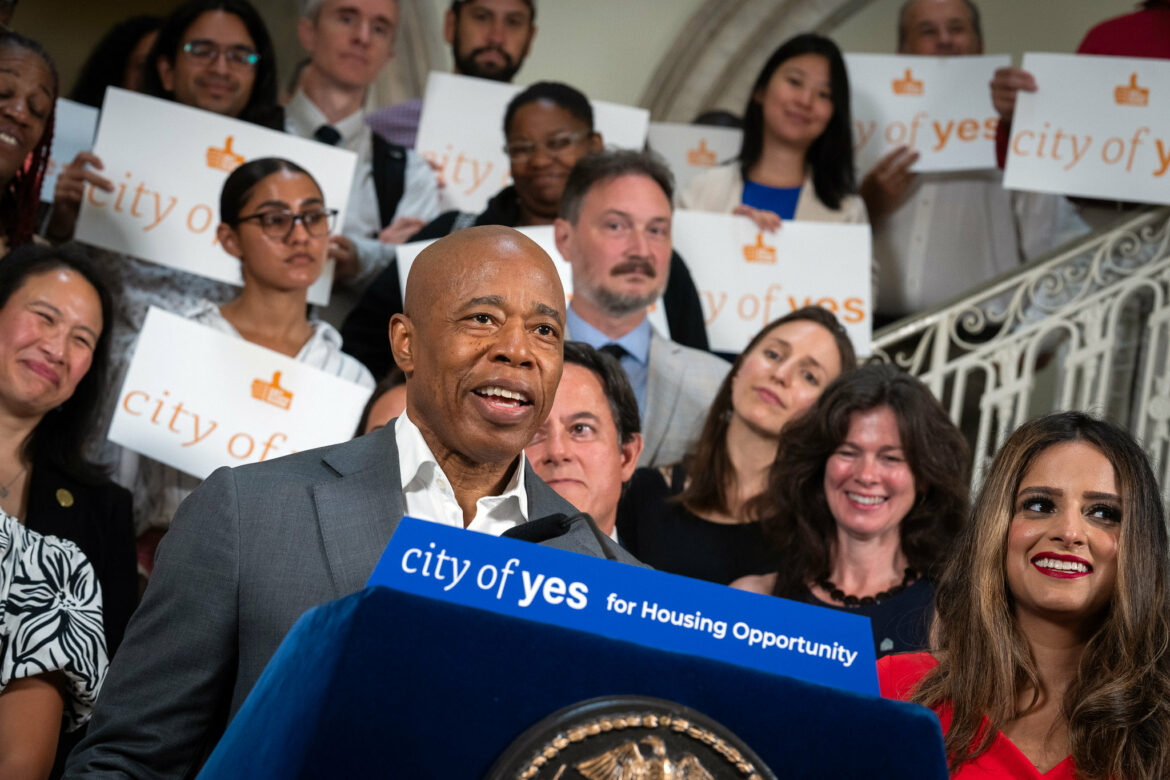
Mayor Adams and other city officials announcing a new pool of funding to help homeowners build or convert ADUs.

In the middle of public review for his proposed City of Yes for Housing Opportunity (COYFHO), Mayor Eric Adams announced new tools for homeowners interested in building accessory dwelling units (ADU). They include a one-stop shop online portal to streamline the approval process, and an additional $4 million in grants to help property owners build or convert existing spaces into homes.

The mayor’s push to create more ADUs—independent units on the same lot as existing housing, such as a backyard cottage, converted garage or basement with a separate entrance—are a key part of his COYFHO proposal.

The plan would, among other zoning reforms, allow for the creation of ADUs on lots with one- or two- family residences. City officials say this will help older residents continue living in the city they helped build, and offer homeowners a way to generate income and create generational wealth by utilizing their existing spaces.

“Many of our older adults are really struggling to meet the mortgage payment, they may have lost a loved one, they may be dealing with retirement and on a fixed income,” Adams said at a press briefing Monday.

“This is a way to use your number one asset, for people in general I believe, but specifically for Black and brown people—the home,” he added. “That’s your asset. That is your foundation. That is what you build your entire financial stability after.”

There is a growing need for more housing, given the city’s historically low rental vacancy rate of 1.4 percent. At the same time, the number of older adults in New York is increasing. Those 65 and up currently represent 20 percent of the city’s residents; by 2040, their population is expected to increase by 40 percent.

There are currently 15 homeowners building or converting ADUs as part of the city’s “Plus One ADU” program in zones where they are legal (single-family homes in areas that allow for two-family homes, according to the program’s eligibility criteria). Each pilot program recipient received up to a $395,000 grant through HPD from New York State Homes and Community Renewal.

The additional funding of $4 million from the state, announced Monday, will allow another 20 homeowners who are permitted under current zoning and building codes to add or convert a secondary home. These units can be up to 800 square feet in size.

HPD’s Website

A rendering of what an accessory dwelling unit might look like.

Those interested and eligible can apply through the one-stop online portal that will be launched soon. The portal, the commissioner said, will provide information on the drawbacks and benefits of ADUs, an online library of building and architectural plans that have been vetted by the Department of Buildings to help accelerate the approval process, and connections to the construction firms that submitted those plans.

Beth Finkel, the state director of AARP, urged communities to endorse ADUs as a way to offer more housing options to its members.

“I asked you to think if this was your own mother, if this was your mother, and she was struggling and wanted to make sure she could stay in her own community, and there was a way to do this by building an accessory dwelling unit,” she said. “Maybe it’s your mother who has the home and then is able to put an accessory dwelling unit in there so that you are there, you’re there when she needs you. And this is a great opportunity.” 

Allowing more older adults to remain in their neighborhoods will help the local economy, she argued, as they will use their social security and pension checks at nearby supermarkets and other shops. 

Within the first few two months of opening applications for the initial 15 ADUs in the city’s pilot program in November 2023, the mayor’s office said it received 2,800 submissions.

Sade Singh, 29, a homeowner in St. Albans, Queens, was one of them, though she ultimately didn’t qualify because of current zoning restrictions. “My home falls in a location where I have strict zoning laws, so unfortunately I didn’t meet the eligibility requirements then,” she said.

Singh lives with her 57-year-old mother who is about to retire, and she is keen to convert her basement to an independent unit. That additional rental income would help “ease the burden of the mortgage,” she said.  

“And then I also see the value in having a space for a family down the line, like just being part of my family’s legacy,” Singh explained.  

So far, out of the city’s 59 community boards voting for COYFHO, 28 have issued “unfavorable” recommendations on the proposal, some citing concerns about new development disrupting the character of low-density neighborhoods. 

At Monday’s announcement, the mayor addressed those worries. “This is not going to change a neighborhood,” he said. “You’re not going to see a 14-story building in someone’s backyard.” 

If approved, out of the 100,000 homes COYFHO aims to build in the next 15 years, ADUs could represent anywhere between 26,000 to 40,000, Deputy Mayor for Housing, Economic Development, and Workforce Maria Torres-Springer said. 

Following recommendations by community boards and borough presidents, COYFHO will head to the City Planning Commission for a vote, then to the City Council.

“We want to ask our partners in the City Council to say yes, we want to ask our community boards not to be afraid of this new adoption,” said Mayor Adams.

“So yes for a little more housing in every neighborhood, yes to build the future for both our grandchildren and grandparents, and yes to ADUs in the opportunity they offer.”

To reach the reporter behind this story, contact Subeksha@citylimits.org. To reach the editor, contact Jeanmarie@citylimits.org

Want to republish this story? Find City Limits’ reprint policy here.