Trump’s rhetorical walkabouts: A sign of ‘genius’ or cognitive decline?

posted in: Politics | 0

James Rainey and Hailey Branson-Potts | (TNS) Los Angeles Times

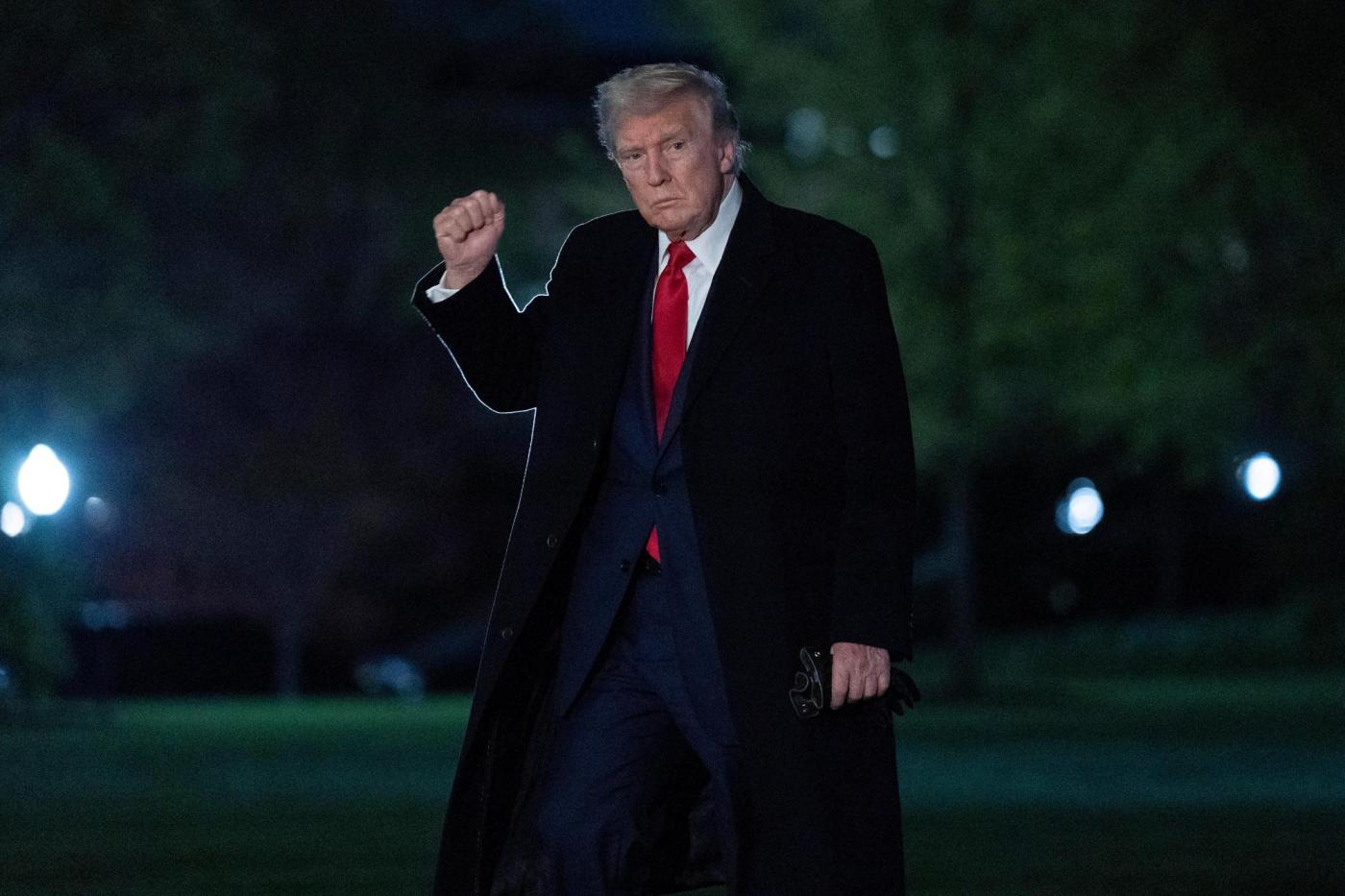
Is he rambling? Indifferent to his audience? Exhibiting symptoms of cognitive decline? Or, instead, could former President Donald Trump’s extended discourses demonstrate his genius — an ability, as he says, to “weave” disparate stories into a beautiful tapestry?

The 78-year-old Republican nominee’s meandering speaking style — and what it might say about his mental state — has become a new fixation in a race already upended when President Joe Biden, 81, dropped out this summer amid questions about his own age and mental acuity.

In recent weeks, Trump has said he would deport Haitian immigrants in Springfield, Ohio, “back to Venezuela.” He said he was being supported by “the vice president’s family” — meaning relatives of Minnesota Gov. Tim Walz, who is running for the office but is not vice president.

He insisted — incorrectly — he had been in a helicopter crash with former San Francisco Mayor Willie Brown. Trump has repeatedly hurled critiques at former President Obama, when his real target seemed to be President Biden, misstatements he insisted were “sarcasm.”

In August, the science-and-health-focused website Stat News published a detailed analysis of Trump’s speech patterns in recent months, comparing them with public speeches in 2017. Several researchers noted “more short sentences, confused word order, and repetition, alongside extended digressions.”

Those changes “could be attributed to a variety of possible causes,” the experts told Stat, “some benign and others more worrisome. They include mood changes, a desire to appeal to certain audiences, natural aging, or the beginnings of a cognitive condition like Alzheimer’s disease.”

James Pennebaker, a social psychologist at the University of Texas at Austin, performed a more formal analysis for Stat based on complete transcripts of 35 Trump interviews from 2015 through this year. Using statistical software, he found a roughly 60% increase in use of absolute terms like “always,” “never” and “completely.”

Trump’s recent dialogue also contained fewer positive words. Increased all-or-nothing thinking can also be linked to changes in cognitive ability, Pennebaker wrote, adding: “Another person whose all-or-nothing thinking has gone up is Biden.”

Last week, critics on the left picketed the New York Times’ headquarters, demanding that the media stop “sane-washing” Trump’s disjointed statements.

Kathleen Hall Jamieson, a co-founder of FactCheck.org and director of the Annenberg Public Policy Center at the University of Pennsylvania, said in an interview that “there’s always been the question: Is Donald Trump in touch with a knowable reality?”

Trump’s speaking style, she said, has always been defined by braggadocio and exaggeration, but, these days, he is making more comments that are outright bizarre. “He’s doing it more now than he was in the past,” she said. “He’s more tangential.”

Jamieson said Americans need to be asking two questions about his ability to communicate: “Does this tell you something important about his capacity as president? And should it factor into our votes or not?”

Trump has made clear he’s aware of the criticism, defending his speaking style repeatedly in recent weeks. He assured a Pennsylvania rally that even English professors marvel at the intricate “weave” of his storytelling. He blamed the “fake news media” for intentionally misrepresenting his sarcastic flourishes to claim he suffered a cognitive impairment.

Speaking in Savannah, Georgia, on Tuesday, Trump sounded off on Biden’s mental state and questioned the competency of Vice President Kamala Harris.

“You talk about cognitive problems? She’s got bigger cognitive problems than [Biden] has,” he said.

Trump campaign spokesperson Karoline Leavitt told The Times that reporting on mental acuity would create “a garbage article based upon a bunch of ‘sources’ who have no idea what they’re talking about and are trying to deflect from the fact that our sitting president, Joe Biden, was ousted off the Democrat ticket due to his clear cognitive decline.”

“President Trump is sharp as a tack,” Leavitt added, “and executes a rigorous campaign schedule every single day.”

Trump suggested at a Tucson rally this month that it wasn’t just his enemies questioning his onstage behavior. He said he called former First Lady Melania Trump, who had watched a recent speech on television, and asked whether she “saw how great my speech was tonight, darling.” People loved it, he said he told her.

“Well, yeah, they might, but you look really bad,” Trump said she replied. “You couldn’t find the stairs off the stage.”

Feigning exasperation, he said he had to explain to his wife that he had been joking — that he was imitating Biden but that “the fake news” was distorting his sarcasm.

Trump’s supporters plead for a more generous interpretation when it comes to Trump on the stump: They say they go to the former reality TV star’s rallies knowing that he will entertain — including with convention-defying remarks and flights of fancy, as when he has mused about whether it would be preferable to die by shark attack or electrocution. (“I’ll take electrocution every single time.”)

To MAGA adherents, those moments offer more proof that their hero is blunt. Real. Unlike Harris and other politicians glued to their teleprompters.

Amid questions about his speaking style, media analyst Jamieson urged journalists to let Trump be Trump, but in a different sense. She said reporters should throw off the traditional journalistic imperative of brevity and simplicity and quote Trump in full, revealing how he actually expresses himself.

As good a place to start in that regard might be Trump’s defense of his verbal walkabouts during a town hall meeting last week in Michigan with Arkansas Gov. Sarah Huckabee Sanders:

“I do have to say, so I give these long, sometimes very complex sentences and paragraphs, but they all come together. I do it a lot. I do it with Raising Caine, that story. I do it with the story on the catapults on the aircraft carriers. I do it with a lot of different stories. When I mentioned Dr. Hannibal Lecter, I’m using that as an example of people that are coming in, from ‘Silence of the Lambs.’ I use it. They say, ‘It’s terrible.’ So they say — so I’ll give this long, complex area, for instance, that I talked about, a lot of different territory.”

He went on, bringing up automobiles:

“The bottom line is, I said, the most important thing: We’re gonna bring more plants into your state and this country to make automobiles. We’re gonna be bigger than before. But the fake news — and there’s a lot of them back there, you know, for a town hall; this is a lot of people. But the fake news likes to say, the fake news likes to say, ‘Oh, he was rambling.’ No, no, that’s not rambling. That’s genius. When you can connect the dots.

“Now, now, Sarah, if you couldn’t connect the dots, you got a problem, but every dot was connected, and many stories were told in that little paragraph.”

The Harris campaign, on X, quoted Trump’s remarks with no comment.

Concerns about mental fitness and age have long been a feature of presidential politics. The media questioned whether Bob Dole and Ronald Reagan were too old to serve as chief executive.

The subject became most prominent in 2020, when Trump and Biden ran as two of the oldest candidates ever to seek the presidency. Trump famously challenged Biden to take a cognitive exam, boasting that he had passed such a test himself, in part by remembering a string of words: “Person. Woman. Man. Camera. TV.”

(Experts said the exam sounded like the Montreal Cognitive Assessment, or MoCA, which is used for early detection of mild cognitive impairment.)

In 2024, Biden’s stiff walking gait and sometimes distracted affect again raised the issue of geriatric cognition. The topic became unavoidable when he and Trump debated in June, with Biden’s incomplete thoughts and vacant stare setting off alarm bells among Democrats. Biden soon abandoned his reelection campaign.

Since then, Democrats have demanded to know why Trump’s public behavior hadn’t gotten as much scrutiny, noting that he would be 82 by the end of another term in the White House. Critics point to his “word salad” diatribes and his misidentification of key players — for instance, saying it was former U.N. Ambassador Nikki Haley who had not done enough to defend the U.S. Capitol during the Jan. 6, 2021, insurrection when he meant then-House Speaker Nancy Pelosi.

Trump’s camp has made clear that it will not exempt his current opponent, the 59-year-old Harris, from cognitive critiques.

Video of Harris’ sometimes meandering sound bites have become a staple of GOP critics. That includes the time Harris made an obscure reference to falling out of a coconut tree and her oft-repeated line about being “unburdened by what has been.” Previously fodder for detractors, those same moments have been remixed by Harris fans into laudatory TikTok videos, Instagram memes and Etsy merch.

Before Biden and Trump, the media tended to treat the mental fitness of would-be presidents gingerly. Part of that caution showed a desire for objectivity, but part also reflected the fear of duplicating what happened to Barry Goldwater, the Republican senator from Arizona, when he ran for president in 1964.

An article in the now-defunct Fact magazine — headlined: “1,189 Psychiatrists say Goldwater is Psychologically Unfit to be President!” — quoted an informal poll of U.S. psychiatrists, none of whom had actually met Goldwater.

After losing in a landslide to Lyndon B. Johnson, Goldwater successfully sued the magazine for libel. The American Psychiatric Assn. then produced the “Goldwater Rule,” which states that it is “unethical for a psychiatrist to offer a professional opinion unless he or she has conducted an examination and has been granted proper authorization for such a statement.”

As a result, psychiatrists today generally hesitate to issue armchair diagnoses.

Dr. Zaldy Tan, director of the Memory and Healthy Aging Program at Cedars-Sinai Medical Center in Los Angeles, noted that partners in law firms are sometimes required to get neurological evaluations. There is no such requirement in politics. And what would the standards be?

“I think the difficulty there would be drawing the line between what is ageist and what is really fair,” Tan said. “And the evaluation would depend on the tasks that are deemed important,” which, he said, would also be hard to agree upon.

Jamieson recommended that voters study the candidates closely and try to separate behavior of real concern from trivial incidents. In the latter category, Jamieson included misnaming individuals and bragging about crowd sizes. Many people slip in identifying people, she said. And Trump has a long history of boasting.

Other comments, she said, merit more scrutiny, including Trump’s claim that the size of Harris’ audiences has been faked by the use of images generated by artificial intelligence.

“If he really believes that,” Jamieson said, “then he’s delusional.”

____

Trump’s speaking style

Trump’s recent answer to a question about how to make childcare more affordable:

“It’s a very important issue. But I think when you talk about the kind of numbers that I’m talking about that — because the child care is, child care, it’s, couldn’t, you know, there’s something, you have to have it. In this country, you have to have it.

“But when you talk about those numbers compared to the kind of numbers that I’m talking about, by taxing foreign nations at levels that they’re not used to, but they’ll get used to it very quickly — and it’s not going to stop them from doing business with us, but they’ll have a very substantial tax when they send product into our country. Those numbers are so much bigger than any numbers that we’re talking about, including child care, that it’s going to take care.”

____

First look at the Lynx-Sun WNBA semifinal series suggests a good one

posted in: News | 0

Minnesota and Connecticut completed the third and fourth sweeps of the WNBA quarterfinals with home victories Wednesday, the Lynx bouncing Phoenix and the Sun downing Caitlin Clark and the Indiana Fever.

Not one team seeded No. 5-8 won a game this postseason, as the top four squads all season flexed their collective muscle.

Now is when the fun starts.

On one side, Las Vegas and New York square off in a rematch of last year’s WNBA Finals, won by the Aces. On the other, it’s the Lynx (30-10) and Sun (28-12), two lesser-heralded but no less dominant teams this season.

And there’s history here, as well. Connecticut has ended Minnesota’s season each of the past two years. Connecticut beat Minnesota on the final day of the regular season in 2022 to officially end the Lynx’s playoff chances and, thus, Sylvia Fowles’ career. Last season, Minnesota upset Connecticut in Game 2 of the first-round series, only to have the Sun blitz the Lynx at Target Center in a decisive Game 3 that was truly competitive.

But this time figures to be different. The stats say the matchup between Minnesota and Connecticut is razor thin — as do the three games the two teams played this season.

THE STATS

Offensive rating (points per 100 possessions)

Minnesota: 102.8

Connecticut: 102.3

Defensive rating

Minnesota: 94.8

Connecticut: 94.1

Net rating

Minnesota: 8.0

Connecticut: 8.1

Connecticut is the better rebounding team, but Minnesota shares and shoots the ball at a higher clip. The pacing numbers between the two squads are strikingly similar. Perhaps that’s why each of their three regular-season meetings went down to the wire.

SEASON MATCHUPS

May 23 in Connecticut: Connecticut 83, Minnesota 82, OT

The skinny: Neither team led by more than five points over the final 22-plus minutes of action. Napheesa Collier scored 31 points, including a bucket in the closing seconds to send the game to an extra session.

Minnesota led by five with 100 seconds to play in overtime, only to have the Sun scratch back. A Kayla McBride jumper put Minnesota back in front with 13 ticks remaining, but DeWanna Bonner drew a foul and cashed in a pair of free-throws with seven seconds remaining to put the Sun up one and McBride missed a potential game-winner at the horn.

The rest of the Lynx players combined to go 1 for 13 from 3-point range, and Minnesota went 12 for 20 from the charity stripe while Connecticut’s Big 3 of Bonner, Alyssa Thomas and Brionna Jones combined for 57 points.

July 4 in Minnesota: Connecticut 78, Minnesota 73

The skinny: Minnesota trailed by two late in the third quarter when Collier had to leave because of a plantar fasciitis aggravation. Without their star player, the Lynx went more than five and a half minutes of the fourth quarter without a point.

The Lynx shot 52 percent from deep (13 for 25) in the defeat but were doomed by 18 turnovers and a minus-even in the rebounding category. Bonner led Connecticut with 24 points, while Thomas tallied a triple double with 13 points, 10 rebounds and a whopping 14 assists.

Sept. 17 in Connecticut: Minnesota 78, Connecticut 76

The skinny: Trailing by one after Bonner put the Sun in front with eight ticks to play, Collier kicked out to Bridget Carleton, who buried a deep triple to lock down the No. 2 seed and home-court advantage in this series.

Minnesota forced a turnover on the ensuing Sun inbounds pass to officially end the duel.

Collier led the way with 25 points on a night where she also had four blocks and two steals. Thomas had 18 points, 10 assists and eight rebounds for the Sun.

The team numbers were nearly identical across the board in the contest, but Minnesota committed three fewer turnovers (13) than Connecticut (16). In a best-of-five series between these teams, something as small as that can prove to be the difference.

THE SCHEDULE

Game 1: Connecticut at Lynx, 7:30 p.m. Sunday, ESPN

Game 2: Connecticut at Lynx, Tuesday, TBD

Game 3: Lynx at Connecticut, 6:30 p.m. Oct. 4, ESPN2

Game 4*: Lynx at Connecticut, Oct. 6, TBD

Game 5* Connecticut at Lynx, TBD Oct. 8, ESPN2

*If necessary

Related Articles

Minnesota Lynx |


Napheesa Collier delivers brilliant performance as Lynx close out Mercury

Minnesota Lynx |


Lynx offensive success runs off Napheesa Collier and the power of spacing

Minnesota Lynx |


Lynx dominate early, rally to beat Phoenix in playoff opener

Minnesota Lynx |


Lynx credit chemistry with return to WNBA championship contention

Minnesota Lynx |


Lynx rest Collier, McBride in season finale and lost 68-51 to last-place Sparks

Minnesota woman gets 20 years in real estate agent’s killing as part of plea deal

posted in: News | 0

A Minnesota judge sentenced a woman to 20 years in prison Tuesday for her alleged role in the 2019 New Year’s Eve killing of a Minneapolis real estate agent.

Elsa Segura pleaded guilty to kidnapping to commit great bodily harm or terrorize as part of an agreement with prosecutors in the case of the death of Monique Baugh, the Hennepin County Attorney’s Office said.

Segura had been found guilty of murder and other counts in 2021, but the Minnesota Supreme Court overturned the conviction this year, citing faulty jury instructions. The plea deal means Segura will avoid a second trial.

Elsa Segura

A public defender for Segura did not immediately respond to messages seeking comment Tuesday evening.

Prosecutors say Segura lured Baugh to a phony home showing in the Minneapolis suburb of Maple Grove, where she was kidnapped. Baugh was found, fatally shot, in a Minneapolis alley in the early hours of 2020.

Prosecutors said she was killed in a complicated revenge scheme against Baugh’s boyfriend, Jon Mitchell-Momoh, a recording artist who had a falling out with former business associate Lyndon Akeem Wiggins, who was also a drug dealer and Segura’s romantic partner.

Mitchell-Momoh, whom Wiggins allegedly considered a snitch, was also shot in front of the couple’s children, then ages 1 and 3. He survived.

The state Supreme Court also tossed Wiggins’ conviction this year, similarly citing faulty jury instructions. The Hennepin County Attorney’s Office said Tuesday that he is being held in the county jail and faces retrial.

The high court has affirmed the convictions of two other defendants who were accused of kidnapping Baugh. Hennepin County Judge Peter Cahill sentenced all four to life in prison without the possibility of parole.

Related Articles

Crime & Public Safety |


St. Paul officers fatally shoot person in relation to homicide of woman in Lowertown

Crime & Public Safety |


Woman working on art project fatally shot outside building in St. Paul’s Lowertown

Crime & Public Safety |


Plaques stolen from Summit Avenue park in latest metal theft

Crime & Public Safety |


1 killed after gunman hijacks Los Angeles Metro bus

Crime & Public Safety |


Woman alleges Sean ‘Diddy’ Combs raped her on video in latest lawsuit

Military recruiting rebounds after several tough years, but challenges remain

posted in: Society | 0

By LOLITA C. BALDOR

FORT JACKSON, South Carolina (AP) — After several very difficult years and a swath of new programs and enticements, the Army, Air Force, Marine Corps and Space Force will all meet their recruiting goals by the end of this month and the Navy will come very close, the military services say.

The results represent a slight uptick in young people joining the military, reversing a dismal trend as the services struggled to overcome severe restrictions on in-person recruiting mandated by the COVID-19 pandemic, the low unemployment rate and stiff competition from private companies able to pay more and provide similar or better benefits.

But Army leaders looking to the future worry that an expected drop in the youth population may signal more difficult times ahead. And other military officials say that while they are seeing improvements, they will still face tough challenges and must keep transforming their recruiting going forward.

Army Secretary Christine Wormuth talks with soldiers at Fort Jackson, a U.S. Army Training Center, Wednesday, Sept. 25, 2024, in Columbia, S.C. (AP Photo/Chris Carlson)

Military leaders note that only about 23% of young adults are physically, mentally and morally qualified to serve without receiving some type of waiver. Moral behavior issues include drug use, gang ties or a criminal record. And of those qualified to serve, many are wary of taking on a job that puts their life or health at risk.

The Army has made the biggest comeback, after falling far short of recruiting goals for the past two years. Two years ago, the Army brought in 45,000 recruits, far less than the 60,000 it needed, and last year it again fell 15,000 short of what leaders publicly set as a “stretch goal” of 65,000 recruits.

This year, with a lower goal of 55,000, the service will meet its target, Army Secretary Christine Wormuth said Wednesday, and she plans to now set a higher goal for 2025.

“We not only met our goal, we exceeded it,” she said in an interview with The Associated Press. “Our goal was 55,000 new contracts and 5,000 young people in our delayed entry program. We exceeded that goal of 55,000 by a few hundred, and we put 11,000 young people into the delayed entry program, which is going to give our recruiters a really strong jumping-off point to start towards our recruiting target for next year.”

Army Secretary Christine Wormuth talks with soldiers at Fort Jackson, a U.S. Army Training Center, Wednesday, Sept. 25, 2024, in Columbia, S.C. (AP Photo/Chris Carlson)

Still, she noted, “the headwinds that we’ve been facing are not going to stop blowing.” Wormuth said that an expected drop of about 10% in the number of college-age young people in 2026 is a significant concern. The dip comes 18 years after the financial recession in 2008, which triggered a decrease in the number of children born.

It’s a big issue, she said, because the Army and the other services recruit from that population. And other challenges will also continue.

“I think we’re going to probably continue to see pretty low unemployment. We’re still going to see 60% go to college. It’s a more competitive labor market,” Wormuth said. “So we’re going to have to kind of keep fighting hard for our new recruits.”

A key to the recruiting success, she said, has been the Army’s future soldier prep course that gives lower-performing recruits up to 90 days of academic or fitness instruction to help them meet military standards. This year more than 13,000 recruits — or 24% of the 55,000 — came in through the program, which was started as a test two years ago.

A new recruit participates in the Army’s future soldier prep course that gives lower-performing recruits up to 90 days of academic or fitness instruction to help them meet military standards at Fort Jackson, a U.S. Army Training Center, Wednesday, Sept. 25, 2024, in Columbia, S.C. (AP Photo/Chris Carlson) call

The Navy is the only service that won’t hit its goal this year. While the service was able to sign up 40,600 recruits as hoped, the crush of last-minute enlistments means it won’t be able to get them all through boot camp by next month. As a result, the Navy will fall about 5,000 short of its target to get all of the recruits into the 10-week training course at Great Lakes, Illinois, by the end of the fiscal year.

“I’m excited that even though we can’t get everybody that we’ve signed up right now through boot camp by the end of this month, we now have a delayed entry pool for the beginning of next year, which will really prime the pump,” said Navy Adm. Lisa Franchetti, in an interview with The Associated Press.

The Navy fell short of its recruiting goal by about 7,000 last year, prompting leaders to take more dramatic steps than the other services. It has worked to greatly expand its pool of applicants by bringing in recruits who don’t have high school diplomas or a GED and by taking young adults who score very low on the armed services test. Both are rare steps that the other services greatly limit or avoid.

Army Secretary Christine Wormuth talks with soldiers at Fort Jackson, a U.S. Army Training Center, Wednesday, Sept. 25, 2024, in Columbia, S.C. (AP Photo/Chris Carlson)

Navy leaders also followed the Army and created a future sailor prep course that gives underperforming recruits academic or physical fitness training to help them qualify for enlistment. That course, said Franchetti, “is having really good results for our teammates that want to be in the Navy.”

The Air Force, which fell short of its recruiting target last year by about 10%, will hit its goal to recruit at least 27,100 this year while also managing to bolster its pool of delayed entry applicants and will start the next fiscal year with more than 13,000.

All of the services try to have a pool of applicants ready to go when they start the year, but they all had to dip heavily into that bank of recruits to make their numbers in recent years.

New recruits participate in the Army’s future soldier prep course that gives lower-performing recruits up to 90 days of academic or fitness instruction to help them meet military standards at Fort Jackson, a U.S. Army Training Center, Wednesday, Sept. 25, 2024, in Columbia, S.C. (AP Photo/Chris Carlson) call

Brig. Gen. Christopher Amrhein, who heads Air Force recruiting, told the AP that there wasn’t one “silver bullet” change and the service was able to make some adjustments “without actually changing the quality of the members that are coming in.”

The service expanded its ability to bring in legal permanent residents, beefed up its social media presence and has looked for improved partnerships with sports events, including NASCAR.

Related Articles


When the US left Kabul, these Americans tried to help Afghans left behind. It still haunts them


Takeaways from the AP’s review of Tim Walz’s descriptions of his military record


Walz’s military record under scrutiny as Vance, GOP question his service


Lawmakers push for more consideration into MDMA-assisted therapy for veterans


A Marine survived the attack on Pearl Harbor in WW2 — only to die in Saipan

“It was several initiatives, thoughts, discipline training, all working in harmony, plus some really hard work by our recruiters to have a very strong year,” he said, but added, “We’ve got to keep our foot on the gas on this. We’re not out of the woods.”

The Marine Corps and the tiny Space Force — the two smallest services — have consistently met their goals. The Space Force brought in 716 recruits — a bit more than its goal of 659.

And the Marine Corps hit its target of roughly 28,000 recruits, and for the first time since the COVID-19 pandemic will go into the next year with a larger delayed-entry pool than the previous year.

“Our recruiters, who are assigned to every ZIP code across the nation, knew this year would be challenging, but they never stopped fighting to accomplish the mission,” said Maj. Gen. William Bowers, head of Marine Corps Recruiting Command, adding that they “are going into the next fiscal year more confident, focused and determined to meet or exceed the 2025 mission.”